

Twill weaves are the weaves that find a wide range of application. They can be constructed in a variety of ways. The main feature of these weaves that distinguishes from other types is the presence of pronounced diagonal lines that run along the width of the fabric.
The basic characteristics of twill weaves are:
- They form diagonal lines from one selvedge to another.
- More ends per unit area and picks per unit area than plain cloth.
- Less binding points than plain cloth
- Better cover than plain weave
- More cloth thickness and mass per unit area.
Classification of Twill Weaves
The twill weaves are produced in a wide variety of forms. They are however classified broadly into important categories, namely:
- Ordinary or continuous twills
- Zigzag, pointed or wavy twills
- Rearranged twills such as satin/sateen weaves and corkscrew weaves
- Combination twills
- Broken twills
- Figured and other related twill weaves
The above types of twills are further subclassified as:
- Warp face twills
- Weft face twills
- Warp and weft face twills
Continuous Twills
Warp Faced Twills
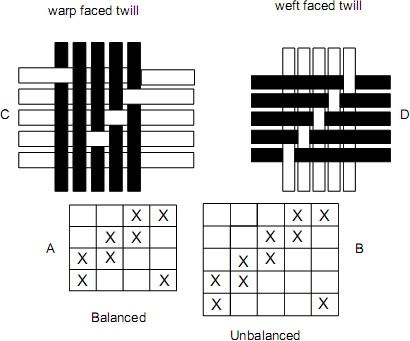
In these types of twills, the warp thread floats over all the picks in a repeat except one pick. The minimum repeat size required is 3. Examples of warp-faced twills are 2/1, 3/1, 4/1, 5/1 etc.
Weft Faced Twills
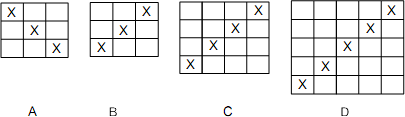
These twills are the reverse of the previous ones. In these weaves, the weft thread floats over the warp on all picks in a repeat except one. Examples of weft-faced twills are 1/2, 1/3, 1/4, 1/5 etc.
In figure, B, C, and D show a right-handed or ‘Z’ twill and Fig. A shows left-handed or ‘S’ twill.
 Balanced and Unbalanced Twills
In these types of twills, the warp and weft floats may be equal or unequal. In other words, the twills may be of the reversible or irreversible types. Accordingly, they may be known as balanced and unbalanced twills. Examples of balanced twills are 2/2, 3/3, 4/4, 5/5 etc. Examples of unbalanced twills are 2/3, 4/2, 5/3 etc. The 2/2 twill is popularly known as “Gaberdine” weave. Fig. 4.3 A and B show designs for balanced and unbalanced twills and C and D show the interlacement diagrams of a 4/1 twill and 1/4 twill (warp-faced) (weft faced).
Warp and Weft Faced Twills
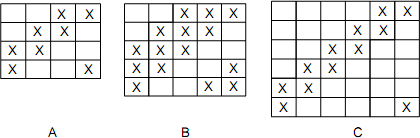
In these twills, the warp and weft floats may be equal or unequal with either the warp floats predominating the weft floats and vice versa. Some examples of these twills are shown in Fig. 4.4 A, B and C respectively.
The Angle of Twills
The angle of twill is the angle between the diagonal twill line and an imaginary horizontal line or an axis parallel to the weft. This angle is dependent on the ratio between the ends/inch and picks/inch in the cloth.
When the warp ends/inch is equal to the weft picks/inch, the twill angle will be 45°. When the warp ends/inch exceeds the weft picks/inch the twill angle will be an obtuse angle i.e., >45° (high angle or steep twill). When the weft picks/inch exceeds the warp ends/inch, the twill angle will be an acute angle i.e., <45° (low angle or flat twill).
End use of Twills
Twill weaves find a wide range of application such as drill cloth, khaki uniforms, denim cloth, blankets, shirtings, hangings and soft furnishings.




Information can be improved by providing suitable diagrams of weave patterns.