This comprehensive article explores the role of digital twin technology in textile manufacturing, covering implementation strategies, use cases, integration with smart systems, and the future of sustainable, data-driven fabric production.
Introduction
Imagine if textile manufacturers could simulate and optimize their entire production line—looms, dye houses, fabric warehouses, and even logistics—in a digital world before making physical changes. This is the promise of Digital Twin Technology: a sophisticated virtual model that mirrors real-world operations in real time. As textile manufacturing adapts to Industry 4.0, digital twins are becoming essential tools for improving efficiency, sustainability, and innovation across the entire value chain.
Digital twin technology goes beyond automation. It enables real-time decision-making by integrating IoT sensors, machine learning, cloud computing, and simulation models into a dynamic digital ecosystem. In the textile sector, it can be used to optimize fabric production, reduce waste, simulate dye outcomes, predict maintenance needs, and monitor energy usage.
A Brief History of Digital Twin Technology
The concept of a digital twin was first introduced by NASA in the early 2000s to simulate space systems and mission performance. In manufacturing, it gained traction with the rise of cyber-physical systems under Industry 4.0. Digital twins became practical with the advancement of:
- Industrial IoT (IIoT): Connecting machines and systems for real-time data exchange
- Cloud Computing: Providing scalable data storage and analytics
- Artificial Intelligence: Enabling predictive analytics and self-optimization
In the textile industry, adoption began around 2016 with early use in weaving and dyeing simulations. Today, advanced digital twin platforms are being applied to entire supply chains, design iterations, and product lifecycle management (PLM).
Understanding Digital Twins in the Textile Context
A digital twin is a virtual replica of a physical asset, system, or process that is continuously updated with real-time data. In textiles, it bridges the gap between physical operations and digital optimization.
Core Components of a Textile Digital Twin:
- Data Layer: Real-time machine data, environmental sensors, supply chain inputs
- Simulation Layer: Virtual modeling of manufacturing processes and product behavior
- Visualization Layer: Dashboards and 3D models for interactive monitoring
- Analytics Engine: AI algorithms for forecasting and optimization
| Component | Function in Textile Application |
|---|---|
| Loom Sensor Data | Detect yarn tension, output rates, errors |
| Dye House Simulation | Predict color fastness and chemical usage |
| Fabric Design Twin | Simulate drape, stretch, and visual aesthetics |
| Energy Twin | Monitor power consumption of machines |
Benefits of Digital Twins in Textile Manufacturing
Digital twins offer a wide range of advantages that improve efficiency and sustainability:
1. Process Optimization
By simulating production runs, companies can reduce trial-and-error in fabric development. Optimal machine settings can be predicted before implementation.
2. Predictive Maintenance
Sensors track equipment performance. AI identifies wear patterns, enabling maintenance before breakdowns.
3. Quality Control
Real-time monitoring detects defects at the source, minimizing scrap and rework.
4. Resource Efficiency
Energy, water, and chemical usage can be modeled and minimized, reducing environmental impact.
5. Faster Time to Market
Virtual prototyping allows brands to test design changes without producing samples.
Use Cases and Real-World Applications
Digital twin technology is already transforming textile operations across the globe:
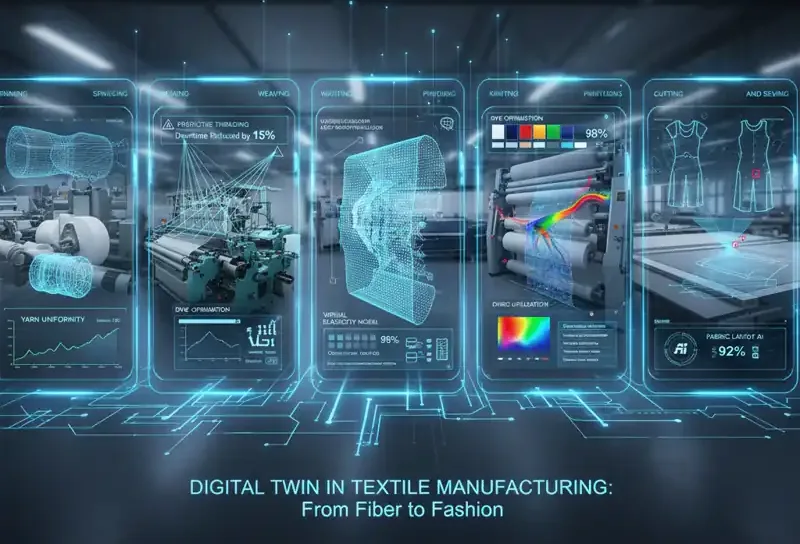
- Spinning: Real-time monitoring of yarn diameter and twist to maintain uniformity.
- Weaving: Predictive threading patterns to reduce downtime from broken ends.
- Knitting: Virtual modeling of elasticity and loop behavior in technical textiles.
- Printing and Dyeing: Simulations that forecast dye uptake and optimize recipes.
- Cutting and Sewing: AI-assisted layouts for fabric utilization and defect avoidance.
Several global textile firms have adopted digital twin solutions for lean manufacturing, product lifecycle optimization, and customized production.
Implementing Digital Twin Technology: A Step-by-Step Approach
To integrate digital twin technology effectively in a textile facility, follow this roadmap:
Step 1: Identify Target Areas
Focus on high-cost, high-variation processes—like dyeing, finishing, or energy management.
Step 2: Sensor Deployment
Install IoT sensors to gather real-time data from machines and processes.
Step 3: Data Integration
Consolidate data into a centralized cloud platform or MES (Manufacturing Execution System).
Step 4: Develop Simulation Models
Work with software providers to create accurate digital models of processes and products.
Step 5: Analyze and Optimize
Use AI to detect inefficiencies and run simulations to test process changes.
Step 6: Scale Across Departments
Expand implementation to design, logistics, inventory, and customer service.
Types and Variants of Digital Twin Applications
| Digital Twin Type | Textile Use Case |
|---|---|
| Product Twin | Simulates behavior of a new fabric or garment |
| Process Twin | Models dyeing, weaving, or finishing workflows |
| Factory Twin | Maps the full textile plant layout and operations |
| Supply Chain Twin | Optimizes material flow and vendor coordination |
| Customer Twin | Tracks post-sale usage and wear to inform R&D |
Each type enables a different layer of insight and optimization.
Integration with Other Industry 4.0 Tools
Digital twins do not operate in isolation—they synergize with other technologies:
- AI & Machine Learning: For anomaly detection and predictive modeling
- Edge Computing: Local data processing near the machines
- 3D Simulation Engines: For realistic fabric behavior modeling
- Blockchain: For traceability in supply chain twins
- Augmented Reality (AR): For technician guidance during machine maintenance
Challenges and Barriers to Adoption
Despite its benefits, digital twin implementation faces some hurdles:
- High Initial Cost: Sensors, software, and skilled personnel require investment
- Data Silos: Incompatible legacy systems hinder integration
- Cybersecurity Risks: Real-time data sharing must be secured
- Skill Gaps: Lack of trained personnel for analytics and simulation
Strategic planning, vendor collaboration, and upskilling are key to overcoming these barriers.
Digital Twin Software and Platforms
Several leading platforms support digital twin implementation in textiles:
- Siemens Digital Industries
- PTC ThingWorx
- Dassault Systèmes 3DEXPERIENCE
- Microsoft Azure Digital Twins
- SAP Digital Manufacturing Cloud
Choosing the right platform depends on the scope of application, scale, and existing infrastructure.
Sustainability Impact of Digital Twins
By simulating and optimizing production, digital twins support:
- Water Conservation: Minimizing overdyeing and rinse cycles
- Energy Reduction: Tuning machine usage to peak efficiency
- Waste Minimization: Predicting defects and overproduction
- Carbon Emissions Management: Tracking and reducing energy-related emissions
In circular fashion models, digital twins also aid in material traceability and recycling process planning.
Market Growth and Industry Outlook
According to industry reports, the digital twin market in manufacturing is projected to surpass $50 billion by 2030. In textiles, growth is expected in regions with strong innovation clusters—such as Europe, East Asia, and parts of India.
Key drivers include:
- Demand for agile manufacturing
- Sustainable production goals
- Growth of on-demand fashion
- Expansion of smart factory initiatives
Future Trends in Digital Twin Technology for Textiles
Looking ahead, we can expect:
- Hyper-realistic Fabric Simulations: With haptic feedback for e-commerce fitting
- Closed-loop Twins: For cradle-to-cradle material tracking
- Digital Twin-as-a-Service (DTaaS): Managed platforms for SMEs
- Consumer Integration: Virtual twins of wardrobes for personalized design services
- Interoperability Standards: Enabling plug-and-play functionality across software and hardware
These trends suggest digital twins will be the backbone of intelligent, ethical, and efficient textile ecosystems.
Summary
Digital twin technology is revolutionizing how textiles are designed, produced, and managed. By creating dynamic virtual replicas of physical assets, processes, and supply chains, manufacturers can optimize operations, cut waste, and accelerate innovation. As the textile industry grapples with sustainability and digital transformation, digital twins are becoming indispensable.
From weaving looms to fashion showrooms, the textile sector must embrace this digital evolution. The factories of tomorrow will not just produce fabric—they will simulate, predict, and evolve in real time, powered by their digital twins.
References
- Siemens Digital Twin Technology Overview: https://new.siemens.com/global/en/company/stories/industry/digital-twin.html
- PTC ThingWorx in Smart Manufacturing: https://www.ptc.com/en/products/thingworx
- McKinsey & Co – Digital Transformation in Textiles: https://www.mckinsey.com/industries/retail/our-insights/how-digitization-will-transform-the-fashion-industry