
Reduction clearing sits at the end of the disperse dyeing cycle and decides whether the fabric keeps its fastness through finishing, making-up and the first domestic wash. Most dyehouses run it with sodium dithionite, and most treat the recipe as fixed. This note deals with a single alternative — thiourea dioxide — in detail: how it generates reducing power, how that behaviour translates into process control, how the result can be verified with numbers, and the practical constraints that determine whether it suits a given plant.
The author works for a manufacturer of thiourea dioxide. Textile School accepts no payment for contributions.
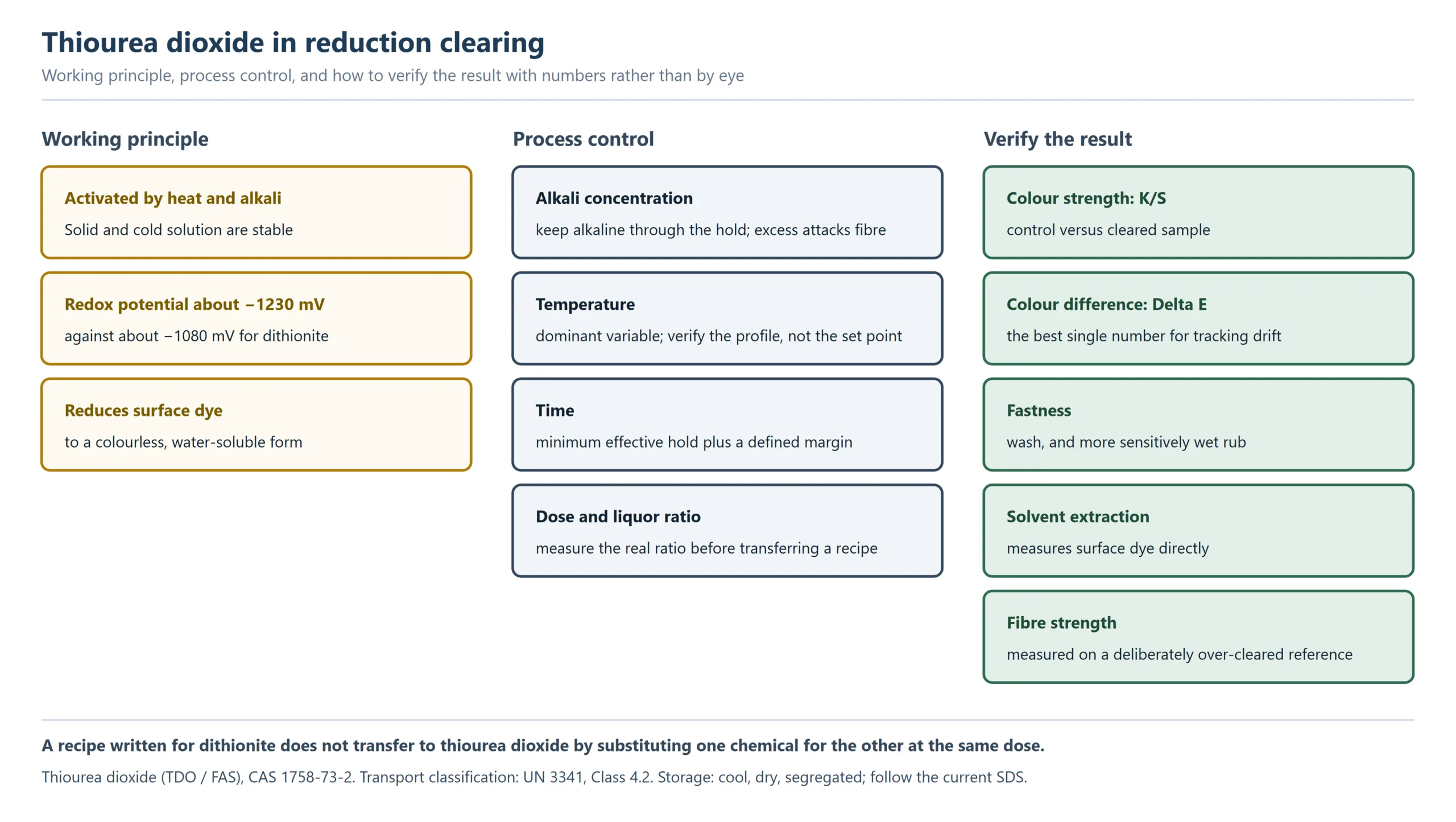
Working principle
Chemical identity
Thiourea dioxide (TDO) is also known as formamidine sulfinic acid (FAS). Its formula is CH₄N₂O₂S, molecular weight 108.12, CAS number 1758-73-2. It is a white, essentially odourless crystalline powder, produced industrially by oxidising thiourea with hydrogen peroxide in the aqueous phase.
The product is weakly acidic: a 1 per cent (10 g/L) aqueous solution sits at about pH 4.5 at 20 °C. Solubility is approximately 26.7 g/L in water at 20 °C, and the solid and its cold solution are both highly stable.
How the reducing power is generated
The defining characteristic of TDO is that it does not act as a reducing agent at room temperature. The molecule only decomposes — and in doing so exerts its reducing action — when the solution is heated under alkaline conditions.
This behaviour, reducing power switched on by heat and alkali, has three consequences for the dyehouse:
- The bath can be prepared in advance without losing strength, unlike dithionite liquors, which decay quickly once made up.
- Reducing power is delivered in the hot, alkaline conditions where the clearing reaction is actually wanted.
- A process that runs cold cannot use TDO on the same basis as a hot process.
For comparison, the maximum redox potential of TDO is reported at around minus 1230 mV, against approximately minus 1080 mV for sodium dithionite, indicating a stronger reducing capability under its activation conditions.
What happens to the dye
Disperse dye remaining at or near the fibre surface is reduced to a colourless, water-soluble form, which leaves the fibre and is carried away in the rinse. The reaction is not selective between loosely held and more strongly held dye, so the process has a genuine optimum rather than a “more is better” curve.
In practice, clearing outcome varies with the specific disperse dye chemistry, because different dyes are reduced at different rates. A recipe validated on one dye class should not be assumed to transfer to another without confirmation.
Process control
Alkali concentration
TDO requires an alkaline environment to develop its reducing power, and the alkali must remain available throughout the holding period rather than being consumed early. Too little alkali leaves the reaction incomplete; too much attacks the fibre, producing strength loss and a harsh handle that no colour measurement will reveal.
Recommended ratios of FAS to alkali differ between sources and between substrates. That is a reason to establish the ratio by trial on the plant’s own shade range, not to copy a figure from a paper written for a different process.
Temperature
Temperature is the dominant variable. Reaction rate rises steeply with it, so a small change in set point can move a marginal result into a comfortable one, or push a satisfactory one into over-reduction. Conventional reduction clearing operates broadly in the 60–90 °C region, and TDO activates within that range.
Control the actual bath temperature profile rather than the controller set point. A bath that is loaded cold and never quite reaches its set point is a common cause of clearing that “should have worked”.
Time
Once the reaction is complete, additional holding time adds cost and the risk of over-treatment without improving the result. Establish the minimum effective time, then add a defined safety margin rather than an arbitrary one.
Dose and liquor ratio
The dose is specified on the weight of fabric but acts at the concentration in the bath, so liquor ratio matters as much as the dose itself. Two machines running the same percentage dose at different liquor ratios deliver different concentrations to the fibre.
Measure the real liquor ratio of each machine — not the nominal figure from the specification sheet — before transferring a recipe between them.
Recipe transfer between chemistries
A recipe written for dithionite does not transfer to TDO by substituting one chemical for the other at the same dose. Alkali ratio, temperature and time interact, and the working window is different. Where the chemistry changes, the recipe must be re-established from trials.
Verifying the result
Visual assessment is not sufficient. Five laboratory checks give a repeatable answer, and most dyehouses already have the equipment.
- Colour strength. Record K/S at the wavelength of maximum absorption for an un-cleared control and for the cleared sample. Clearing reduces K/S; the difference is the process effect.
- Colour difference. Record Delta E between control and cleared sample. This captures changes in lightness, chroma and hue together and is the most useful single number for tracking drift over time.
- Fastness. Test wash fastness and, more sensitively, wet rub fastness on the cleared sample. Relevant methods include ISO 105-C06 and ISO 105-X12, or AATCC 61 and AATCC 8.
- Surface dye. Extract the dyed sample in a solvent and compare the extract against the control. This measures surface dye directly, independently of what the eye or the colorimeter reports.
- Fibre condition. Measure tensile or tear strength on a deliberately over-cleared reference. If strength falls measurably at the extended condition, the production recipe is running closer to the limit than it should.
If a standard method is quoted, follow the current published version and record which version was used. Fastness results are only comparable between laboratories when method, adjacent fabric and assessment conditions match.
Practical considerations
Quality specification
A purchase specification that states only “purity” is not sufficient. Assay determines the active material delivered per kilogram; moisture drives caking and loss of activity in storage; residual thiourea indicates how well the oxidation step was controlled; sulfate, iron and other impurities affect performance and stability; and thermal stability — specified in the industry standard HG/T 3258 — is the parameter that most directly predicts shelf life.
Storage and handling
Thiourea dioxide is classified as a dangerous good for transport under UN 3341, Class 4.2. That classification determines packaging, labelling, documentation and carrier acceptance. Moisture accelerates the slow reactions that degrade the material in storage, and heat accelerates them further, so cool, dry, segregated storage with the current safety data sheet as the governing document is the baseline rather than an optimisation.
Effluent
Thiourea dioxide is itself a sulfur compound. In the hot alkaline bath it decomposes to urea and sulfinate, which ends as sulfite and sulfate. Because it is generally used at a lower active dose than dithionite, its use is often reported to give lower chemical oxygen demand, and the dyehouse is free of the characteristic sulfur odour of dithionite. For plants close to discharge limits, or in enclosed buildings, these are material advantages rather than a footnote. The urea, however, adds nitrogen to the effluent, which matters where nitrogen discharge is limited.
Where TDO fits
TDO is not a universal replacement. Where the process already runs hot, where odour and effluent load matter, and where storage stability is valued, it is a strong candidate. Where the process runs cold, or where dithionite kinetics are already optimised and no effluent or odour issue exists, a switch may not repay the trial work. Thiourea dioxide costs more per kilogram than sodium dithionite, so the comparison has to be made per batch, at the dose each actually needs, not per kilogram of chemical.
Troubleshooting
| Symptom | Likely cause |
|---|---|
| Incomplete clearing with good fastness elsewhere | Alkali, temperature or dose below the working window |
| Incomplete clearing despite a high dose | Bath not reaching set point, or alkali consumed before the hold |
| Dull or shifted shade | Over-reduction from excessive temperature or time |
| Strength loss, harsh handle | Excess alkali |
| Results differ between machines | Recipe transferred without correcting for liquor ratio or heating rate |
| Good laboratory result, poor bulk result | Laboratory liquor ratio, agitation or rinse efficiency differs from production |
Summary
Thiourea dioxide works on a different principle from dithionite: it is stable until heat and alkali activate it, and that behaviour is the source of both its advantages and its constraints. Controlling it means controlling alkali, temperature, time and dose against a measured liquor ratio, and confirming the outcome with colour measurement, fastness testing and surface extraction rather than by eye. Where the process runs hot and the effluent or working environment matters, that control effort is usually repaid.
References
- Krug, P. (1953). Thiourea Dioxide (Formamidinesulphinic Acid): A New Reducing Agent for Textile Printing. Journal of the Society of Dyers and Colourists, 69(13), 606–611. doi:10.1111/j.1478-4408.1953.tb02803.x
- ISO 105-C06:2010. Textiles — Tests for colour fastness — Part C06: Colour fastness to domestic and commercial laundering.
- ISO 105-X12:2016. Textiles — Tests for colour fastness — Part X12: Colour fastness to rubbing.
- AATCC TM61. Test Method for Colorfastness to Laundering: Accelerated.
- AATCC TM8. Test Method for Colorfastness to Crocking: Crockmeter.
- CAS Common Chemistry. Thiourea dioxide, CAS 1758-73-2.
- HG/T 3258-2010. Industrial thiourea dioxide (Thiourea dioxide for industrial use). Chinese chemical industry standard, issued 2010-11-10.