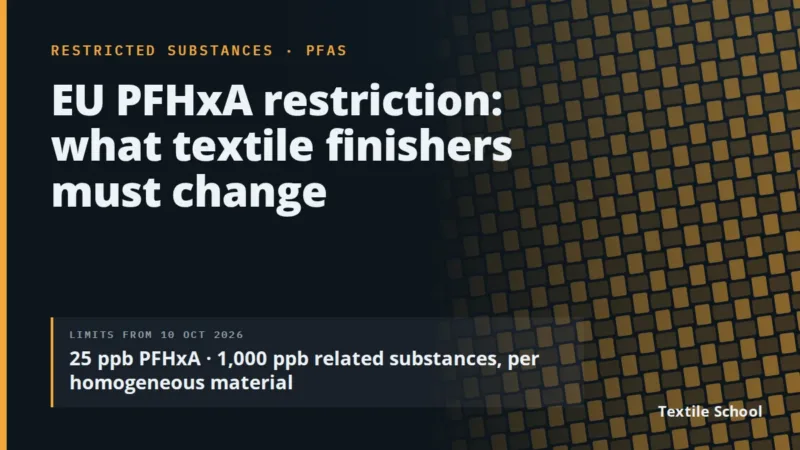
Under the EU PFHxA restriction, from 10 October 2026, clothing, related accessories and footwear for the general public may not be placed on the EU market if any homogeneous material in them contains 25 ppb or more of PFHxA and its salts, or 1,000 ppb or more of PFHxA-related substances. That is entry 79 of REACH Annex XVII, added by Commission Regulation (EU) 2024/2462 (see also the record in this site's regulation register). Other consumer textiles follow on 10 October 2027. For a dyehouse or finisher in India or Bangladesh it comes down to two things: C6 fluorinated repellents are out for EU consumer orders, and their residue on shared equipment now matters.
Laboratory bulletins explain the rule. This page sets out what each person in the mill does about it before the date: the chemicals buyer, the finishing manager, the lab or QA head, and the merchandiser who answers the buyer. For the PFAS rules of other markets, and how each one is measured, see PFAS in textiles: limits, dates and test methods by export market.
Who does what before 10 October
| Role | This week | Keep on file |
|---|---|---|
| Chemicals buyer | List every finish and auxiliary used on EU consumer orders, and ask each supplier for a declaration against entry 79. | Declarations per product and batch, dated |
| Finishing manager | Take C6 fluorinated repellents off EU consumer recipes; clean or separate shared padders, stenters and liquor. | Recipe cards per lot; cleaning and changeover records |
| Lab or QA | Plan tests per homogeneous material, starting with treated, coated and bought-in materials. | Reports naming the method, reporting limits and uncertainty |
| Merchandiser | Tell the buyer what changed and which performance specifications need agreeing again; check what is already at sea. | The evidence the buyer’s importer will ask for |
The PFHxA restriction, in the terms a finisher needs
| Products | Limits apply from | Where it says so |
|---|---|---|
| Textiles, leather, furs and hides in clothing and related accessories for the general public. The recitals give rain jackets and handbags as examples. | 10 October 2026 | Entry 79, paragraph 1(a); recital 15 |
| Footwear for the general public | 10 October 2026 | Paragraph 1(b) |
| Mixtures (chemical products) for the general public | 10 October 2026 | Paragraph 1(d) |
| Other textiles, leather, furs and hides for the general public: carpets, rugs, curtains, blinds, upholstery, textile wall coverings, tablecloths and bed linen, including those used in transport, public places and offices | 10 October 2027 | Paragraph 2; recital 17 |
| Not covered: category III personal protective equipment against the risks listed below, medical and in vitro diagnostic devices, and construction textiles | — | Paragraph 3; recital 18 |
The limits. 25 ppb for the sum of PFHxA and its salts, and 1,000 ppb for the sum of PFHxA-related substances. Both bite at “equal to or greater than”, so a result exactly on the figure fails. In mass terms, 25 ppb is 25 micrograms per kilogram of material and 1,000 ppb is one milligram. The regulation was published on 20 September 2024; the two textile dates are its transition periods.
What counts as PFHxA-related. The entry defines the group by structure: substances carrying a perfluorohexyl chain (C6F13-), or a perfluoropentyl chain (C5F11-) bonded to another carbon atom, with three named exclusions (perfluorohexane itself, longer-chain acids and chains, and one ether structure). Paragraph 9 gives the reason for the grouping: these are substances whose structure gives them the potential to degrade or transform into PFHxA. ECHA published an indicative list of substances in scope for the consultation, and says on it that a substance missing from the list may still be covered.
Homogeneous material. REACH does not define the term. EU electronics law does, in Directive 2011/65/EU (Article 3(20)): a material of uniform composition throughout, or one that cannot be separated into different materials by mechanical means such as cutting or grinding. Read that way, a jacket is not one sample. Its shell fabric, lining, coated or laminated layers, wadding, sewing thread, zip tape and labels are each judged on their own, and a clean shell does not dilute a treated zip tape. For footwear the paragraph covers the shoe as a whole, so each of its materials counts.
The exemptions are narrow. The PPE exemption covers only category III equipment under Regulation (EU) 2016/425 that protects against these risks from its Annex I: substances and mixtures hazardous to health, harmful biological agents, ionising radiation, heat comparable to an air temperature of at least 100 °C, cold comparable to −50 °C or lower, electric shock and live working, and bullet wounds or knife stabs. Category III protection against oxygen deficiency, falls from a height, drowning, chainsaw cuts, high-pressure jets or noise is not on the list, and neither is category I or II equipment. Construction textiles are exempt too; recital 18 gives membranes for light shoring, reinforcement fabric, façade substructures, insulation and textile roofing as examples.
“For the general public.” Both textile paragraphs are limited to products for the general public, and the entry does not define the term. Products made only for professional users are not named, but this page has found no official guidance on where the line falls. A mill rarely controls where a fabric or garment is finally sold, so treat an order as in scope unless the buyer confirms a professional-only or exempt end use in writing. The same applies to the exemptions: rely on the buyer’s documented end use, not the mill’s assumption.
The date that counts is the date of import
Paragraph 7 exempts goods placed on the market before 10 October 2026. Under the REACH Regulation, import counts as placing on the market (Article 3(12)), and import means the goods physically entering the EU customs territory (Article 3(10)). For goods finished in South Asia, the date that matters is the day they enter the EU, not the day they were dyed, finished or shipped. A container that sails in September and arrives after 10 October is caught. The recitals expect the supplier to be able to demonstrate the earlier date (recital 25), so arrival records belong in the file.
Chemicals buyer: find every fluorinated input
Start with the repellents. ECHA’s background document to the restriction traces fluorotelomer alcohols and PFCAs in textiles primarily to durable water-repellent finishing for water, oil and stain resistance (section 2.5.1.2, p. 56). It describes these finishes as side-chain fluorinated polymers applied as aqueous dispersions: a non-fluorinated backbone carrying fluorinated side chains (pp. 13 and 52). C6 chemistry partly replaced the restricted long-chain substances, and the trend in fluorotelomer polymers has been a shift from C8 and longer to C6 (pp. 13 and 52). The C6 side chain is built from 6:2 fluorotelomer acrylate and methacrylate (p. 28), which carry the C6F13- group the entry names. Both are on ECHA’s indicative list, as CAS 17527-29-6 and 2144-53-8: a safety data sheet or declaration that lists either number answers the question at once.
That is why a “C6”, “short-chain” or “PFOA-free” label settles nothing: it describes the chemistry this restriction is aimed at. The background document names two routes from such a polymer to PFHxA-related substances. Side chains split from the backbone as the polymer ages, and, the more relevant source, residue from manufacture such as unreacted monomer stays in the product (p. 52).
Then widen the list. Stain-release and soil-resistant finishes, fluorinated wetting agents (the same document notes that low-molecular PFHxA-related substances are also used as surface-active agents, p. 28), and coating or laminating compounds bought for repellency all belong on it. So do the suppliers of anything bought in already finished, such as laminates, coated fabrics, zip tapes, threads and labels, because each of those is measured as a material in its own right.
What a useful declaration says
- The product’s trade name, the batches it covers, and the date.
- Whether the product contains, as an ingredient or as a residue, PFHxA, its salts or any substance within REACH Annex XVII entry 79, not only whether it is free of PFOA or long-chain PFAS.
- If the product is sold as fluorine-free, what that rests on: the formulation, a total fluorine result on the product, or both.
- Any test it cites, with the method, the reporting limit and the date.
- An undertaking to tell you before the product is reformulated.
A statement written before the regulation was published, or a general restricted-substance compliance letter that does not name entry 79, does not answer the question.
Finishing manager: substitute, then separate
For EU consumer clothing and footwear, replace C6 fluorinated repellents rather than trying to run them under the limit. By the entry’s own definition they belong to the group it restricts; they are not a contaminant of it. ECHA’s background document records that fluorine-free alternatives (it names dendrimers, silicone–carbon hybrids, hydrocarbons, polyurethanes and silicones) give good water repellency, and that they are applied by similar methods with only minor modifications. It also records that no alternative gave equivalent oil and dirt repellency (p. 58, in its final version of December 2021). Plan trials on that basis: water repellency is the realistic target, and an oil-repellency grade may not be reachable at all.
Then separate the EU work from any fluorinated finishing that still runs for other customers. The limits are trace levels, so a residue too small to change the fabric’s performance can still show in a test. The practice that follows:
- Run EU consumer lots on a padder, trough and feed line that has not carried a fluorinated finish since it was last cleaned, or dedicate one line to fluorine-free work.
- After any fluorinated run, drain and clean the trough, mixing tank, feed pipes and squeeze rollers before an EU lot. Do not top up or carry finish liquor across the changeover.
- Include the stenter. Freshly padded fabric touches its pins or clips and rollers, and some fluorinated compounds are volatile enough to need their own test method (EN 17681-2, below).
- Treat recycled water as an input. If treated effluent returns to the process while fluorinated finishes still run elsewhere in the mill, it can bring them back: the background document describes these substances as very persistent, mobile and difficult to remove from wastewater (p. 13). Use fresh water for EU finishing baths, or test the recycled stream.
- Test the first EU lot after each changeover, so that the cleaning is shown to work rather than assumed.
- Record the line, the recipe and the cleaning against each lot number.
Lab and QA: a test plan per homogeneous material
Build the sample list from the bill of materials, one line per homogeneous material, as set out above. Test first where the risk is: anything with a repellent, stain-release, coating or laminate; anything from a supplier without a declaration; and the first lot off shared equipment after a changeover.
The method. Entry 79 names none, and recital 7 records that standard analytical methods were still to be developed. The CEN textile method for targeted PFAS is EN 17681-1:2025, which analyses an alkaline extract by liquid chromatography with tandem mass spectrometry. Its published scope says the alkaline extraction breaks down certain side-chain fluorinated polymers, which release fluorotelomer alcohols (6:2 among them) that the method then measures. Volatile compounds have a separate gas-chromatography method, EN 17681-2:2022. Before sending samples, ask the laboratory:
- which PFHxA-related substances are in its target list, since the rule defines the group by structure and ECHA’s list is only indicative;
- whether the report gives the two sums separately, against 25 ppb and 1,000 ppb;
- the reporting limit for each substance, and the expanded uncertainty of the result;
- that each sample is one homogeneous material, not a composite of several.
Reading a result against the limit. An illustrative case with invented figures: a shell fabric reports 800 ppb (0.8 mg/kg) for the sum of PFHxA-related substances, with 30% expanded uncertainty. In the restricted substance limit calculator, the interval runs from 0.56 to 1.04 mg/kg, so the result is not conclusively below the 1 mg/kg limit. With a guard band of one expanded uncertainty, which is a laboratory convention and not something the regulation sets, the acceptance limit is 0.76 mg/kg and the result is 0.04 mg/kg past it. Open the calculator with these figures. The later-limit field is set to the same 1 mg/kg, because this rule has no second step. A number under the limit is not yet a pass, and a buyer may set its own decision rule.
Merchandiser: what to tell the buyer, and what to keep
Tell the buyer in writing, before the first shipment after the switch: the date the mill took fluorinated repellents off EU recipes, which styles and lots carry the new finish, what was tested, by which laboratory and method, and what the results were. Raise performance before production, not at inspection. Re-run the tests the specification names on the new finish, after the washes the buyer specifies: the spray rating under ISO 4920, any hydrostatic head under ISO 811, and any oil grade under ISO 14419, which is the requirement most likely to need renegotiating.
The file to keep
- Chemical suppliers’ declarations against entry 79, per product and batch.
- Recipe cards showing which finish ran on which lot, and on which line.
- Cleaning and changeover records for shared padders, stenters and baths.
- Test reports per homogeneous material, naming the method, laboratory, reporting limits and uncertainty.
- Declarations and reports from component suppliers for laminates, threads, zip tapes and labels.
- For goods shipped close to the date, the dispatch date and, from the importer, the date the goods entered the EU.
- Where an exemption or a professional-only channel is relied on, the buyer’s written statement of end use.
Stock already made
- Already in the EU before 10 October 2026: paragraph 7 lets it be sold through. The importer should be able to show the date it entered.
- Made, but not yet in the EU: it is caught on arrival. Garments finished with a C6 repellent cannot go to EU consumers after the date; before sending them anywhere else, check that market’s own rules on the matrix page linked above.
- Finished fabric in the warehouse: segregate rolls finished with fluorinated chemistry, label them as not for EU consumer clothing or footwear, and keep their recipe records with them. Fabric for other consumer textiles, such as curtains or upholstery, has until 10 October 2027, which is one more year and not an exemption.
How this page is kept
Last verified: 3 October 2026. Built from the Official Journal text of Regulation (EU) 2024/2462 and the consolidated REACH text of 22 June 2026, in which entry 79 is unchanged; Regulation (EU) 2016/425 for the PPE risk categories; ECHA’s RAC and SEAC background document of 8 December 2021; and the published scopes of EN 17681-1:2025 and EN 17681-2:2022. The regulation register record holds the instrument’s dates and is updated when they change. This page describes what the instrument says; it is not legal advice for a particular product or shipment. Corrections are welcome through the contact page.