Rotary or Digital: Where the Two Cost Lines Actually Cross
Routes a print book design by design instead of by a rule of thumb. Rotary is almost all fixed cost — a screen per colour per colourway, strike-offs, setup.
Professional tool
Pretreatment, dyeing auxiliaries interface, mechanical and chemical finishes for handle, shrinkage, and fastness. Energy, water, and effluent optimization are emphasized. This section explains practical decision criteria, typical test methods, and failure modes that matter in real production. Readers get checklists, calculation steps, and case examples connecting specifications to cost, reliability, and compliance. Links map core concepts to upstream inputs and downstream processes so choices remain consistent across sourcing, manufacturing, and end-use performance. Each article includes definitions, diagrams where helpful, and plain-language notes to help newcomers ramp quickly while giving experienced professionals the depth needed to troubleshoot and optimize. Standards references are cited with context, and whenever trade-offs exist, we make them explicit so you can defend decisions.
Routes a print book design by design instead of by a rule of thumb. Rotary is almost all fixed cost — a screen per colour per colourway, strike-offs, setup.
Professional tool
Takes the wash-down a recipe actually reaches and finds the cheapest combination of processes that reaches the same one, inside the tensile loss the fabric.
Professional tool
Works out the first move on an off-shade batch by looking forward to the last attempt the cloth will survive rather than at the cost of this one. Prices.
Professional tool
Costs the same lot down every dyeing route the house owns, separating what each route costs to start from what it costs to run. Reports the lot size band.
Professional tool
Works out how much of a plant can be sold as priority work before the priority stops meaning anything, using the waiting times of a two-class queue rather.
Professional tool

Scope 1, Scope 2 (location- and market-based), energy and emissions per kilogram, filled field by field from an illustrative knit dyehouse’s coal, diesel and power records, with the emission factor to use and where it comes from.
Article
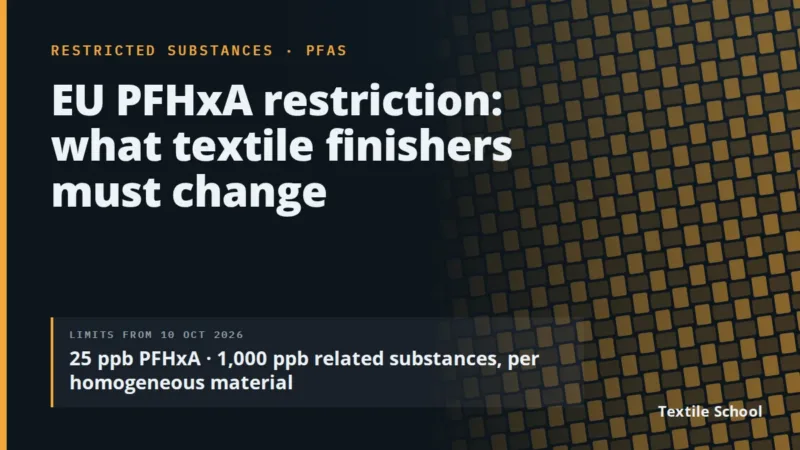
From 10 October 2026 the EU limits PFHxA and related substances in consumer clothing, accessories and footwear. What the chemicals buyer, finishing manager, lab and merchandiser at a finisher change now, and what to keep on file.
Article
The EU PFHxA restriction applies from 10 October 2026. Every PFAS rule for textiles in the EU, France, Denmark and US states, with its limit, date and test method.
Article

Explore how algae-derived pigments are transforming the future of sustainable textile dyeing. Learn about production, performance, real-world use, and future innovation.
Article
Every record in these registers was sent in by somebody. Submissions are reviewed before they are published.
1,484 machines in the register.Tell us about a missing one 306 event series in the register.Submit a trade fair or conference 3,038 standards tracked in the register.Get the changes by email each week