Construction of Twill weaves
In the plain weave, each end is alternately raised and lowered, but in a twill, the warp ends are so raised that the warp and filling floats form diagonal lines across the cloth known as twill lines.In a twill, each warp end must be either over or under the filling for at least 2 picks in succession and at least 2 successive warp ends must be raised or lowered on each pick, in order to make the twill line across the cloth. On this account at least 3 harnesses are necessary to weave a twill, or in other words, three is the smallest number of harnesses on which a twill effect can be formed in the cloth. Thus, the 3-harness, or pnunelle, twill, as it is called, is the simplest twill that can be made.
The first end of the weave is down on the first pick, but floats over the second and third picks; the second end is down on the second pick but floats over the third and first picks; the third end is down on the third pick but floats over the first and second picks. Each end in this weave, therefore, floats over 2 picks in succession. This constitutes one repeat of the weave; that is, if the fourth end were shown, it would be found to be similar to the first end, while the fifth end would be like the second, and the sixth like the third.
It will also be noted that on the first pick the second and third warp ends are raised, on the second pick the first and third warp ends are raised, and on the third pick, the first and second warp ends are raised. Thus it will be seen that in this weave all the requirements of a twill weave are met.With this weave, a twill, or diagonal, line is formed running up to the right. Weaves may be twilled either to the right or to the left, although in the majority of cases they are so constructed as to form twill lines running up to the right, which would show a warp-flush prunelle twill running to the left.
A weave may be warp flush, filling flush or equally, depending on whether a preponderance of warp or filling or an equal amount of each is brought to the face of the cloth; thus, warp-flush prunelle twill, shows a filling-flush prunelle twilled to the right and filling-flush prunelle twilled to the left. A cloth woven with a warp—flush weave shows a filling-flush weave on the back, and if woven with a filling-flush weave shows a warp-Hush weave on the back. Thus it will be seen that these terms simply refer to the effect on the face of the cloth.
Repeat of Weave
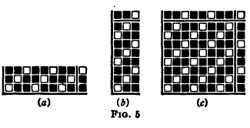 One of the most important things in designing and probably one of the most difficult for the beginner to understand is the repeat of the weave; especially this is of importance in dealing with twills. It will be found a great aid, when only one repeat of a weave is given, to practice extending the weave on design paper for several repeats. By this, we mean that one repeat of any weave will more readily be found when it becomes necessary to distinguish a single repeat from several repeats.
Weaves may be repeated on design paper either on their ends or in their picks, or they may be repeated at both the ends and the picks. Suppose, for example, that it is desired to extend a weave for three repeats in its ends. As already stated, this weave is complete on 3 ends; consequently, three repeats will occupy three times this number or 9 ends. If it is desired to repeat the weave in its picks three times, it will occupy 9 picks; while if it is repeated three times in both ends and picks, it will occupy 9 ends and 9 picks.
When repeating a weave it is simply necessary to copy the weave exactly as it is; that is, one repeat of the weave would first be set down and the other repeats copied. The fourth end would be the same as the first; the fifth end, the same as the second; and the sixth end, the same as the third.This would make two repeats. If another repeat is required, the ends will simply, be copied again in their proper order. If the weave is to be repeated in its picks, the picks will be copied in the same manner as were the ends when repeating in its ends.
Deriving new weaves by rearranging a twill
New weaves can be derived from a regular twill, or from any weave, by copying its ends or its picks in a different order. The derived weave can itself be rearranged again to give still more weaves.
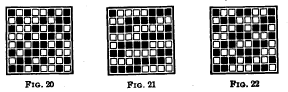
In Fig. 21 the first end of the new weave is copied from the first end of Fig. 20, the second from the fourth end, the third from the seventh, and so on, taking every third end until the first end comes round again. In Fig. 22 the ends are taken in pairs: 1 and 2, then 5 and 6, then 3 and 4, then 7 and 8.
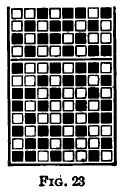
Picks are rearranged in the same way as ends. In Fig. 23 the first three picks of Fig. 20 are copied, the next three are missed, the next three (the seventh, eighth and first) are copied, and so on. The order of picks is 1, 2, 3, 7, 8, 1, 5, 6, 7, 3, 4, 5, and the thirteenth pick is the same as the first. The sixth pick is also the same as the first, but the weave does not repeat there, because the seventh pick is not the same as the second. A weave repeats only when a whole run of picks (or ends) starts again in the same order.
Choosing an order that uses every end
The rearranged weave must use every end of the original, or it is not a repeat of the weave. Taking every second end of an 8-end twill gives 1, 3, 5, 7 and then 1 again, so the even ends are never used. Taking every fourth end of a 12-end twill gives only 1, 5 and 9.
A step works only if it shares no common factor with the number of ends. For 12 ends, a step of 5 or 7 works: stepping by 7 gives the order 1, 8, 3, 10, 5, 12, 7, 2, 9, 4, 11, 6, which uses every end once. A step of 4 or 8 does not, because 4 and 8 share the factor 4 with 12. Checking only that one number does not divide the other is not enough: on 15 ends a step of 6 fails (1, 7, 13, 4, 10, then 1 again), because 6 and 15 share the factor 3. A twill rearranged this way is said to be rearranged in satin order; the same rule picks the move number for a satin weave, as explained under twill weaves.