Knitting is the most common method of inter-looping and is second only to weaving as a method of manufacturing textile products. It is estimated that over 7 million tons of knitted goods are produced annually throughout the world.
Although the unique capability of knitting to manufacture shaped and form-fitting articles has been utilized for centuries, modern technology has enabled knitted constructions in shaped and unshaped fabric form to expand into a wide range of apparel, domestic and industrial end-uses.
A knitted fabric is made of interlocking loops, using one or more yarns. If the loops are broken the fabric will come apart easily. There are two types of knitted fabric: Weft Knit and Warp Knit.
- Knitted fabrics are made by warp and weft knitting
- Knitted fabrics can be designed in a virtual programme on the computer
- CAM equipment can speed up the manufacturing process
- The main qualities of knitwear are stretch, comfort and warmth
- Most garments can be made from knitted fabrics
Weft-knitted Fabrics
- A single yarn can be used. Knitting can be done by hand or machine
- The fabric is made by forming interlocking loops of yarn across the width or on around
- This type of knitting can be unravelled and from a ladder
Characteristics of Weft Knit
- The fabric has high elasticity and stretch
- Loops trap air and retain heat
- There are two sides to the fabric and they are easily identifiable
- Fabric can lose shape easily
- Fabric unravels and ladders when pulled and cut
Type of the weft knit fabric
- Single jersey: this is used for T-shirts, ribbed socks and jumpers, sportswear and fake fur. An example is a 100 per cent wool polo neck weft knit jumper
Warp-Knitted fabrics
- The yarn loops in a vertical direction; the fabric is held together by interlocking vertical loops on alternate sides.
- The fabric does not become unravelled and therefore will not form a ladder
Characteristics of Warp knit
- The production system is fast
- The fabric is elastic but can keep its shape
- The fabric is hard to unravel, less likely to ladder so can be cut and sewn more easily than weft knit
- The machine is complicated and therefore more expensive to produce
Type of warp-knit fabrics
Lock knit: this is used for bed sheets, furnishing fabrics, velour, swimwear fabrics, lace and nets, and fleece fabrics. An example is a pair of 97% polyamide, 3% Lycra warp-knit tights.
Types of Knitting
There are 2 types of knitting. One is Circular knitting (Tubular knit). Another is Flat knitting. Circular knit is used to knit body fabrics. Flat knit is used to knit Collars & Cuffs.
There is another type of flat knit machines which are used to make Sweaters (Tricot garments). With these machines, the body fabrics, sleeves and necks are being made. And they are joining together with the help of linking machines. We have to note that the attachments of these parts are done with the main yarns. No separate sewing threads are used for joining. Buyers use to call these garments as Knitted garments or Tricot garments or Sweaters. Mostly acrylic and wool yarns are used. Lower counts like 2’s, 4’s, 6’s, etc are used.
T-shirts, polo shirts are also called knitted garments. Like the body, sleeves, collars, cuffs are cut separately and joined together, some buyers use to call these garments as ‘Cut & Sewn Garments’.
There are 2 things making the knit fabric. They are Wales and Course. Wales is the vertical yarn. Course is the horizontal yarn.
Wales lines are fixed by the mechanical gauge. This can not be changed. Coarse lines can be altered by adjusting in the machine. This is called Texture.
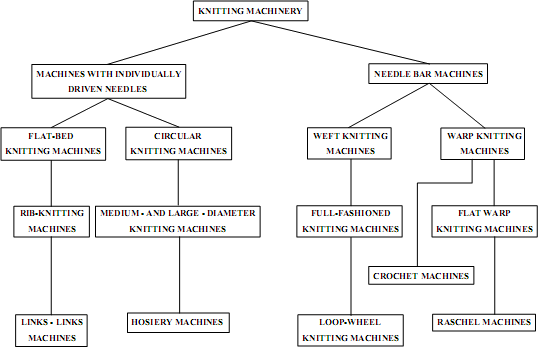
Classification of Knitting Machinery
The machines used for the manufacturing of knit fabrics can be divided into machines with individually driven needles and needle bar machines.
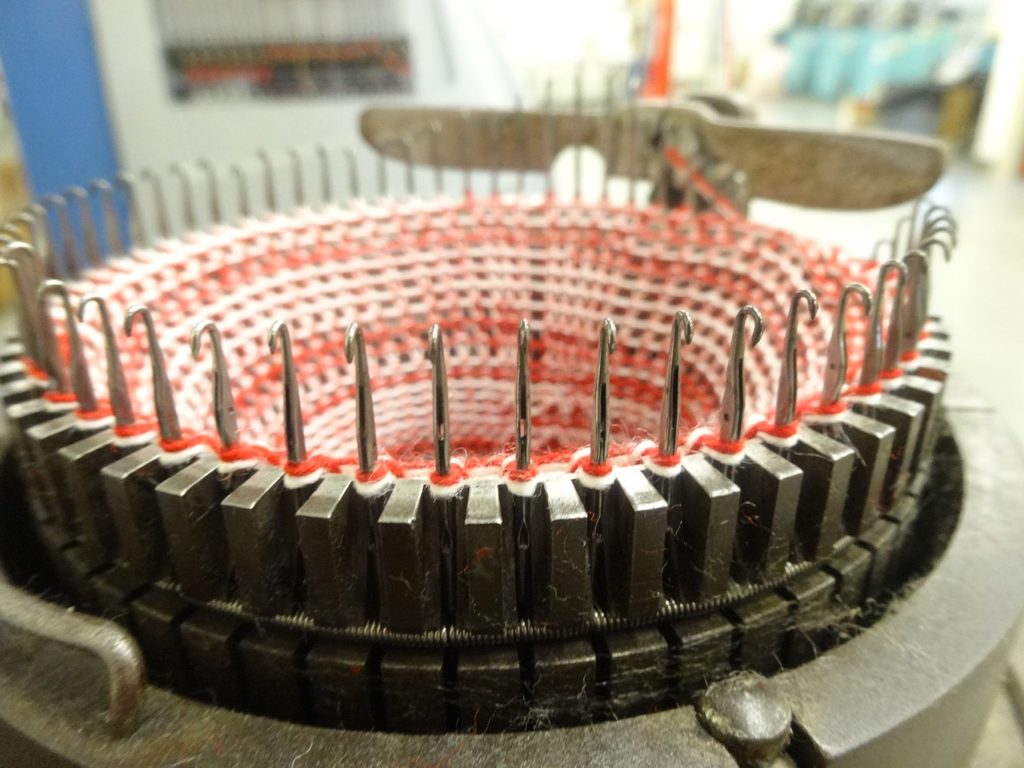
The former type of machine incorporates needles which are moved individually by cams acting on the needle butt; they are used for producing weft knits and are subdivided into circular knitting machines and flat-bed knitting machines.
The needles used can be latch needles or compound needles. The needle bar machines incorporate needles which move simultaneously since they are all fixed to the same bar; we distinguish full-fashioned knitting machines and circular loop-wheel machines for the production of weft knit fabrics, which only use spring-beard needles, and warp knitting machines which use spring-beard needles, latch needles and compound needles.