

A woven cloth is formed by the interlacement of two sets of threads, namely, warp and weft threads. These threads are interlaced with one another according to the type of weave or design. The warp threads are those that run longitudinally along the length of the fabric and the weft threads are those that run transversely across the fabric. For the sake of convenience, the warp threads are termed as ends and the weft as picks or fillings.
Classification of Woven Structures
Woven structures are classified into the following categories:
- Simple structures
- Compound structures
In case of simple structures, there is only one series of warp and weft threads. These threads interlace with one another perpendicularly. All the neighboring warp and weft threads are parallel to one another and play an equally important role in determining the properties of the fabric. In case of compound structures, there may be more than one series threads, of which one set forms the body or ground and the other forms the figuring or ornamentation. Unlike the simple structures, the neighboring threads need not be parallel to one another.
Methods of Weave Representation
A weave is the interlacing pattern of the warp and weft. Two kinds of interlacing are possible :
- Warp overlap in which warp is above weft
- Weft overlap in which weft is above warp
When the warp is lifted above the inserted weft, a warp overlap is obtained. When the warp thread is lowered, the weft thread is inserted above the warp thread and the weft overlap is obtained.
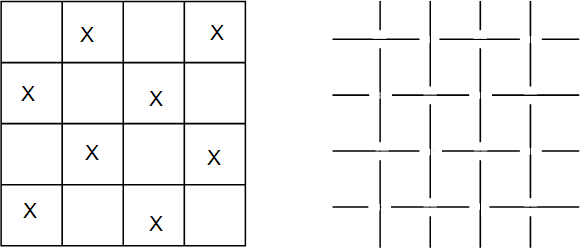 There are two practical methods of weave representation:
- Linear
- Canvas
In the linear method, each warp thread is represented by a vertical line and each weft thread by a horizontal line. The point of intersection of lines corresponding to a warp overlap is marked by the dot, and the point of intersection corresponding to weft overlap remains unmarked.
Though this is a simple method, it is seldom used because the designer has to draw plenty of horizontal and vertical lines, which is time-consuming.
In the canvas method, a squared paper is employed, on which each vertical space represents a warp thread and each horizontal space represents a weft thread. Each square, therefore, indicates an intersection of warp and weft thread.
To show the warp overlap, a square is filled in or shaded. The blank square indicates that the weft thread is placed over the warp i.e. weft overlap. Several types of marks may be used to indicate the warp overlap. The ‘x’ mark is most commonly used.
Weave Repeat
The repeat of a weave is a quantitative expression of any given weave. It indicates the minimum number of warp and weft threads for a given weave. It comprises of warp and weft repeat. The size of the repeat may be even or uneven depending upon the nature of the weave.
In elementary weaves such as plain, twill, satin etc. the repeat size is normally even. However, in weaves such as honeycomb, huck a back the repeat size may be even or uneven. For any weave, the repeat size is the sum of the warp and weft floats. Thus in case of a 2/1 twill the repeat size is 3 x 3. It is common practice to denote one repeat of a weave on design paper.
Basic Elements of a Woven Design
The three basic elements in a woven design are :
- Design
- Draft or drawing plan
- Peg or lifting plan
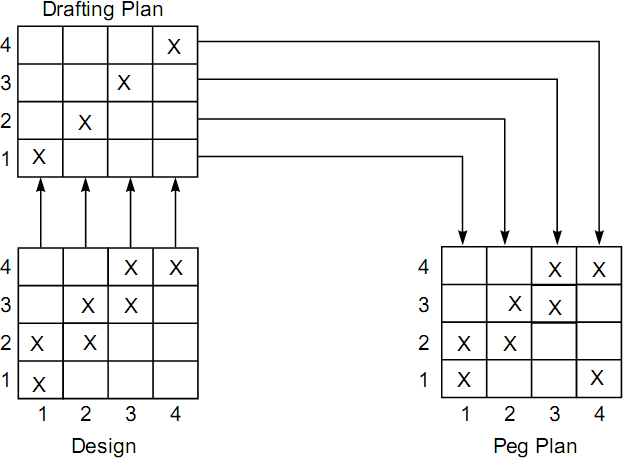 The design indicates the interlacement of warp and weft threads in the repeat of the design. It is made up of a number of squares, which constitute the repeat size of a design.
The vertical direction of the squares indicate the picks and the horizontal direction indicates the ends. A blank in a square indicates that a warp goes below the corresponding weft and ‘X’ mark in the square indicates that the warp floats above the weft.
The draft or drawing plan indicates the manner of drawing the ends through the heald eyes and it also denotes the number of heald shaft required for a given weave repeat. The choice of the type of drafting plan depends upon the type of fabric woven.
The peg or lifting plan provides useful information to the weaver. It denotes the order of lifting of heald shafts. In a peg plan, the vertical spaces indicate the heald shafts and the horizontal spaces indicate the picks.
The peg plan depends upon the drafting plan. In the case of a straight draft, the peg plan will be the same as the design. Hence no peg plan is necessary in the case of a straight draft.






Just good but I want to know about weft faced twill