

The processes of coating and laminating have become much more important and novel techniques for adding performance, durability, appearance retention and aesthetic value to textiles. Custom coating and lamination processes add an additional range of property, usages, functionality, improves the ability to perform as needed, and retains overall inherent properties of textiles, all of which have been consistently proven after receiving proper customer coating and laminating services.
Vinyl coated polyester is a material frequently used for flexible fabric structures. It acts as a bonding or adhesive agent, and an exterior PVC coating. Fabric can be manufactured with different levels of light transmission that range from very transparent to completely opaque.
Definitions
There are two definitions of a ‘coated fabric’ in the Textile Institute’s publication, Textile Terms and Definitions.
The second definition will be regarded as that definition which most closely describes coated fabrics. The first quoted definition could also be applied to a laminated fabric. Textile Terms and Definitions defines a ‘laminated fabric’ (or a ‘combined fabric’) as A material composed of two or more layers, at least one of which is a textile fabric, bonded closely together by means of an added adhesive, or by the adhesive properties of one or more of the component layers.
In simpler terms, a laminated fabric consists two (or more) layer construction with a polymer film bonded to a fabric.
Uses of laminated fabrics are in rainwear, automotive, and other applications are for three-dimensional woven fabrics. For the purposes of this topic, a ‘laminated fabric’, also sometimes called a ‘bonded fabric’, is considered to be different from a coated fabric. However, these definitions are of academic interest and there is little benefit in taking a rigid view.
Typical Applications of Coated/Laminated Fabrics
Coating and lamination techniques are used to add properties to fabrics which do not have those assumed by textile fabrics. Having widespread application across a range of technical textiles sectors, they increase functionality and durability as well as value. They can include; waterproofness, increased abrasion, stain, flame and UV resistance, retro-reflection or fluorescence, anti-microbial or phase change materials.
Usually, the back of the fabric surface is laminated, so as to not affect the design look of the fabric face, and in the case of the Hydrophilic membranes, these are more effective worn close to the body. All this criterion is to be taken into consideration before coating and lamination are done with appropriate application of adhesive. The definition between the two is a technicality relating to the application method, generally, coatings are applied to a fabric in their preparatory state, often in liquid form. Lamination requires the pre-preparation of a laminate membrane that is then applied to the textile.
The application for coated and laminated textiles is widespread across a variety of technical textile sectors, these include:
Coating and Laminated materials cut across all industry segments!
-
Agriculture
-
- Bulk containers
- Fencing Seed/crop covers
- Bags
- Shade materials
- Irrigation systems
- Pond liners
- Irrigation Hoses
- Safety fencing
- Wind covers
-
Construction
-
- Concrete Curing
- Safety Vests
- Hoses
- Conveyor Belting
- Truck covers
- Drainage ditches
- Substrate preparation
- Architectural structures
- Shoe uppers and linings
- Artificial leather/bags/belts
- Rainwear
-
Clothing
-
- Garment linings
- Backing/stiffeners
- Water/stain repellants
- Combining different materials
- Gloves Hats
-
Geotextiles
-
- Settling pond liners
- Irrigation liners
- Landfill liners & covers
- Soil stabilizers
- Erosion barriers
-
Home Furnishings
-
- Upholstery
- Trim
- Carpet backing
- Drapery backing
- Bedding
- Artificial leather
-
Industrial
-
- Conveyor belts
- Filtration
- Barrier materials
- Field covers
- Abrasive backing
- Mechanical rubber goods
-
Medical
-
- Barrier materials
- Implants
- Bandages
- Prosthetic Devices
- Gloves
- Incontinence materials
- Upholstery
- Body Bags
- Hygiene products
-
Transportation
-
- Seating/Trim for automotive, trucks, aircraft, buses
- Hoses/Belts
- Tires
- Headlining
- Seating
- Carpeting
- Airbags
- Truck covers
-
Sport/Leisure
-
- Athletic shoes
- Artificial leather/bags/belts
- Rainwear
- Backpacks
- Tents
- Exercise Mats
- Exercise Equipment Balls
- Seating
- Field Covers
-
Packaging
-
- Bulk containers
- House Wrap
- Lumber Wrap
- Gas holding
- Barrier packaging
- Liquid bulk storage/hauling
- Waterproof materials
-
Protective
-
- Gloves
- Cut/slash resistant materials
- Aprons
- Clean Room Chemical/Haz-Mat suits
- Footwear
- Space suits
The coating and laminating industry is large, fragmented and exciting. There is a need for quality product development and for research and development of new products and processes. Innovation and creativity are the keys to the future!
Coatings and laminates will interact differently with the fabric depending on their material usage and application technology methods and use of modern machines; this is due to the way in which they affix to the textile surface. While the productivity of the coating and laminating system that is in place is important, the flexibility of the service provider’s custom coating and laminating operations is critical to success.
Production speed and the versatility of the service provider’s coating and/or laminating methods are crucial factors to consider when deciding on the appropriate service provider. Other distinctions the separate average coating and laminating providers from skilled ones include a high level of process monitoring, process control, high-end technical specifications, and automation – all of which lead to a much likelier customer satisfaction rating.
Raw-materials and their properties of Coated and Laminated Fabrics
A coated fabric combines the benefits of the base fabric construction plus use of the appropriate polymer with which it is coated. The resulting coated fabric will have many properties which cannot be offered by either component individually, and careful consideration is necessary to select both base fabric and coating polymer. The base fabric provides the mechanical strength of the composite material and supports the layer of coating applied to it. For quality coated fabrics, quality base fabrics are essential.
Base Fabrics
- Polyester and nylon are the main fibres used, because of their strength and general resistance to moisture, oils, micro-organisms and many common chemicals. Generally, polyester is more resistant to light and ultraviolet (UV) degradation than nylon while nylon is more resistant to hydrolysis. Polyester, however, has grown at the expense of nylon because of its better dimensional stability and shrink resistance, lower extensibility and generally lower cost.
- High tenacity nylon and polyester yarns are used in many coated articles for extra strength, and aramid fibres are used where more specialist properties, such as high strength to weight ratio and resistance to high temperatures, are required.
- Acrylic fibres are used for some applications where very high UV resistance is necessary, such as for awnings, car roofs and hoods for convertibles.
- Cotton was the first fabric used in textile coating and it is still used in large quantities. In applications where strength is required, however, it has been replaced by nylon and polyester.
- Use of special verities of nylon and polyester, such as high tenacity (HT) and low shrinkage (LS), which are used in coating applications, such as tarpaulins and conveyor belts.
- Glass woven fabrics are used as bases for PTFE coatings for industrial uses, such as calendar belts and building structures. These applications make specific use of the glass properties of very high strength with very low elongation and excellent flammability resistance.
Adhesives
POLYMER adhesives
Polytetrafluoroethylene, silicone polymethyl, polyethene, polyisoprene, polystyrene, polyvinyl alcohol, polymethyl methacrylate, polyvinyl chloride, polyacrylonitrile, amino cured epoxide, polyethene terephthalate, cellulose, poly hexamethylene adipamide.
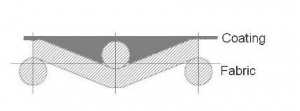
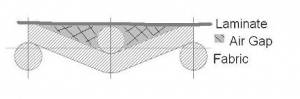
As with both lamination and coating, the bonding mechanism is of importance. The bonding can occur through the thermoplastic qualities of the coating or laminate, whereas it is heat set, although this is not appropriate for all materials, so solvent or water-based adhesives are used. The use of adhesives is a highly technical area, as gaining a strong yet flexible bond can be a challenge.
The most important factor with both lamination and coating the bonding mechanism is of prime importance which may occur through the thermoplastic qualities of the coating or laminate, or is heat set, although this is not appropriate for all materials, so solvent or water-based adhesives are used. The use of adhesives is a highly technical area, as gaining a strong yet flexible bond can be a challenge.
Fabric preparation and fabric structure prior to coating is important, particularly for its stabilization, which may impact on the coating or laminate applied
The end product is sometimes referred to as a composite, as it is a composition of a textile and non-textile component. Many of the mechanical properties are determined by the fabric, such as tear strength, the coating largely determines the chemical properties, and the handle is often determined by both.
It is not just technical applications which utilize coating and lamination technology, the fast-paced fashion market is constantly giving the technology new challenges with the need to create innovative and visually interesting looks such as a high shine, futuristic finish, or imitation animal skin.
Coating/laminating Methods
Coating: Polymer or elastomer, usually in viscous form, is applied directly to the fabric and cured. A variety of techniques are used. A bond-coat (adhesive) may or may not be used.
Laminating: A pre-made or extruded film is bonded onto the substrate, generally with thermal or adhesive bonding. Curing is generally not required.
Coating and laminating can involve virtually every textile form:
- Fibres
- Yarns
- Fabrics (woven, knit or nonwoven)
- And many polymers/elastomers: Rubbers of all types (natural and synthetic), acrylic, vinyl, urethane, silicone, PTFE,… the list goes on and on.
Many techniques are used:
- Yarn coating
- Spread coating – many variants
- Dipping/Impregnating
- Calendaring
- Extrusion coating/laminating
- Film to substrate bonding
- Combinations
Knife Coating (floating knife) or Direct Coating
In Knife Coating, as seen in Figure 3, the liquid coating is applied to the fabric while being run at tension under a floating knife blade, the distance between the fabric and the knife blade determines the thickness of the coating. The blade can be angled and have different profiles to affect the coverage. For this process to be effective the liquid coating must be quite viscous in order to prevent it soaking through the fabric, the coating is then dried or cured.
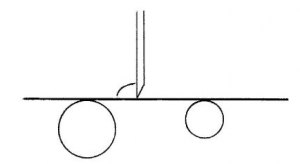
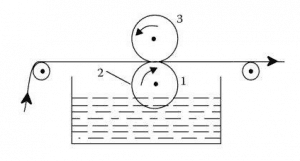
This technique is best used for Filament yarns as the staple fibres in spun yarns can protrude on the surface creating an uneven finish, but this is dependent upon the thickness of the applied coating. For this type of coating to be most successful the weave structure has to be quite tight and the fabric capable of being held taught.
In this process, the coating liquid is rolled onto the fabric by a roller suspended in the coating solution, often a blade is positioned close to the roller to ensure not too much coating solution is applied.
Pad-Dry Cure
Also referred to as Padding, this technique, widely regarded as a textile finishing technique, can, in fact, be used to add a variety of coatings, but this usually refers to a fibre coating for the application of micro or Nanomaterials or chemical compositions.
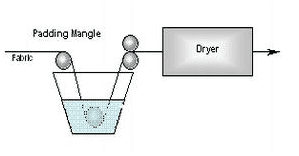
As shown in figure 5, the fabric is submerged in the coating solution then the excess squeezed out of the rollers, which dictates the pick-up percentage, the fabric is then dried and cured.
Calendar finishing
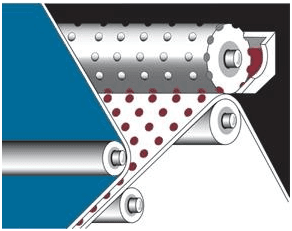
Calendar finishing involves the fabric passing through a set of heated rollers to singe off any surface fibres and add lustre and smoothness. Calendar coating is the same principle in which the fabric passes through heated rollers, but through this process, a coating is applied as demonstrated in figure 6.
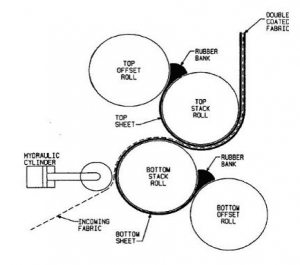
This image demonstrates the simultaneous coating of both sides of the fabric with the thickness of the coating determined by the width of the nip in-between the rollers, more rollers used can provide a thinner coating.
Hot melt extrusion coating
Hot melt extrusion coating is applied in the same process as calendaring with the coating being melted from granules fed to heated rollers which then nip the coating on the fabric. It is used to produce un-supported films and these freshly produced films are added directly to the fabric. Its uses are mainly for Thermoplastic polymers such as Polyurethane, Polyolefins and PVC.
Foam Finishing
Foam finishing was developed as a more environmentally friendly version of the pad-dry-cure system, as the chemical applied requires less product in weight, but equates to a high surface area. Foam also ensures less wetting takes place, which requires less drying; furthermore, waste is reduced in terms of residual liquor. This technique is useful in coating heavy fabrics such as carpets and can be used to effectively coat only one side.
Laminated textiles consist of one or more layers of textile and component. The Textile Institute defines a laminated or combined fabric as:
A material composed of two or more layers, at least one of which is a textile fabric, bonded closely together by means of an added adhesive, or by the adhesive properties of one or more of the component layers
This adhesive is required to bond the fabric and component layers together. Creating a strong bond, which will not deteriorate through conditions experienced in use such as movement and laundering, is not the biggest challenged faced.
Adhesives are often associated with making the fabric too rigid and thus affecting the handle, which is often a negative characteristic, particularly for applications in performance clothing where comfort is a requirement. Environmental consideration has led towards more interest in hot melt adhesives, rather than solvent based adhesive, or the use of flame adhesion.
Laminated fabrics are widely used in high-performance apparel where fabrics are required to be waterproof yet breathable. In this case, a laminate membrane Laminates often consist of a non-textile membrane sandwiched between 2 textiles, for example in the case of the microporous membrane Gore-Tex.
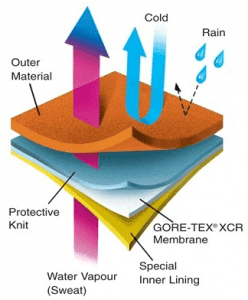
Usually the reverse or technical back of the fabric surface is laminated, so as to not affect the look of the fabric, and in the case of the Hydrophilic membranes, these are more effective worn close to the body. As in the gore-tex example, the membrane or laminate is often sandwiched between two fabric layers. However, this is not the case for fashion fabrics where the look is the priority over function. Lamination is carried out on the fabric surface to produce some visually interesting designs such as foil holograms or textures.
Lamination is widely used in garment manufacture where woven or non-woven fabrics are pre-prepared with thermoset adhesive. These are then cut and applied to the fabric as part of the manufacturing process to provide reinforcement, for example of a buttonhole, or to give shape and stability, for example in a collar. These fusible are applied under heat and pressure for a specified time, to set the thermos adhesive.
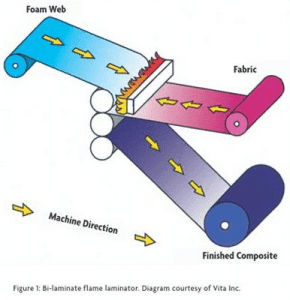
Flame Lamination
This technique is mainly used to attach the foam to a textile fabric, which is widely used in automotive. As displayed in figure 9 the foam is presented to the flame, which encourages melting; as it then dries it bonds the textiles. This technique has associated health and safety risks due to the release of gases when melting takes place.
There are two processes involved in hot melt lamination, the application of a thermoset adhesive, and the fusing of the fabric and the non-textile component through heat and pressure. The adhesive is applied either to the whole surface or discreet, where the adhesive is applied as a thermoset, which just attaches in patterns, such as glue dots. Discreet provides greater flexibility due to the reduced contact areas.


Thanks for sharing.
Brand Animators – Bringing Your Vision to Life with Innovative Video Solutions. From start-ups to large corporations, every business has a unique story to tell. At Brand Animators, our mission is to help you tell that story in a captivating and memorable way. As a top quality 3d, 2d animation video production company in Houston, Texas and best explainer video company in San Antonio, Texas and professional Healthcare & Medical animation video making studio in Dallas, Texas offer services such as 2d animation videos 3d animation videos, Motion graphics, 3d medical animation, Healthcare videos, Corporate films, Whiteboard animation videos, 3d Architectural walkthrough animation, Marketing and training videos, Product videos. And more! Whether you’re looking to promote your brand, educate your audience, or simply convey information in an engaging and visually appealing manner, Brand Animators has you covered. Our video solutions are tailored to your budget, timeline, and company objectives.
You can contact me for any advise on technical fabrics.
In search of Proper consultant for technical textile & coating industry