Introduction
For centuries weaving was carried out by hand in the home on a cottage industry basis, where the two processes of spinning and weaving were carried out side by side in the home. There is evidence of cloth being woven can be traced as far back as 7000 to 8000 BC in Mesopotamia and Turkey, but the exact date is difficult to identify due to the perishable nature of textile goods.
As civilisation developed figures in royalty and the church began to indicate their stature through the use of intricately woven ornate fabrics. In the cottage weaving industry, men and women took on the different roles of weaving and spinning, to produce a final cloth on hand-operated looms, which was then sold onto a cloth merchant. Evidence of this cottage industry can still be seen in the weaver’s cottages of West Yorkshire, where mullioned windows span the full width of the house allowing sufficient light into what was
the loom chamber on the upper floor.
Woven fabrics are made with a variety of textures by having combinations of interlacement of threads. The order of interlacement of threads in a fabric is called weave and when there are no interlaces and the yarn runs over two or more threads are termed as a float.
There are three basic weaves which form the basis for almost all types of existing fabrics namely Plain Weave, Twill Weave, and Satin Weave.
Woven fabrics are may be categorized as light, medium and heavyweight fabrics, according to their thickness and heaviness.
Weaving Loom Motions
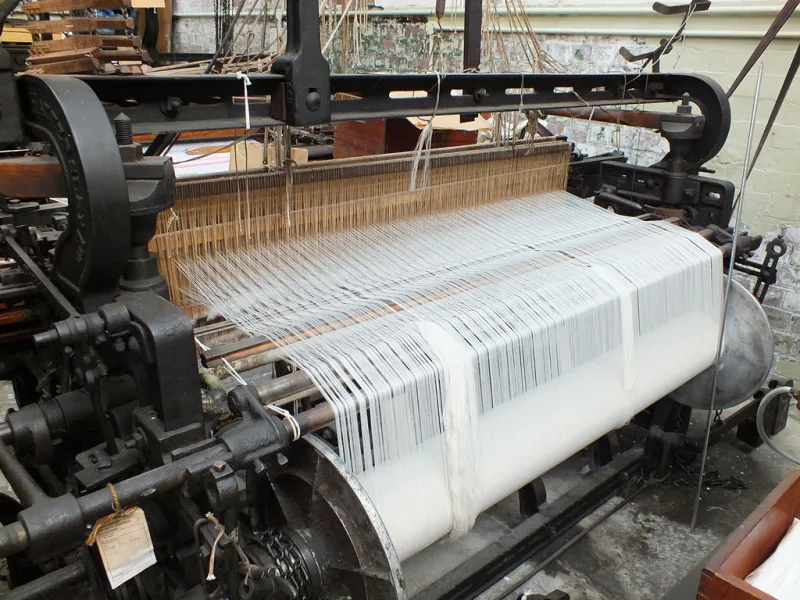
Weaving is the most basic process in which two different sets of yarns or threads are interlaced with each other to form a fabric or cloth. One of these sets is called warp which is the lengthwise yarn running from the back to the front of the loom.
The other set of crosswise yarns are the filling which is called the weft or the woof.Therefore, Weaving loom motions can be broadly categorized as follows:
Primary motions to produce woven fabric:
- Shedding
- Picking
- Beating-up
Secondary motions
- Let-off
- Take-up
- Weft selection
Auxilliary motions
- Warp stop motions
- Warp protectors
- Weft stop motions
- Weft replenishment
Warp protectors are only necessary for looms which use a free-flying media to insert the weft, such as a shuttle or a projectile. They stop the loom before beat-up can occur if the media fails to be arrested in the correct position after it has traversed the loom.
After preparation, the warp yarn is “drawn in” through the eyes of the heald mounted on the required shafts (harnesses).
Primary Motions
Shedding process
It is a primary motion in weaving that does separation of warp threads, according to the pattern, to allow for weft insertion or picking prior to beating. It is the mechanism that raises certain harnesses above the others. Yarns that pass through the heald eyes in those harnesses are raised above that are not controlled by the raised harnesses. In this way, a sheet of warp yarns is up, and a sheet of yarns is down. The space between two yarn sheets is called “shed”.
-
Open shedding
It is a method of forming a shed in which, between the insertion of one weft pick and the next, the only warp threads moved are those that are required to change position from the upper to the lower line of the shed, or vice versa.
-
Semi-open shedding
It is a method of forming a shed in which threads, which are to remain in the top shed line for the next pick, are lowered a short distance and then raised again. The other threads are raised and lowered as in open shedding.
-
Closed shedding
It is a method of forming a shed in which all warp threads are brought to the same level after the insertion of each pick of weft. They are of two types i.e., bottom closed and center closed sheddings. The difference between them is that the terms ‘bottom’ and ‘centre’ indicate the position of the warp threads when at rest.
Picking (weft insertion)
Picking is the second operation of the weaving process. After the shed has been formed, the length of weft is inserted through the shed.
Beating up
Beating-up is the third operation of the weaving cycle. As soon as a weft yarn is inserted, the reed pushes or beats-up the weft to the fell of the cloth. The fell of the cloth is the edge which is nearest to the reed as the cloth is being woven. In other words,beating-up occurs when the reed pushes the newly inserted weft against the fell of the cloth. Temple is a device used in weaving to hold fabric at the fellas near as possible to the width of the warp in the reed.
Secondary Motions
Let-off (warp control) motion
This is the motion which delivers warp to the weaving area at the required rate and at a suitable constant tension by unwinding it from a flanged tube known as the weaver’s beam.
-
Positive let off motion
A mechanism controlling the rotation of the beam on a weaving or other fabric forming machine where the beam is driven mechanically.
-
Negative let off motion
A mechanism controlling the rotation of the beam on a weaving or other fabric forming machine where the beam is pulled around by warp against a braking force applied to the beam.
Take Up (cloth control) motion
This is the motion that withdraws fabric from the weaving area at a constant rate. It ensures that the required pick spacing is maintained, and then winds it onto the cloth roller.
-
Positive take up the motion
It is the motion in which the take-up roller is gear driven, a change wheel or variable-throw pawl and ratchet being provided to allow the required rate to be obtained, so determining the pick spacing.
-
Negative take up the motion
It is the motion in which the take-up roller is rotated by means of a weight or spring, this roller only rotates when the force applied by the weight or spring is greater than the warp lay tension in the fabric. The take-up rate is controlled by the size of the force applied by the weight or spring and/or the warp tension.
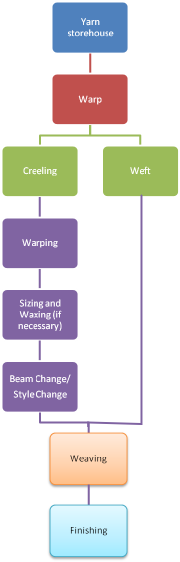
Weaving Process
Auxilliary Motions
To get high productivity and good quality of fabric, additional mechanisms, called auxiliary mechanisms, are added to a plain power loom.The auxiliary mechanisms are useful but not absolutely essential. That is why they are called the auxiliary mechanisms. These are listed below.1. Warp protector mechanism 2. Weft stop motion 3. Temples 4. Brake 5. Warp stop motion (Predominantly found in automatic looms)
- Warp protector mechanism – The warp protector mechanism will stop the loom if the shuttle gets strapped between the top and bottom layers of the shed. It thus prevents excessive damage to the warp threads, reed wires, and shuttle
- Weft stop motion – The object of the weft stop motion is to stop the loom when a weft thread breaks or gets exhausted. This motion helps to avoid cracks in a fabric.
- Temples – The function of the temples is to grip the cloth and hold it at the same width as the warp in the reed before it is taken up.
- Brake – The brake stops the loom immediately whenever required. The weaver uses it to stop the loom to repair broken ends and picks.
- Warp stop motion – The object of the warp stop motion is to stop the loom immediately when a warp thread breaks during the weaving process.