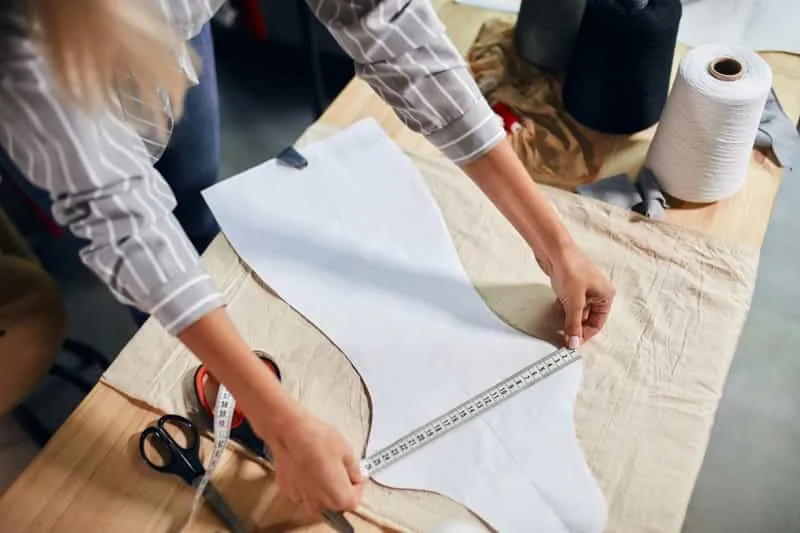
After all the pattern pieces are cut, you can begin marking each piece. It provides “road signs” showing where to sew and press. It will also speed your sewing time when done correctly. Marking will take only a little time and is not as tiring as using the tracing wheel or placing the pattern back on the fabric to look for a lost detail. There are 2 types of notches Pattern notches and center notches.
Accurate marking throughout garment construction is extremely important. This process begins with marking pattern symbols. How and where to mark the garment will aid in putting the garment together. Marking should be done as soon as the garment sections have been cut and before the pattern pieces have been removed. Pattern symbols to be marked include darts, pleats, tucks, and matching circles. Beginners should also mark seam lines. In some situations, marking a seamline is important to even the most
Sketching is an important tool for any sewer—it serves as a roadmap for all phases of garment creation, from fabric and color selection to actual construction. If you can sketch, you can record fashions seen on the street, work out design details, and communicate your ideas to others.
Fashion sketching not only involves the act of drawing an initial idea but also the process of considering and developing the idea across the pages of a sketchbook. It is always best to have an idea of what you want to draw. In many respects a fashion sketch is a problem-solving process, which brings together the visual elements of articulating an idea in its purest form. This can mean recording a sudden idea before it is lost or forgotten, or capturing a moment in time, such as observing a deta
Fashion sketching or fashion flats can be defined as a base template one can use to create unique apparel designs. We have industry standard flat sketches that demonstrate a professional and accurate illustration of garments and important design details like topstitching, hardware, trims and fabric treatments.
After cutting, there are several pattern markings that help us put the project together accurately. Not all markings will be found on every project, as some are specific to a particular construction technique. Some construction markings need to be transferred to the fabric so they will be visible for placement and sewing; others, like seamlines, small arrows, etc. do not need to be transferred, only heeded during assembly. Check the pattern directions for more specific marking needs.
Where large quantities of a garment style must be cut, a layer is created which consists of many piles of fabric spread one above the other. From this, all the garment pieces for all the sizes that have been planned for that layer are cut. The pattern shapes for these garments may be drawn on a paper marker placed on top of the lay, or information as to their shape and position may be held within a computer, to be plotted similarly on a paper marker or used to drive an automatic cutter.
Cutting room is an extremely important section of the garment manufacturing process which has a major impact on the profitability of the business. It is therefore important to an efficient management of the cutting room in garment manufacturing process.
Some of the factors determine the properties of the fused laminate such as the basic fabric of the inner lining, methods of applying resins to base cloths – Scatter coating, dry dot printing, paste coating.
Since fusing is a crucial process in garment manufacturing, it is not completely without risk. For this reason, it is necessary to follow, aside from regular maintenance, a few important rules to secure fusing quality