Home » Fabric » Page 13

Fabric

Covers fabric constructions from woven and knitted to nonwovens and composites. Details GSM, cover factor, drape, air permeability, pilling resistance, and handle. Includes test methods and how structure drives performance. This section explains practical decision criteria, typical test methods, and failure modes that matter in real production. Readers get checklists, calculation steps, and case examples connecting specifications to cost, reliability, and compliance. Links map core concepts to upstream inputs and downstream processes so choices remain consistent across sourcing, manufacturing, and end-use performance. Each article includes definitions, diagrams where helpful, and plain-language notes to help newcomers ramp quickly while giving experienced professionals the depth needed to troubleshoot and optimize. Standards references are cited with context, and whenever trade-offs exist, we make them explicit so you can defend decisions.

Home » Fabric » Page 13

Weaving

Warping Systems and Selvedges and it’s types

The arranging of yarn threads in long parallel lengths of equal tension, onto a beam in preparation for weaving.During the warping process cones of yarn are placed onto a rack called a creel. From this creel yarn passes through tension and spacing devices and through a leasing reed which separates the yarn threads and keeps them in the correct order before being wound onto a warping balloon.Selvedge means the edge of a fabric that is woven so that it will not ravel or fray.

Read more »

Article

knitted fabric

Knitting

Yarn guide in Knitted fabric formation

In warp knitting a yarn guide wraps the yarn around the needle hook, thus forming a loop. However, to form a fabric, the yarn guide must wrap the yarn around a different needle during the next course. The yarn guides, therefore, must be displaced laterally during knitting. Different warp knitted structures are produced by varying the magnitude of their lateral displacement. Therefore warp knitted structures can be described by noting the guide bar displacement.

Read more »

Article

warp knitting

Knitting

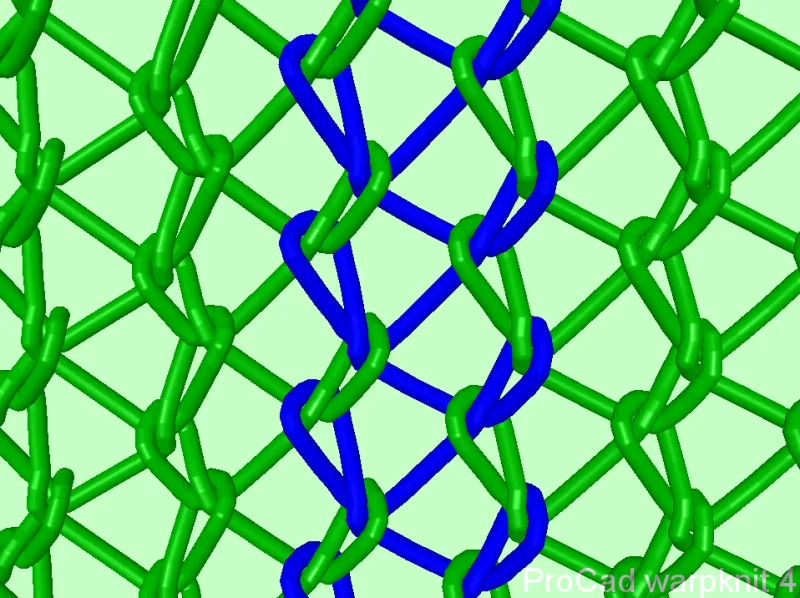
Warp Knitting

Warp knitting is the sequential formation and interlinking of loops in an axial direction on a lateral array of needles with at least one separate thread being supplied to each needle. The loops are joined together in a width-wise direction by moving the threads back and forth between adjacent needles.

Read more »

Article

Geocomposite_drain

Non-woven

Raw materials for the production of nonwovens

Cellulosic chemical fibers of all lengths and degrees of refinement and with clearly different properties are at the disposal of the industry of nonwoven bonded fabrics. They are all characterized by the ability to absorb a fairly high amount of moisture. That recommends their use wherever this property is useful for the production of nonwoven bonded fabrics and/or the use of nonwoven bonded fabrics is even a precondition.

Read more »

Article

non-woven

Non-woven

Non-Woven Fabrics

Nonwovens do not depend on the interlacing of yarn for internal cohesion. Intrinsically they have neither an organized geometrical structure. They are essentially the result of the relationship between one single fiber and another. This provides nonwoven fabrics with characteristics of their own, with new or better properties (absorption, filtration) and therefore opens them up to other applications.

Read more »

Article

fabric finishing

Fabric

Ways to Finish Fabrics

Fabrics which are woven or knitted, freshly coming off the machine are called grey goods which must be treated in different ways to give them the important finishing touch. We call this finishing touch “finish”. This finishes we apply to fabrics are either for practical reasons or appearances. There is a wide range of finish we use on fabrics.

Read more »

Article

Scroll to Top