
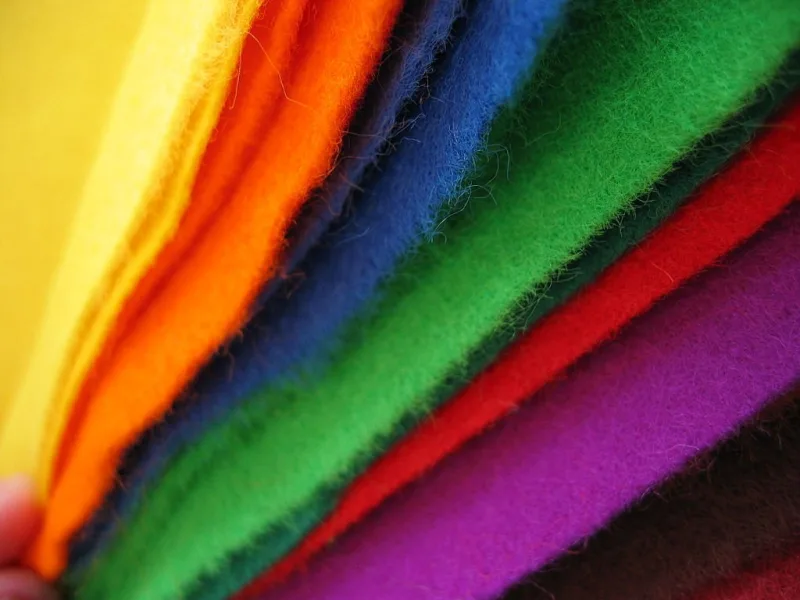
Acrylic is a synthetic fibre made from polyacrylonitrile: by law, at least 85% of the polymer is acrylonitrile (Regulation (EU) No 1007/2011, Annex I; 16 CFR 303.7). It is sold as the cheaper alternative to wool, “a common substitute for wool in clothing and home furnishings” in Britannica’s words, because it can be made soft, bulky and warm. It is light, dries fast, takes bright colours and resists sunlight, which is why it is used for knitwear, blankets, faux fur and outdoor awnings. Against that, it takes up little moisture, it pills, it is flammable, and in one study it shed the most microfibres per wash of the fabrics tested. It is a small fibre: just under 1.6 million tonnes in 2024, 1.2% of the world’s fibre, and declining (Textile Exchange).
Below: the questions buyers ask first (is acrylic like wool, is it warm, is it safe, how to wash it), then the depth: the definition and modacrylic, how acrylic is made, its sourced properties, uses, producers, and how to identify it. Two of the site’s calculators are worked through.
Last verified: 6 October 2026. Sources are linked where they are used and listed at the end.

Is acrylic “artificial wool”?
That is how it is sold, and it is what the fibre was designed for. A Bayer patent states that acrylic fibres “are widely used because they embody a number of outstanding properties, one of the more important of which is their wool-like character” (US 4,035,884), and “the most common use of acrylics in apparel and carpets is as a wool replacement—for example, in knitted wear such as sweaters and socks” (Britannica, polyacrylonitrile). The likeness is in the hand, bulk and warmth, not the chemistry: wool is a protein that holds 13.6% moisture at standard conditions; acrylic is a plastic that holds 1.5 to 2%. The site’s wool page compares the two fibres line by line.
Is acrylic warm?
Yes, for its weight. Acrylic fibres “are soft and flexible, producing lightweight, lofty yarns” (Britannica), and Vardhman Acrylics lists its fibre as “Warm and high bulk” (Vardhman). Much of that loft is made in the yarn. High-bulk yarns mix shrinkable and already-shrunk fibres; when the yarn is steamed or dyed, “the yarn ‘bulks up’ through shrinkage of the shrinkable staple fibre and acquires a bulky, wool-like feel”, with 40 to 45% shrinkable fibre in a typical high-bulk yarn (Bayer patent). Unlike wool, acrylic does not hold much moisture, so it feels clammy sooner in warm weather.
Is acrylic safe to wear?
The hazard is in the factory, not the finished fibre. In 2024 the International Agency for Research on Cancer moved acrylonitrile, the monomer acrylic is made from, from “possibly carcinogenic” (Group 2B, 1998) to “carcinogenic to humans (Group 1) on the basis of sufficient evidence for cancer in humans for lung cancer”. The evidence comes from workers: “all of the studies except one evaluated occupational exposure to acrylonitrile in industries that use or produce acrylonitrile”, and “The general population is exposed to acrylonitrile mainly via cigarette smoke” (IARC, Monographs volume 136, questions and answers). The polymer is a different substance: “PAN has none of the hazardous properties of the monomer” (Britannica). No source found measures residual monomer in finished garments.
The environmental concern is microfibres. In a University of Plymouth study, a 6 kg wash load was estimated to release 728,789 fibres from acrylic fabric, 496,030 from polyester and 137,951 from polyester-cotton; the paper found polyester-cotton “consistently shed significantly fewer fibres than either polyester or acrylic” (Napper and Thompson, Marine Pollution Bulletin, 2016; University of Plymouth).
How to wash acrylic
- Wash cool. GINETEX, which administers the care symbols, says “Acrylic clothes can be washed at 40°C maximum”, on a mild cycle (clevercare, GINETEX).
- Skip the dryer. “Acrylic dries very quickly … Never use the dryer for acrylic” (clevercare). Dry knitwear flat.
- Iron rarely and low. One dot on the iron symbol means “maximum sole plate temperature of 120 °C. Corresponding to the ‘Polyacryl, polyamide (nylon), acetate’ setting”, and “Steam iron may cause irreversible damage” (GINETEX).
Pros and cons of acrylic
| Advantages | Drawbacks |
|---|---|
| Soft, light and bulky: wool-like warmth for less money | Holds only 1.5–2% moisture, so it feels clammy in warmth |
| Dries fast and keeps its shape after washing | Pills: the fibres work to the surface and ball up |
| Strong resistance to sunlight and weather, so it suits awnings and outdoor cushions | Flammable, with a limiting oxygen index of 18, and softens around 220–240 °C |
| Not eaten by moths and resists mildew | Had the highest microfibre release per wash of the fabrics in the Plymouth study |
| Takes bright colours with basic dyes | Made from acrylonitrile, now an IARC Group 1 carcinogen in occupational exposure |
What counts as acrylic: acrylic and modacrylic
| Name | EU (Regulation 1007/2011, Annex I) | US (16 CFR 303.7) |
|---|---|---|
| Acrylic | “at least 85 % (by mass) in the chain of the acrylonitrilic pattern” | “at least 85 percent by weight of acrylonitrile units” |
| Modacrylic | “more than 50 % and less than 85 % (by mass) of the acrylonitrilic pattern” | “less than 85 percent but at least 35 percent by weight of acrylonitrile units” |
So a fibre of 40% acrylonitrile is modacrylic in the United States but not in the EU. Both carry an EU agreed allowance of 2.00% (Annex IX). The rest of an acrylic polymer is comonomer: “The remaining composition of the fiber typically includes at least one of the following: methyl methacrylate, methyl acrylate, vinyl acetate, vinyl chloride, or vinylidene chloride” (US EPA, AP-42, section 6.9). A copolymer with 2 to 7% of a vinyl comonomer such as vinyl acetate gives “fibres that soften enough to allow penetration by dyestuffs” (Britannica), and a sulphonate comonomer adds the dye sites that let acrylic take bright basic (cationic) dyes (Monsanto patent). Modacrylics carry chlorine-containing comonomers: “The presence of chlorine imparts a notable flame resistance to the fibre” (Britannica).
How acrylic fibre is made
- Polymerisation. Acrylonitrile and its comonomers are polymerised to polyacrylonitrile (PAN), “using 2 methods, suspension polymerization and solution polymerization” (Vardhman). Vardhman’s plant, for example, polymerises “Acrylonitrile (ACN) and Methyl Acrylate (MA) at 60 Degrees Centigrade”.
- Spinning. PAN cannot be melt-spun: it decomposes before it melts. It is dissolved instead. In dry spinning, as Dralon described its process, the polymer is stirred into dimethylformamide (DMF) and “The solvent (DMF) is evaporated from the solution using hot air”; in wet spinning it is dissolved in dimethylacetamide (DMAc) and coagulated “using a water bath” (Dralon, production processes). Other plants use dimethyl sulphoxide or aqueous sodium thiocyanate or zinc chloride (Montefibre patent).
- Drawing, crimping and cutting. “The filaments are gathered into a tow band, stretched to improve strength, dried, crimped, heat set, and then cut into staple” (US EPA). Some tow is broken into tops for worsted-system spinning, and some goes into high-bulk yarns as above.
The route leaves its mark on the fibre. Dry-spun fibre has a “double-T” cross-section that “comes closest to natural fibers”, while wet-spun fibre has a kidney or round section (Dralon, fibre types; Vardhman). India’s two producers show both: Indian Acrylics dry-spins with DMF on DuPont technology, Vardhman wet-spins on Japan Exlan’s.
Properties of acrylic fibre
| Property | Value | Source |
|---|---|---|
| Density | 1.16–1.18 g/cm³ (Vardhman: 1.17) | CAMEO; Rosa and colleagues (2024); Vardhman |
| Tenacity | 2.5–5.0 g/den dry, 2.0–4.5 wet (Vardhman); 2 to 4 g/den, 18 to 36 g/tex, dry, falling to 13 to 27 g/tex wet (review) | Vardhman; Rosa and colleagues |
| Elongation at break | 25–50% dry, 25–60% wet | Vardhman |
| Moisture regain | 1.5–2.0% commercial; EU allowance 2.00% | Vardhman; Regulation 1007/2011 |
| Glass transition | 70–80 °C in water; 95–105 °C dry | Vardhman |
| Melting | “no definite melting point… decomposes before melting”; softens at about 220–240 °C | Vardhman |
| Limiting oxygen index | 18 | Rosa and colleagues |
| Sunlight | “high resistance to weathering and to sunlight” | Vardhman |
| Solvents | Dissolves in DMF, DMSO, DMAc and saturated zinc chloride | Vardhman; EU Annex VIII, method 8 |
The glass transition explains acrylic’s behaviour in hot water. Below about 70 °C wet, the fibre is glassy and holds its shape; above it, it can be stretched, set or shrunk, which is how high-bulk yarn is made, and why GINETEX warns that a steam iron “may cause irreversible damage”. In dyeing, “110 °C should be considered the maximum temperature due to the risk of excessive shrinkage in acrylic fibres” (Dralon).
Worked example: invoicing an acrylic and wool yarn. Acrylic is often spun with wool. Take 1,000 kg of 70/30 acrylic and wool knitting yarn found holding 5% moisture on its dry weight (an assumed figure). Its oven-dry mass is 952.38 kg. With the EU allowances, 2.00% for acrylic and 18.25% for combed wool, the blend’s allowance is 6.88% and the blend invoice weight calculator gives a commercial weight of 1,017.86 kg. With commercial regains of 1.5% and 13.6% (IS 13157), it is 5.13% and 1,001.24 kg. The wool, at 30% of the blend, carries about four-fifths of the EU allowance.
Worked example: a knitting count. Acrylic knitting yarns are often quoted in the metric count; take a two-ply 2/32 Nm. Each ply is Nm 32, which the count converter shows as 31.25 tex, Ne 18.90 or 281.25 denier, so the two-ply yarn is about 62.5 tex, Nm 16, before any allowance for twist (this page’s arithmetic).
Uses of acrylic
- Knitwear and socks, alone or blended with wool, the largest use (Britannica).
- Home textiles: “hand and machine-knitting yarns, furnishing fabrics, table cloth, upholstery fabrics, carpets, velours, fur imitations, blankets” (Dralon X 100 data sheet), and the mink blankets that Vardhman lists among its fibre’s applications.
- Outdoor fabrics. Solution-dyed acrylic, with the pigment added before spinning, provides “superior resistance to UV rays and harsh weather conditions, effectively preventing fading” (Aksa, Acrysole); in awnings and outdoor furnishing fabrics acrylic accounts “for more than 90% of production” (Rosa, Rosace and Trovato, Polymers, 2024).
- Industrial: acrylic fibres are “used as precursors for the production of carbon and graphite fibres, as replacements for asbestos in cement, and in industrial filters and battery separators” (Britannica). Carbon fibre precursor is a special grade of 90 to 99% acrylonitrile (Montefibre patent); see carbon fibre.
- Modacrylic goes where flame resistance or a hair-like look matters: flame-resistant workwear and furnishings (Aksa, Armora; flame-retardant fabrics) and wigs, where Kaneka’s Kanekalon “is widely used for hair wigs around the world thanks to its resemblance to human hair appearance” (Kaneka).
Who makes acrylic
World output was “just under 1.6 million tonnes” in 2024, down from 1.7 million in 2020, and only 0.8% of it was recycled (Textile Exchange, Materials Market Report 2025). Production is concentrated in a few companies:
- Aksa, Türkiye, describes itself as “the world’s largest producer of acrylic fiber”, with 355,000 tonnes a year of capacity, 271,000 tonnes shipped in 2025 and “global market share” of 23% (Aksa, integrated annual report 2025). The same report notes that a Portuguese competitor, SGL, wound down production in June 2025.
- Thai Acrylic Fibre, an Aditya Birla company, has grown to 108,000 tonnes a year (Aditya Birla).
- In India, Indian Acrylics makes 42,000 tonnes a year of dry-spun fibre, tow and tops (Indian Acrylics), and Vardhman Acrylics 18,000 tonnes a year of wet-spun fibre at Jhagadia, Gujarat (Vardhman).
- Dralon, Germany, Bayer’s original brand of 1954, filed for protective proceedings in 2020 (Man-Made Fibers International).
A short history of acrylic
“DuPont introduced its trademarked Orlon acrylic fibre in 1948; Orlon was soon followed by the Monsanto Chemical Company’s Acrilan, American Cyanamid’s Creslan, Courtaulds’ Courtelle, and others” (Britannica). “In 1950 Orlon® became the first commercially manufactured acrylic fiber”, and DuPont discontinued it in 1990 (CAMEO, Orlon). Bayer launched Dralon in 1954 (Dralon). The first modacrylic, Dynel, was introduced in 1949 (CAMEO, modacrylic), and Kaneka’s modacrylic in 1957 (Kaneka). The site’s timeline of manmade fibres sets acrylic among the others.
How to identify acrylic
- Burn test. Acrylic “Burns readily with smoky flame and acid smell. The ash is hard” (CAMEO); see the site’s fibre identification tests.
- Solubility. The EU’s official blend method dissolves “The acrylic, modacrylic or chlorofibre … with dimethylformamide heated in a water-bath at boiling point” (Annex VIII, method 8; ISO 1833-12).
- Microscope. The cross-section depends on the spinning route: “variable (dogbone, round, bean shaped or lobed)” (CAMEO). The site’s guide to the microscopic appearance of fibres shows the others for comparison.
Dye houses test acrylic’s colour fastness with an acrylic adjacent fabric, ISO 105-F05, and the compatibility of basic dyes on it to ISO 105-Z03.
Related on this site
- Wool, the fibre acrylic imitates, and polyester, the synthetic that outsells it many times over.
- Properties of common manmade fibres, and the list of textile fibres.
- Types of sweater.
Sources and corrections
- Definitions: Regulation (EU) No 1007/2011, Annexes I, VIII and IX; 16 CFR 303.7.
- Chemistry, manufacture and properties: Britannica, polyacrylonitrile; US EPA, AP-42 section 6.9, synthetic fibers; Vardhman Acrylics, product characteristics, strengths and process; Dralon, production processes and fibre types; CAMEO, Museum of Fine Arts, Boston, Orlon and burn test table; G. Rosa, G. Rosace and V. Trovato, Polymers 16, 2111, 2024; patents US 4,035,884 (Bayer), US 3,965,227 (Monsanto) and US 9,296,889 (Montefibre).
- Health and environment: IARC, Monographs volume 136, questions and answers, July 2024; I. E. Napper and R. C. Thompson, Marine Pollution Bulletin 112, 2016.
- Market and producers: Textile Exchange, Materials Market Report 2025; Aksa, integrated annual report 2025; Aditya Birla, Thai Acrylic Fibre; Indian Acrylics; Vardhman Acrylics.
- Care: GINETEX, care symbols and clevercare, washing and drying acrylic.
Change log. 6 October 2026: rewritten in full, with the site’s second acrylic page folded in. Corrected: acrylic is made from acrylonitrile, a petrochemical, not from coal and limestone as the earlier page said; DuPont trademarked Orlon in 1948 and made it commercially from 1950; acrylic does not melt cleanly but softens and decomposes; the EU and US define modacrylic differently. Added: the IARC reclassification of acrylonitrile, microfibre shedding, sourced properties, producers and care. Removed: notes on nytril and lastrile, generic names no longer in commercial use.
Found an error? Please tell us through the contact page, naming the section and the source that disagrees.

Great article! I recently found one of the trusted Spun Polyester Yarn Producers in India offering durable and high-performance yarns for knitting, weaving, and textile manufacturing industries.
Does anyone know the chemical formula for acrylic fibres? Specifically for felt..
How is Tricel made and what is it used in ?