Synthetic man-made account for the largest part of the raw material used in manufacturing nonwoven bonded fabrics. In this group of synthetic nonwoven bonded fabrics, polyamide fibres are the not only the oldest ones used in production, but they also increase the serviceability of the product. This improved quality is of importance for various purposes, e.g.:
- where nonwoven bonded fabrics are subjected to frequent folding, as in the case of paper reinforced with synthetic fibres
- where exceptional resistance to abrasion is required, as is the case with needled floor coverings
The polyamide fibres include the nylons and the aramid fibres. Both fibre types are formed from polymers of long-chain polyamides. The nylons generally are tough, strong, durable fibres useful in a wide range of textile applications.
The fully aromatic aramid fibres have high-temperature resistance, exceptionally high strength, and dimensional stability.
The number of carbon atoms in each monomer or comonomer unit is commonly designated for the nylons. Therefore the nylon with six carbon atoms in the repeating unit would be nylon 6 and the nylon with 6 carbons in each of the monomer units would be nylon 6,6.
A group of fully synthetic fibre materials, which are manufactured in a melt spinning process. Characteristics: highly elastic, tear and abrasion-free, low humidity absorption capability, fast drying, no loss of solidity in a wet condition, crease-free, rot and seawater proof.
Application: fine stockings (for example nylon), outer sporting and motorcycle garments (for example Tactel, Cordura), female underclothes (for example Perlon), parachutes.
In the middle of the 1930s nylon, a polyamide was brought to the market by the American chemical company DuPont. It was the first material fully obtained from basic chemical elements. A sure sign for the economic breakthrough of synthetic fine chemical fibres was the triumph of nylon stockings at the beginning of the 1950s.
The textile industry concentrated above all on space research and during the years of the Cold War on equipment for soldiers. At the end of this, the industry had to look for new sales markets.
During the last ten years, a series of new synthetic textiles and techniques for processing textiles have been developed, in which war and space technology has been matched with innovative novelties from design laboratories. A milestone: the active breathing microfibers (such as Gore-Tex).
Type of Polyamides
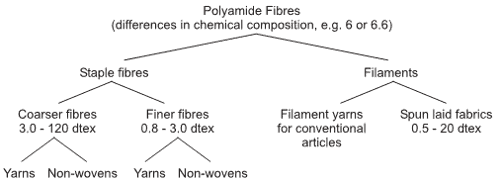
The two main types of fibre are polyamide 6, usually known as Perlon, and polyamide 6.6, which is generally called Nylon to distinguish it from Perlon. The number or numbers after the word ‘polyamide’ indicate how many carbon atoms there are in each molecule making up the polyamide. The fact that there is only one number in one instance and two in the other shows that polyamide 6 contains only one basic module and polyamide 6.6 contains two, with six carbon atoms in each molecule.
Nylon 6 and 6.6
Polyamide 6 is made from caprolactam and polyamide 6.6 from hexamethylenediamine and adipic acid. For fibre production, the resulting polyamide has to have the capacity to be spun into filaments, i.e.
- it must have the capacity to be melted without decomposing and to be forced through a jet
- the molten mass must be such that the filaments that are still ductile when formed do not break during cooling. Certain conditions must be met, one of them being a minimum prescribed length for the macromolecule
These nylon polymers form strong, tough, and durable fibres useful in a wide variety of textile applications. The major differences in the fibres are that nylon 6,6 dyes lighter, has a higher melting point, and a slightly harsher hand than nylon 6.
Aramid Fibers
The aramid polyamide fibres are formed from a long chain of synthetic polyamides in which at least 85% of the amide linkages are attached to aromatic rings. These essentially fully aromatic polyamides are characteristically high melting and have excellent property retention at high temperatures and excellent durability. They are unaffected by moisture and most chemicals and are inherently flame retardant. The fibres have high strength and can be used in a number of unique high-strength applications.
Common trade names for aramid fibres include Nomex and Kevlar (DuPont). Aramid fibres are extremely strong and heat resistant. Fabrics from the aramids have a high lustre with a fair hand and adequate draping properties.
The fibres are light yellow unless bleached and exhibit moderate moisture absorption characteristics. The fibres recover readily from stretching and bending deformation and are extremely abrasion resistant. They do tend to pill due to the high strength of the fibre.
Other Polyamides
Several other polyamides have been introduced for use as fibres in speciality applications where certain combinations of properties are desired. The major speciality nylons include Qiana, nylon 4, nylon 11, nylon 6,10, and biconstituent nylon-polyester.
Manufacturing of Polyamide Filaments
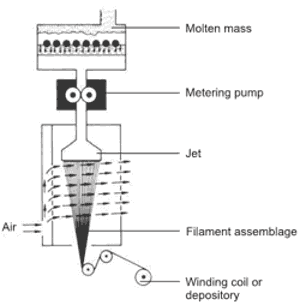 The molten mass is forced through the holes in the spinneret by pressure pumps and metering pumps, after which it is pulled off in the form of filaments. They cool rapidly in the (air) blasting chamber and are then either baled or wound onto bobbins at a constant speed.
The macromolecules are still randomly distributed in the filaments, which is why they are stretched so that molecules are more longitudinally oriented.
Once they have this orientation, the filaments take on their characteristic physical properties and can be cut to the lengths needed to make the fibres. Then the filaments of staples are prepared to ensure that they retain their processing properties.