Sisal is a stiff, strong natural fibre taken from the leaves of an agave, Agave sisalana. EU labelling law defines it as “fibre obtained from the leaves of Agave sisalana” (Regulation (EU) No 1007/2011, Annex I). It is a hard fibre: coarse, creamy white, long (strands of 1 to 1.5 metres) and strong for its weight, but too stiff to spin into soft cloth. That is why it goes into rope, agricultural twine, sacking, rugs and matting, polishing buffs, dartboards, paper and composite panels rather than clothing. Brazil and Tanzania grow most of it; the world produced about 234,000 tonnes in 2024 (FAOSTAT). The name comes from Sisal, the port in Yucatán, Mexico, from which the fibre was first exported.
Below: the plant, how the fibre is extracted and graded, its measured properties, sisal against jute and coir, what it is used for and what that costs, where it is grown, and the standards for sisal rope and twine. Three of the site’s calculators are worked through.
Last verified: 6 October 2026. Sources are linked where they are used and listed at the end.
What is sisal?
Sisal is a leaf fibre. Britannica describes leaf fibres as “hard, coarse fiber obtained from leaves of certain monocotyledonous plants … used mainly for cordage. Such fibers, usually long and stiff, are also called ‘hard’ fibers, distinguishing them from the generally softer and more flexible fibers of the bast, or ‘soft,’ fiber group” (Britannica, leaf fiber). FAO puts it plainly: sisal “is a coarse, hard fibre unsuitable for textiles or fabrics. But it is strong, durable and stretchable” (FAO, International Year of Natural Fibres 2009).
Its relatives are named separately in law. Henequen comes from Agave fourcroydes of Mexico and Guatemala, “closely related to sisal” (Britannica, henequen). The EU regulation, oddly, defines henequen and maguey as fibre “from the bast” of their agaves, though both are leaf fibres like sisal. Sisal is not named in the US fibre rules at all; it is labelled by its common name (16 CFR Part 303). The site’s page on natural cellulosic leaf fibres covers abaca, henequen and the rest of the family.
The sisal plant
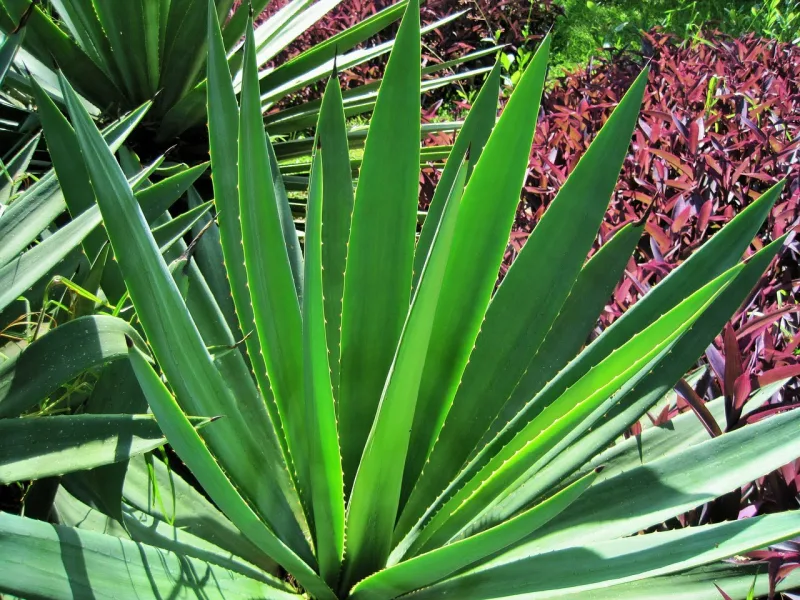
Agave sisalana belongs to the asparagus family, Asparagaceae (formerly Agavaceae), and its native range is Mexico’s Yucatán Peninsula (Kew, Plants of the World Online), though “wild forms are not known” (PROSEA). It grows as a rosette of thick, sword-shaped leaves on a short stem, and it is the leaves that are cut for fibre.

- A plant flowers once, then dies. Sisal is “monocarpic”. “After having produced (180—)200—250(—300) leaves, which may be up to (3—)6—9(—20) years after planting depending on climate and soil conditions, a long flowering shoot (‘pole’) is produced”, 2 to 8 metres tall, and “After the production of flowers and bulbils the entire plant dies” (PROSEA, Plant Resources of South-East Asia 17: Fibre plants, 2003).
- It is grown from bulbils or suckers. “Sisal is propagated vegetatively with bulbils or suckers. … bulbils are more often preferred, because they are produced in greater numbers” (PROSEA): the pole carries many small plantlets.
- Each leaf is mostly water. A leaf holds 1,000 to 1,200 fibre bundles and is “composed of 4% fibre, 0.75% cuticle, 8% dry matter and 87.25% water”; a leaf of about 600 g yields about 3% of its weight as fibre (Li, Mai and Ye, Composites Science and Technology 60, 2000). PROSEA gives about 3.5 kg of fibre from 100 kg of leaves.
Three kinds of fibre in one leaf
A sisal leaf holds three types of fibre, which behave differently in extraction (Li, Mai and Ye):
- Mechanical fibres lie towards the edge of the leaf, have a thickened horseshoe shape in section and seldom split in processing. They are the most useful commercially; PROSEA puts them at about 75% of the fibre.
- Ribbon fibres run with the conducting tissue along the midline of the leaf. They are the longest, and split lengthwise more easily; about 25%.
- Xylem fibres are irregular, thin-walled cells opposite the ribbon fibres, and are mostly broken and lost in extraction.
What the trade calls a sisal fibre is a bundle: a strand 100 to 300 micrometres across (Li, Mai and Ye; FAO gives 200 to 400 microns), made of many short cells each 15 to 30 µm wide (PROSEA), glued together by lignin and hemicellulose. The cell walls are “reinforced with spirally oriented cellulose in a hemicellulose and lignin matrix”, which is why sisal is stiff and why it bonds poorly to plastics without treatment.
How sisal fibre is extracted
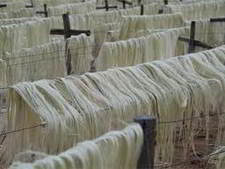
There are two ways to free the fibre from the leaf pulp: retting followed by scraping, or crushing and scraping the fresh leaf in a decorticator. Decortication gives the better fibre, “lustrous” in colour, at a yield of 2 to 4% of the leaf, while retting gives a larger quantity of poorer fibre (Li, Mai and Ye). In decortication “15—20% of the total leaf fibre (‘flume tow’) is lost” into the wash water (PROSEA). The fibre is then washed to remove the leaf juices and chlorophyll, hung to dry in the sun, and brushed, which takes out the short fibre (tow) and leaves the long line fibre: “about 92—96% is line fibre and 4—8% tow”.
How sisal is graded
Sisal is sold by grade, which records length, colour and cleanliness. Kenya’s grades are set in law, in the Fifth Schedule of the Crops (Fibre Crops) Regulations, 2020, and “All grades to be of parallel packing, no ties or knots, free of dampness and excessive baling pressure”. The main grades:
| Grade | What the regulations require |
|---|---|
| 1 | Length from 3 ft, averaging 3 ft 6 in; properly brushed; free of tow, bunchy ends, knots and harshness; creamy white to cream |
| A | As Grade 1, but yellowish, sunburned, slightly spotted or slightly discoloured |
| 2 | Length from 2 ft 6 in; otherwise as Grade 1 |
| 3L | Length from 3 ft; otherwise as Grade 3 |
| 3 | Length from 2 ft; brushed fibre not up to Grades 1, A or 2; minor defects in colour and cleaning allowed, but no barky or undecorticated fibre |
| UG | Fibre outside the grades above for length, colour and cleaning, but at least 2 ft long |
| SSUG | At least 60 cm; below standard UG; yellowish to darker and blemished |
| SCWF | Short clean white fibre, 18 to 24 in long; otherwise as Grade 3 |
| Tow 1 and Tow 2 | Short fibre from the brushing machines; Tow 2 may be brownish or spotted, but black fibre, a sign of rot, is not allowed |
| Flume tow | Cuttings recovered from the decorticator’s wash channel and dried |
| UHDS | Unwashed, hand-decorticated sisal, from 60 cm, brushed or not |
The world price is quoted for two East African grades and one Brazilian. In 2024 East African 3L averaged US$1,929 a tonne free on board, UG US$1,740, and Brazil’s Bahia type 3DB US$1,105 (FAO, Jute, kenaf, sisal, abaca, coir and allied fibres: statistical bulletin 2024). Grade matters: long, clean, white 3L fetched 75% more than Brazil’s type 3DB.
Properties of sisal fibre
| Property | Value | Source |
|---|---|---|
| Strand length | 1.0–1.5 m | Li, Mai and Ye (2000) |
| Strand diameter | 100–300 µm (FAO: 200–400 µm); single cells 15–30 µm | Li, Mai and Ye; FAO; PROSEA |
| Density | 1.3–1.5 g/cm³ | Pickering and colleagues (2016) |
| Tensile strength | 507–855 MPa | Li, Mai and Ye |
| Tenacity | 36–61 cN/tex | The site’s fibre list |
| Elongation at break | 2.0–2.5% | Li, Mai and Ye |
| Young’s modulus | 9.4–28 GPa | Li, Mai and Ye |
| Composition | 54–66% α-cellulose, 12–17% hemicellulose, 7–14% lignin | Li, Mai and Ye |
| Colour | Lustrous, creamy white | Li, Mai and Ye; Kenyan grade 1 |
| EU agreed moisture allowance | 14.00% | Regulation 1007/2011, Annex IX |
As with every plant fibre, the strength depends on the test: Li, Mai and Ye note that the properties depend on the fibre’s “source, position, and age” and on “fiber diameter, gauge length, strain rate and test temperature”. Sisal also takes up water readily. Its EU allowance of 14% is above cotton’s 8.5%, and “sisal ropes … swell more and quicker in water without regaining their shape on drying” than abaca ropes, and “become stiff when wet” (PROSEA).
Worked example: megapascals and centinewtons per tex. Composites papers quote sisal in megapascals, textile tables in cN/tex. At a density of 1.4 g/cm³, the textile unit converter shows 36 cN/tex as 504.00 MPa and 61 cN/tex as 854.00 MPa, so the fibre list’s range and Li, Mai and Ye’s 507 to 855 MPa are the same measurement in two units. At 61 cN/tex a sisal strand could hang 62.2 km of its own length before breaking.
Sisal vs jute vs coir
| Sisal | Jute | Coir | |
|---|---|---|---|
| Part of the plant | Leaf (hard fibre) | Stem bark (soft, bast fibre) | Coconut husk |
| FAO’s description | “A coarse, hard fibre” | “Long, soft and shiny”, 1 to 4 m, 17 to 20 microns | “A coarse, short fibre”, up to 35 cm, 12 to 25 microns |
| Tenacity, cN/tex | 36–61 | 24–45 | 11–18 |
| Elongation at break | 2.0–2.5% | 1–2% | 15–30% |
| EU moisture allowance | 14% | 17% | 13% |
| Main uses | Twine, rope, rugs, buffs, composites | Sacking, hessian, carpet backing | Floor coverings (white coir); rubberised pads and mattresses (brown coir) |
Sources: descriptions, FAO International Year of Natural Fibres 2009 (sisal, jute, coir); tenacity, elongation and allowances, the site’s fibre list. “Sisal can be used for making sacks, but cannot be spun as fine as jute” (PROSEA). FAO groups sisal, abaca and coir as “the three major hard fibres” (FAO, CCP:HF 04/4, 2004). See also jute and the other plant fibres.
What sisal is used for
- Twine and rope. “Sisal fibre is mainly used to make twines, ropes, strings, fishing nets and hammocks”, and it “has been widely used for the manufacture of binder and baler twines, but this use has declined steadily” (PROSEA). In 2004 FAO still wrote that “The bulk of sisal goes into harvest twine”.
- Floor coverings. Twine, rope and yarn “can also be woven into carpets, mats, and various handicrafts” (FAO, Future Fibres); sisal is also woven into carpet backing, sacks and industrial fabrics.
- Polishing. “A major use of the fibre is in buffing cloth – because sisal is strong enough to polish steel and soft enough not to scratch it” (FAO).
- Dartboards. “Sisal also continues to make the best material for dart boards” (FAO), and dartboard makers still advertise boards “Made from the finest East African sisal” (Winmau).
- Paper, padding and composites. Sisal pulp “adds bulk to paper and cardboard”, and sisal “can substitute or enhance fibre-glass used to reinforce plastic in automobiles, boats, furniture, water tanks and pipes”, strengthen cement and “replace asbestos in roofing and brake-pads” (FAO). It is also used as padding in cars, upholstery and mattresses.
Worked example: why a rope is weaker than its fibres. Twisting fibres into strands, and strands into rope, tilts every fibre away from the line of pull. Take a 24 mm three-strand rope whose fibres together could hold 100 kN in a straight line, with 8% extra loss in processing (assumed figures). With a lay length of 170 mm, the rope lay strength calculator puts the helix angle at 16.08° and the rope at 84.94 kN. Twist it twice as hard, an 85 mm lay, and the angle rises to 29.97° and the rope drops to 69.05 kN. Rope makers trade that strength for a firmer rope that holds its shape.
Worked example: sisal in a composite. Take a panel of 300 g of sisal mat in 450 g of resin, with densities of 1.4 and 1.2 g/cm³, that measures 1.25 g/cm³ (assumed figures). The fibre volume fraction calculator gives 36.36% fibre by volume against 40% by weight, a theoretical density of 1.27, and 1.79% voids. Sisal’s low density is the attraction: by volume it does more work than its weight suggests, which is why it competes with glass fibre in car panels.
Where sisal is grown, and how much
| Country | 2023, tonnes | 2024, tonnes |
|---|---|---|
| Brazil | 95,567 | 93,261 |
| Tanzania | 56,733 | 61,216 |
| Kenya | 25,577 | 20,940 (imputed) |
| Madagascar | 17,577 (imputed) | 17,592 (imputed) |
| China | 14,289 (estimated) | 14,292 (estimated) |
| Mexico | 6,894 | 6,735 |
| World | 236,950 | 233,961 |
Brazil grows the most, almost all of it in Bahia: 90,407 of Brazil’s 95,567 tonnes in 2023 (IBGE, table 1613). Estimates differ by source: FAO’s own statistical bulletin puts world sisal at 260,600 tonnes for 2023 and China at 64,000, which would make China second. About 153,100 tonnes crossed borders in 2023, 109,800 as fibre and 43,400 as manufactures; Brazil exported 61,400 tonnes, Tanzania 39,100 and Kenya 22,800 (FAO bulletin 2024).
East Africa’s sisal began with one shipment. In 1892 the German botanist Richard Hindorf ordered a thousand young plants from Florida for German East Africa; “62 plants” survived to be planted in 1893, and they became “the basis of East African sisal production” (Botanical Garden, University of Potsdam; Neue Deutsche Biographie).
Sisal rugs and water
Sisal rugs are hard-wearing and naturally coloured, but water is their weak point: the fibre swells when wet and does not fully recover its shape (PROSEA), and plant-fibre rugs can brown when they dry slowly. The cleaning trade’s body, the IICRC, warns that “Cellulosic browning may occur when plant-based fibers (cotton, jute, etc.) dry too slowly” and that “The risk of shrinkage may be lessened but not completely eliminated through the use of low moisture cleaning methods”, so shrinkage-prone rugs should be cleaned professionally (IICRC, area rug tip sheet). In practice: vacuum often, blot spills at once, and avoid soaking.
Standards for sisal rope and twine
- ISO 1181: fibre ropes, manila and sisal, 3-, 4- and 8-strand.
- ISO 1970: eight-strand plaited manila and sisal ropes.
- ISO 5080: sisal agricultural twines.
- In India, the Bureau of Indian Standards covers sisal ropes in IS 1321, sisal lines in IS 7082 and sisal agricultural twines in IS 11058.
Related on this site
- Natural cellulosic leaf fibres, sisal’s family, and pineapple leaf fibre.
- Plant fibres, and the list of textile fibres.
- Natural fibre composites.
Sources and corrections
- Definitions: Regulation (EU) No 1007/2011, Annexes I and IX; US 16 CFR Part 303; Britannica, leaf fiber and henequen; Merriam-Webster and the Online Etymology Dictionary, sisal.
- Plant and fibre: Kew, Plants of the World Online, Agave sisalana; P. Dahal, I. H. Utomo and M. Brink, Agave sisalana, PROSEA 17: Fibre plants, 2003; Y. Li, Y.-W. Mai and L. Ye, Sisal fibre and its composites: a review of recent developments, Composites Science and Technology 60, 2037 to 2055, 2000; K. L. Pickering, M. G. Aruan Efendy and T. M. Le, A review of recent developments in natural fibre composites and their mechanical performance, Composites Part A 83, 2016.
- FAO: Future Fibres, sisal; International Year of Natural Fibres 2009; CCP:HF 04/4, 2004; statistical bulletin 2024; FAOSTAT.
- Grades, production and history: Kenya, Crops (Fibre Crops) Regulations, 2020; IBGE, SIDRA table 1613; University of Potsdam Botanical Garden, fibre production; Neue Deutsche Biographie, Hindorf.
- Care: IICRC, area rugs tip sheet.
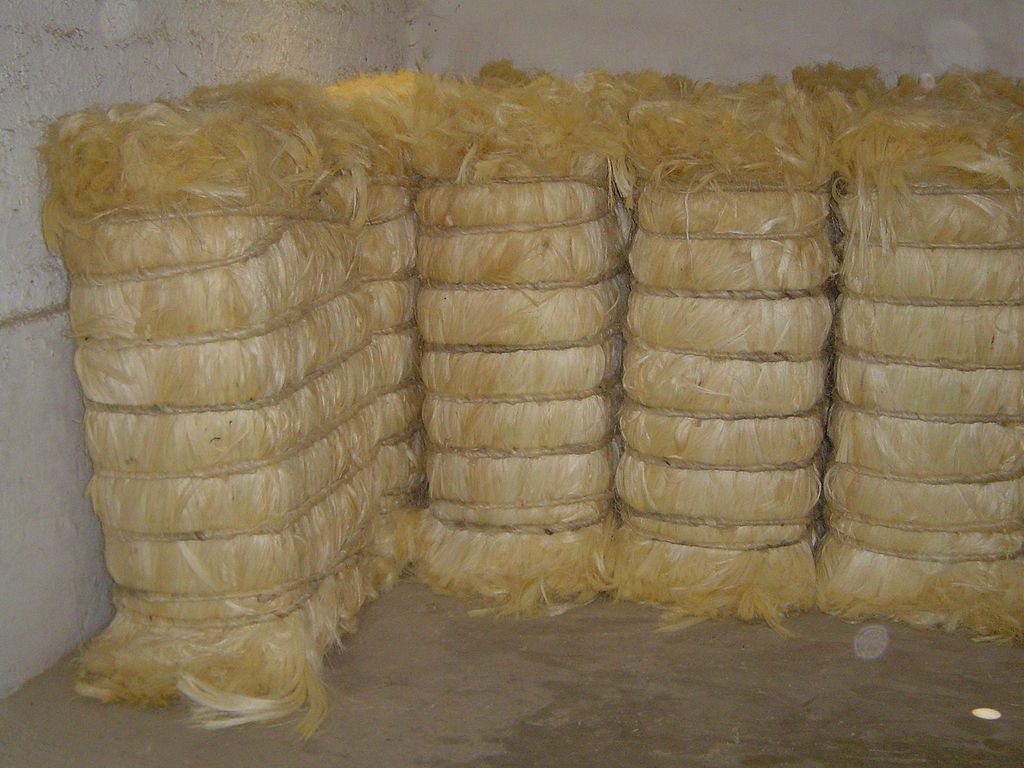
Change log. 6 October 2026: rewritten in full. Corrected: the fibre strand is 100 to 300 micrometres across, not millimetres; sisal is native to Mexico’s Yucatán, not to “tropical and sub-tropical North and South America”; the bales photograph shows henequen, now captioned as such. Added: the plant’s life cycle, grades, sourced properties, production, prices, uses, and the rope and twine standards. Removed: a long passage on hybrid composites with no figures.
Found an error? Please tell us through the contact page, naming the section and the source that disagrees.