

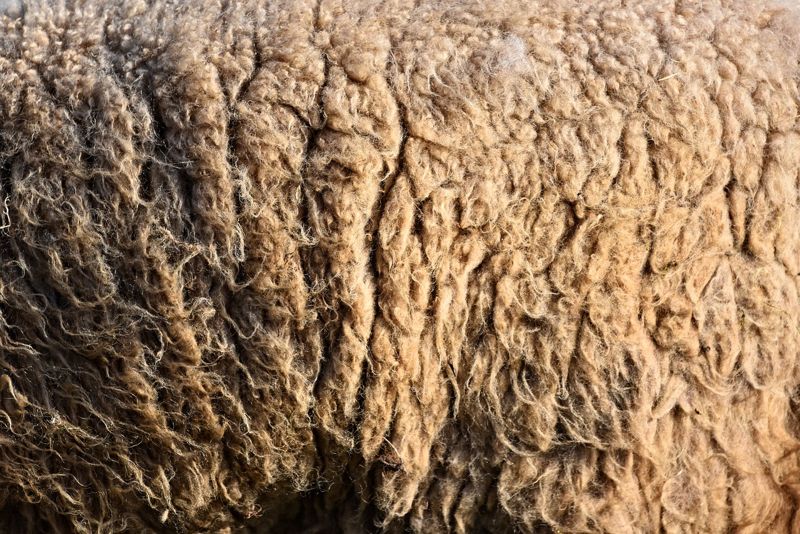
Wool is the fibre that grows as the fleece of the domestic sheep, Ovis aries. It is a protein fibre: about 97% protein, chiefly keratin, the protein of hair and horn, with 2 to 3% lipid (Woolmark). Two features explain most of how it behaves. Each fibre is crimped, so wool is bulky for its weight and springs back when it is crushed. And its surface is covered with overlapping scales, which is why wool felts and shrinks when it is washed warm and rubbed. Wool can take up about a third of its own weight in water vapour, does not melt, and is hard to ignite. Fine Merino wool, around 20 microns across, is soft enough to wear next to the skin; coarser wool goes into tweeds, blankets and carpets. By volume it is a small fibre: wool, mohair, cashmere and alpaca together made up less than 1% of the world’s fibre output in 2024, according to Textile Exchange.
The questions readers ask come first: what wool is made of, how it looks under a microscope, why it is warm, why it shrinks, why some wool itches, whether it burns, Merino against other wool, and how to wash it. Then the depth, with every figure sourced: the fibre’s measured properties, its structure and chemistry, grading by micron, how a fleece becomes yarn and cloth, how wool is invoiced by weight, where it is grown, welfare and labelling rules, and 23 British breeds with the wool each one grows. Three of the site’s calculators are worked through, each with a link that opens the tool with the same figures entered.
Last verified: 6 October 2026. Sources are linked where they are used and listed at the end.
What is wool?
In everyday use, wool means sheep’s wool. The law draws the line a little wider, and differently on each side of the Atlantic. In the European Union, “wool” is “fibre from sheep’s or lambs’ fleeces (Ovis aries) or a mixture of fibres from sheep’s or lambs’ fleeces and the hairs of animals listed in number 2″. That list is alpaca, llama, camel, cashmere, mohair, angora, vicuna, yak, guanaco, cashgora, beaver and otter, each of which may also be sold under its own name, “followed or not by the word ‘wool’ or ‘hair'” (Regulation (EU) No 1007/2011, Annex I).
In the United States the Wool Products Labeling Act defines wool as “the fiber from the fleece of the sheep or lamb or hair of the Angora or Cashmere goat (and may include the so-called specialty fibers from the hair of the camel, alpaca, llama, and vicuna) which has never been reclaimed from any woven or felted wool product” (15 U.S.C. 68). So mohair and cashmere count as wool there, while yak and guanaco are not named. The site’s record of the US wool labelling rules, 16 CFR Part 300, covers how the act is applied, and the labelling section below covers “virgin” and “recycled” wool.
What is wool made of?
Clean wool is keratin, a family of proteins rich in the sulphur-containing amino acid cystine, whose disulphide bonds tie the protein chains together. In one CSIRO study of Merino wool, sulphur made up a mean 3.43% of the fibre, with a range of 3.08 to 3.92% (Reis and colleagues, 1967). That sulphur is why burning wool smells like burning hair, the basis of the burn test, and the disulphide bonds are where bleach and alkali attack it (chemistry, below).
Wool straight off the sheep is not clean. Greasy wool carries wool wax (refined, it is lanolin), suint (dried sweat salts), dirt and vegetable matter such as burrs and seeds, all removed by scouring. What is left is the clean yield: 63.6% on average for the Australian clip in the 2025/26 season (Australian Wool Innovation). Fine wools carry more grease and yield less: a South Dakota State extension guide gives 40 to 68% for fine wool against 55 to 75% for the coarser grades (SDSU Extension).
What does wool look like under a microscope?
Along its length, a wool fibre shows a rough, scaly outline. The scales “are distinctly visible under an ordinary light microscope. The surface scales overlap, project slightly from the shaft of the fibres and point towards the fibre tip” (Chaudri, Khan and Khaliq, 1970). The Canadian Conservation Institute’s identification key separates the two kinds: fine wool has an “outer surface and edges rough, due to overlapping surface scales, no medulla”, while coarse wool has “closely spaced, zig-zag or jagged-edge surface scales, medulla visible” (CCI Notes 13/18).
In cross-section a wool fibre is nearly round but slightly elliptical. Measured on single Merino fibres from four directions, the ratio of the largest to the smallest diameter averaged 1.08, “confirming that the Merino wool fibres under review were elliptical rather than circular” (Wang and colleagues, Deakin University). Cotton, by contrast, is a flat twisted ribbon with a kidney-shaped section, and silk a smooth filament with a triangular one; the site’s guide to the microscopic appearance of fibres compares them side by side, and the article on crimp in wool spinning shows the scales of a wool fibre under the scanning electron microscope.
The microscope is also how wool is told apart from cashmere, yak and the other fine hairs, which a chemical test cannot do. ASTM’s identification method says microscopy “is indispensable for positive identification of the several types of cellulosic and animal fibers, because the infrared spectra and solubilities will not distinguish between species” (ASTM D276). Scale patterns and diameters are counted under the light microscope to ISO 17751-1, or under the scanning electron microscope to ISO 17751-2; ISO 18074 does it by DNA. Medullated and kemp fibres are counted to ISO 2647 and ASTM D2968.
Why is wool warm?
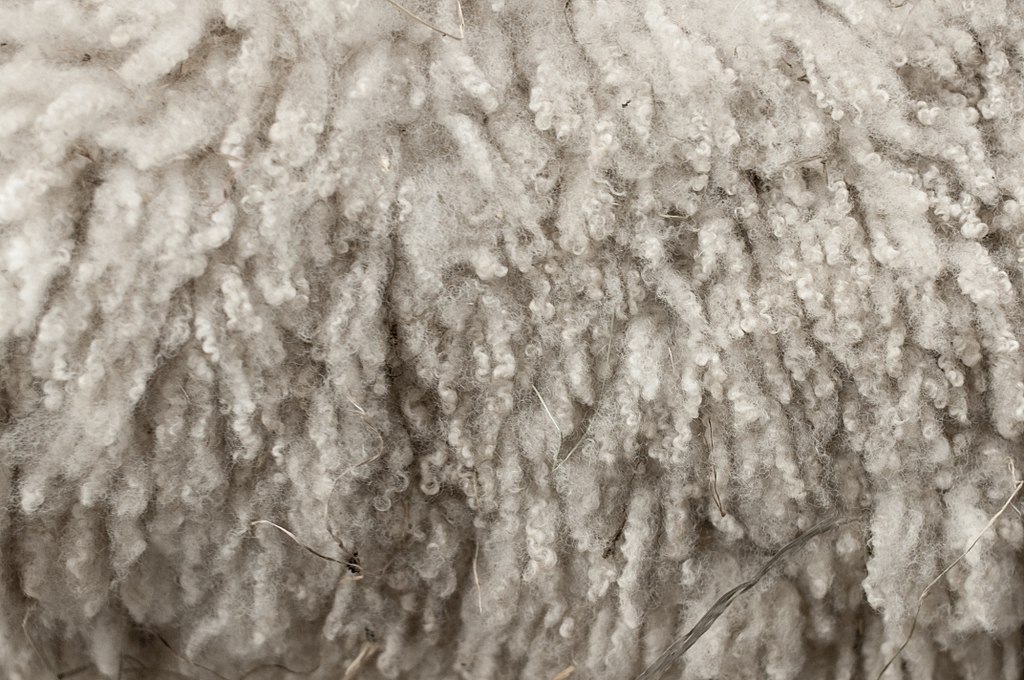
Mostly because of crimp. A wool fibre’s cortex is built from two kinds of cell, and in Woolmark’s words they “grow side by side, but at different rates, to create a natural bend in the fibre known as crimp” (Woolmark). Crimped fibres cannot pack flat, so a wool yarn, knit or batt is bulky for its weight, and it is the still air held in that bulk that insulates. Crimp also makes the fibre springy, so the bulk recovers after it is squashed.
Wool also gives off heat as it takes up moisture. Woolmark puts it plainly: “As absorption occurs, wool releases heat, keeping the wearer feeling warmer and drier in cold damp conditions” (Woolmark). Going out from a dry, heated room into damp winter air, a wool garment absorbs vapour and warms slightly as it does. Figures quoted online for the size of the effect, such as “960 kJ per kilogram”, could not be traced to a measurement, so none is given here.
Does wool keep you dry? Moisture and breathability
Wool takes up more water vapour than any other common apparel fibre. The textile measure is regain, the mass of water as a percentage of the dry fibre. At ordinary room conditions the agreed commercial figure for wool is 13.6%, against 11.0% for viscose, 7.0% for raw cotton and 0.4% for polyester (IS 13157:1991, which is built on ASTM D1909-1985). In saturated air wool reaches a regain of 33 to 34%, about a third of its own weight (Menkart, Wolfram and Mao, 1966). Claims that wool can absorb “almost double its own weight” or “up to 50%” of its weight in vapour are wrong.
Because that water sits inside the fibre rather than on its surface, wool feels dry long after a synthetic would feel clammy. Woolmark says wool “can absorb up to 35% of its weight before feeling wet and clinging to the skin”. The industry bodies differ on the comparison with cotton: Woolmark says wool absorbs “twice as much as cotton”, the IWTO says “50% more” (IWTO, Wool and Skin). The commercial regains above put it at nearly double. The same moisture helps with odour: Woolmark reports a New Zealand panel study in which wool fabrics “retained 66 per cent less body odour intensity than polyester fabrics and 28 per cent less than cotton fabrics” (Woolmark).
Regain is measured, not guessed: a sample is weighed as received and again after oven-drying, to ASTM D1576 for wool, and the moisture regain calculator turns the two weights into regain and moisture content. A sample of 113.6 g that dries to 100 g is at 13.6% regain, or 11.97% moisture content. How long a wool lot takes to settle to that equilibrium is what the fibre conditioning time calculator estimates.
Why does wool shrink and felt?
Wool can shrink in two quite different ways. Relaxation shrinkage happens to fabric of any fibre the first time it is wetted: strains set into the yarn and cloth during spinning, knitting and finishing are released, once. Felting shrinkage is particular to wool and other scaled animal fibres, and it carries on wash after wash.
Felting comes from the scales. Because they point towards the tip, “the fibre exhibits a higher friction when it moves with its tip forward than in the reverse direction” (van der Vegt, 1955). Each time a wet wool fabric is squeezed and released, the fibres can creep root-first but not tip-first, so they ratchet into one another: “The fibres actually migrate in a rootward direction when woollen goods are subjected to compression during washing” (Chaudri and colleagues, 1970). Warmth, soap or alkali and agitation all speed it up. The fabric thickens, tightens and shrinks, and it does not come back.
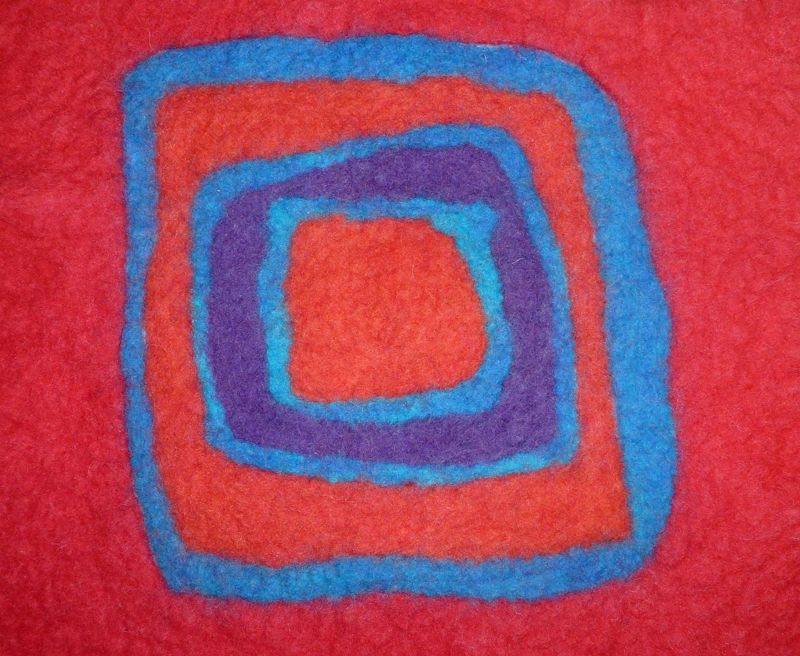
The same property makes felt, and the fulling or milling that gives woollen cloth such as flannel and melton its dense, matted face. To make wool machine-washable, the scales are treated. The most widely used route is the chlorine–Hercosett process, a chlorine pre-treatment followed by a polyamide-epichlorohydrin resin (Woolmark). About 75% of machine-washable wool is treated this way, and it puts organic halogen compounds (AOX) into the wastewater; a chlorine-free plasma treatment was demonstrated in an EU LIFE project from 2008 and worked for fine wool, with “still problems with coarse wool” (European Commission, LIFE05 ENV/D/000195).
Shrinkage is tested, not taken on trust. Woolmark’s method TM31 washes a garment through relaxation and felting cycles and measures the change in dimensions (Woolmark specification AF-1); India’s IS 1313 does the same for knitted goods containing wool. The relaxation shrinkage calculator turns before-and-after measurements into a percentage, and the wash shrinkage calculator sizes a pattern for fabric that will still shrink.
Why does some wool itch? Is it an allergy?
The prickle is mechanical, not allergic. It comes from the ends of coarse fibres pressing into the skin, and the threshold is fibre diameter: “The primary factor is the incidence of fibre ends coarser than approximately 30–32 µm making contact with the skin.” The same 2017 review concluded that “Current evidence does not suggest that wool-fibre is a cutaneous allergen”, that contact allergy to lanolin, chromium or formaldehyde “is highly unlikely with modern wool garments”, and that superfine and ultrafine Merino “are well tolerated and may benefit eczema management” (Zallmann and colleagues, Acta Dermato-Venereologica, 2017).
Wool buyers measure this as the comfort factor: the percentage of fibres 30 microns or finer. Montana State University’s wool laboratory advises that wool going into garments “should have a CF% of at least 95%” (Montana State University). A low average is not enough; a fine wool with a tail of coarse fibres can still prickle. For skin-close garments, look for wool labelled by micron, ideally under about 19.5 µm, the band Woolmark gives for base layers and underwear.
Is wool flammable?
Wool will burn in a strong enough flame, but it is the hardest of the common apparel fibres to ignite and it does not melt. The IWTO’s figures: wool ignites at 570 to 600 °C, “compared to Cotton (255 °C) or Polyester (485-560°C)”; its limiting oxygen index is 25.2%; its heat of combustion is 4.9 kcal/g; and “Wool may be ignited if subjected to a significantly powerful heat source, but it does not normally support flame. If smouldering occurs, it usually continues only for a short time” (IWTO, Wool and Fire).
The limiting oxygen index is the share of oxygen a material needs in the surrounding gas to keep burning. Air is about 21% oxygen, so a fibre with an index above that tends to go out once the flame is taken away. Cotton’s is about 18 and polyester’s 20 to 21 (fibre list). Not melting matters as much: a burning synthetic drips and sticks to skin, wool chars. The FR LOI predictor starts wool at about 25 and estimates how much a flame-retardant finish raises it; wool for fire-resistant textiles and flame-retardant fabrics for industrial safety go further.
Merino wool vs other wool
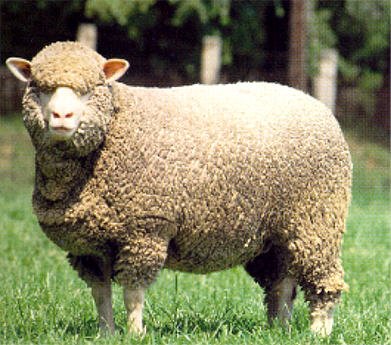
Merino is a breed, or a family of breeds, bred for fine wool. Woolmark says “Merino wool fibre diameter typically ranges from less than 17.5 microns to around 22-24 microns”, and the IWTO defines superfine wool as “wool of 18.5 microns and finer” (IWTO, Market Information 2026). The Australian clip, mostly Merino, averaged 20.5 µm with an 87.3 mm staple in 2025/26 (AWI). The British breeds in the table below grow wool of 29 to 42 µm.
Diameter decides the use. Woolmark’s guide by micron:
| Mean fibre diameter | Typical use |
|---|---|
| Under 19.5 µm | Base layers, underwear, fine knitwear |
| 19.5–22 µm | Apparel, knitwear |
| 22–24 µm | Outerwear |
| Over 24 µm | Carpets and interiors |
So “Merino” on a label is a promise about fineness, but not a measurement; a micron figure is. Merino is also the breed at the centre of the welfare question of mulesing, covered below. Woolmark states that Australia “provides 81% of the world’s superfine wool” (Woolmark), a figure from the industry’s own marketing body.
Wool vs cotton, silk, polyester and acrylic
Wool is weaker than cotton and silk but stretches much further before it breaks, which is why wool cloth recovers from creasing. The figures below come from the site’s sourced table of 34 fibres, where each value carries its reference.
| Wool | Cotton | Silk | Polyester | Acrylic | |
|---|---|---|---|---|---|
| Source | Sheep’s fleece, protein | Seed hair, cellulose | Silkworm cocoon, protein | Synthetic polymer | Synthetic polymer |
| Tenacity, cN/tex | 8–18 | 24–44 | 27–40 | 28–80, by grade | – |
| Elongation at break | 25–40% | 4–10% | – | 18–27% (apparel staple) | – |
| Commercial regain | 13.6% | 7.0% | 11.0% | 0.4% | 1.5% |
| Heat | Does not melt; ignites at 570–600 °C | Does not melt; decomposes above about 149 °C | Does not melt | Melts at 250–260 °C | Glass transition about 100 °C |
| Limiting oxygen index | 25.2 | 18–18.5 | 23.6 (fabric) | 20–21 | 18.2 |
| Felts when washed warm | Yes | No | No | No | No |
| Eaten by clothes moths | Yes | No | Yes | No | No |
| World price, July 2026 | Fine wool 1,600.70 US cents a kilogram | 88.78 US cents a pound (195.72 a kilogram) | – | – | – |
Sources for the table: tenacity, elongation, regain, heat and LOI, the fibre list and its references, with wool’s ignition and LOI from IWTO; felting, van der Vegt (1955); moths, University of Kentucky, which names wool, fur, silk, feathers, felt and leather; prices, the IMF’s monthly benchmarks on the site’s fine wool and world cotton series. By weight, fine wool cost about 8.2 times as much as cotton that month.
Acrylic is the fibre sold as “artificial wool”: a synthetic spun and crimped to imitate wool’s bulk and warmth at a lower price. It does not felt and moths leave it alone, but it takes up almost no moisture and burns more readily; the site’s acrylic page covers it. Polyester is the fibre most often blended with wool for suiting, where it adds strength and crease recovery; see the polyester pillar, and cotton, silk and linen for the natural fibres.
How to wash and store wool
Follow the care label first: a garment labelled machine-washable has had its scales treated, and one that is not will felt in a normal wash. The rest follows from the fibre’s chemistry.
- Keep the water cool and the agitation gentle, and do not move a wet garment between hot and cold water. Heat, alkali and rubbing are what drive felting.
- Use a neutral wool detergent, never chlorine bleach. Hypochlorite dissolves wool outright; the EU’s official method for analysing wool blends uses it to remove the wool from a sample (Regulation 1007/2011, Annex VIII, method 2; ISO 1833-4). Strong alkali dissolves wool too.
- Squeeze, do not wring, and dry flat away from direct heat, easing the garment back to shape. Tumble-dry only if the label allows it.
- Store it clean, dry and sealed. The larvae of the webbing clothes moth (Tineola bisselliella), the case-making clothes moth (Tinea pellionella) and carpet beetles can digest keratin, which few other animals can; they feed on “animal fibers, especially wool, fur, silk, feathers, felt, and leather” (Potter, University of Kentucky; Vilcinskas and colleagues, 2020). Check stored wool through the summer.
Alpaca, cashmere and the other fine hairs are washed the same way; the site’s guide to washing alpaca goes step by step.
Pros and cons of wool
| Advantages | Drawbacks |
|---|---|
| Warm for its weight, from crimp and bulk | Felts and shrinks in a hot or vigorous wash unless treated |
| Takes up about a third of its weight in vapour at saturation, and feels dry well beyond the point a synthetic feels damp | Coarse wool, over about 30 µm, prickles |
| Stretches 25–40% before breaking and recovers from creasing | Weaker than cotton, silk or polyester, especially when wet |
| Hard to ignite, does not melt, and tends to go out by itself | Eaten by clothes moths and carpet beetles |
| Holds less body odour than polyester or cotton in panel tests | Damaged by chlorine bleach and alkali |
| Renewable each year, and biodegrades in warm, moist soil | Expensive: fine wool cost about 8 times cotton by weight in July 2026 |
Properties of wool fibre
| Property | Value | Source |
|---|---|---|
| Composition | About 97% protein (keratin), 2–3% lipid; sulphur 3.08–3.92% in Merino, mean 3.43% | Woolmark; Reis and colleagues (1967) |
| Fibre diameter | Merino under 17.5 to about 24 µm; British breeds 29–42 µm | Woolmark; British Wool |
| Staple length | Australian clip average 87.3 mm (2025/26); British longwools 15–30 cm | AWI; British Wool |
| Cross-section | Slightly elliptical; ratio of diameters 1.08 in Merino | Wang and colleagues |
| Crimp | About 20 per inch at 20 µm; about 4 per inch at 40 µm | NMSU Extension |
| Density | 1.30–1.31 g/cm³ | Zimniewska and Kicińska-Jakubowska; Beckman and colleagues |
| Tenacity | 8–18 cN/tex | Zimniewska and Kicińska-Jakubowska; Beckman and colleagues |
| Elongation at break | 25–40%; slightly weaker and more extensible when wet | Beckman and colleagues; Khan and Khan (1970) |
| Commercial moisture regain | 13.6% | IS 13157:1991 |
| EU agreed allowance | 17.00% carded, 18.25% combed | Regulation 1007/2011, Annex IX |
| Regain in saturated air | 33–34% | Menkart and colleagues (1966) |
| Heat | Does not melt; ignites at 570–600 °C | IWTO |
| Limiting oxygen index | 25.2 (IWTO); 23.6–25 in two reviews | IWTO; Bajaj (1992); Kakar and colleagues (2023) |
| Heat of combustion | 4.9 kcal/g | IWTO |
| Clean yield of greasy wool | 63.6%, Australian average 2025/26 | AWI |
Full references are in the sources. Natural fibre strength varies with the test: single fibres broken in a laboratory give higher figures than bundles, and the range above spans both.
Worked example: reading wool’s strength in other units. Fibre papers quote strength in megapascals, mills in centinewtons per tex or grams per denier. Put the bottom of wool’s range, 8 cN/tex, and a density of 1.31 g/cm³ into the textile unit converter: it is 0.91 g/den, a stress of 104.80 MPa and a breaking length of 8.16 km. The top of the range, 18 cN/tex, is 2.04 g/den and 235.80 MPa. Silk, at 27 to 40 cN/tex, is two to three times as strong, so the old claim that wool is “stronger than silk” has it backwards.
Structure of the wool fibre: cuticle, cortex and medulla
A wool fibre has up to three layers.
- The cuticle is the outer sheath of flat, overlapping scale cells, “the outer layer of overlapping scales with the edges pointing in the direction of the tip of the fibre” (Chaudri and colleagues, 1970). It gives wool its directional friction, and so its felting.
- The cortex is the bulk of the fibre, long spindle-shaped cells of two types, the orthocortex and the paracortex, lying side by side. The paracortex carries more sulphur, and the more reactive orthocortex “always lies on the convex side of the crimp wave” (Leon, 1972). Their different growth is what curls the fibre into crimp.
- The medulla is a core of hollow cells. It “does not occur in fine wool fibres” (Leon); it appears in coarser fibres and always in kemp, the coarse, heavily medullated fibres found in some fleeces (Hatcher, NSW Agriculture).

Crimp tracks fineness. A New Mexico State University guide gives about 20 crimps per inch for fine wool of 20 µm, 14 at 24 µm, 10 at 31 µm and 4 for common or braid wool at 40 µm (NMSU Guide B-409). One measured Merino flock averaged 12.2 crimps per inch (Beattie, 1962), so the “30 crimps per inch” often quoted for Merino is too high. Crimp is tested to IS 6124, and the site’s article on crimp in wool spinning covers what it does in the mill.
Chemical properties: acids, alkalis and bleach
- Acids. Wool withstands dilute acid that destroys cellulose, and the industry uses that difference. Carbonising “uses sulphuric acid to remove vegetable matter, such as burrs or seeds, when levels exceed 5% of the weight of the wool” (Woolmark): the acid-soaked wool is baked, the plant matter chars, and it is crushed and dusted out. Wool is also dyed from acid baths, with acid and metal-complex dyes.
- Alkalis. Wool dissolves in alkali, and how much of a sample dissolves is a test of damage. The US National Bureau of Standards’ method used “a 0.1 N solution of sodium hydroxide at 65° C for 1 hour” (Harris and Smith, 1936); India’s IS 3429 is the current Indian method.
- Oxidising agents and chlorine. “Oxidizing agents attack the disulfide groups of the cystine in wool and increase the solubility of the wool in alkaline solutions” (Harris and Smith). Controlled, this is how chlorine shrink-proofing works; uncontrolled, it is why household bleach destroys wool.
Wool is even the reference for light fastness: dyed wool cloths, the eight blue wool references, are faded beside a sample to rate it (ISO 105-B08 controls their quality). The blue wool lightfastness calculator turns an exposure into a rating.
How wool is graded and measured
“The three systems of wool grading used in the United States are: American Blood Grade System, Spinning Count System, and Micron System” (NMSU). The blood grades (fine, half blood, three-eighths blood and so on) began as the share of Merino blood in a sheep. The spinning count “is based on the number of ‘hanks’ of yarn that can be spun from one pound of clean wool”, where “A hank is equal to 560 yards”. The micron system, the average fibre diameter measured in micrometres, is the one “used internationally and preferred by wool buyers and manufacturers”. The counts survive as grade names tied to micron bands: in NMSU’s table, 80s is 17.70–19.14 µm, 64s is 20.60–22.04 µm and 46s is 32.70–34.39 µm.
Worked example: what 64s meant. The 560-yard hank is also the unit of the worsted yarn count. A 64s top was a wool that could, in principle, spin to a worsted count of 64, and the count converter shows that yarn as 13.84 tex, Nm 72.25, Ne 42.66 in the cotton count, or 124.57 denier. Today 64s names a diameter band, 20.60 to 22.04 µm, rather than a yarn; the arithmetic shows where the number came from.
Diameter is measured by projection microscope to ASTM D2130, by laser scanner to ASTM D6466, or by airflow to ASTM D1282; length distribution by the capacitance method of ISO 2648; and the clean wool content of raw wool to ASTM D584 or India’s IS 1349. The terms are defined in ASTM D4845. For finished cloth, the “Super 100s” style of label is governed by ISO 18103. The site’s pages on the grading of wool and the distribution of fibre diameter go into each system.
How wool is made: from fleece to fabric
Shearing and classing
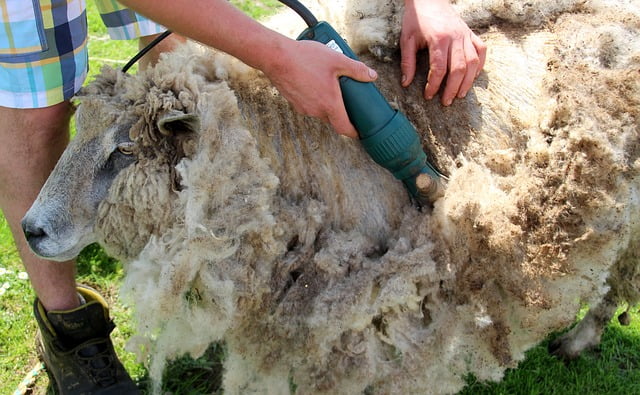
Most sheep are shorn once a year with an electric handpiece, the fleece coming off in one piece. Australia’s growers sheared 253.9 million kilograms of greasy wool in 2025/26, an average 4.29 kg a head (AWI). The fleece is skirted, its stained and short edges pulled away, and classed into lines of similar fineness, length and colour, so that a buyer gets an even lot. A few primitive breeds, such as the Soay, shed their fleece and are plucked rather than shorn (breeds).
Scouring, and lanolin
Scouring washes the greasy wool in warm water and detergent through a train of bowls, then rinses and dries it, removing the wool wax, suint and dirt (Woolmark). The wax is spun out of the scour liquor in centrifuges and refined into lanolin: “LANOLIN IS refined wool grease which is a by-product of the wool-scouring industry”, and “Chemically, lanolin is not a fat but a wax” (Malmstrom, 1948). Lanolin goes into ointments and cosmetics, and the US Food and Drug Administration lists it as a skin protectant at 12.5 to 50% (21 CFR 347.10).

Carbonising
Where burrs and seeds are too many to card out, the clean wool is carbonised: soaked in dilute sulphuric acid, baked so the plant matter chars, then crushed and dusted. It works because the acid destroys cellulose and leaves wool, as above. Woolmark’s threshold is vegetable matter above 5% of the wool’s weight.
Carding and combing: woollen and worsted
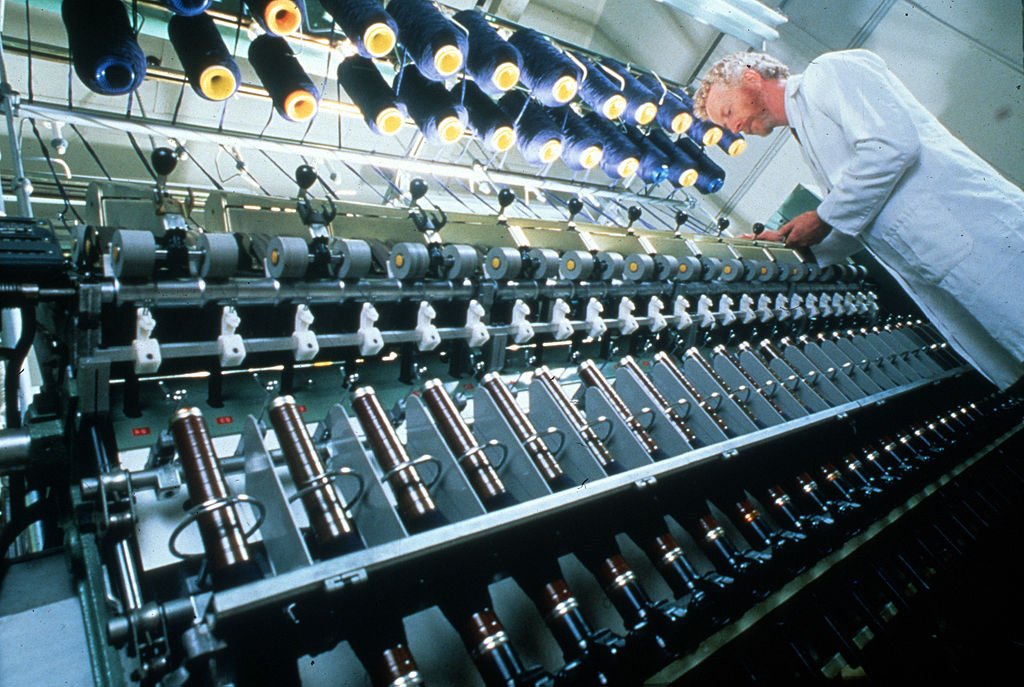
Here wool divides into two systems. “Woollen yarn is usually created from the shorter fibres of the sheep’s fleece. These wool fibres vary more in diameter and length. Woollen yarn is used to make thick, heavyweight woven or knitted garments.” Worsted yarn “mainly uses the highest quality fleece wool… the longest wool fibres”, “used to make flatter, lighter and smoother fabrics such as those used for traditional tailoring” (Woolmark).
- Woollen: the wool is carded, its fibres opened and mixed in every direction, and spun with little drafting into a soft, hairy, bulky yarn for tweed, flannel, blankets and chunky knitwear.
- Worsted: the carded sliver is gilled to straighten it and combed, which takes out the short fibres (the noils) and lays the long ones parallel in a rope called a top. “Top-making is unique to the worsted system of wool manufacturing, and is not carried out in the woollen system” (Woolmark). The top is drafted and ring spun into a smooth, strong yarn for suiting, gabardine and fine knitwear.
Dyeing, weaving and finishing
Wool can be dyed at any stage: as loose fibre (stock-dyed, the origin of “dyed in the wool”), as top, as yarn, or as woven or knitted fabric (piece-dyed). Woollen cloth is usually fulled, or milled: worked wet and warm so that it felts slightly, tightens and thickens. Fabric is then set in steam so that it keeps its size and shape, and garments are steam-pressed into their creases and pleats. The types of fabric page lists the wool cloths by name: flannel, gabardine, serge, tweed, baize and felt among them.
Buying wool by weight: regain and invoice weight
Because wool holds so much water, its weight on the scale changes with the weather, and it is never invoiced as weighed. It is sold at a commercial weight: the oven-dry mass plus an agreed allowance for moisture. Which allowance is agreed matters. The commercial regain in India’s IS 13157 (from the 1985 ASTM table) is 13.6% for wool, while the EU’s agreed allowances, used for declaring fibre content, are 17.00% for carded and 18.25% for combed wool (Regulation 1007/2011, Annex IX). India sets out the calculation in IS 4902, and ASTM in ASTM D2118.
Worked example: invoicing a wool and polyester yarn. Take 1,000 kg of 55/45 wool and polyester worsted yarn that a laboratory finds holding 10% moisture on its dry weight (an assumed figure). Its oven-dry mass is 909.09 kg. With the EU allowances, 18.25% for combed wool and 1.50% for polyester, the blend’s allowance is 10.71%, and the blend invoice weight calculator gives a commercial weight of 1,006.48 kg. With the commercial regains of IS 13157, 13.6% and 0.4%, the allowance is 7.66% and the same lot invoices at 978.73 kg. The yarn has not changed; the contract’s choice of table moves 27.75 kg, 2.8% of the invoiced weight.
Where wool is grown, and how much
Shearing yielded an estimated 1,695,974 tonnes of greasy wool worldwide in 2024, from a stock of 1.36 billion sheep (FAOSTAT, estimates). Scoured, that comes to roughly a million tonnes of clean wool. The IWTO estimates that clean production fell 7% between 2023 and 2025, and by 13% in the main southern-hemisphere exporters (IWTO, Market Information 2026).
| Country | Greasy wool, 2024, tonnes | Share of world |
|---|---|---|
| China | 364,481 | 21.5% |
| Australia | 281,000 | 16.6% |
| New Zealand | 124,951 | 7.4% |
| Türkiye | 84,270 | 5.0% |
| United Kingdom | 68,520 | 4.0% |
| Morocco | 62,899 | 3.7% |
| India | 33,690 | 2.0% |
| World | 1,695,974 | 100% |
Tonnage is not value. China shears the most wool, but the fine Merino wool that sets world prices comes mainly from Australia. Its 2025/26 clip of 253.9 million kilograms greasy was 9.4% below the season before, and AWI forecasts 249.3 million for 2026/27. On the IMF’s monthly benchmarks, fine wool fetched 1,600.70 US cents a kilogram in July 2026 and coarse wool 1,483.99; the site keeps both series back to 1992 (fine, coarse), and the gap between them is the gap between a worsted spinner’s raw material and a carpet maker’s.
Wool in India
India produced an estimated 34.57 million kg of wool in 2024-25, 2.63% more than the year before. “The Major contribution in the total Wool production comes from Rajasthan with a share of 47.85% followed by Jammu & Kashmir (22.88%), Gujarat (6.22%), Maharashtra (4.75%) and Himachal Pradesh (4.30%)” (Basic Animal Husbandry Statistics 2025, via PIB). FAOSTAT’s 33,690 tonnes for 2024 is close.
Most of it is carpet wool. The Ministry of Textiles says “The quality of Indian wool is generally coarse, limiting its use to carpets and blankets, while fine apparel-grade wool continues to be imported” (National Fibre Mission concept note, February 2026). India imported 74.03 million kg of raw wool, worth ₹1,330.01 crore, in April to November 2025, more than twice its own clip in eight months; the main suppliers are Australia, New Zealand, Turkey, Syria and China (Ministry of Textiles, Annual Report 2025-26).
Panipat, in Haryana, is the centre of India’s other wool supply: discarded woollens torn back into fibre, the old shoddy trade (de Bercegol, Métropolitiques). The Ministry of Textiles now calls it “India’s textile waste processing hub” (Mapping of Textile Waste Value Chain in India, 2026). The finest fibre India grows is not sheep’s wool at all but pashmina, the cashmere of the Himalayan goats; the Bureau of Indian Standards’ wool methods include IS 1349, IS 6124 and IS 4902.
Mulesing and the Responsible Wool Standard
“Mulesing is a surgical procedure during which the skin around the breech and tail area of Merino sheep is removed. It is usually carried out on young sheep before they reach six months of age” (ANZCCART, University of Adelaide). It is done to stop flystrike, in which blowflies lay eggs in the soiled wrinkles of the breech, and it is the most argued-over practice in wool. New Zealand banned it from 1 October 2018: “A person must not, by any method, remove the breech, tail skin folds, or tail skin wrinkles of a sheep”, with fines of up to NZ$5,000 for a person and NZ$25,000 for a company (Animal Welfare (Care and Procedures) Regulations 2018, regulation 59).
Buyers who want to exclude it can source wool certified to the Responsible Wool Standard, Textile Exchange’s farm-to-product standard, which “is globally applicable to all breeds of sheep, and mulesing is strictly prohibited” (RWS Quick Guide). Wool sold as non-mulesed but not certified rests on the grower’s declaration.
Wool on the label: virgin, recycled and blends
- Virgin wool or fleece wool (EU). Only wool “which has not previously been incorporated in a finished product, which has not been subjected to any spinning and/or felting processes other than those required in the manufacture of that product, and which has not been damaged by treatment or use”. In a blend, all the wool must qualify and must be at least 25% of the weight, and stray fibres may not exceed 0.3% (Regulation 1007/2011, Article 8).
- Recycled wool (US). Fibre reclaimed either from wool products never used by a consumer, or from products “after having been used in any way by the ultimate consumer” (15 U.S.C. 68(c)). The site’s piece on recycled Italian wool follows one maker’s process.
- Blends. Fibre content is declared by weight at the agreed allowances, and checked by dissolving one fibre out of the blend: the wool with hypochlorite, for instance, to ISO 1833-4.
Is wool sustainable?
Wool grows back each year and it rots. Woolmark, citing a 2023 soil-burial study, says “100% Merino wool fabrics can biodegrade by 95% after 15 weeks of burial in soil, but the rate varies with soil, climate and wool characteristics” (Woolmark); the IWTO puts it at “almost completely degraded after six months in the ground” under ideal conditions (IWTO). Old wool is also torn back into fibre and spun again, the shoddy trade that centres in India on Panipat.
Against that: sheep are grazing animals with a land and methane footprint, scouring produces a heavy effluent, chlorine shrink-proofing adds AOX to wastewater, and mulesing is a welfare cost where it is still practised. A fibre’s footprint also depends on everything done to it after the farm. The site’s carbon footprint calculator adds up the stages, and wool’s use as building insulation has its own standard, ISO 17749.
Sheep breeds and the wool they grow
Breed sets the wool. The 23 British breeds below run from the Southdown, at 29 to 30.5 µm one of the finest wools in the British clip, to the Greyface Dartmoor at 40 to 42 µm, and from 4 cm staples to locks 30 cm long. British Wool now files them in groups: Fine (mostly the Down breeds), Medium, Lustre (the longwools), Hill, Mountain, Cross and Naturally Coloured.
| Breed | British Wool group | Diameter, microns | Staple, cm | Fleece, kg | What marks it out |
|---|---|---|---|---|---|
| Southdown | Fine | 29–30.5 | 4–6 | 1.5–2 | From the Sussex Downs, and the foundation of the Down breeds; among the finest wool in the British clip |
| Dorset Down | Fine | 30–32 | 5–8 | 2.25–3 | Bred from Southdown rams on Hampshire, Wiltshire and Berkshire ewes |
| Oxford Down | Fine | 31.5–33.5 | 6–10 | 2.5–3.5 | The largest Down breed, from the 1830s: Cotswold rams on Hampshire Down and Southdown ewes |
| Portland | Fine | 31–35 | 5–9 | 1.5–2.25 | Lambs are born foxy red; the wool turns white or grey |
| Shropshire | Fine | 31–33 | 6–10 | 2–3 | Its breed society, founded in 1882, is the oldest in the UK |
| Llanwenog | Medium | 31.5–34 | 6–10 | 2–2.5 | West Wales, late 19th century, from the Shropshire and an extinct local black-faced breed |
| Cotswold | Lustre | 35–38 | 15–25 | 4–7 | Prized in the Middle Ages, when its wool was exported and the “wool churches” were built |
| Greyface Dartmoor | Lustre | 40–42 | 15–20 | 5.5–8 | A long, curly, heavy and lustrous fleece; the Rare Breeds Survival Trust says one can weigh up to 12 kg |
| Leicester Longwool | Lustre | 35–38 | 20–25 | 5–7 | Developed by Robert Bakewell in the 18th century; it shaped most British longwools |
| Lincoln Longwool | Lustre | 35–38 | 15–30 | 5–8 | Described by the Rare Breeds Survival Trust as having the heaviest and longest wool of any British breed |
| Teeswater | Lustre | 32.5–34 | 15–30 | 3–6 | Long, curly, lustrous locks with a soft handle; the sire of the Masham crossbred |
| Wensleydale | Lustre | 32.5–34 | 15–30 | 3.5–7 | Blue skin on the head, ears and legs; descended from the ram Bluecap, born in 1839 of a Leicester and Teeswater cross |
| Hill Radnor | Hill | 31.5–33 | 8–14 | 1.5–2 | Tan face and legs; a dense, springy fleece that can carry kemp |
| Kerry Hill | Hill | 31.5–33 | 6–12 | 2–3 | Named after Kerry, near Newtown in Powys; black and white patches on the face and legs |
| Whitefaced Woodland | Hill | 32–33 | 10–15 | 2–3 | Once called the Penistone, after the Yorkshire town where it was traded |
| Shetland, white | Hill | 30–31 | 5–10 | 1–1.5 | Very fine, soft wool |
| Shetland, coloured | Naturally coloured | 30–31.5 | 6–12 | 1–2 | Moorit (brown), shaela (dark grey), fawn, grey and black |
| Balwen | Naturally coloured | 33 and over | 5–10 | 1.25–1.75 | Black or dark brown with a white blaze, white feet and a half-white tail |
| Castlemilk Moorit | Naturally coloured | 30–31.5* | 6–12* | 1–2* | Bred in the early 1900s at Castlemilk, Dumfriesshire, from Shetland moorit ewes and Manx Loaghtan and mouflon rams |
| Hebridean | Naturally coloured | 35 and over | 5–15 | 1.25–2.25 | Black, greying with age; two or four horns |
| Manx Loaghtan | Naturally coloured | 30–31.5* | 6–12* | 1.5–2 | Loaghtan is Manx for “mouse brown”; usually four horns, sometimes six |
| North Ronaldsay | Naturally coloured | 32–35 | 4–8 | 1.5–2.5 | Kept on the Orkney shore by a dyke built about 1832, and grazes seaweed for most of the year |
| Soay | Naturally coloured | 9 to 48 in one fleece* | 5–15* | 1.5–2.25* | From St Kilda; it sheds its fleece, which is plucked (“rooed”) rather than shorn |
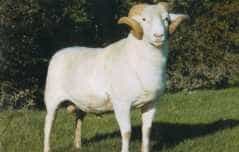
| Wiltshire Horn | Not graded | – | – | – | A short fleece that falls each spring and leaves a hair coat, so it is never shorn |
| Australian clip, mostly Merino (for comparison) | – | 20.5 average | 8.7 average | 4.29 average, greasy | Woolmark puts Merino wool generally below 22 µm, and says Australia grows 81% of the world’s superfine wool |
Sources for the table: fibre diameter, staple length, fleece weight and groups, British Wool’s breed sheets (Meet our sheep); the identity notes, the same sheets and the Rare Breeds Survival Trust‘s breed pages; Wensleydale, the Wensleydale Longwool Sheep Breeders’ Association; North Ronaldsay, Historic Environment Scotland; Soay, the Soay and Boreray Sheep Society; Wiltshire Horn, the Wiltshire Horn Sheep Society; Australian clip, AWI’s production forecast of August 2026 for the 2025/26 season (all breeds) and Woolmark, What is Merino wool?
* British Wool’s sheets give Castlemilk Moorit, Soay and coloured Shetland the same figures line for line, and Manx Loaghtan the same except for weight, which looks like a template carried over. The Rare Breeds Survival Trust gives Castlemilk Moorit a staple of 4–7 cm and Manx Loaghtan 8–13 cm. The Soay row uses the Soay and Boreray Sheep Society’s staple and fibre range and the Trust’s fleece weight.
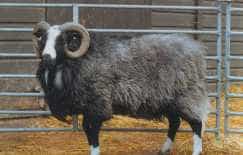
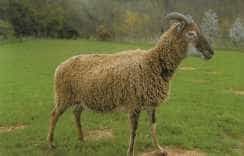
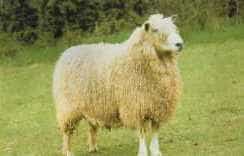
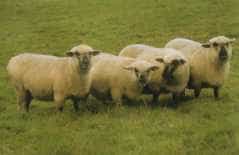
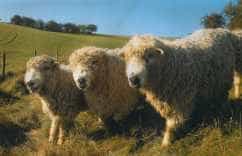
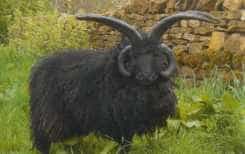
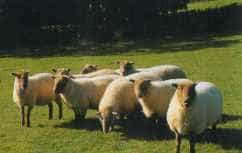
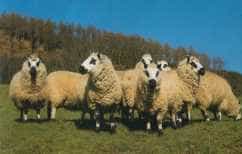
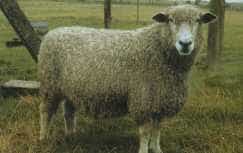
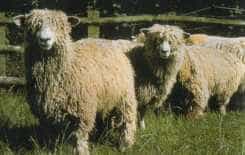
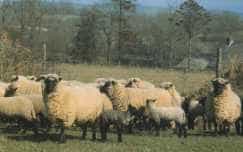
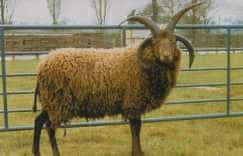
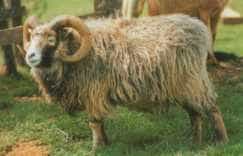
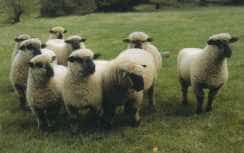
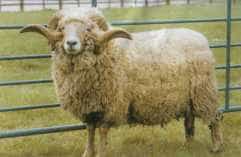
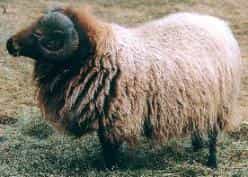
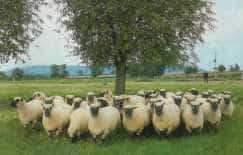
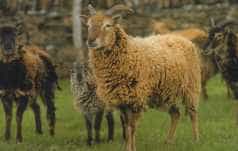
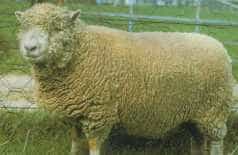
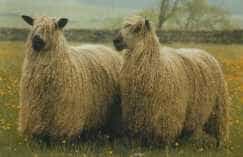
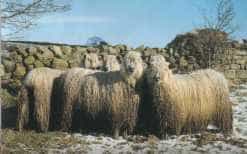
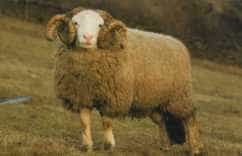
Wool still sits at the centre of Parliament. “The Woolsack is the seat of the Lord Speaker in the House of Lords. It is a large square cushion of wool covered in red cloth and is stuffed with wool brought from around the Commonwealth”; it was restuffed in 1938 with wool from England, Wales, Scotland, Northern Ireland and the Commonwealth (UK Parliament). And the Cotswolds’ medieval “wool churches” were built on the export trade in Cotswold fleece (British Wool).
Other animal fibres
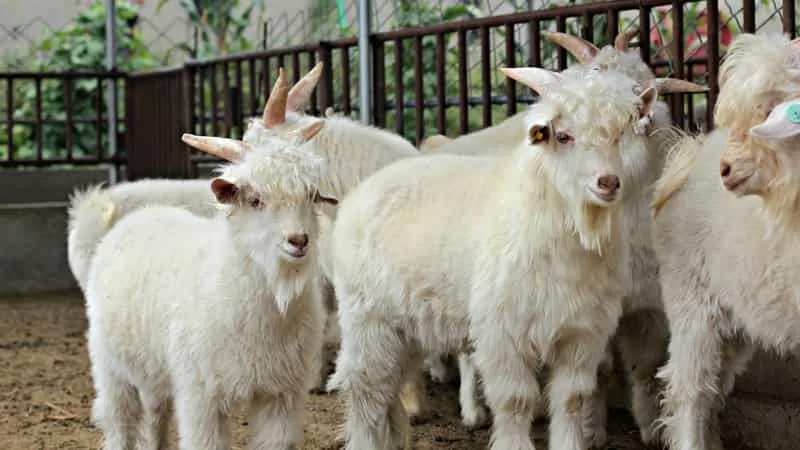
- Goats: cashmere and pashmina, mohair from the Angora goat, and cashgora, their cross.
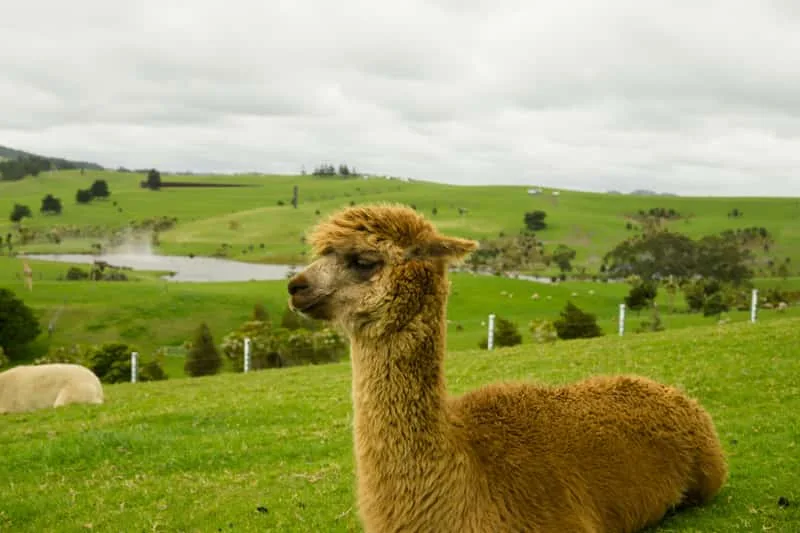
- Camelids: alpaca and suri alpaca, llama, guanaco, vicuña and camel.
- Others: angora from the Angora rabbit, yak, qiviut from the musk ox, and bison.
- Overviews: natural protein fibres, hair fibres in textile manufacturing and a comparison of protein fibres.
Uses of wool
- Clothing: worsted suiting and trousers, knitwear (see types of sweater), coats, socks and, in fine Merino, base layers and sportswear.
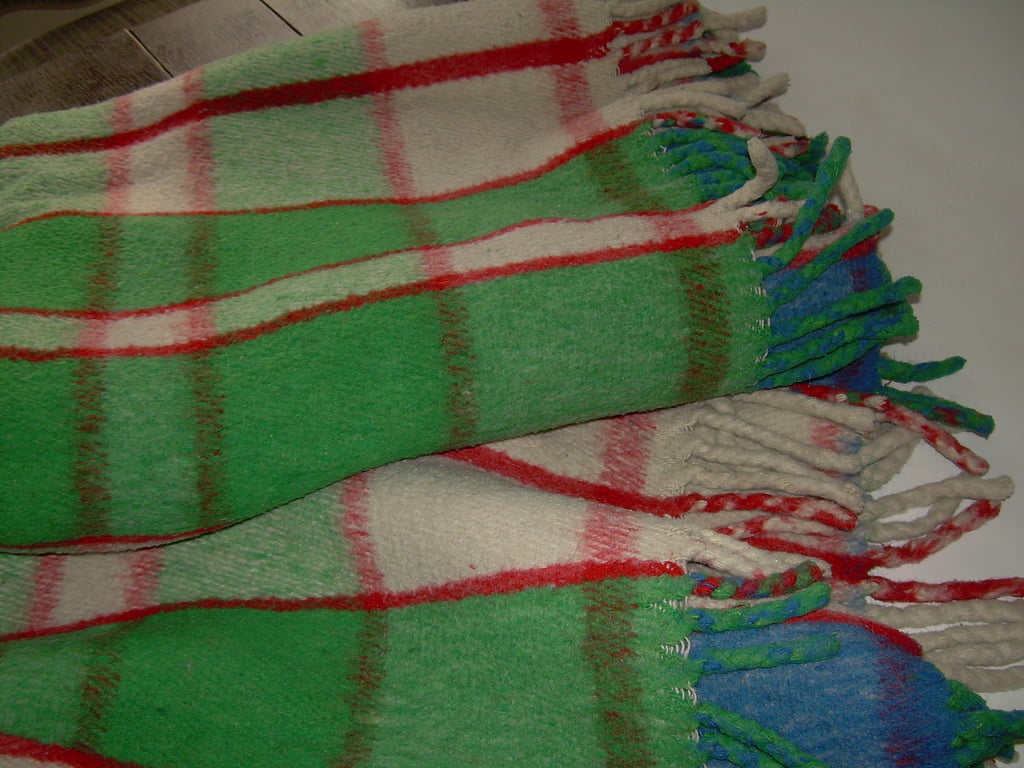
- Home: carpets and rugs, the main use of coarse wool, including hand-knotted pile carpets to ISO 11859; blankets, upholstery and bedding fill.
- Felt: hats, piano hammers, pads and craft felt.
- Technical: building insulation (ISO 17749), fire-resistant upholstery and protective wear, and the blue wool references used to rate light fastness.
Wool in the language
A spinster was first “woman who spins, female spinner of thread”, recorded from the late 14th century; because unmarried women were expected to spin, the word became “the legal designation in England of all unmarried women” from the 1600s to the early 1900s (Online Etymology Dictionary). “Dyed in the wool” comes from stock dyeing, colour put into the fibre before it is spun and so fixed for good. One story that does not hold: Babylon does not mean “land of wool”; the name means “the gate of the gods” (Online Etymology Dictionary).
Related on this site
- Grading of wool, and the distribution of grade or fibre diameter.
- The role of crimp in wool spinning.
- Wool grades for fire-resistant textiles.
- Microscopic appearance of fibres and fibre identification tests.
- Types of fabric, and the list of textile fibres.
Sources and corrections
Every figure on this page was read at its source on 6 October 2026. Where sources disagree, both values are given. Industry bodies’ claims are attributed to them.
- Definitions and labelling: Regulation (EU) No 1007/2011 on textile fibre names, Articles 7 and 8, Annexes I, III and VIII, and its consolidated text of 15 February 2018, Annex IX; United States Code, 15 U.S.C. 68.
- Structure, chemistry and microscopy: The Woolmark Company, What is the wool fibre?; N. H. Leon, Structural aspects of keratin fibres, Journal of the Society of Cosmetic Chemists 23, 1972; M. A. Chaudri, M. A. Khan and A. Khaliq, Pakistan Journal of Scientific and Industrial Research 12, 1970; A. K. van der Vegt, A study on the mechanism of wool felting, TNO, 1955; P. J. Reis and colleagues, Australian Journal of Biological Sciences 20, 1967; S. Hatcher, Fibre medullation, micron, marketing and management, NSW Agriculture; Wang and colleagues, Deakin University, diameter profiles of single wool fibres; Canadian Conservation Institute, CCI Notes 13/18; ASTM International, ASTM D276; M. Harris and A. L. Smith, Journal of Research of the National Bureau of Standards 17, 1936.
- Properties: E. Menkart, L. J. Wolfram and I. Mao, Journal of the Society of Cosmetic Chemists 17, 769 to 787, 1966, a comparison of wool and human hair; Bureau of Indian Standards, IS 13157:1991; M. Zimniewska and A. Kicińska-Jakubowska, animal fibres sheet, Discover Natural Fibres Initiative; I. P. Beckman and colleagues, Polymers 13, 2231, 2021; Khan and Khan, Pakistan Journal of Scientific and Industrial Research 13, 1970; IWTO, Wool and Fire and Wool and Skin; P. Bajaj, Bulletin of Materials Science 15, 1992; P. Kakar, A. Singh and J. Sheikh, Indian Journal of Fibre and Textile Research 48, 2023; Woolmark, Wool is naturally breathable and Wool is naturally odour resistant.
- Comfort and skin: A. Zallmann and colleagues, Debunking the myth of wool allergy, Acta Dermato-Venereologica 97, 2017; Montana State University Wool Lab, OFDA testing.
- Grading: New Mexico State University, Understanding Wool Grades, Guide B-409; A. W. Beattie, Queensland Journal of Agricultural Science 19, 1962; South Dakota State University Extension, Wool Evaluation 101.
- Processing: Woolmark, Wool processing, worsted top-making, machine washable wool and specification AF-1; European Commission, LIFE05 ENV/D/000195; W. Malmstrom, Technological aspects of lanolin, Journal of the Society of Cosmetic Chemists 1, 1948; 21 CFR 347.10.
- Production, trade and prices: FAOSTAT, crops and livestock products, 2024; IWTO, Market Information, edition 20, 2026; Australian Wool Innovation, Australian wool production forecast, August 2026; Woolmark, What is Merino wool?; Textile Exchange, Materials Market Report 2025, as summarised by the EU Transition Pathways platform; IMF primary commodity prices via FRED, PWOOLFUSDM, PWOOLCUSDM and PCOTTINDUSDM.
- India: Press Information Bureau, Basic Animal Husbandry Statistics 2025, 26 November 2025; Ministry of Textiles, National Fibre Mission concept note, Annual Report 2025-26 and Mapping of Textile Waste Value Chain in India; R. de Bercegol, Métropolitiques.
- Welfare and environment: ANZCCART, Mulesing of sheep; New Zealand, Animal Welfare (Care and Procedures) Regulations 2018; Textile Exchange, RWS Quick Guide; Woolmark, Wool is biodegradable; IWTO, Wool is biodegradable.
- Moths: M. F. Potter, Clothes moths, University of Kentucky ENTFACT-609; A. Vilcinskas and colleagues, Microorganisms 8, 1415, 2020.
- Breeds: British Wool, breed sheets; Rare Breeds Survival Trust, breed pages; Wensleydale Longwool Sheep Breeders’ Association, breed history and breed standard; Soay and Boreray Sheep Society, Soay sheep; Wiltshire Horn Sheep Society, the breed; Historic Environment Scotland, listing LB46400; UK Parliament, Woolsack.
- Words: Online Etymology Dictionary, spinster and Babylon.
Change log. 6 October 2026: rewritten in full, with three other overviews of wool on this site folded in. Corrected from the earlier versions: wool is weaker than silk, not stronger; it takes up about a third of its weight in water vapour at saturation, not “almost double its own weight” or “up to 50%”; fine Merino has about 20 crimps to the inch, not 30; the woolsack is the Lord Speaker’s seat, stuffed since 1938 with wool from across the Commonwealth, not the Lord Chancellor’s with Cotswold wool; the Wiltshire Horn grows a short fleece that it sheds, rather than no wool; Babylon does not mean “land of wool”; shearing is not “sheering”; and wool is not mercerised. Removed: a usage breakdown whose shares could not be traced and did not add up, repeated bullet points, and a claim that wool “even self-extinguishes”, which the IWTO words more carefully.
Found an error? Please tell us through the contact page, naming the section and the source that disagrees.

really helped
thx 🙂