
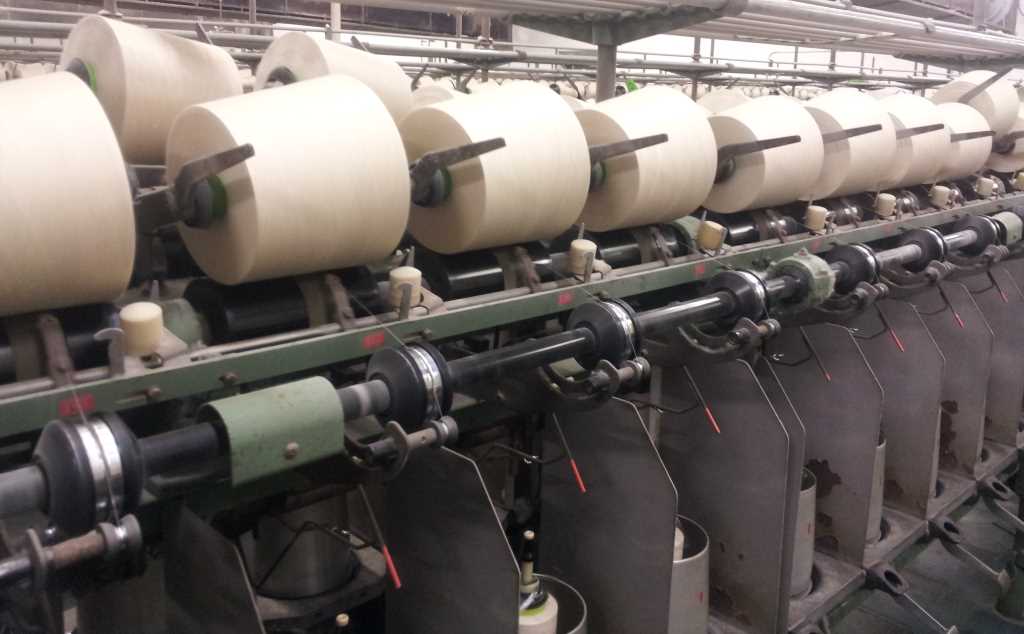
Two-For-One (TFO) is a two-stage process where the yarns are doubled and then twisted. In TFO process two or more single yarns are twisted in order to enhance the properties of the end-products such as strengthening the yarns.
Generally, the wax is applied to yarns before the first twisting stage in order to reduce the friction on yarns.
Objectives of doubling
- To increase the strength of the yarn
- To increase smoothness, evenness, lusture, uniformity, and compactness of yarn.
- To obtain the better deposition of a twist.
Doubling Applications
- Jeans sewing thread
- Type Cord
- Cable yarn
- Cutting yarn
Types of Doubling
-
Ring Doubling
The difference of ring doubling from the ring is:
- No drafting
- Creel in a system is different & creel contains yarn(No rove)
- Roller combination is different
Doubling Yarn is designated as follows:
Ends up with 40 Count 2/40 Ends up with 10 Count 3/10 Two For One twister (TFO)
Here yarn is transferred to a cone, then two ends yarns are combined (Doubled) and wound on a cone without twisting. Then the yarn is supplied to twister machine where the twist is applied in such a way that one revolution of rotating disc inserts two round of twist. The twisted yarn is then wound on a cone.
Qualities of Single yarn to get best-Doubled yarn
- The elongation of the yarn under lea strength tension should be uniform of the same count.
- The twist should be uniform throughout
- The breaking strength of yarn should not vary too much
- 4% tolerance on either side should be allowed.
The formula for Double Yarn Count
Single yarn of the same count
2 thoughts on “Yarn Doubling – types, objectives, and application”
Leave a Comment






How to double spun with polyester yarn
Good job