
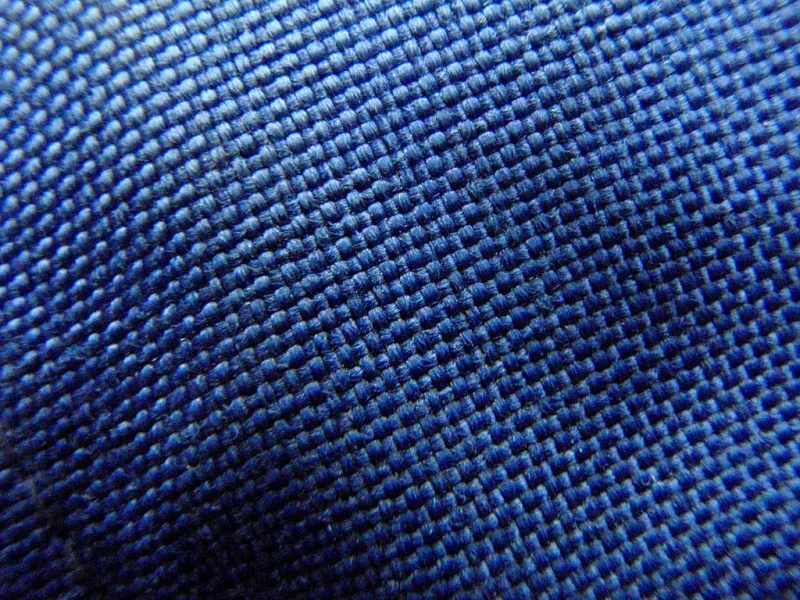
Nylon is a synthetic fibre, a plastic melted and spun into filaments, and its chemical name is polyamide: the two words name the same fibre in the EU’s textile rules and in the international list of fibre names. Almost all textile nylon is one of two polymers, nylon 6, made from caprolactam, and nylon 6,6, made from hexamethylenediamine and adipic acid, all of them made from oil and gas. Nylon is strong, elastic, hard-wearing and light, takes up more water than polyester but far less than cotton, and melts rather than burns away, at about 220 °C for nylon 6 and 260 °C for nylon 6,6. It is the second most used synthetic fibre: 7.0 million tonnes in 2024, about 5% of all fibre made, according to Textile Exchange.
The questions readers ask come first, then the engineering, with every figure sourced. Three of the site’s calculators are worked through, each with a link that opens the tool with the same figures entered. Where a number could not be confirmed at a primary source, this page leaves it out and says so at the end.
Last verified: 14 November 2026. Sources are linked where they are used and listed at the end.
Is nylon natural or synthetic?
Synthetic. Nylon is made entirely in a chemical plant, and the law defines it by its chemistry. The EU’s textile-names regulation lists it as “polyamide or nylon”: a “fibre formed from synthetic linear macromolecules having in the chain recurring amide linkages of which at least 85 % are joined to aliphatic or cycloaliphatic units” (Regulation (EU) No 1007/2011, Annex I, No 30). The US rule, 16 CFR 303.7(i), calls it a manufactured fibre of “a long-chain synthetic polyamide in which less than 85 percent of the amide linkages are attached directly to two aromatic rings”. The international list of generic fibre names, ISO 2076, gives “polyamide or nylon”, code PA.
Three practical consequences follow. Nylon is a thermoplastic, so it softens and melts under heat instead of charring, which is the basis of the burn test and the reason a hot iron can glaze it. It can be remelted, and nylon 6 can be broken back down to its starting chemical and made again (recycling). And because it is a plastic, nylon garments shed microfibres in the wash, though one study measured far less from nylon than from polyester (environment section).
Nylon and polyamide: are they the same?
Yes, for textiles. “Polyamide” is the chemical family, polymers held together by amide links, and “nylon” is the name the fibre was launched under. A European care label usually says “polyamide”, a US label “nylon”; both are correct, and both laws accept the other’s word. A brand such as Tactel is a trademark for a nylon yarn, not a fibre name, and cannot replace “nylon” or “polyamide” on a label.
One branch of the polyamide family is a different fibre in law. When at least 85% of the amide links join two aromatic rings, the fibre is an aramid (EU Annex I, No 31; US 303.7(s)), the family of heat- and cut-resistant fibres such as Kevlar and Nomex. They are covered on the aramid page; everything below is about the ordinary, aliphatic nylons.
The name itself means nothing chemical. DuPont chose it as a generic word and decided not to register it as a trademark; an early candidate, “Nuron”, spelled “no run” backwards, and trademark conflicts turned it into “Nilon” and then “nylon” (Science History Institute). The story that it joins “New York” and “London” is a popular misreading; a historian of chemistry writing in the Journal of Chemical Education found the name “totally devoid of both chemical and historical significance” (Jensen, 2005).
Nylon 6 vs nylon 6,6
The numbers count carbon atoms in the starting chemicals. Nylon 6 is made from one chemical, caprolactam, which has six carbon atoms. Nylon 6,6 (also written 66 or 6.6) is made from two, each with six carbon atoms: hexamethylenediamine and adipic acid. The two fibres look and behave much alike in a garment. The differences that matter are heat, processing and recycling.
| Nylon 6 (PA6) | Nylon 6,6 (PA66) | |
|---|---|---|
| Made from | Caprolactam, by opening its ring | Hexamethylenediamine and adipic acid, via “nylon salt” |
| First made | 1938, Paul Schlack, Germany; sold as Perlon | 28 February 1935, Wallace Carothers’s group at DuPont |
| Melting point, BASF Ultramid resin | 220 °C | 260 °C |
| Melting point, spun fibre, measured by DSC | 223 °C | 263 °C |
| Glass transition, dry | About 50 to 75 °C (review) | 58 °C; 24 °C after conditioning at 23 °C and 50% humidity |
| Density, resin | 1.13 g/cm³ | 1.13 g/cm³ |
| Melt-spinning temperature, one DuPont process | 275 °C | 285 to 295 °C |
| Chemical recycling | Broken back down to caprolactam on an industrial scale | Gives two monomers; Toray reported recovering both in 2024 work |
| Typical heavy-duty use | High-tenacity industrial yarn | Airbags and tyre cord |
The 40 °C gap in melting point is the practical difference. Nylon 6,6 holds its shape at higher temperatures, which is why it is the usual polymer for airbag and tyre-cord yarn (Asahi Kasei, 2018). Nylon 6 melts lower and is easier to process. Resin melting points are from BASF’s Ultramid brochure (Ultramid B is PA6, Ultramid A is PA66); fibre values are from differential scanning calorimetry of lab-spun fibres (Liu et al., 2018; Wu et al., 2023). Some references give nylon 6,6 a melting point of 250 °C and nylon 6 210 to 217 °C; the measured values above are higher, and a page that gives one number for “nylon” is usually mixing the two.
Is nylon breathable? Does it absorb water?
Breathability depends far more on the fabric than on the fibre: a fine open nylon knit breathes, a dense coated nylon taffeta, as used in rainwear, barely does. As a fibre, nylon takes up a moderate amount of water, more than polyester and much less than cotton. The EU’s agreed allowances for fibre-content calculations put the gap in numbers: polyamide 5.75% for filament and 6.25% for staple fibre, against 1.50% for polyester and 8.50% for cotton (Regulation 1007/2011, Annex IX). Those are conventional figures for invoicing and analysis, not measurements of a particular yarn; regain itself is measured in the standard atmosphere of ISO 139, and the moisture regain calculator turns a weighing into regain.
The water that nylon takes up changes it. In a study of nylon 6,6, the glass transition, the temperature at which the polymer turns from stiff to rubbery, fell from 58 °C dry to 24 °C once the material had absorbed about 3% water at 23 °C and 50% humidity (Wetzel et al., 2023, on moulding-grade PA66). That is why damp nylon feels softer and why nylon loses some stiffness in humid conditions. Nylon still dries quickly, because the fibre holds little water compared with cotton.
Does nylon shrink or melt?
Nylon melts; it does not burn away like cotton. It melts at about 220 °C (nylon 6) or 260 °C (nylon 6,6), and it softens well below that, so a hot iron, a tumble dryer on high or a spark can glaze or hole it. The care-label system sets the iron for polyamide at one dot: GINETEX, the international care-labelling association, assigns “polyacryl, polyamide (nylon), acetate” to one dot, “maximum sole plate temperature of 120 °C” (GINETEX care symbols, following ISO 3758:2023). Older charts give 110 °C.
Shrinkage comes from heat, not water. Nylon fabric is heat-set in finishing, held at its finished size and heated above any temperature it will meet in use, which fixes its dimensions. Below that temperature the set holds, so nylon does not shrink in a normal wash; heat close to or above it, in a hot dryer or under a hot iron, releases the set and the fabric can shrink or distort. The heat-set time and temperature tool works through the trade between temperature and dwell time.
Nylon vs polyester
The two synthetic fibres overlap in sportswear, swimwear, bags and outerwear. Nylon is lighter and takes up more moisture; polyester is made in ten times the volume, melts at a similar temperature to nylon 6,6, and takes different dyes. The full polyester page is Polyester: what it is, properties and uses.
| Nylon | Polyester | |
|---|---|---|
| Polymer | Polyamide, almost always nylon 6 or 6,6 | Polyethylene terephthalate (PET) |
| World production, 2024 | 7.0 million tonnes, about 5% of all fibre | 77.7 million tonnes, about 59% |
| Density | About 1.13 g/cm³, so a lighter fabric for the same bulk | 1.38 g/cm³ |
| Melting point | 220 °C (6) or 260 °C (6,6) | 250 to 260 °C |
| EU moisture allowance | 5.75% filament, 6.25% staple | 1.50% |
| Iron | One dot, up to 120 °C | Two dots, up to 160 °C |
| Dyed with | Mainly acid dyes, at or near the boil | Disperse dyes, at about 130 °C under pressure |
| Microfibres shed in one washing study | 27 mg per kg of fabric per wash | 161 mg per kg per wash |
For sunlight, a 2026 review of polyamide fibres notes that “polyamide fibers are particularly susceptible to ultraviolet radiation” and that “prolonged UV exposure may lead to a substantial reduction in tensile strength” (Zahorska et al., Polymers). That matters for awnings, ropes and boat covers left outdoors, where stabilised grades or polyester are chosen; the UPF predictor and the blue wool lightfastness tool cover the fabric side.
How to wash and care for nylon
- Washing. Follow the garment’s own label: nylon is often blended with elastane, whose limits usually set the temperature. The figure in the wash-tub symbol is a maximum.
- Drying. Nylon dries quickly. Line-dry it out of strong sun, or tumble-dry on low if the label allows; high heat can shrink or glaze it, and long exposure to sunlight weakens it.
- Ironing. One dot, a sole plate of no more than 120 °C (GINETEX). Iron on the reverse or through a cloth, and never leave the iron standing on the fabric.
- Whites. White nylon can yellow with heat and age: the 2026 review notes that thermal and oxidative degradation of polyamides “is often accompanied by yellowing”. Avoid hot drying and store whites away from light.
Pros and cons of nylon
| Advantages | Disadvantages |
|---|---|
| Strong for its weight: apparel filament of about 6 g/den, industrial yarn over 8 g/den | Melts at 220 to 260 °C; glazes under a hot iron |
| Light: density about 1.13 g/cm³ | Weakened and yellowed by long exposure to sunlight |
| Elastic and hard-wearing; used for hosiery, carpets and bags | Made from oil and gas; adipic acid for nylon 6,6 releases nitrous oxide unless abated |
| Takes up more moisture than polyester: EU allowance 5.75 to 6.25%, against 1.50% | Softens when damp: its glass transition falls with absorbed water |
| Takes acid dyes at or below the boil; polyester needs about 130 °C | Does not biodegrade; sheds microfibres, though less than polyester in one study |
Properties of nylon fibre
Producer data sheets describe particular grades, and the figures below are quoted as such. Where nylon 6 and 6,6 differ, both are given.
| Property | Value | Source |
|---|---|---|
| Melting point | PA6 220 °C, PA66 260 °C (resin); 223 and 263 °C (spun fibre, DSC) | BASF Ultramid; Liu 2018; Wu 2023 |
| Glass transition | PA66 58 °C dry, 24 °C at about 3% water; PA6 about 50 to 75 °C dry | Wetzel 2023; Zarbali 2026 (review) |
| Density | 1.13 g/cm³ (PA66 resin, confirmed by buoyancy) | Wetzel 2023 |
| Apparel filament, nylon 6 FDY | Tenacity 5.8 to 6.2 g/den; elongation 39 to 44% (20, 40 and 70 denier yarns) | Formosa Chemicals and Fibre |
| High-tenacity nylon 6 industrial yarn | At least 8.0 g/den | Formosa Chemicals and Fibre |
| High-tenacity nylon 6,6 industrial yarn | Airbag types 72 to 84 cN/tex at 19.5 to 24.5% elongation; tyre cap-ply types 86.5 to 87 cN/tex at 19% | INVISTA |
| EU agreed moisture allowance | 5.75% filament; 6.25% staple | Reg. 1007/2011, Annex IX |
| Limiting oxygen index, ASTM D2863 | PA6 fabric 22.1; PA66 fabric 19.5 and 23.1 in two studies; PA6 resin 22 to 23.5 | Liu 2018; Kundu 2022; Wu 2023; Horrocks 2016 |
| Refractive index | 1.57 to 1.59 along the fibre, 1.51 to 1.53 across; birefringence about 0.06 | MicroLab NW |
| Chemicals | Resists alkalis; not resistant to concentrated mineral acids; dissolves in 90% formic acid | BASF Ultramid (resin) |
Tenacity is quoted in grams per denier in the yarn trade and in centinewtons per tex in standards; the two differ by a factor of 8.826. A worked example with the textile unit converter: the 70-denier nylon 6 yarn above, at 6.0 g/den, is about 53 cN/tex. At 7.78 tex (70 denier) that is a breaking force of 4.12 N for the whole yarn, and, at a fibre density of 1.14 g/cm³, a true stress of about 604 MPa. The fabric fields in the link are the tool’s defaults and play no part.
The limiting oxygen index is the oxygen share an atmosphere needs before a sample keeps burning; air is about 21%. Nylon fabrics sit close to that line, so how a fabric is made moves the result, which is why two studies of nylon 6,6 fabric found 19.5 and 23.1. The LOI predictor estimates what a flame-retardant finish adds.
How to identify nylon: burn test, microscope and solvent
Burn test. Nylon melts in a flame rather than burning to ash. FabricLink’s burn-test guide describes the smell as “likened to celery” and the residue as “initially a hard, cream-colored bead that becomes darker” (FabricLink). A hard bead points to a thermoplastic, nylon or polyester, rather than to a natural fibre, which leaves soft ash. Test a snipped thread over a non-flammable dish, away from anything that can catch. More methods are on the fibre identification page.
Microscope. Ordinary nylon is a smooth, uniform rod. A 2026 review describes “smooth, uniform fibers with a consistent diameter”, with a cross-section that is “typically oval or nearly circular” (Zahorska et al.); producers also extrude trilobal and other shapes, which look irregular along the fibre (MicroLab NW). Between crossed polarisers it shows a relatively high birefringence, about 0.06. Pictures of fibres side by side are on the microscopic appearance of fibres page.
Solvent. Formic acid dissolves nylon and leaves cotton, viscose, polyester and acrylic. That is the basis of the standard method for the nylon content of a blend, ISO 1833-7:2017, “Mixtures of polyamide with certain other fibres (method using formic acid)” (ISO). It is not used for blends with more than 25% wool, which go to ISO 1833-4. A declared blend can be checked against its test result with the fibre content tolerance tool.
How nylon is made
Nylon 6,6: from nylon salt
Adipic acid is made from cyclohexane, which is oxidised in air to a mixture of cyclohexanone and cyclohexanol and then “oxidised further by hot nitric acid, using a copper/vanadium catalyst” (Royal Society of Chemistry, Nylon teacher notes). Adipic acid and hexamethylenediamine react in water to form a salt, nylon salt, which fixes the two in exactly equal proportions. Carothers’s patent describes making it: “A salt was prepared from hexamethylenediamine and adipic acid” (US 2,130,948). The salt solution is then heated under pressure in an autoclave, the water is driven off, and the molecules join into long chains.
Nylon 6: from caprolactam
Caprolactam is a ring-shaped molecule. The usual route makes it by a Beckmann rearrangement of cyclohexanone oxime, which yields 1.6 to 4.0 tonnes of ammonium sulphate for every tonne of caprolactam; Sumitomo developed a gas-phase process that avoids it (Chemical Online, 2000). Heated with a little water, the ring opens and the units join into nylon 6. In a continuous VK tube, liquid caprolactam with about 1 to 4% water is polymerised “at temperatures of between 240° C. and 270° C. in 15 to 30 hours” (US 6,916,901).
The reaction does not run to completion. At equilibrium at 270 °C about 10% of the mass is still caprolactam and short cyclic chains, removed “by aqueous extraction or by vacuum delactamization” before spinning (same patent; a second, from DSM, gives “in the order of 10 weight % of monomer” removed by leaching with water, US 6,566,487). The polymer chips are dried before spinning; the polymer drying calculator sizes the drying hopper.
Melt spinning and drawing
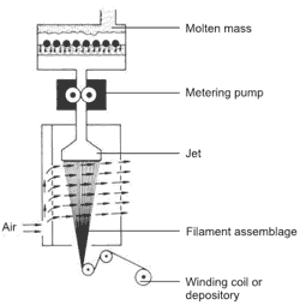
Nylon is melt-spun like polyester. The molten polymer is metered through a spinneret with fine holes, the filaments are cooled in a stream of air, and they are wound up. In one DuPont process nylon 6,6 is extruded at “about 285° to 295° C” and nylon 6 at 275 °C; older high-speed spinning ran at about 3,000 m/min, and the patent’s own process at 4,500 m/min or more (US 5,137,666). Those are one company’s examples, not a general range.
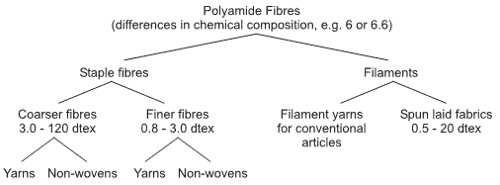
The freshly spun filaments have their molecules lying in all directions. They are drawn, stretched so that the molecules line up along the fibre, which gives nylon its strength and elasticity. Drawn filament is wound as yarn, textured for bulk and stretch, or crimped and cut into staple fibre for spinning and nonwovens. The spinneret arithmetic, filament denier from throughput and speed, is in the filament throughput calculator, and texturing output in the DTY texturing calculator.
Dyeing nylon
Nylon is usually dyed with acid dyes, which polyester cannot take. Each nylon chain ends in an amino group, and in an acid bath those groups carry a positive charge that holds the negatively charged dye: “The lower the pH of the liquor, the more amino end-groups are protonized. Anionic dyes mainly color these groups” (DyStar polyamide brochure; also Textile World, 2000). The number of end groups therefore limits how dark a nylon can be dyed: DyStar asks for a high content, more than 70 mg equivalents per kg, for dark shades. Disperse, metal-complex and reactive dyes are also used.
A 2026 review gives typical acid-dye conditions as “pH 3–6, 80–100 °C for 45–60 min”, with jet dyeing at 98 °C (Chowdhury et al., RSC Advances), below the 130 °C that polyester needs. Two dyes in one recipe must strike at similar rates or the shade comes out uneven; the dye compatibility tool checks that, and the dyeing recipe calculator turns a recipe into bulk quantities.
What nylon is used for
- Hosiery and intimate apparel. Nylon’s first market. On the first day of national sale, 15 May 1940, nearly 800,000 pairs of nylon stockings were sold, and by 1941 nylon had over 30% of the US hosiery market (American Chemical Society). Fine filament yarns, often with elastane, are used for tights, lingerie and swimwear; see Tactel for one branded example. Pairing and knitting tools: sock pairing yield.
- Carpets. Textile Exchange notes that “a significant share” of polyamide fibre goes into home textiles such as carpets, Tools: BCF carpet face weight and tufting gauge.
- Airbags and tyre cord. High-tenacity nylon 6,6 is “widely used in industrial applications, notably airbags and tire cord” (Asahi Kasei). See airbag woven fabrics and how airbags are made, and the airbag calendering and tyre cord shrinkage tools.
- Outdoor and safety gear. Parachutes, ropes, webbing, tents and bags use nylon’s strength for its weight and its stretch, which absorbs shock. In the Second World War “all nylon output was diverted to military needs” (ACS), mostly parachutes and tyre cord. Tools: parachute canopy area and climbing rope length; narrow fabrics are on the tapes and webbings page.
- Blends. Nylon is blended with cotton, wool and, most often, elastane. The Martindale abrasion tool extrapolates a test result.
Worked example: invoicing a nylon/cotton blend. Commercial weight is the oven-dry weight plus the agreed allowance of each fibre. Take 5,000 kg of a 50/50 cotton and nylon staple yarn, measured at 4.0% regain. With the EU allowances, 8.50% for cotton and 6.25% for nylon staple, the blend invoice weight calculator gives an oven-dry weight of 4,807.69 kg, a blend allowance of 7.38% and a commercial weight of 5,162.26 kg: the buyer pays for 162 kg more than was weighed, because the yarn was drier than the agreed allowance. For nylon filament the EU allowance is 5.75%, not 6.25%.
How much nylon is made
Textile Exchange’s Materials Market Report 2025 puts world polyamide fibre production at 6.7 million tonnes in 2023 and 7.0 million tonnes in 2024, “about 5% of global fiber production”, making it the second most used synthetic fibre after polyester. Recycled nylon was about 0.2 million tonnes, around 2% of the total (the report gives 2% in its summary and 2.3% in its chapter), and bio-based nylon about 0.03 million tonnes, about 0.4%. How much goes into clothing is uncertain: the report notes that estimates “range widely, from less than 10% to more than 50%”.
This site does not yet publish a nylon, caprolactam or adipic acid price series. Its synthetic-fibre series are for polyester: polyester staple fibre and its raw material PTA.
Environmental impact and recycling
Nitrous oxide. The nitric-acid step that makes adipic acid, for nylon 6,6, releases nitrous oxide, a strong greenhouse gas, as an unintended by-product. The IPCC’s default emission factor is 300 kg of nitrous oxide per tonne of adipic acid when nothing is done to stop it; catalytic destruction removes about 92.5% and thermal destruction about 98.5% (IPCC 2006 Guidelines, vol. 3, ch. 3, table 3.4). So the footprint of nylon 6,6 depends heavily on whether its adipic acid plant abates.
Recycling. Nylon 6 can be broken back into caprolactam and polymerised again. Aquafil makes its ECONYL yarn this way, saying its process “depolymerizes nylon 6 waste back to its original monomer”, from fishing nets, fabric scraps and carpet (Aquafil, the producer’s own description). Toray uses water near its critical point to depolymerise nylon 6 without a catalyst, and in 2024 reported recovering both monomers of nylon 6,6 with a method that suppresses side reactions (Toray). General textile recycling is covered on the re-spinning page.
Microfibres. In a laboratory study of 37 fabrics, polyester “released six times more microfibers (161 ± 173 mg kg-1 per wash) than did nylon samples”, which shed 27 ± 14 mg/kg (Vassilenko et al., PLoS ONE 2021). The nylon samples were woven filament fabrics, so part of the gap is construction, not fibre. Worked through the microfibre shedding calculator for a 250 g garment over 50 washes, with the tool’s 3% fall per wash and no filter, the nylon figure gives 175.94 mg over the garment’s life, 0.07% of its mass; the polyester figure gives 1,049.10 mg. Shedding rates vary by more than ten times between test methods, so the comparison holds only within one study.
Testing nylon fibre and yarn: the standards
| What is measured | Method | Tool |
|---|---|---|
| Generic name on the label | ISO 2076 | – |
| Nylon content of a blend | ISO 1833-7 (formic acid); general rules in ISO 1833-1 | Fibre content tolerance |
| Conditioning before any test | ISO 139, 20 °C and 65% relative humidity | Conditioning time |
| Linear density of yarn | ASTM D1907; ISO 2060 | Count converter |
| Linear density of fibres | ISO 1973 | Unit converter |
| Yarn breaking force and elongation | ISO 2062; ASTM D2256 | Unit converter |
| Single-fibre tensile properties | ISO 5079 | – |
| Commercial moisture allowances | ASTM D1909; EU Regulation 1007/2011, Annex IX | Blend invoice weight |
| Colour fastness to light | ISO 105-B02 | Blue wool lightfastness |
| Care labelling and domestic washing | ISO 3758; ISO 6330 | – |
A short history
Wallace Carothers’s research group at DuPont made the polymer they called “fiber 66” from adipic acid and hexamethylenediamine on 28 February 1935, and DuPont chose it for full-scale production that July (American Chemical Society, National Historic Chemical Landmark). The patent, US 2,130,948, was filed on 9 April 1937 and granted on 20 September 1938 (Google Patents). DuPont announced nylon on 27 October 1938 at the Herald Tribune forum in New York, held at the site of the coming World’s Fair, where nylon was exhibited in 1939 (Science History Institute). Commercial production began at Seaford, Delaware, on 15 December 1939, and national sales of stockings on 15 May 1940.
In Germany, Paul Schlack, head of the laboratories of Aceta, an IG Farben company in Berlin, polymerised caprolactam in 1938; the fibre was first called Perluran and then Perlon, and it is nylon 6 (Neue Deutsche Biographie). Nylon is often called the first synthetic fibre. The American Chemical Society’s wording is narrower and safer: “the first totally synthetic fiber to be fashioned into consumer products”. More dates are on the timeline of man-made fibres.
Related on this site
- Polyester, the other major synthetic fibre
- Aramid fibres, the aromatic polyamides
- Tactel nylon: who owns the brand and how to label it
- Spandex (elastane), nylon’s usual partner in stretch fabrics
- How man-made fibres are made
- Types of textile fibres, with a property table
Sources and corrections
Every figure on this page was read at its source in November 2026. Producer data sheets and patents describe particular grades and examples, and are quoted as such.
- Definitions and allowances: Regulation (EU) No 1007/2011, Annex I (No 30 and 31) and Annex IX; US 16 CFR 303.7 (i) and (s); ISO 2076, “polyamide or nylon”, code PA.
- Production: Textile Exchange, Materials Market Report 2025 (September 2025), pages 6, 8, 11, 57 and 58.
- Polymer and fibre data: BASF, Ultramid product brochure; Formosa Chemicals and Fibre, nylon 6 FDY and nylon 6 industrial yarn; INVISTA industrial nylon 6,6 yarns; Asahi Kasei, release of 19 January 2018.
- Papers: Liu et al., RSC Advances 2018 (PMC9078688); Wu et al., Polymers 2023 (PMC10007604); Wetzel et al., Polymers 2023 (PMC10459301); Zarbali et al., ACS Omega 2026 (PMC13234804); Kundu et al., ACS Omega 2022 (PMC9453786); Horrocks et al., Polymers 2016 (PMC6431929); Zahorska et al., Polymers 2026 (PMC13667064); Chowdhury et al., RSC Advances 2026 (PMC13613645); Vassilenko et al., PLoS ONE 2021, doi 10.1371/journal.pone.0250346 (PMC8270180).
- Identification and dyeing: FabricLink burn test; MicroLab NW nylon; ISO, ISO 1833-7:2017; DyStar, polyamide carpet brochure; Textile World, August 2000; GINETEX, care symbols.
- Manufacture: Royal Society of Chemistry, Nylon teacher notes; patents US 2,130,948, US 6,916,901, US 6,566,487 and US 5,137,666; Chemical Online, 13 October 2000.
- Environment: IPCC 2006 Guidelines, volume 3, chapter 3; Aquafil ECONYL; Toray recycling.
- History: American Chemical Society, Foundations of Polymer Science: Wallace Carothers and the Development of Nylon (archived copy); A. J. Wolfe, Nylon: a revolution in textiles, Science History Institute, 2008; W. B. Jensen, The origin of the name nylon, J. Chem. Educ. 82, 676 (2005); A. Kipnis, Schlack, Paul, Neue Deutsche Biographie 23 (2007).
Change log. 14 November 2026: rewritten in full, with this site’s separate page on polyamide fibres folded in. Corrected from the previous versions: a list headed “Characteristics of Polyester Fibers” sat on the nylon page; nylon 6,6’s name was explained as two “modules” rather than two six-carbon starting chemicals; nylon was not “brought to the market in the middle of the 1930s” (it was announced in October 1938 and sold from 1939); and Gore-Tex, which the old page called a microfibre, is a membrane. Removed because no source could be found: an annual US production figure, a 1940 magazine ranking of textile developments, and a list of speciality nylons.
Found an error? Please tell us through the contact page, naming the section and the source that disagrees.

The “Characteristics” section is about polyester, not nylon.