

The origin of clothing lies with early humans in the Pleistocene, at least 83,000 and possibly 170,000 years ago, and no single person invented it. Clothes rot, so the date comes from indirect evidence: the genes of the clothing louse, which can only live in clothes, show it split from the head louse in that window; bone tools from a cave in Morocco suggest leather and fur were being worked 120,000 to 90,000 years ago; and eyed needles appear in Eurasia 45,000 to 40,000 years ago, first in Siberia. The first clothes were animal hides and furs worn for warmth. Spun and dyed plant fibres follow by about 30,000 years ago, twined linen by about 10,000 years ago, and the oldest woven garment that survives, the Tarkhan Dress from Egypt, was made between 3482 and 3102 BC. Decoration, modesty and status came to matter as much as warmth, which is why clothing never went away, even in hot climates.
Last verified: 18 October 2026. Every date on this page comes from a peer-reviewed paper, a museum or a patent, linked where it is used and listed under Sources. Dates for the deep past are ranges, and the oldest find of anything is only the oldest found so far.
The history of clothing at a glance
| Question | Short answer | Best evidence |
|---|---|---|
| When were clothes invented? | At least 83,000 and possibly 170,000 years ago | When the clothing louse split from the head louse (Toups and colleagues, 2011) |
| Who invented clothes? | No one person; early humans, most likely Homo sapiens in Africa | The same lice study; Neanderthals in Europe probably wore cape-like clothing |
| Why were clothes invented? | For warmth first; decoration, modesty and status followed | Cold-climate tools and needles; a debate running since the 1800s |
| What were the first clothes made of? | Animal hides and fur, then plant fibres | Fur-working tools 120,000 to 90,000 years ago; spun flax about 30,000 years ago |
| When was the needle invented? | 45,000 to 40,000 years ago | Eyed bone needles from Siberia and China |
| What is the oldest textile? | In the Near East, twined linen, 8210 to 7300 BC; in South America, textiles about 12,000 years old | Nahal Hemar Cave, Israel, including a linen head covering; Guitarrero Cave, Peru |
| What is the oldest woven garment? | The Tarkhan Dress, a linen shirt, 3482 to 3102 BC | Radiocarbon date on the dress, Petrie Museum, London |
| What is the oldest complete outfit? | The Iceman’s, about 3300 BC | Found in the Italian Alps in 1991; coat, leggings, loincloth, cap and shoes |
| When did clothing become machine-made? | Through the 1800s | Elias Howe’s sewing-machine patent, 10 September 1846 |
When were clothes invented?
No garment survives from the time clothing began, so the date is worked out from things that do survive. The sharpest estimate comes from lice. Humans carry two kinds: the head louse, which lives on the scalp, and the clothing (body) louse, which lays its eggs in clothes and cannot thrive without them. The clothing louse must therefore have evolved after people began wearing clothes regularly. Comparing the two lice’s DNA, Toups, Kitchen, Light and Reed found that clothing lice split from head lice at least 83,000 and possibly as early as 170,000 years ago, and concluded that clothing most likely began with anatomically modern humans in Africa. An earlier lice study by Kittler, Kayser and Stoneking (Current Biology, 2003) used the same reasoning and found an African origin for human lice; its authors published an erratum to it the following year.
Archaeology points the same way. At Contrebandiers Cave on the Atlantic coast of Morocco, deposits dated 120,000 to 90,000 years old hold bone tools that were likely used for leather and fur working, found with the bones of carnivores that were possibly skinned for their fur (Hallett and colleagues, 2021). Before the 2011 lice study, estimates for the start of clothing ranged from 40,000 to 3 million years ago, as that paper notes. The lice and the Moroccan tools give firmer evidence, but the lice estimate is still wide: its 95% range runs from 29,000 to 691,000 years ago.
So the honest answer to “when was clothing invented” is a window rather than a year: the habit of wearing clothes was established at least 83,000 and possibly as early as 170,000 years ago, and eyed needles, the mark of finer sewn clothing, followed tens of thousands of years later.
Who invented clothes first?
Nobody invented clothes in the way that a named person patented a sewing machine. Clothing was worked out gradually, by many people, over a very long time. On the lice evidence it most likely began with our own species, Homo sapiens, in Africa. Neanderthals in Ice Age Europe covered themselves too, but probably more simply. Comparing the animal bones left at Neanderthal and early modern human sites, Collard and colleagues found that three families of fur-bearing animals, hares and rabbits, the dog family and the weasel family, turn up more often at modern human sites, which fits the view that Neanderthals wore only cape-like clothing while modern humans made specialised cold-weather clothing, probably trimmed with fur.
Nor did clothing spread from one country. Eyed needles may have been invented independently in Siberia and in China, and possibly again in Eastern Europe (see needles below). Asking “which country invented clothes” is a little like asking which country invented cooking.
Why were clothes invented? Theories of clothing
Four theories of why people first wore clothes are usually named: protection, modesty, immodesty and adornment. Writing in 1930, the psychologist J. C. Flügel noted in The Psychology of Clothes that almost everyone agreed clothes serve three main purposes, decoration, modesty and protection, and that the argument was only about which came first; the immodesty theory was, for him, part of the decoration view.
- Protection theory. Clothes began as protection from cold, sun, rain, thorns and insects. In Flügel’s day this had few supporters. It now has the best evidence: the earliest fur-working tools and the cold-weather clothing of Ice Age Europe both point to warmth as the first job clothing did.
- Modesty theory. Clothes began as a covering for the body, from shame. Flügel records that only a few anthropologists gave modesty first place; most saw modesty as a habit that grew up once clothes were already worn, because what counts as modest differs so much from one society to another.
- Immodesty (attraction) theory. The reverse of modesty: clothes began by drawing attention to the body, and partial covering makes a body more interesting, not less. Flügel did not list it separately: he reports that most of those who put decoration first held that clothing began “through the desire to enhance the sexual attractiveness of the wearer”.
- Adornment theory. Clothes began as decoration, to stand out, to please or to show rank. Flügel reported this as the majority view of his time, because some peoples went unclothed but never undecorated.
Recent work joins the theories rather than choosing one. In a 2024 review, Gilligan, d’Errico and colleagues argue that clothing began as thermal protection, and that the fine eyed needles of the Upper Palaeolithic may mark the point where clothes took on the social functions of dress: layered garments and ornaments sewn onto clothing instead of painted or cut into the skin. Once clothing carried identity, status and belonging, people kept wearing it even where the climate did not demand it. That is the best short answer to why clothes were invented and why they never went away.
What were the first clothes made of?
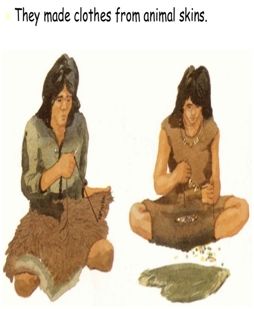
The first clothes were made of animal hides and fur. Hides were scraped clean, softened, and either wrapped around the body or tied on; later they were cut and joined. The Contrebandiers Cave tools point to hide and fur work 120,000 to 90,000 years ago, and the carnivore bones there suggest fur was taken from animals that were not eaten.
Plant fibres came into use well before farming. At Dzudzuana Cave in the foothills of the Caucasus, Georgia, layers as old as 32,000 to 26,000 years hold wild flax fibres that are spun, dyed and knotted (Kvavadze and colleagues, 2009). The fibres could have been cord for hafting tools, baskets or thread for sewing garments; the dyed fibres show that coloured twine was already being made. Cord made from plant fibre is also known from Ohalo II in Israel, about 23,000 years ago, as summarised by Liu and colleagues (2022).
So “what were clothes made of before cotton” has a long answer: hides, fur, leather, grass, bark fibre and wild flax for tens of thousands of years, then linen from cultivated flax, wool, silk and cotton once people farmed. The Iceman’s outfit (below) shows how these were combined as late as 3300 BC.
Needles, awls and the first sewn clothes
A pointed awl punches holes in a hide so that it can be laced with sinew or thong; an eyed needle carries the thread through in one movement and allows finer, closer-fitting seams. Awls are older than needles, and fitted clothing could be made with them alone. Eyed bone needles are a later invention: reviewing finds from 271 sites, d’Errico and colleagues conclude that they emerged in Eurasia between 45,000 and 40,000 years ago. The earliest come from Siberia and China, and the size difference between them suggests two separate inventions. Needles reached Western Europe later, during the Solutrean period, and the smallest of all were made by Palaeoindian people in North America.
Bone needles of different sizes were used for different jobs, from heavy hide seams to fine work, and in China robust needles of round section were followed, between 26,000 and 23,000 years ago, by small flat ones.
Timeline of the origin of clothing
The finds that date the history of clothing, oldest first. Each date is the range its source gives; “years ago” is used for the Pleistocene and BC for the last 10,000 years.
| Date | Find | Place | Source |
|---|---|---|---|
| At least 83,000, possibly 170,000 years ago | Clothing lice split from head lice: regular clothing use begins | Africa (inferred) | Toups et al. 2011 |
| 120,000 to 90,000 years ago | Bone tools likely used for leather and fur working; carnivores possibly skinned for fur | Contrebandiers Cave, Morocco | Hallett et al. 2021 |
| 45,000 to 40,000 years ago | Earliest eyed bone needles | Eurasia, first in Siberia; in China by about 35,000 years ago | d’Errico et al. 2018; Gilligan et al. 2024 |
| 32,000 to 26,000 years ago | Spun, dyed and knotted wild flax fibres | Dzudzuana Cave, Georgia | Kvavadze et al. 2009 |
| About 26,000 years ago | Impressions of interlaced and woven fibre work in fired clay | Pavlov I, Czech Republic | Adovasio et al. 1996 |
| About 23,000 years ago | Plant-fibre cord | Ohalo II, Israel | Nadel et al. 1994, cited in Liu et al. 2022 |
| About 12,000 years ago | Finely woven textiles and cords, directly dated: South America’s earliest textiles | Guitarrero Cave, Peru | Jolie et al. 2011 |
| 8210 to 7300 BC | Twined linen fabrics, among them a head covering, with knotted netting and baskets | Nahal Hemar Cave, Judean Desert, Israel | Solazzo et al. 2016 |
| About 6500 BC (8,500 years ago) | Silk protein in the soil of tombs, with bone needles | Jiahu, Henan, China | Gong et al. 2016 |
| First half of the 6th millennium BC | Cotton threads preserved inside a copper bead, the earliest cotton in the Old World | Mehrgarh, Pakistan | Moulherat et al. 2002 |
| 5200 to 4700 BC | Earliest cotton in the Near East, some fibres dyed | Tel Tsaf, Jordan Valley, Israel | Liu et al. 2022 |
| 3627 to 3377 BC | A complete leather shoe made from a single piece of hide, stuffed with grass | Areni-1 cave, Armenia | Pinhasi et al. 2010 |
| 3482 to 3102 BC | The Tarkhan Dress, a linen shirt: the oldest woven garment dated directly | Tarkhan, Egypt (now in the Petrie Museum, London) | Stevenson and Dee 2016 |
| About 3300 BC (over 5,300 years ago) | The Iceman: a full outfit of leather, fur and grass | Ötztal Alps, South Tyrol, Italy | South Tyrol Museum of Archaeology; O’Sullivan et al. 2016 |
| 10 September 1846 | US patent 4,750 for a sewing machine, granted to Elias Howe | United States | US patent 4,750 |
The Iceman: a complete outfit from 5,300 years ago
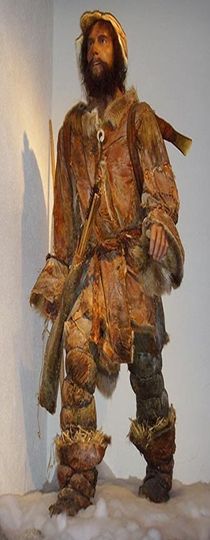
The best picture of prehistoric clothing comes from one man. The Iceman, often called Ötzi, was found by hikers in 1991 on a glacier in the Schnalstal (Val Senales) in South Tyrol, on the Italian side of the Ötztal Alps; he was killed while crossing the Tisenjoch pass more than 5,300 years ago, in the Copper Age, and the ice preserved him with his clothes and gear. He has been shown at the South Tyrol Museum of Archaeology in Bolzano since 1998.
DNA from the leather tells what each piece was made from. O’Sullivan and colleagues found that the coat was stitched from at least four hides of two species, sheep and goat; the leggings were goat; the loincloth was sheep; the shoelaces were cattle; the cap was brown bear; and the quiver was roe deer. At least four sheep and two goats went into the garments. The authors read the mix of farmed and wild animals as a sign that people of the Copper Age made considered choices, taking bearskin for the cap and deer hide for the quiver, though they also note that the patchwork coat may have been stitched from whatever hides were available.
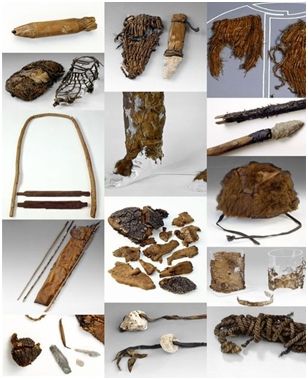
For anyone asking what early humans wore, the Iceman is the answer that survives: a layered outfit of leather and fur, joined with sewn seams, with a cap, leggings, loincloth and shoes stuffed with grass for warmth. It shows a working clothing tradition, not a first attempt; by his time people had been sewing for more than 35,000 years.
From fibre to fabric: the first textiles and the oldest garments
The history of clothing and textiles runs together. Interlacing fibres is older than farming: clay fragments from Pavlov I in the Czech Republic carry the impressions of interlaced and woven fibre work about 26,000 years old (Adovasio, Soffer and Klíma, 1996). The oldest textiles that survive as fabric in the Near East are from Nahal Hemar Cave in the Judean Desert, Israel: pieces of twined linen, among them a head covering and a napkin, found with baskets and netting in a layer radiocarbon-dated to 8210 to 7300 BC. They were made by twining, which needs no loom. Older still are the finely woven textiles and cords from Guitarrero Cave in Peru, which are South America’s earliest textiles, about 12,000 years old (Jolie and colleagues, 2011). The methods are explained in early textile production by hand.
Each of the great natural fibres has a dated first appearance. Flax became linen in the Near East; see flax and linen. Silk protein has been found in the soil of 8,500-year-old tombs at Jiahu in China, together with bone needles and simple weaving tools (Gong and colleagues, 2016); see silk fibre. Cotton threads were found mineralised inside a copper bead in a grave at Mehrgarh, Pakistan, dated to the first half of the 6th millennium BC, the earliest cotton known in the Old World; and the earliest cotton in the Near East, some of it dyed, comes from Tel Tsaf in Israel, 5200 to 4700 BC (Liu and colleagues, 2022); see cotton fibre. When wool from domesticated sheep came in is still argued: some scholars place it in the 4th millennium BC, others as early as 7000 BC in Mesopotamia, as the same 2022 paper sets out.
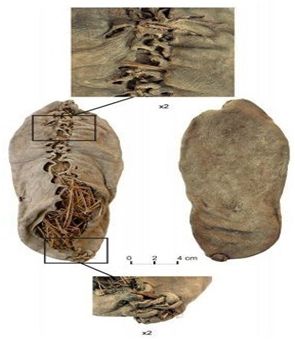
Three finds answer the question “what is the oldest piece of clothing in the world”, depending on what is meant. The oldest textile garment piece from the Near East is the Nahal Hemar linen head covering, 8210 to 7300 BC. The oldest woven garment is the Tarkhan Dress, a V-necked linen shirt with pleated sleeves, which its dating study calls the earliest surviving example of complex woven clothing, cut, fitted and tailored. It came from Flinders Petrie’s 1912–13 excavations at Tarkhan in Egypt, but was only recognised as a garment in 1977, when the dirty bundle it lay in was sent to the Victoria and Albert Museum for conservation; a radiocarbon test on a sample from the dress itself gave 3482 to 3102 BC at 95% probability (Stevenson and Dee, 2016), and it is in the Petrie Museum at University College London. And one of the oldest shoes is a complete leather shoe from the Areni-1 cave in Armenia, cut from a single piece of hide, laced, stuffed with grass and shaped by wear to its owner’s right foot, dated 3627 to 3377 BC (Pinhasi and colleagues, 2010).
Weaving on a loom turned fibre into cloth faster and in larger widths than twining; the loom’s own history, from the ground loom to the power loom, is told in history of looms.
Clothing, costume, apparel and fashion: what the words mean
The words carry some of the history. Clothes comes from Middle English clothes, the plural of cloth in its old sense of “cloth, garment”, from Old English clāþas (Wiktionary). Costume came into English from French costume, from Italian costume, from Latin consuetudo, “custom, habit” (Wiktionary): costume is the dress that is customary for a people, a period or an occasion, which is why museums speak of costume history and theatres of costumes. Apparel comes from Old French apareillier (Wiktionary), “to equip, to prepare” (Wiktionary).

Flügel divided dress into two kinds that are still useful. Fixed costume changes slowly over time but differs from place to place: regional and traditional dress, uniforms, religious dress. Modish (fashionable) costume changes quickly over time but is much the same from place to place. The origin of fashion, in this sense, is the point where dress begins to change for the sake of change and novelty becomes a value in itself. Both kinds tell other people who the wearer is, where they come from and what role they hold. How dress and its economics developed in later societies is the subject of the socio-economic evolution of clothing.
From hand-sewn to ready-made
For almost all of its history, clothing was made by hand from start to finish: fibre was spun at home or in workshops, woven on hand looms and sewn by the household or by a local tailor or dressmaker. Mechanised spinning and weaving made cloth far cheaper, and the sewing machine later sped up the making of garments. Elias Howe of Cambridge, Massachusetts, was granted US patent 4,750 for an improvement in sewing machines on 10 September 1846, and machine sewing helped make ready-to-wear clothing, bought finished in standard sizes, possible on a large scale.
Measured against the whole history of clothing, this is very recent. People wore clothes for more than 80,000 years before the first sewing machine, and twined and woven cloth for at least 10,000 years before cloth was made by machines.
What the evidence can and cannot tell us
Hide, fur, plant fibre and thread decay within years in most soils. They survive only in ice (the Iceman), extreme dryness (Nahal Hemar, Tarkhan), waterlogged ground, or where metal salts have soaked into them (the Mehrgarh cotton). So every “first” in the timeline is the oldest that happens to have survived and been found, and most dates for the deep past are minimums. Tools, the bones of skinned animals, impressions in clay and the genes of lice fill the gap, each with its own uncertainty: the lice dates depend on the molecular clock used, and a tool’s purpose is read from wear marks. Where sources disagree, as on the date of the first wool, this page gives the disagreement rather than picking a side.
Questions people ask about the origin of clothing
When were clothes first invented?
Regular clothing use began at least 83,000 and possibly as early as 170,000 years ago, according to the genetic split between clothing lice and head lice. Bone tools for working leather and fur are known from Morocco 120,000 to 90,000 years ago, and eyed needles from 45,000 to 40,000 years ago.
Who invented clothes first in the world?
No individual did. Clothing developed gradually among early humans, most likely Homo sapiens in Africa. Neanderthals also wore clothing, probably simpler cape-like garments, and needles may have been invented separately in more than one region.
Why were clothes invented?
The evidence points to warmth and protection first, as humans lived through cold periods and moved into colder regions. Decoration, modesty and social status later became just as important, and those social roles are why people wear clothes even where it is warm.
What did early humans wear?
Animal hides and furs, at first wrapped or tied, later cut and sewn into fitted garments. By about 30,000 years ago people also used spun and dyed plant fibres. The Iceman, about 3300 BC, wore a sheep and goat hide coat, goat leggings, a sheepskin loincloth, a bearskin cap and grass-stuffed shoes.
What is the oldest piece of clothing ever found?
The oldest woven garment is the Tarkhan Dress from Egypt, a linen shirt dated 3482 to 3102 BC. Older fragments exist: twined linen from Nahal Hemar Cave in Israel, including a head covering, dates to 8210 to 7300 BC.
What were clothes made of before cotton?
Hides, fur, leather and plant fibres such as wild flax, grass and bark. Linen from flax is older than cotton cloth in the Near East, and silk was in use in China about 8,500 years ago. The earliest known cotton, from Mehrgarh in Pakistan, dates to the 6th millennium BC.
Sources
- Lice and the date of clothing: M. A. Toups, A. Kitchen, J. E. Light and D. L. Reed, “Origin of clothing lice indicates early clothing use by anatomically modern humans in Africa”, Molecular Biology and Evolution 28 (2011) 29–32, doi:10.1093/molbev/msq234; R. Kittler, M. Kayser and M. Stoneking, “Molecular evolution of Pediculus humanus and the origin of clothing”, Current Biology 13 (2003) 1414–1417, doi:10.1016/s0960-9822(03)00507-4, with an erratum in Current Biology 14 (2004) 2309, doi:10.1016/j.cub.2004.12.024.
- Hide and fur working: E. Y. Hallett and colleagues, “A worked bone assemblage from 120,000–90,000 year old deposits at Contrebandiers Cave, Atlantic Coast, Morocco”, iScience 24 (2021) 102988, doi:10.1016/j.isci.2021.102988.
- Needles and dress: F. d’Errico and colleagues, “The origin and evolution of sewing technologies in Eurasia and North America”, Journal of Human Evolution 125 (2018) 71–86, doi:10.1016/j.jhevol.2018.10.004; I. Gilligan, F. d’Errico, L. Doyon, W. Wang and Y. V. Kuzmin, “Paleolithic eyed needles and the evolution of dress”, Science Advances 10 (2024) eadp2887, doi:10.1126/sciadv.adp2887.
- Neanderthal and modern human clothing: M. Collard, L. Tarle, D. Sandgathe and A. Allan, “Faunal evidence for a difference in clothing use between Neanderthals and early modern humans in Europe”, Journal of Anthropological Archaeology 44 (2016) 235–246, doi:10.1016/j.jaa.2016.07.010.
- Early fibres and textiles: E. Kvavadze and colleagues, “30,000-year-old wild flax fibers”, Science 325 (2009) 1359, doi:10.1126/science.1175404; J. M. Adovasio, O. Soffer and B. Klíma, “Upper Palaeolithic fibre technology: interlaced woven finds from Pavlov I, Czech Republic, c. 26,000 years ago”, Antiquity 70 (1996) 526–534, doi:10.1017/S0003598X0008368X; E. A. Jolie, T. F. Lynch, P. R. Geib and J. M. Adovasio, “Cordage, textiles, and the Late Pleistocene peopling of the Andes”, Current Anthropology 52 (2011) 285–296, doi:10.1086/659336; C. Solazzo and colleagues, “Identification of the earliest collagen- and plant-based coatings from Neolithic artefacts (Nahal Hemar cave, Israel)”, Scientific Reports 6 (2016) 31053, doi:10.1038/srep31053.
- Silk and cotton: Y. Gong and colleagues, “Biomolecular evidence of silk from 8,500 years ago”, PLoS ONE 11 (2016) e0168042, doi:10.1371/journal.pone.0168042; C. Moulherat, M. Tengberg, J.-F. Haquet and B. Mille, “First evidence of cotton at Neolithic Mehrgarh, Pakistan”, Journal of Archaeological Science 29 (2002) 1393–1401, doi:10.1006/jasc.2001.0779; L. Liu, M. J. Levin, F. Klimscha and D. Rosenberg, “The earliest cotton fibers and pan-regional contacts in the Near East”, Frontiers in Plant Science 13 (2022) 1045554, doi:10.3389/fpls.2022.1045554.
- The oldest garments and shoes: A. Stevenson and M. W. Dee, “Confirmation of the world’s oldest woven garment: the Tarkhan Dress”, Antiquity Project Gallery 90 (2016), doi:10.15184/S2978855200900271; R. Pinhasi and colleagues, “First direct evidence of chalcolithic footwear from the Near Eastern highlands”, PLoS ONE 5 (2010) e10984, doi:10.1371/journal.pone.0010984.
- The Iceman: South Tyrol Museum of Archaeology, Bolzano; N. J. O’Sullivan and colleagues, “A whole mitochondria analysis of the Tyrolean Iceman’s leather provides insights into the animal sources of Copper Age clothing”, Scientific Reports 6 (2016) 31279, doi:10.1038/srep31279.
- Theories of clothing: J. C. Flügel, The Psychology of Clothes (London: Hogarth Press, 1930), pages 16–19, 25–26 and 129–130.
- The sewing machine: E. Howe, US patent 4,750, “Improvement in sewing-machines”, 10 September 1846.
How this page is kept
Last verified: 18 October 2026. Every date and figure is taken from the paper, patent or museum that reported it, each read on this date, and is given as the range that source states; nothing is rounded into a single “invention year”. An independent fact-check on the same date tightened several wordings against the sources, among them the lice date range and the claim for the oldest textile. The page was rewritten in full on this date, and our separate article tracing the origin of clothing from prehistory to modernity was folded into it. Corrected from the earlier versions: there is no evidence that Neanderthals were the first people to make clothing, and the lice evidence points most likely to Homo sapiens in Africa; the Iceman was found on the Italian side of the Alps, not in Austria, and his clothes were made of leather from farmed sheep, goats and cattle as well as wild bear and deer; eyed needles are 45,000 to 40,000 years old, not 30,000; Latin consuetudo means custom or habit, not a set of garments; and the fourth theory of clothing is the protection theory. New finds move these dates often. Spotted an error or a newer date? Tell us through the contact page, naming the section and the source, and it will be corrected.






Some experts argue that open-end spinning, which involves twisting fibers together without a traditional spinning wheel, is more energy-efficient and produces less waste compared to other spinning methods.
Obviously they had a lot less clothes during the Roman Warm Period, just a single sheet of cloth, and then they had a lot more layers of underwear, shirts, dresses, boots, hats, gloves, scarfs, and furs during the Little Ice Age. But because of the Global Warming narrative this is taboo to even say now… (God forbid if the people get the idea it was both warmer and colder before.)
During the Ice Age proper, 100-20,000 years ago, they needed a lot of padding if they were to survive the winter (practically all year round). The fashion back then was furs from wild animals…
P.S. Monalisa. I think your timescale for the Stone Age is a lot better than mine taken from memory. But reading your article one more time I realize you are correct. Thanks for a very interesting article! 🙂
Good
Thanks!
This help me in my holiday homework
Thank you
This totally helped with my project I’m doing in Honors Social Studies. I’m in 7th grade by the way! THANKS!
Thank you
Thanks
can i get a more pecise information about ” the History of Clothing and Textiles ” other than the one posted in wikipedia site????