
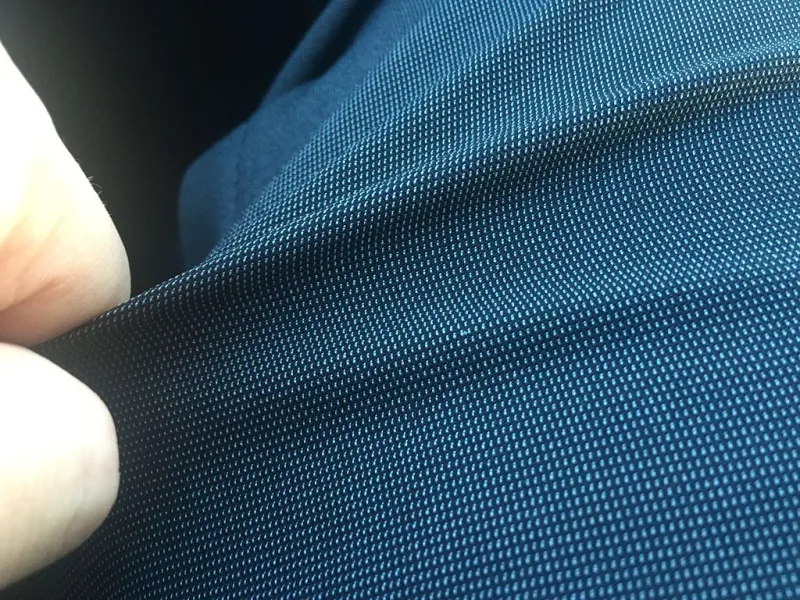
Polyester is a synthetic fibre made from a plastic, almost always polyethylene terephthalate (PET), the same polymer most drinks bottles are made of. PET is made from two chemicals that come from oil and natural gas, purified terephthalic acid and monoethylene glycol; it is melted and pushed through fine holes to make filaments. Polyester fabric is strong, dries fast, resists creasing and shrinking, and absorbs very little water, which is also why it can feel clammy. It is the most produced fibre in the world: 59% of all fibre made in 2024, according to Textile Exchange.
The common questions are answered first, then the engineering, with every figure sourced. Prices come from this site’s own price series, and four of the site’s calculators are worked through, each with a link that opens the tool with the same figures entered.
Last verified: 5 October 2026. Sources are linked where they are used and listed at the end.
Is polyester plastic?
Yes. Polyester fibre is a thermoplastic, and the law defines it by its chemistry. The EU’s textile-names regulation describes polyester as a “fibre formed of linear macromolecules comprising at least 85% (by mass) in the chain of an ester of a diol and terephthalic acid” (Regulation (EU) No 1007/2011, Annex I). The US rule, 16 CFR 303.7(c), is broader: a manufactured fibre of “any long chain synthetic polymer composed of at least 85% by weight of an ester of a substituted aromatic carboxylic acid”. In practice the diol is ethylene glycol and the polymer is PET, the polymer of drinks bottles and of the PET film used in packaging and electronics. The international list of generic fibre names is ISO 2076.
Three practical consequences follow. Polyester melts rather than burning away, which is the basis of the burn test and the reason a hot iron can glaze it. It can be remelted and spun again, which is how most recycled polyester is made, from bottle flake. And it does not meaningfully biodegrade: a 2017 review in Microbial Biotechnology counts PET among the “recalcitrant petroleum-based plastics” that persist in the environment (Wei and Zimmermann). Polyester garments also shed microfibres in the wash; the environment section gives measured amounts.
Is polyester breathable?
Breathability has two parts, and polyester scores differently on each. The first is whether air and water vapour pass through the fabric, which depends on the yarn and the construction far more than on the fibre: an open polyester knit breathes, a dense polyester taffeta barely does. The second is whether the fibre itself takes up moisture, and polyester takes up very little. Its moisture regain, the water it holds as a percentage of its dry weight, is about 0.4%, against 7.0 to 8.5% for cotton, according to the conservation reference CAMEO of the Museum of Fine Arts, Boston (polyester, cotton). Regain is compared in the standard testing atmosphere of ISO 139.
So sweat is not absorbed into polyester; it stays on the skin or in the spaces between the fibres. In a close fabric worn next to the skin that feels clammy. Sportswear turns the same property to use: knitted polyester fabrics are built to spread liquid sweat across their outer face, where it evaporates, and they dry quickly because the fibre holds so little. Both effects are measurable, and the site has a tool for each: the air permeability calculator and the moisture management calculator, which works from the indices of a moisture management tester.
Does polyester shrink?
Not in normal washing, once the fabric has been heat-set. In finishing, the fabric is held at its finished width and heated in dry air, typically at 190 to 220 °C (heat setting), far above any washing temperature. The fibre is supplied stabilised too: one producer specifies no more than 5.5% shrinkage in dry heat at 160 °C for its apparel staple (Indo Rama Synthetics). Below the setting temperature the set holds, so a heat-set polyester fabric keeps its size at the washing temperatures on its care label. Heat close to the setting temperature, from a very hot iron, makes it shrink or pucker permanently, and at 250 to 260 °C it melts. In a polyester and cotton blend it is the cotton that shrinks.
Shrinkage is measured rather than guessed. ISO 5077 is the method for dimensional change in washing and drying, using the laundering procedures of ISO 6330. The heat-setting time and temperature calculator shows how a stenter’s temperature and dwell trade against each other.
Does polyester pill?
Spun polyester can, and its pills tend to stay. Rubbing teases fibre ends out of the surface and rolls them into small balls. With a weaker fibre the ball soon breaks away; with polyester it does not. As the fibre maker Trevira put it in a patent granted in 2007, “owing to the high strength of polyester fibers, these balls or pills cannot drop off, but remain on the surface” (US 7,189,794 B2). The same patent notes that most low-pill polyesters are made by lowering the polymer’s molecular weight, so that the weaker fibre lets the pills fall off. Filament fabrics, which have no loose fibre ends, pill much less than fabrics of spun yarn. Pilling is graded with the modified Martindale method of ISO 12945-2:2020, and the pilling propensity calculator shows what drives it.
Polyester vs cotton
Cotton is the fibre polyester is most often compared with, blended with and substituted for. The table sets the two side by side; each figure is sourced in the text above or below it.
| Polyester | Cotton | |
|---|---|---|
| What it is | A synthetic polymer, PET, made from oil and gas | A natural cellulose fibre, the seed hair of the cotton plant |
| Share of world fibre production, 2024 | 59%, about 78 million tonnes | 19%, about 24.5 million tonnes (2023/24 crop) |
| Price, Chinese futures, 30 September 2026 | Staple fibre: 8,208 CNY a tonne | Cotton: 15,620 CNY a tonne |
| Density | 1.38 g/cm³ | 1.52 to 1.56 g/cm³ |
| Moisture regain | About 0.4% | 7.0 to 8.5% |
| Moisture allowance in EU fibre-content calculations | 1.50% | 8.50% |
| Effect of water on strength | Takes up almost no water | Stronger wet than dry |
| Heat | Softens, then melts at 250 to 260 °C; iron at two dots, no more than 160 °C | Does not melt; decomposes, rapidly above about 246 °C; iron at up to three dots, 210 °C |
| Creasing | Resists creases; holds heat-set pleats | Creases easily |
| End of life | Does not biodegrade; can be remelted | Biodegrades |
Sources for the cotton column: production share, Textile Exchange (Materials Market Report 2025); density 1.52 g/cm³ from Beckman and colleagues (2021) and 1.54 to 1.56 from CAMEO; wet strength (27 to 45 g/tex dry, 30 to 54 wet) and decomposition from Cotton Incorporated’s technical guide. The prices are settlement prices on the Zhengzhou Commodity Exchange, the Chinese domestic market, carried daily on this site; read the series rather than one day’s number.
The two are blended because each covers the other’s weakness: polyester brings strength, crease resistance and quick drying, cotton brings absorbency and comfort. How much of each a fabric contains is a laboratory question, not a label claim: ISO 1833-11 dissolves the cotton in sulfuric acid and weighs the polyester left behind, and the fibre content tolerance calculator checks a test result against the declared blend. See also cotton fibres and their properties.
Worked example: what polyester’s low regain does to an invoice. Yarn is sold at a commercial weight, its oven-dry mass plus an agreed allowance for moisture, so that a buyer does not pay for water. Take 5,000 kg of 65/35 polyester and cotton yarn that a laboratory finds holding 2.9% moisture on its dry weight (an assumed figure). Under the EU allowances in Annex IX of Regulation 1007/2011, 1.50% for polyester and 8.50% for cotton, the blend’s allowance is 3.95%. The blend invoice weight calculator gives an oven-dry mass of 4,859.09 kg and a commercial weight of 5,051.02 kg, 51 kg more than was weighed, because the yarn is drier than its allowance. Put polyester’s measured regain of 0.4% in place of its 1.50% allowance and the commercial weight falls to 5,016.28 kg. The polyester figure alone moves the invoice by about 35 kg in 5 tonnes, 0.7%, so a contract should name the table of allowances it uses. ASTM publishes one as ASTM D1909.
How to wash and care for polyester
Follow the care label: it states the most severe treatment the garment survives. The symbols are set by ISO 3758:2023 and administered by GINETEX, the international association for textile care labelling. GINETEX explains that the number in the wash tub is the maximum washing temperature, and that the dots in the iron set the maximum sole-plate temperature: one dot 120 °C, two dots 160 °C, which it equates with the “wool/silk/polyester/viscose” setting of an iron, and three dots 210 °C (GINETEX care symbols).
- Washing. Use the temperature in the wash tub; it is a maximum. GINETEX lists polyester among the fabrics for its 40 °C mild wash and its 60 °C coloured wash, and advises short spins for fine synthetics to limit creasing. Heat-set polyester does not shrink at its label temperature.
- Drying. Polyester dries fast because the fibre holds so little water. Line-dry it, or tumble-dry on a low setting if the label allows, and hang garments up promptly to limit creasing.
- Ironing. Use two dots, no more than 160 °C. Too hot an iron glazes the surface and, close to the melting point, melts it.
- Microfibres. Every wash releases some fibre fragments. A wash bag or an external filter catches part of them; the environment section gives the amounts.
Pros and cons of polyester
| Advantages | Disadvantages |
|---|---|
| Strong and hard-wearing; high-tenacity grades are made for industrial yarn (properties) | Absorbs almost no sweat, so close fabrics feel clammy (breathability) |
| Dries fast and resists creasing; heat-set fabric keeps its size (shrinkage) | Spun polyester pills, and the pills stay on (pilling) |
| Holds permanent pleats, set by heat | Melts at 250 to 260 °C; a hot iron or a spark marks it |
| Cheap: staple fibre cost about half as much as cotton per tonne in China on 30 September 2026 (prices) | About 88% of it is made from fossil feedstock (production) |
| Blends well with cotton, viscose and wool | Sheds microfibres in the wash and does not biodegrade (environment) |
| Can be remelted and recycled; about 12% of polyester is already recycled (recycled polyester) | Needs disperse dyes and high-temperature dyeing (dyeing) |
Properties of polyester fibre
Polyester is not one material but a family of grades, so most properties are ranges. Each figure below links to where it was read. Tenacity is quoted both in grams per denier, the unit producers still use, and in centinewtons per decitex (1 g/den = 0.883 cN/dtex); the textile unit converter does the conversion.
| Property | Value | Source |
|---|---|---|
| Density | 1.38 g/cm³ (amorphous PET 1.335, crystalline 1.455) | MiniFIBERS data sheet; Di Lorenzo (2024) |
| Tenacity, apparel staple fibre | 6.0 to 6.7 g/den (5.3 to 5.9 cN/dtex) | Indo Rama Synthetics staple fibre grades |
| Tenacity, high-tenacity industrial filament | 5.8 to 8.2 cN/dtex (583 to 820 mN/tex) | Diolen industrial yarn data, as reproduced by Politecnico di Milano |
| Tenacity, all grades | 2.2 to 9.5 g/den | CAMEO |
| Elongation at break | Apparel staple 18 to 27%; industrial filament 14.7 to 20.5%; all grades 10 to 50% | Indo Rama; Diolen; CAMEO, as above |
| Moisture regain | About 0.4% (0.1 to 0.4%) | CAMEO |
| Agreed moisture allowance, EU | 1.50% | Regulation 1007/2011, Annex IX |
| Glass transition temperature | About 69 °C for amorphous PET; higher as crystallinity rises (69 to 115 °C measured on PET chips) | Di Lorenzo (2024); Kim and colleagues (2026) |
| Melting point | 250 to 260 °C | Di Lorenzo (2024), about 250 °C; MiniFIBERS, 260 °C |
| Limiting oxygen index (LOI) | About 21%: 21.1% for an untreated PET fabric, 21.4% for moulded PET | Inprasit and colleagues (2026), tested to ASTM D2863; Xiang and colleagues (2022) |
Two of these numbers explain much of how polyester behaves. The glass transition, around 70 °C in amorphous PET, is where the chains in the non-crystalline regions start to move; drawing, texturing and dyeing all happen above it, which is why polyester is dyed hot. The limiting oxygen index is the oxygen concentration a material needs to keep burning. Air holds about 21%, so polyester sits close to the line, and, as the burn test shows, it tends to go out once the flame is taken away. Flame-retardant polyesters raise it. The LOI calculator estimates the effect of a flame-retardant finish, and the moisture regain calculator turns a weighing into regain and conditioned weight.
How to identify polyester: the burn test and the microscope
Burn test. Hold a few fibres or a snip of fabric in tweezers over a non-flammable dish and bring a small flame to the edge. Polyester is difficult to ignite; it melts and burns with a shiny, yellow-orange, sooty flame and a sweetish smell, tends to go out when the flame is taken away, and leaves a hard bead (CAMEO). The bead starts cream-coloured and darkens, and the smoke is black (University of Arkansas 4-H textile guide). Cotton, by contrast, burns with a steady flame, smells like burning leaves and leaves an ash that crumbles easily (CAMEO). Other synthetics such as nylon also melt, so the test separates polyester from cotton easily and from other synthetics only with practice. A blend behaves as its parts do, which is why a burn test cannot give a blend ratio.
Microscope. Seen along its length, a polyester fibre has a smooth, regular surface with none of cotton’s twist or wool’s scales (MicroLab Northwest). Its cross-section is whatever shape the spinneret hole gave it: usually round, but trilobal and other profiles are common (CAMEO).
For anything that matters, a laboratory method replaces both: quantitative chemical analysis to the ISO 1833 series gives the blend ratio, and infrared spectroscopy identifies the polymer. The site’s fibre identification guide covers the other fibres.
How polyester is made
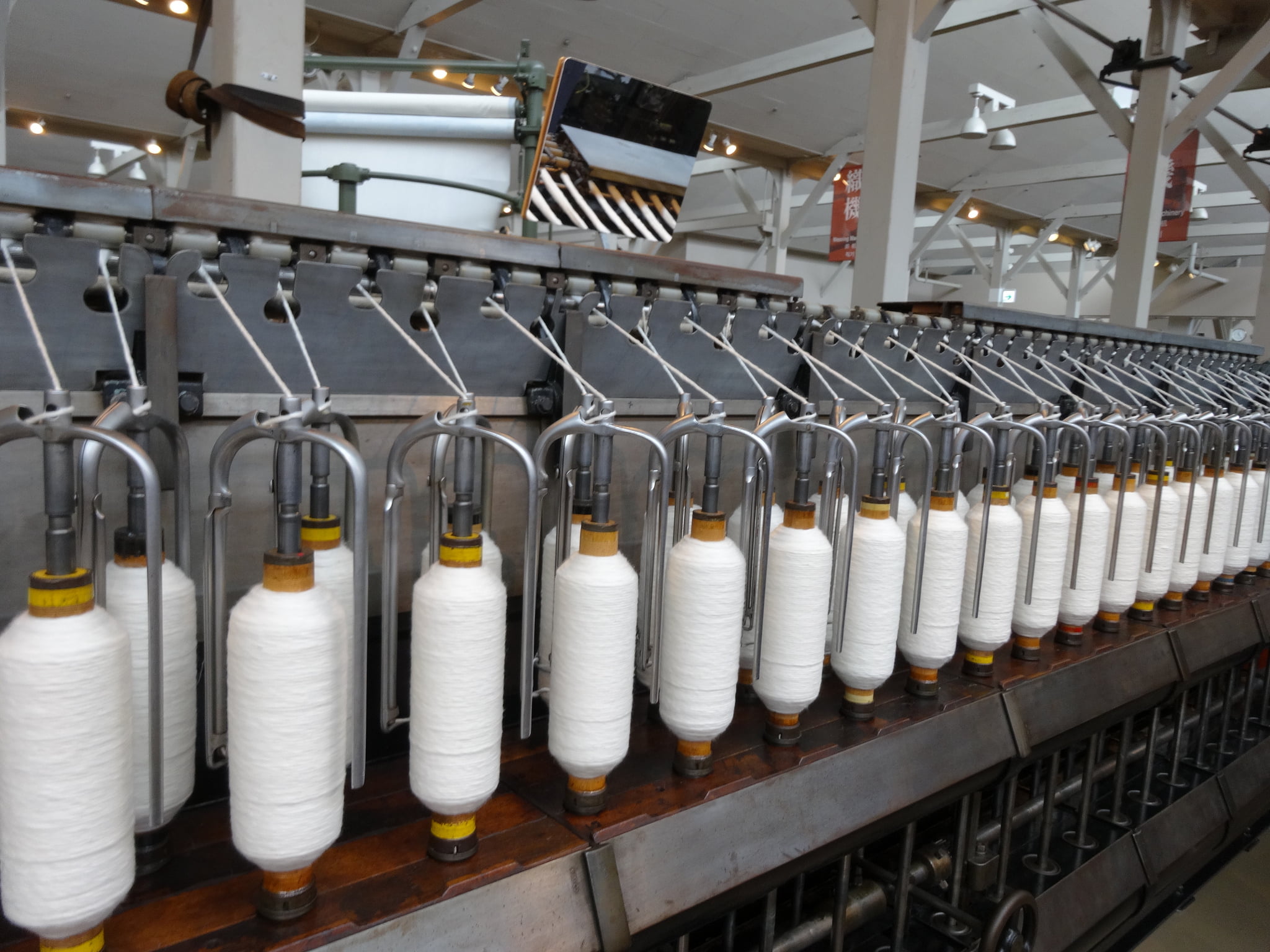
Polyester is made in three steps: the polymer is made from PTA and MEG, it is melt-spun into filaments, and the filaments are drawn to give them strength. What follows depends on whether the product is continuous filament yarn or staple fibre for spinning.
From oil and gas to PET
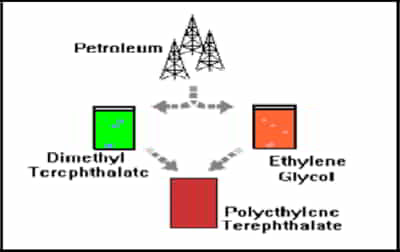
Purified terephthalic acid (PTA) is made by oxidising paraxylene, an aromatic from oil refining, and monoethylene glycol (MEG) is made from ethylene. In the usual continuous process the two are first esterified at 240 to 260 °C under pressure, then polymerised in the melt as the temperature is raised to 280 to 290 °C under a vacuum below 25 Pa, which draws off the glycol released as the chains grow; antimony trioxide is the usual catalyst (NPTEL course notes, IIT Delhi). The older route started from dimethyl terephthalate (DMT) and released methanol. It was commercialised first because DMT could then be made pure enough, and it is the route in the diagram below. The production section shows what the raw materials cost.
The melt is spun directly or cast into chips. Chips are dried before they are remelted, because water left in them breaks the polymer chains in the melt and lowers the yarn’s strength. The polymer drying calculator sizes the dryer, and the melt residence calculator estimates how much viscosity the melt loses on its way to the spinneret.
Melt spinning
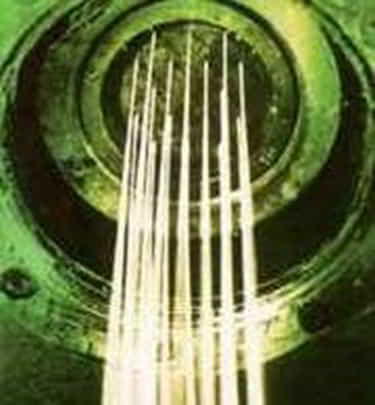
The polymer is melted and pumped through a spinneret, a plate drilled with fine holes. A Goodyear patent gives about 280 to 310 °C as the preferred temperature at which PET is extruded (US 5,049,339). A metering pump fixes the flow to each spinneret, the filaments are cooled by a cross-flow of air as they fall, and they are wound up at speed. The shape of the holes sets the cross-section: round, trilobal for lustre, hollow for warmth.
Worked example: from throughput to filament. The mass balance alone fixes how fine the filament is: the polymer each hole delivers, divided by the take-up speed. Take one spinning position with a 48-hole spinneret delivering 5 kg of PET an hour, wound at 3,000 m/min (assumed figures for a POY threadline). The filament denier calculator shows 1.74 g a minute through each hole, 5.21 denier (5.79 dtex) per filament, a yarn of 250 denier in 48 filaments, and a solid filament 23.11 µm across. It also shows that melt spinning stretches the filament from the start: the melt leaves a 0.25 mm hole at 29.47 m/min and is wound at 3,000, a spin draw ratio of 101.79. The spin pump calculator and the quench airflow calculator take the next two steps.
Drawing: POY, FDY and DTY
As spun, the polymer chains are only partly aligned. Drawing the filaments between rolls running at different speeds, above the glass transition, aligns and crystallises them; that gives the fibre its strength and lowers its elongation. The godet draw calculator relates the draw ratio to the orientation it produces. Filament yarn is made in three main forms.
- POY, partially oriented yarn, is wound fast and only partly drawn; one producer’s patent gives winding speeds of about 3,000 to 4,000 m/min (Wellman, US 5,471,828). It is an intermediate rather than a finished yarn, and it changes with time on the package: see the POY shelf life calculator.
- FDY, fully drawn yarn, is spun and drawn in one step. An Oerlikon patent describes taking the filaments off at above 1,500 m/min and drawing them at above 4,000 m/min (US 9,428,848).
- DTY, draw-textured yarn, is POY drawn and crimped on a texturing machine, where, in Oerlikon Barmag’s words, “pre-oriented yarn (POY) is permanently crimped using friction” (Oerlikon Barmag). The crimp gives the yarn bulk and stretch.
Worked example, continued. Feed that 250-denier POY to a texturing machine at a draw ratio of 1.667 and the DTY output calculator gives a yarn of 149.97 denier (166.63 dtex), a 150-denier DTY. At 800 m/min on 576 positions and 95% efficiency, which are the tool’s own default figures rather than a machine builder’s rating, the machine makes 437.67 kg an hour. The false-twist surge calculator looks at the twisting unit itself.
Staple fibre
For spinning into yarn, polyester is made as staple fibre. The filaments from many spinnerets are gathered into a heavy tow, drawn, crimped so that they will hold together in a card, heat-set and cut. One producer’s apparel grades run from 1.0 to 1.7 denier, cut at 32 to 64 mm for spinning on cotton and viscose systems, with a tenacity of 6.0 to 6.7 g/den and 12 to 12.5 crimps per inch (Indo Rama Synthetics). The staple is then spun alone or blended with cotton or viscose on the same machines as cotton. The staple cut-length calculator follows the tow to the bale, and the site’s study of drafting polyester and viscose blends looks at one spinning step in detail.
Heat setting and dyeing
Polyester fabric is heat-set on a stenter, held at its finished width and heated in dry air, typically at 190 to 220 °C under tension for a short time (Standring and colleagues, 2025). That fixes its size and shape, and pleats set the same way are permanent. The stenter production calculator turns a dwell time into a line speed.
Polyester has none of the chemical sites that the dyes for cotton or wool attach to, so it is dyed with disperse dyes, which dissolve into the fibre. That needs the chains to move freely, so dyeing is done at about 130 °C under pressure, or at the boil with a carrier, a chemical that swells the fibre (e-PG Pathshala, INFLIBNET). At those temperatures small cyclic molecules of PET, oligomers, come out of the fibre and can deposit on fabric and machine as the bath cools; the oligomer risk calculator estimates a safe temperature to drain the bath. A finish in hot caustic soda dissolves part of the fibre surface, the usual optimum being a weight loss of 10 to 24%, to give polyester a silk-like handle and lustre (Čorak and colleagues, 2022).
Types of polyester
“Polyester” on a label nearly always means PET. The other members of the family are made for particular jobs, and recycled and bio-based PET are the same polymer from different feedstocks.
| Type | What it is | Melting point | Used for |
|---|---|---|---|
| PET, polyethylene terephthalate | Terephthalic acid with ethylene glycol: the standard textile polyester | 250 to 260 °C | Almost all polyester apparel, home textiles and industrial yarn |
| PBT, polybutylene terephthalate | Terephthalic acid with 1,4-butanediol | 223 °C (BASF Ultradur B4500 data sheet) | Mainly engineering plastics; also some textile yarns |
| PTT, polytrimethylene terephthalate | Terephthalic acid with 1,3-propanediol. In the US its fibre may be labelled “triexta”, a subclass of polyester the FTC created in 2009 for fibres whose glycol is at least 90 mole percent 1,3-propanediol (Federal Register, 26 March 2009) | 226 to 230 °C (Chan and colleagues, 2012) | Carpets and stretch apparel; sold as Sorona, which contains 37% plant-based ingredients by weight (DuPont, 2020) |
| PCDT (also PCT), poly(1,4-cyclohexylenedimethylene terephthalate) | Terephthalic acid with 1,4-cyclohexanedimethanol; the ring in the chain makes it stiffer and raises the melting point | About 290 °C (Eastman, US 5,428,086) | Specialty uses that need its higher heat resistance |
| Cationic-dyeable polyester (CDP) | PET copolymerised with a little of a sulfonated monomer, about 2 mole percent of a sodium sulfoisophthalate unit in DuPont’s description (US 5,559,205), so that it takes cationic dyes | Near PET’s | Brighter shades, and two-tone effects when mixed with standard PET |
| Recycled PET (rPET) | PET remelted from bottles or waste (mechanical), or broken down to monomers and repolymerised (chemical) | As PET | See recycled polyester |
| Bio-based PET and PEF | PET made partly from plant-derived glycol; PEF, a polyester of plant-derived furandicarboxylic acid (FDCA) | Bio-PET as PET | Bio-based PET was about 0.01% of polyester in 2024 (Textile Exchange) |
Some types describe the fibre rather than the polymer. A microfibre is a very fine fibre, usually taken as finer than about 1 dtex per filament, though definitions vary; a 2025 review uses “less than 1.2 dtex” (Standring and colleagues). Hollow fibres trap air for wadding and insulation, and shaped cross-sections change lustre and wicking.
How much polyester is made, and what it costs
Textile Exchange’s Materials Market Report 2025 puts world fibre production at 132 million tonnes in 2024. Polyester was 78 million tonnes of it, 59%, up from 71 million tonnes and 57% in 2023. Cotton, the second most produced fibre, was 19%: polyester is made in about three times cotton’s quantity. About 12% of polyester, roughly 9.3 million tonnes, was recycled, and about 88% was virgin PET from fossil feedstock.
Prices are tracked on this site as daily series from the Zhengzhou Commodity Exchange, which trades the Chinese domestic market in yuan a tonne. On 30 September 2026 polyester staple fibre settled at 8,208 CNY a tonne and cotton at 15,620, so staple polyester cost about half as much as cotton by weight. Polyester’s price follows its feedstock. The chemistry fixes the quantities: a PET repeat unit (192.17 g/mol) is made from one molecule of terephthalic acid (166.13 g/mol) and one of ethylene glycol (62.07 g/mol), losing two of water, so a tonne of PET takes 0.865 t of PTA and 0.323 t of MEG. On the same day PTA settled at 6,268 CNY a tonne, so the PTA in a tonne of staple fibre was worth about 5,420 CNY, two-thirds of the fibre’s price. PTA in turn follows paraxylene, and paraxylene follows crude oil (Brent). These are futures settlements in one market, not a world price; read the direction of the series rather than one day’s level.
Recycled polyester
Recycled polyester is made in two ways. Mechanical recycling washes and flakes PET, remelts it and spins it, with some loss of molecular weight; this is how “most recycled polyester is currently recycled”, and plastic bottles make up an estimated 98% of the feedstock (Textile Exchange, 2025). Chemical recycling breaks the polymer back to its building blocks and polymerises them again, which removes dyes and contaminants: glycolysis gives bis(2-hydroxyethyl) terephthalate (BHET), methanolysis gives dimethyl terephthalate and ethylene glycol, and hydrolysis gives terephthalic acid (Damayanti and Wu, 2021). An enzyme route works too: an engineered PET depolymerase broke down at least 90% of PET to monomers in 10 hours (Tournier and colleagues, Nature, 2020).
Textile-to-textile recycling is still small: about 2% of recycled polyester in 2024, by Textile Exchange’s estimate. Recycled content is certified under Textile Exchange’s standards. The Global Recycled Standard applies to products with at least 20% recycled content, and only products with at least 50% may carry a product-specific GRS label; the Recycled Claim Standard applies from 5%. The site’s article on recycled polyester covers the processes in more detail.
Environmental impact: microfibres and end of life
Polyester’s environmental record turns on three facts already given: about 88% of it is made from fossil feedstock, it does not biodegrade, and recycling so far runs mostly from bottles into fibre rather than from fibre back into fibre. The fourth is microfibres. In a study that washed garments in a household machine, two 100% polyester T-shirts released 124 and 125 mg of microfibres per kilogram of fabric in their first wash at 40 °C, or 770,000 and 1,100,000 fibres (De Falco and colleagues, Scientific Reports, 2019). Results vary widely with the fabric, the machine and the test method, so figures from different studies should not be compared directly.
Worked example: microfibres over a garment’s life. One wash is not a lifetime, because shedding falls as the loose surface fibre is used up. Take a 250 g polyester garment, use De Falco’s 125 mg per kilogram as its first-wash rate, and let release fall 3% a wash (the tool’s default decay, a modelling assumption rather than a measurement) over 50 washes with no filter. The microfibre release calculator shows 31.25 mg in the first wash, 7.03 mg in the fiftieth, and 814.52 mg over the life, 0.33% of the garment’s mass. A million such garments would release about 815 kg. Change the filtration figure to see what a machine filter would catch.
Testing polyester fibre and yarn: the standards
The methods below are the ones a polyester fibre or yarn specification normally cites. Records on this site summarise each standard and link to the publisher; where the site has no current record yet, the link goes to the ISO catalogue.
| What is measured | Method | Tool |
|---|---|---|
| Conditioning before any test | ISO 139, standard atmospheres | Conditioning time |
| Fibre fineness (linear density) | ISO 1973:2021, gravimetric and vibroscope methods | Count converter |
| Single-fibre breaking force and elongation | ISO 5079:2020; ASTM D3822 in the US | Tenacity units |
| Yarn count | ISO 2060; ASTM D1907 | Count converter |
| Yarn breaking force and elongation | ISO 2062; ASTM D2256 | Tenacity units |
| Commercial mass and moisture allowance | ASTM D1909; EU Regulation 1007/2011, Annex IX | Blend invoice weight |
| Blend ratio, polyester with cotton or viscose | ISO 1833-11, sulfuric acid method | Fibre content tolerance |
| Shrinkage in laundering | ISO 5077 with ISO 6330 | Relaxation shrinkage |
| Pilling | ISO 12945-2:2020, modified Martindale | Pilling propensity |
| Flammability (oxygen index) | ISO 4589-2:2017; ASTM D2863 | LOI calculator |
| Care labelling | ISO 3758:2023 | |
| Generic name | ISO 2076 |
A short history
Polyethylene terephthalate was discovered by John Rex Whinfield and James Tennant Dickson of the Calico Printers’ Association in Britain. The Science Museum Group dates the discovery to 1941 (Science Museum Group), and the British patent, GB 578,079, claims priority from 29 July 1941 and was published in 1946 (GB 578,079). In Britain ICI developed the fibre as Terylene and opened a large Terylene plant at Wilton in 1952 (Wilton International). In the United States DuPont developed it as Dacron: on 8 May 1951 the first commercially marketed polyester fibre went on sale as men’s suits, and DuPont built its Dacron plant at Kinston, North Carolina, in 1953 after pilot production at Seaford, Delaware (Hagley Museum and Library). By 2024 it made up 59% of all the fibre produced in the world.
Related on this site
- Recycled polyester: mechanical and chemical recycling and certification.
- Polyester (PET) film: the same polymer as a film.
- Drafting polyester and viscose blend yarns: a research study of drafting conditions in spinning.
- Manufacturing of man-made fibres: melt, dry and wet spinning compared.
- Nylon, the other melt-spun synthetic fibre, and cotton, its main rival.
Sources and corrections
Every figure on this page was read at its source on 5 October 2026. Producer data sheets and patents describe particular grades and examples, and are quoted as such.
- Definitions: Regulation (EU) No 1007/2011 on textile fibre names, consolidated text of 15 February 2018, Annex I (names) and Annex IX (agreed allowances); US 16 CFR 303.7, generic names of manufactured fibres; Federal Trade Commission, “triexta” final rule, Federal Register, 26 March 2009.
- Production and recycling: Textile Exchange, Materials Market Report 2025 (September 2025); Textile Exchange, Global Recycled Standard 5.0 and Recycled Claim Standard 3.0, both effective 1 July 2026; Damayanti and H.-S. Wu, Strategic possibility routes of recycled PET, Polymers 13, 2021; V. Tournier and colleagues, An engineered PET depolymerase to break down and recycle plastic bottles, Nature 580, 2020.
- Fibre properties: MiniFIBERS, polyester fibre data sheet; Indo Rama Synthetics, polyester staple fibre grades; Diolen industrial yarn data, reproduced by Politecnico di Milano; CAMEO, Museum of Fine Arts, Boston, polyester fiber and cotton; Cotton Incorporated, cotton morphology and chemistry; M. L. Di Lorenzo, Crystallization of poly(ethylene terephthalate): a review, Polymers 16, 2024; I. P. Beckman and colleagues, Fiber selection for reinforced additive manufacturing, Polymers 13, 2021; H. Kim and colleagues, solid-state polymerisation in melt spinning of recycled PET, Scientific Reports 16, 2026; T. Inprasit and colleagues, intumescent flame-retardant coating for polyester fabrics, Polymers 18, 2026; Xiang and colleagues, Frontiers in Chemistry, 2022.
- Other polyesters: BASF, Ultradur B4500 data sheet; C. H. Chan, Sarathchandran and S. Thomas, Poly(trimethylene terephthalate): the new generation of engineering thermoplastic polyester, InTech, 2012; Eastman, US patent 5,428,086; DuPont, Sorona 20th anniversary, 8 September 2020; DuPont, US patent 5,559,205 (cationic-dyeable copolyester).
- Manufacture: NPTEL, IIT Delhi, polyesters; US patents 5,049,339 (Goodyear), 5,471,828 (Wellman) and 9,428,848 (Oerlikon); Oerlikon Barmag, texturing flyer; Z. Standring and colleagues, Impact of chemicals and processing treatments on thermo-mechanical recycling of polyester textiles, Molecules 30, 2025; R. Sukanya Devi, disperse and sulphur dyes, e-PG Pathshala; I. Čorak and colleagues, Sustainable alkaline hydrolysis of polyester fabric at low temperature, Materials 15, 2022.
- Wear, care and identification: Trevira, US patent 7,189,794 (pilling); GINETEX, care symbols; University of Arkansas Cooperative Extension, 4-H textile booklet; MicroLab Northwest, polyester under the microscope.
- Environment: F. De Falco and colleagues, The contribution of washing processes of synthetic clothes to microplastic pollution, Scientific Reports 9, 2019; R. Wei and W. Zimmermann, Microbial enzymes for the recycling of recalcitrant petroleum-based plastics, Microbial Biotechnology 10, 2017.
- History: Science Museum Group; British patent 578,079; Wilton International; Hagley Museum and Library, 8 May 2023.
- Prices: this site’s series for polyester staple fibre, PTA, paraxylene and cotton, settlement prices of the Zhengzhou Commodity Exchange on 30 September 2026.
Change log. 5 October 2026: rewritten in full, with two shorter overviews of polyester on this site folded in. Corrected from the previous version: polyester’s legal definition (the old wording garbled it); its raw materials, which are terephthalic acid and ethylene glycol made from oil and gas, not “coal, air, water and petroleum”; PBT melts at about 223 °C, not 232 °C; the filaments solidify in the cooling air before they are drawn, not after; and polyester is 59% of the world’s fibre production (Textile Exchange, 2024), not the 52% one of the merged pages gave, citing Textile Exchange’s 2021 report. Removed: an undated table of trade names and producers, and claims that could not be sourced.
Found an error? Please tell us through the contact page, naming the section and the source that disagrees.



What remarkable phrase
It’s hard to seek out knowledgeable individuals on this subject, however you sound like you recognize what you’re talking about! Thanks
polyester is one of the most harmful fabrics and uses alot of water even if it is cheap is horrible for the environment and can cause interference with hormones and can cause cancer so watch how much of it you use and do you know how much water goes into making 1 polyester t-shirt litres and litres and litres of dyed water then it goes into the rivers and Kills the fish we eat the fish and it can be very harmful to our systems that is why it is better to use natural dyes and organic fabric like pinatex cotton ‘silk bamboo silk pineapple fabric pretty much anything but polyester