Buyers’ sustainability questionnaires, and the Higg Facility Environmental Module (FEM), ask a dyehouse for its water in litres per kilogram. Whether 90 L/kg is good depends first on which 90 it is. The same dyehouse, reading the same meters, can truthfully report anything from 88 to 120 L/kg, depending on whether recycled water and the canteen are counted, and whether it divides by the fabric it dyed or the fabric it shipped.
This page sets out the published benchmarks for water consumption in dyeing by process, says what each one counts, and works one invented dyehouse through this site’s water footprint calculator, mill water balance calculator and liquor ratio calculator. It is about the water a wet process uses; for dyeing without water, see our guide to waterless dyeing technologies.
Water consumption in dyeing: the short answer
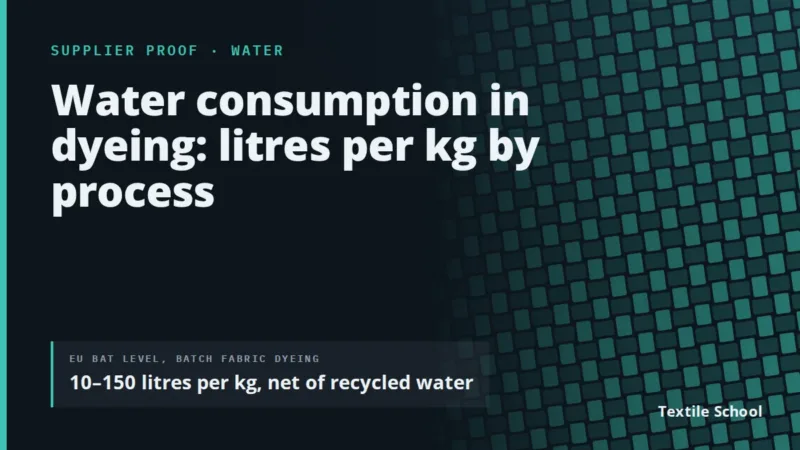
- The EU BAT level for batch fabric dyeing is 10–150 litres per kg, net of recycled water. Yarn is 3–140, loose fibre 13–60 and continuous dyeing 2–16, each a yearly average for one process.
- India: the Central Pollution Control Board’s water charter for the Ganga basin froze knit processing at 85 L/kg and woven cotton at 120, with targets of 58 and 82 two years after its release.
- China: the 2023 printing and dyeing conditions allow up to 85 tonnes of fresh water per tonne of yarn or knit fabric, and 1.4 tonnes per 100 metres of woven fabric.
- Bangladesh: a 2023 survey of 18 factories found an average of 136 L/kg of dyehouse water.
- The Higg FEM sets no litres-per-kilogram benchmark. It measures you against your own baseline and divides by product shipped.
Benchmarks by process: the EU BAT levels
The textiles BAT conclusions (Commission Implementing Decision (EU) 2022/2508 of 9 December 2022, Official Journal L 325, 20 December 2022) cover EU installations that pre-treat or dye textiles with a capacity above 10 tonnes a day. Table 1.1 gives what the Decision calls indicative environmental performance levels for specific water consumption, as yearly averages in cubic metres per tonne, which is the same number as litres per kilogram.
| Process | Indicative level, L/kg (m³/t), yearly average | Note in the Decision |
|---|---|---|
| Bleaching, batch | 10–32 | Lower end with a high level of water recycling |
| Bleaching, continuous | 3–8 | — |
| Scouring of cellulosic materials, batch | 5–15 | Lower end with high recycling |
| Scouring of cellulosic materials, continuous | 5–12 | Lower end with high recycling |
| Desizing of cellulosic materials | 5–12 | Lower end with high recycling |
| Combined bleaching, scouring and desizing of cellulosic materials | 9–20 | Lower end with high recycling |
| Mercerisation | 2–13 | Lower end with high recycling |
| Washing of synthetic material | 5–20 | Lower end with high recycling |
| Batch dyeing, fabric | 10–150 | Lower end with high recycling |
| Batch dyeing, yarn | 3–140 | Lower end with high recycling; also applies to combined yarn and loose-fibre dyeing |
| Batch dyeing, loose fibre | 13–60 | — |
| Continuous dyeing | 2–16 | Lower end with high recycling; up to 100 in plants combining continuous and batch processes |
- Net of recycling. The water counted is everything a process consumes in the year, including washing and rinsing the textile and cleaning the equipment, minus the water reused or recycled back to that process, divided by the tonnes treated in that process. The lower ends, the Decision says, may be reached with a high level of water recycling, for example on sites with integrated water management for several plants.
- Per process. A knit dyehouse that scours and bleaches in its jets before dyeing runs two processes from the table, and one meter on the dyehouse header measures both.
- Indicative. The Decision keeps the term BAT-associated environmental performance level (BAT-AEPL) for other measures, such as wool-grease recovery. The monitoring it pairs with the water levels (BAT 6) is yearly, measured directly where possible, with meters or invoices acceptable, and broken down to process level as far as possible.
The batch fabric range spans fifteen-fold because shade depth, fibre, dye class and machine all move it. Inside the range is not the same as good; outside it is a flag that needs an explanation.
Other published benchmarks, and what each one counts
| Source | Who it covers | Figures | What it counts |
|---|---|---|---|
| CPCB charter (India) | Textile units in the Ganga basin states | Knit 85, woven and woven cotton 120, polyester 60, polyester-viscose 90 L/kg; after two years 58, 82, 41 and 61 | Inlet water per kg of product |
| MIIT conditions, 2023 (China) | Printing and dyeing enterprises in mainland China | Yarn and knit fabric up to 85 t per t; cotton, linen, man-made and blended woven fabric up to 1.4 t per 100 m | Fresh water drawn per unit of a standard product |
| Uddin et al., 2023 (Bangladesh) | 18 wet-processing factories near Dhaka | Averages 136 L/kg dyehouse water, 164 L/kg groundwater; factories from 28 to 285 L/kg | Self-reported yearly figures per kg processed |
India. The Central Pollution Control Board’s Charter for Water Recycling and Pollution Prevention in Textile Industries in Ganga River Basin (Table 7(a)) describes its first column as the average at release, frozen as the upper limit, followed by a 20% cut after one year and a further 15% after two. Units record water per tonne of product and monitor inlet water; effluent of up to 85% of the water consumed is the allowance. The charter is undated on its face, and its action plan runs to 31 December 2022. It is written for one river basin, not as a national norm.
China. The Ministry of Industry and Information Technology’s Printing and Dyeing Industry Standard Conditions (2023 edition), in force from 12 December 2023, limit fresh water drawn per unit of product. The yarn and knit limit is per tonne of light-shade dyed cotton; other products are converted with the industry standard FZ/T 01105, which we have not read. The woven limit is per 100 metres of a cotton fabric 152 cm wide weighing 10–14 kg per 100 m, which works out at 100–140 L/kg. The conditions also ask for a water reuse rate of at least 45% and a minimum liquor ratio of 1:8 or lower on batch dyeing machines. They call themselves guidance, not compulsory; a dyehouse applies to be listed as meeting them. For a buyer sourcing from both countries, it is the Chinese reference point.
Bangladesh. Uddin and co-authors (PLOS Sustainability and Transformation, 31 July 2023) collected a year’s figures by questionnaire from 18 factories in Gazipur and Narayanganj, mostly knit composites and knit dyehouses running cotton with reactive dyes, about 47% of it deep shade. The averages were 164 L/kg of groundwater drawn, 136 L/kg of dyehouse water and 119 L/kg of wastewater, with standard deviations between 70.6 and 81.8 L/kg. The authors say the sample may not represent the whole industry. It is a survey of peers, not a target.
If a buyer quotes a figure not listed here, ask for its source, process and basis before you compare.
What the Higg FEM asks for
Cascale’s How to Higg guide for the Higg FEM (version 4.0, published October 2025, last updated 18 March 2026) covers FEM 2025, whose reporting period is the 2025 calendar year.
- Production and domestic water. Production water includes dyeing and rinse water, steam generation and cleaning of equipment that touches the product. Domestic water covers washrooms, drinking, food, irrigation and non-contact cooling. The FEM asks whether you track the two separately.
- Every source, by name. Blue sources include groundwater, surface and municipal water and rainwater. Grey sources include recycled water (wastewater treated and used again) and reuse water (used directly in another process without treatment). Water cycled through cooling towers counts as neither.
- Who answers what. A facility using 35 m³ or more per operating day, or in an area of high water risk on the WRI Aqueduct tool or the WWF Water Risk Filter, answers every water question; others answer Level 1 only.
- Tracking. For each source: quantity, unit, method and frequency, backed by bills, meter records and meter calibration records. Tracking no source scores zero. RO reject from incoming pre-treatment is asked about but not scored in FEM 2025.
- The denominator. Product shipped or sold in the year, rejects excluded, in the unit the FEM sets for the facility type. A fabric dyehouse is a Material Production facility.
- Baselines. The guide prefers normalised baselines, such as water per metre of fabric, from a full calendar year within the past five years. Reductions count against your own baseline, but not those that come only from producing less. A water balance whose intake and discharge differ by less than 10–15% of total use may be normal, the guide says.
None of the water questions in the guide compares your litres per kilogram with an industry figure. Whether the level is good is for your buyer to judge, against benchmarks like those above.
How to measure your own figure
| Item | EU BAT specific water consumption | Higg FEM |
|---|---|---|
| Fresh water to the process | Counted | Counted, by source (blue water) |
| Water recycled or reused back into the process | Subtracted | Reported as its own grey source |
| Washing, rinsing and cleaning equipment | Counted, inside the process | Production water |
| Steam generation | Not named in the definition | Production water |
| Washrooms, canteen, non-contact cooling | Not part of any process | Domestic water |
| Reject from incoming water treatment, such as RO | Not named in the definition | Asked separately; not scored in FEM 2025 |
| Denominator | Tonnes treated in that process in the year | Product shipped or sold in the year, rejects excluded |
Kilograms of what. A batch stripped and dyed again goes through the jets twice, and on the BAT basis it is arguably textile treated twice; the FEM counts only what ships. A poor right-first-time rate therefore raises the figure per kilogram shipped more than the figure per kilogram processed. The right-first-time reprocessing cost calculator prices the re-dyes.
Where to meter. One layout serves BAT 6 and the FEM: a meter on every source at the boundary (each borewell, the municipal connection, tankers); the softener or RO outlet and its reject; the recycled-water return to production; the dyehouse header, or each machine group if pre-treatment and dyeing are reported separately; the domestic branch and the boiler feed. Production records should give both the kilograms through each process and the kilograms shipped. Monthly readings let the annual total be checked against the bills.
Worked example: one dyehouse, six correct figures
The dyehouse is invented. It dyes cotton single jersey with reactive dyes in soft-flow jets, 300 days a year, scouring and bleaching in the same jets on the same meter.
| Input | Value |
|---|---|
| Fabric loaded into the jets | 24 t a day, including 1.6 t of re-dyes |
| Fabric shipped | 22 t a day; the other 0.4 t is rejects and seconds |
| Process water to the jets | 2,640 m³ a day, of which 528 m³ is RO permeate recycled from the effluent plant |
| Domestic water | 60 m³ a day |
Step 1: litres per kilogram, on two denominators
In the water footprint calculator, enter the fabric, the total process water and the recycled water. Open it with the fabric through the jets, 24,000 kg a day, then with the fabric shipped, 22,000 kg a day.
| What the calculator shows | Per kg through the jets | Per kg shipped |
|---|---|---|
| Water per kg of fabric, recycled water included | 110.00 L/kg | 120.00 L/kg |
| Freshwater per kg | 88.00 L/kg | 96.00 L/kg |
| Recycling rate | 20.00% | 20.00% |
Step 2: the whole site, against a benchmark
In the mill water balance calculator, enter 24 t a day, 110 L/kg of process water before recycling, 20% recycling, the default 8% evaporation, 60 m³ a day of domestic water and 300 operating days. For the benchmark, enter 85 L/kg, the CPCB charter’s frozen knit figure and the Chinese knit limit. Open it with these inputs.
| Result | Shown |
|---|---|
| Fresh process water | 2,112.00 m³/day |
| Total intake | 2,172.00 m³/day |
| Discharged to drain | 1,900.80 m³/day |
| Specific fresh intake | 90.50 L/kg |
| Gap to benchmark | 25.00 L/kg |
| Recycle rate that matches the benchmark | 22.73% |
Two of those lines use the benchmark on different bases. “Gap to benchmark” subtracts 85 from 110, the demand before recycling, though the CPCB and MIIT figures both count fresh water. Like for like, the gap is 90.50 − 85 = 5.50 L/kg for the whole site, or 3.00 L/kg for process water alone. “Recycle rate that matches the benchmark” treats 85 as fresh process water: lift recycling from 20% to 22.73% and the jets draw 85 L/kg. Read the second line; here the first overstates the gap more than four times.
Now set the benchmark to 58, the charter’s two-year knit target, and open it with 58. Recycling alone would have to reach 47.27% of demand. The calculator’s notes say why that is usually out of reach: recycled water carries salts, colour and hardness that build up with every pass, so most mills use it for washing, rinsing and cooling, not for dyeing pale shades. The demand itself has to fall.
Step 3: check the meter against the recipe
The liquor ratio calculator counts the dye bath plus each further fill of the same volume. Count every fill in the cycle, from scouring and bleaching through rinsing, soaping and softening: 14 here, so enter 13 after the dye bath. For a 600 kg batch at 1:6, open it with these inputs: the bath is 3,600.00 L, the batch uses 50.40 m³ and the cycle needs 84.00 L/kg. At 1:8 it needs 112.00 L/kg.
At 1:6 the recipe accounts for 84 of the 110 L/kg the meter records. The other 26 L/kg is what a water audit looks for: overflow rinsing, cleaning between shades, sample machines and leaks. If the jets really run at 1:8, the recipe alone needs more than the meter shows, and either the meter or the production figure is wrong.
Step 4: the six figures, and where each belongs
| Figure, L/kg | Per kg through the jets | Per kg shipped | Where it belongs |
|---|---|---|---|
| Total process water, recycled included | 110.00 | 120.00 | Sizing pumps and the effluent plant |
| Fresh process water, net of recycling | 88.00 | 96.00 | The EU BAT basis (per kg processed) |
| Fresh water for the whole site | 90.50 | 98.73 | CPCB’s inlet-water basis; the FEM’s blue water per kg shipped |
The 88 L/kg of fresh process water covers scouring, bleaching and dyeing together, so it sits inside the BAT range for batch fabric dyeing alone (10–150) before batch bleaching’s 10–32 is added. The site’s 90.50 L/kg is above the CPCB charter’s frozen knit figure of 85 and well above its two-year target of 58. The Chinese limit is for light-shade cotton, and this dyehouse runs mixed shades. The 110 L/kg of total water is below the Bangladesh survey’s average of 136 L/kg of dyehouse water, though the study does not say whether recycled water is inside that figure.
In the FEM, for a calendar year, the dyehouse would report 633,600 m³ of groundwater for production, 158,400 m³ of recycled water for production, 18,000 m³ of domestic water under its source, 300 operating days and 6,600,000 kg shipped.
Which figure to send
- Send the figure on the basis the buyer’s form asks for, and state the basis in the same line: fresh or total, process or site, per kilogram processed or shipped, the period, and metered or estimated.
- If the form does not say, send two labelled figures. For the example: “88 L/kg fresh process water per kg of fabric processed, calendar year, metered, net of 20% recycled water; 98.73 L/kg site fresh water per kg shipped.”
- Give the recycle rate separately. A low figure reached by recycling and one reached by short liquor ratios are different achievements, and a buyer comparing suppliers needs to see which.
Water usually sits beside energy on the same questionnaire. For the carbon half, the supplier carbon questionnaire guide works through Scope 1 and 2 from a dyehouse’s own fuel and power bills.
Bringing the figure down
The BAT conclusions for water (BAT 10) start with a water management plan, water balances, efficiency objectives and a yearly water audit. They add scheduling dark shades after light ones in the same machine, segregating clean streams such as cooling water for reuse, low-liquor-ratio machines, several small drain-and-fill rinses, countercurrent washing on continuous ranges, and reuse of process liquor and water. For reactive dyeing of cellulose they add hot rinsing, up to 95 °C, without detergent and with the heat recovered, and removing unfixed dye with enzymes or vinyl polymers so that fewer rinses are needed. For the general formulas behind water-use efficiency and recycling rates, see our water and energy efficiency calculations.
How this page is kept
Last verified: 3 October 2026. The process levels and definitions come from Decision (EU) 2022/2508; the Indian figures from CPCB’s Ganga basin charter; the Chinese limits from MIIT Announcement No. 35 of 2023 and its attachment; the Bangladesh averages from Uddin et al. (2023); and the FEM’s rules from Cascale’s How to Higg guide for FEM 2025, each linked where it is used. The dyehouse is invented; every figure attributed to a calculator was computed with its own formula and checked on its page through the links above. This page describes published levels and reporting rules; it is not legal advice, and your permit, your buyer’s requirements and the FEM’s current guidance govern your own reporting. Corrections are welcome through the contact page.