Home » Sustainability & Compliance » Sustainable Textiles & Circularity

Sustainable Textiles & Circularity

Decarbonization, water, waste, and circularity with measurable KPIs. This section explains practical decision criteria, typical test methods, and failure modes that matter in real production. Readers get checklists, calculation steps, and case examples connecting specifications to cost, reliability, and compliance. Links map core concepts to upstream inputs and downstream processes so choices remain consistent across sourcing, manufacturing, and end-use performance. Each article includes definitions, diagrams where helpful, and plain-language notes to help newcomers ramp quickly while giving experienced professionals the depth needed to troubleshoot and optimize. Standards references are cited with context, and whenever trade-offs exist, we make them explicit so you can defend decisions. The coverage also includes metrics, data tables, and example calculations so results are reproducible. Where regulations apply, we highlight jurisdiction, scope, and verification pathways. Tools and templates are provided to speed up daily work without sacrificing rigor.


Grid emission factor by country: official figures for India, Bangladesh, Vietnam, Türkiye, Indonesia, Sri Lanka, Egypt and China, each with its year and basis.

Printing/Dyeing

Grid Emission Factor by Country: Official Figures for Textile Mills, and What Each Does to Scope 2

Official grid emission factors for nine textile manufacturing countries, each with its year, basis and publisher, from India’s 0.675 t CO2/MWh for 2025-26 to the countries that publish only margins or nothing. Worked for one illustrative dyehouse in the carbon footprint calculator.

Read more »

Article

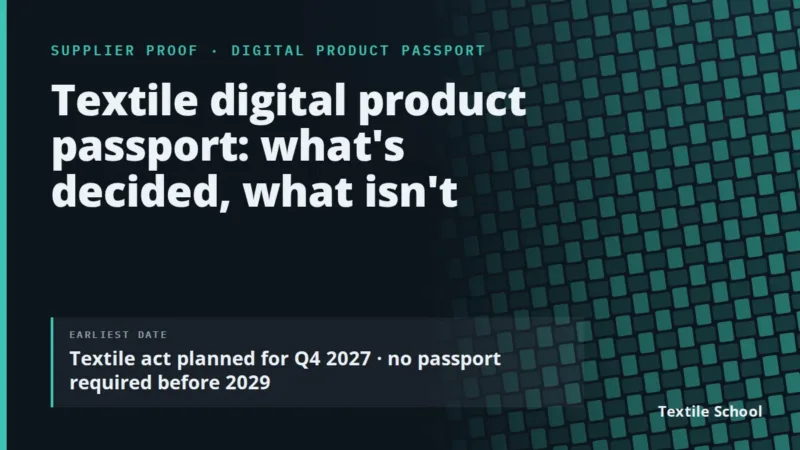
Textile digital product passport: what is decided and what is not. The textile act is planned for Q4 2027 and no passport is required before 2029.

Business & Marketing

Textile Digital Product Passport: Dates, What’s Decided and What Isn’t

No textile digital product passport is required yet: the EU act that would create one is planned for late 2027 and cannot apply until at least 18 months after it takes effect. What is decided, what is only planned, what is still open, and what a supplier can sensibly hold now.

Read more »

Article

Scroll to Top

Follow on WhatsApp

Scan with your phone’s camera to open the channel, then tap Follow.

QR code for the WhatsApp channelOr open WhatsApp on this device