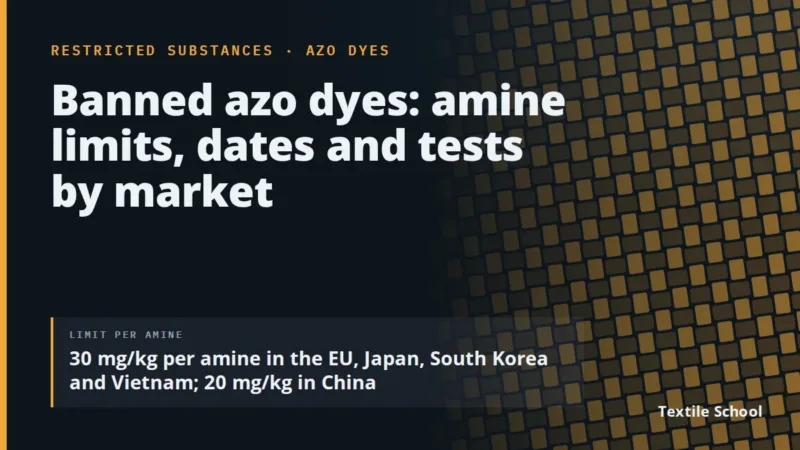
No market bans azo dyes as a class. What is banned is the group of azo colourants that, when the azo bond is broken by reduction, release one of a listed set of carcinogenic aromatic amines. Banned azo dyes are defined by the amine they release, not by their name, which is why every rule below is enforced by testing the dyed fabric for amines, not by checking a dye list.
The figures a dyehouse needs: 30 mg/kg per amine in the EU, Japan, South Korea and Vietnam; 20 mg/kg in China and in the widely used buyer lists OEKO-TEX STANDARD 100 and AFIRM. The EU and Vietnam list 22 amines; China, Japan and Korea list 24, adding 2,4-xylidine and 2,6-xylidine. The textile test is EN ISO 14362-1:2017, with EN ISO 14362-3:2017 for the one amine the first method cannot see. This page sets out each market’s rule as its own text states it, what the test does and where it misleads, and what a dyehouse in India, Bangladesh or Pakistan keeps on file.
Banned azo dyes: the short version
- The EU has restricted these dyes since 11 September 2003, first under Directive 2002/61/EC and since 1 June 2009 under REACH Annex XVII, entry 43. There is no exemption for recycled fibre or second-hand goods.
- China bans them in all three safety classes of GB 18401-2010, with a limit value of 20 mg/kg.
- Japan, South Korea and Vietnam set 30 mg/kg for each amine; Japan and Korea test for 24 amines, Vietnam for the EU’s 22.
- The Eurasian Economic Union sets no azo or amine requirement in its light-industry or children’s regulations; a figure quoted for it comes from a laboratory or a buyer, not the law.
- India bans the handling of named azo and benzidine dyes, and textiles imported into India must not contain them.
- The United States sets no federal limit. A notice rule covers benzidine-based dyes, and California’s Proposition 65 requires warnings.
- Buyer lists such as OEKO-TEX and AFIRM set 20 mg/kg for each of 24 or more amines, whatever the destination.
Banned azo dyes by market
| Market | Rule | Limit | Amines | What it covers | Test it names | Applies from |
|---|---|---|---|---|---|---|
| European Union | REACH Annex XVII, entry 43 | Above 30 mg/kg (0.003% by weight) in the article or its dyed parts; read per amine | 22 | Textile and leather articles that may come into direct and prolonged contact with the skin or mouth, “such as” clothing, bedding, towels, hats, nappies and sleeping bags; footwear, gloves, watch straps, handbags, wallets and chair covers; textile or leather toys; and yarn and fabric for the final consumer (the list is longer) | EN ISO 14362-1 and -3:2017 (textiles); EN ISO 17234-1:2015 and 17234-2:2011 (leather) | 11 September 2003 |
| China | GB 18401-2010 (mandatory) | Banned, with a limit value of 20 mg/kg | 24 | Class A (infant), B (skin contact) and C (no skin contact) alike. Its Appendix A excludes, among others, shoes, umbrellas, suitcases and backpacks, carpets, soft toys, and industrial, agricultural and medical textiles. GB 31701-2015 applies it to children’s products | GB/T 17592-2024 (in force since 1 April 2025), then GB/T 23344-2009 for 4-aminoazobenzene | 1 August 2011 |
| Japan | Act No. 112 of 1973: Cabinet Order 175/2015 and the enforcement regulations | 30 µg per gram of sample (30 mg/kg) for each amine | 24 | A closed list: nappies and nappy covers, underwear, nightwear, gloves, socks, mid-layer and outer garments, hats, bedding, floor coverings, tablecloths, neckwear, handkerchiefs, and towels, bath mats and related products; and leather and fur underwear, gloves, garments, hats and floor coverings. Ministry guidance has samples cut from the parts in direct or prolonged contact with the skin or mouth | The health ministry’s method, set by notice; for sampling it refers to JIS L 1940 | 1 April 2016 |
| South Korea | KATS safety standards for household, infant and children’s textiles | 30 mg/kg each | 24 | Dyed fibre parts only. Household textiles for ages 14 and over; infant textiles under 36 months; children’s textiles from 36 months to 13 years | Korea’s own Appendix B method, plus KS K 0739 for 4-aminoazobenzene | Current standards in force since 7 March 2024 |
| Vietnam | QCVN 01:2017/BCT (Circular 21/2017/TT-BCT) | 30 mg/kg for each amine | 22 | Textile products listed by HS code in its Appendix I. Unbleached and undyed goods are excluded | TCVN 12512-1 and -3:2018, identical to ISO 14362-1 and -3:2017, since Amendment 01:2026 (1 July 2026); ISO 24362 or EN 14362 before that | 1 January 2019 (postponed from 1 May 2018 by Circular 07/2018/TT-BCT) |
| India (imports) | General Note 10 to the import policy, resting on the 1990 and 1997 dye bans | No figure: imported textiles must not contain the banned dyes | Named dyes, not amines | Textiles and textile articles imported into India, with a pre-shipment test certificate | Not named; India’s methods are IS 15570 and IS 17336 | 1997 ban in force from late June 1997 |
| Eurasian Economic Union | TR CU 017/2011 and TR CU 007/2011 | None | — | No azo or amine provision in either regulation or its list of test standards | — | — |
| United States | No federal limit; 40 CFR 721.1660; California Proposition 65 | None | — | A 90-day notice duty for benzidine-based dyes, including in imported articles; Proposition 65 warnings | — | Articles covered from 27 February 2015 |
Per amine. The EU entry speaks of “one or more of the aromatic amines … above 30 mg/kg” and does not say “each”. Laboratories and authorities apply it to each amine separately, and Japan, Korea and Vietnam write “each” into their texts. China’s footnote gives “limit value ≤20 mg/kg” without saying each or in total; laboratories report and apply it per amine.
What the EU entry reaches. Its first paragraph bans using these dyes in the listed articles, which binds a dyehouse in the EU. Its second bans placing such articles on the market, which binds the importer of finished goods. The product list opens with “such as”, so it is a set of examples; the test is direct and prolonged contact with the skin or mouth. Fabric sold to a garment maker is not on the list as such, but the garment it becomes is, so the requirement reaches the mill through the order. A separate paragraph bans one blue chromium-complex dye, listed in Appendix 9, above 0.1% in any dye mixture for colouring textiles or leather, since 30 June 2004.
No recycled-fibre exemption. The 2002 directive let recycled fibres release up to 70 ppm of the listed amines from earlier dyeing, but only until 1 January 2005. Entry 43 has had no such clause since. Recycled cotton and polyester sold into the EU meet the same 30 mg/kg as virgin fibre. (Entry 72, on substances that cause cancer, gene mutations or harm to fertility in clothing, does exempt second-hand clothing; that exemption does not carry over to azo dyes.)
Buyer lists are tighter than the law
| List | Limit | Applies to | Amines |
|---|---|---|---|
| OEKO-TEX STANDARD 100 (restricted substance list version 03.2026) | 20 mg/kg each, in all four product classes | The finished textile | 27 amines and 4 amine salts, including both xylidines; aniline is listed separately (20 mg/kg for baby articles, 50 for the other classes) |
| AFIRM RSL (version 11, 2026) | 20 ppm each; reporting limit 5 ppm each | The finished material | 24 amines and 4 salts |
| ZDHC MRSL V4.0 (see the ZDHC MRSL) | 150 mg/kg per substance | The dye or chemical formulation, before use | 24 amines and 4 salts |
The ZDHC figure applies to the dye as bought, not to the fabric. A dye at the 150 mg/kg limit, applied at a 10% shade, could put up to 15 mg/kg of that amine on the fabric (150 × 0.10) if all of it stayed on the fibre, and a deep shade built from several dyes can add more. An MRSL-conforming dye keeps most shades well under 20 mg/kg, but it does not prove the deepest ones. Ask for the MRSL conformance level for each dye, and test the fabric as well.
The 24 amines
Numbers 1 to 22 are REACH Appendix 8, which Vietnam, India’s IS 15570 and EN ISO 14362-1 follow. China, Japan and Korea add numbers 23 and 24. Numbers 5 and 6 are reduced further during the test and are measured as numbers 18 and 19.
| # | Amine | CAS No |
|---|---|---|
| 1 | 4-aminobiphenyl | 92-67-1 |
| 2 | benzidine | 92-87-5 |
| 3 | 4-chloro-o-toluidine | 95-69-2 |
| 4 | 2-naphthylamine | 91-59-8 |
| 5 | o-aminoazotoluene | 97-56-3 |
| 6 | 5-nitro-o-toluidine | 99-55-8 |
| 7 | 4-chloroaniline | 106-47-8 |
| 8 | 4-methoxy-m-phenylenediamine | 615-05-4 |
| 9 | 4,4′-methylenedianiline | 101-77-9 |
| 10 | 3,3′-dichlorobenzidine | 91-94-1 |
| 11 | 3,3′-dimethoxybenzidine (o-dianisidine) | 119-90-4 |
| 12 | 3,3′-dimethylbenzidine | 119-93-7 |
| 13 | 4,4′-methylenedi-o-toluidine | 838-88-0 |
| 14 | p-cresidine | 120-71-8 |
| 15 | 4,4′-methylene-bis(2-chloroaniline) | 101-14-4 |
| 16 | 4,4′-oxydianiline | 101-80-4 |
| 17 | 4,4′-thiodianiline | 139-65-1 |
| 18 | o-toluidine | 95-53-4 |
| 19 | 4-methyl-m-phenylenediamine (2,4-diaminotoluene) | 95-80-7 |
| 20 | 2,4,5-trimethylaniline | 137-17-7 |
| 21 | o-anisidine | 90-04-0 |
| 22 | 4-aminoazobenzene | 60-09-3 |
| 23 | 2,4-xylidine (China, Japan, Korea) | 95-68-1 |
| 24 | 2,6-xylidine (China, Japan, Korea) | 87-62-7 |
How the azo test works, and where it misleads
EN ISO 14362-1:2017 reduces the dye on the fabric with sodium dithionite in a citrate buffer at pH 6 and 70 °C, and measures the amines released. Polyester, polyamide, acetate, triacetate, acrylic and chlorofibre dyed with disperse dyes are extracted first, with xylene since the 2017 edition. Pigment prints, and any material where pigment use is uncertain, go to direct reduction. The method covers dyed, printed and coated textiles. Leather has its own method, EN ISO 17234-1, which tests all 24 amines.
The amine the first test cannot see. Dyes that release 4-aminoazobenzene break down further under these conditions, into aniline and 1,4-phenylenediamine. The standard’s rule is that aniline above 5 mg/kg triggers the second method, EN ISO 14362-3:2017, which reduces under alkaline conditions at 40 °C. The standard’s own example of such a dye is Disperse Yellow 23, so this matters most for disperse-dyed polyester. For leather the second method is EN ISO 17234-2:2011. China’s GB 18401 writes the same sequence into its text.
Sampling. Up to three colours may be tested together, and white or uncoloured parts need not be tested, though pale prints need attention. Material under 0.5 g in total is a minor component, and below 0.2 g it is not analysed. Japan’s health ministry guidance adds a rule worth copying: if a pooled result for any amine falls between 5 and 30, test each colour on its own.
Confirmation. A positive result has to be confirmed by a second chromatographic method. EN ISO 14362-3 itself warns that 4-aminoazobenzene results below 30 mg/kg need care in interpretation. That is one reason a buyer’s 20 mg/kg is harder to work to than the EU’s 30.
Results that do not mean what they seem.
- 4-chloroaniline in dark shades. ZDHC’s wastewater guidelines note that it can be a trace contaminant in dyes that are not restricted, particularly where a mill dyes many black or dark shades. A low 4-chloroaniline result on a black is not proof of a banned dye.
- Two amines appear under other names. o-Aminoazotoluene and 5-nitro-o-toluidine (numbers 5 and 6) are reduced further during the test and show up as o-toluidine and 2,4-diaminotoluene.
- Known false positives. ETAD, the dye makers’ association, in its information notice on the azo rules (revised 2008), says a 4-aminobiphenyl finding “should always be treated with suspicion”, because no known azo dye or pigment forms it, and gives C.I. Acid Red 1 and C.I. Solvent Yellow 7 as sources of false results. It also warns that aggressive laboratory conditions tend to produce false positives.
Reading one result against two markets
An illustrative case with invented figures: a laboratory reports 18 mg/kg of 3,3′-dimethoxybenzidine in a dark red cotton, with 25% expanded uncertainty. In the restricted substance limit calculator, put the EU’s 30 in the limit field and China’s 20 in the later-limit field:
- The result runs from 13.5 to 22.5 mg/kg. Its upper bound is well under 30, so it is conclusively below the EU, Japanese, Korean and Vietnamese limits.
- With a guard band of one expanded uncertainty, the acceptance limit against 30 is 25.5 mg/kg, leaving 7.5 mg/kg of headroom.
- Against 20 mg/kg the result is 2 mg/kg under, but its upper bound is 2.5 mg/kg over. It does not clear China, OEKO-TEX or AFIRM.
The same lot is a pass for one order and not for the next. The guard band is a laboratory convention, not something any of these rules sets, and a buyer may set its own decision rule. Open the calculator with these figures.
Where failures have come from
Our count of the EU’s Safety Gate weekly reports finds 70 alerts between January 2012 and September 2026 for clothing, textiles and other dyed goods with azo dyes releasing listed amines (clothing and textiles read from 2012, other non-chemical categories from 2019). They fell from 12 in 2012 to one a year from 2020 to 2023, and there were none in 2024, 2025 or 2026 to the end of September. The last was a balaclava in 2023, with 140 mg/kg of benzidine. China was the country of origin in 37 cases and India in 14.
Benzidine itself was named in 28 of the alerts, and benzidine or one of its congeners in 41; 3,3′-dimethoxybenzidine was named in 17 and 4-aminoazobenzene in 15. Benzidine and its congeners are the parent amines of the benzidine-based dyes India banned in 1990, which is why the Indian cases are worth reading as a warning about old dye stock and unverified dye sources.
What a dyehouse keeps on file
- Dye declarations. For each dye: its Colour Index name, the supplier’s statement that it releases none of the 24 amines, and its ZDHC MRSL conformance level. Ask for the 24, not the EU’s 22, because most buyers use the longer list.
- A dye inventory without the banned names. Check stock against India’s 1997 schedule of 70 azo dyes and the 1990 benzidine ban. Old or relabelled stock is the likeliest source of a failure.
- A test plan by colour and material. Dark shades, reds and blacks, disperse-dyed polyester (for 4-aminoazobenzene) and pigment prints first. Leather trims under EN ISO 17234-1.
- The right questions for the laboratory. Which list it tests (22 or 24 amines), which edition of the method, whether aniline triggered the second method, the reporting limit, the expanded uncertainty, and whether colours were pooled. For leather, whether it used EN ISO 17234-1:2024 or the 2015 edition that REACH still names.
- Reports kept per lot, with the recipe card that shows which dyes went into which shade.
India’s own rules
India regulates the dyes themselves under the Environment (Protection) Act, 1986. Notification S.O. 108(E) of 30 January 1990 prohibits benzidine-based dyes in dyeing and colour processing and gave three years to stop using them. Notification S.O. 243(E) of 26 March 1997 prohibits the “handling” of 70 azo dyes, listed by Colour Index name and number, from 90 days after its issue. The Act defines handling broadly: manufacture, processing, storage, transport, use and offering for sale, among other acts. The often-quoted figure of “112 banned dyes” adds to the 70 a list of 42 benzidine-based dyes that testing laboratories attribute to the 1990 ban; the 1990 notification as published names no dyes and gives no number.
Imported textiles fall under General Note 10 to the import policy: they must not contain any dye banned under the Act, and each consignment needs a pre-shipment certificate from a laboratory accredited in the country of origin. Without one, samples are tested by the Textiles Committee or Central Silk Board laboratories. Imports from countries listed in the policy’s Appendix 2X, where azo dyes are banned, are exempt from that testing. The import condition sets no mg/kg figure.
India has two test standards. IS 15570:2005 is BIS’s own method; it covers the 22 amines and concludes that azo dyes were used when any amine exceeds 30 mg/kg. IS 17336 (Parts 1 and 3):2019 are identical to ISO 14362-1 and -3:2017, and are the ones to cite to an export buyer. The Eco-Mark figures in Indian standards are voluntary.
Questions dyehouses ask
Are all azo dyes banned?
No. Only azo colourants that release one of the listed amines when the azo bond is reduced. The rule is defined by the amine, so a dye’s class or name settles nothing; its supplier’s declaration and the fabric test do.
Does the EU limit apply to recycled fibre?
Yes. The only derogation for recycled fibres ended on 1 January 2005. Recycled content meets the same 30 mg/kg as virgin fibre.
Is there an azo limit for Russia and the Eurasian Economic Union?
Not in the law. TR CU 017/2011 and TR CU 007/2011 contain no azo or aromatic-amine requirement, and their lists of test standards include no azo method. A figure for that market comes from a buyer or a laboratory’s own practice.
Does a certificate replace the test in Vietnam?
For sampling, yes. QCVN 01:2017/BCT exempts products holding a listed eco-label from sampling for formaldehyde and amines; OEKO-TEX STANDARD 100 is on the list. The limits still apply.
Is the United States safe without a test?
There is no federal limit, but 40 CFR 721.1660 requires 90 days’ notice to the EPA before listed benzidine-based dyes are imported for a significant new use, including as part of an article, and 21 of the EU’s 22 amines are on California’s Proposition 65 list, which requires a warning, not a limit. Many US brands work to their own lists, such as AFIRM’s 20 ppm.
How this page is kept
Last verified: 3 October 2026. Built from the consolidated REACH text of 22 June 2026 and the directives behind entry 43; the official texts of GB 18401-2010 and GB 31701-2015 and China’s standards registry; Japan’s Cabinet Order 175/2015, Enforcement Regulations and health-ministry notices; Korea’s KATS notices; Vietnam’s Circulars 21/2017, 07/2018 and 37/2026; the EAEU regulations and their standards lists; India’s 1990 and 1997 notifications, import policy and BIS records; 40 CFR 721.1660 and the Proposition 65 list of 31 July 2026; the published scopes of EN ISO 14362-1, 14362-3 and 17234-1; and the current OEKO-TEX, ZDHC and AFIRM lists. The ZDHC row was updated on 31 October 2026 to MRSL V4.0 (October 2026), whose group 1Q keeps 150 mg/kg per substance and the same 24 amines and 4 salts as V3.1. The REACH record in this site's regulation register carries the instrument. This page describes what each rule says; it is not legal advice for a particular product or shipment. Corrections are welcome through the contact page.
More on restricted substances: PFAS in textiles: limits and dates by market.