

The Importance of Sustainability in Denim
Growing concern over the environmental and health impacts of textiles in general and denim, in particular, are putting pressure on companies to employ more sustainable production methods.
Article
Apparel product development from tech packs to fit. Pattern, grading, sewing line balancing, quality, and compliance for brands and OEMs. This section explains practical decision criteria, typical test methods, and failure modes that matter in real production. Readers get checklists, calculation steps, and case examples connecting specifications to cost, reliability, and compliance. Links map core concepts to upstream inputs and downstream processes so choices remain consistent across sourcing, manufacturing, and end-use performance. Each article includes definitions, diagrams where helpful, and plain-language notes to help newcomers ramp quickly while giving experienced professionals the depth needed to troubleshoot and optimize. Standards references are cited with context, and whenever trade-offs exist, we make them explicit so you can defend decisions.
Growing concern over the environmental and health impacts of textiles in general and denim, in particular, are putting pressure on companies to employ more sustainable production methods.
Article

Among many pollution-creating industries, textile has a larger share in terms of its impact with regard to noise, air, and effluent. It is, therefore, felt worthwhile to study the environmental hazards associated with various operations of textiles. In this paper, pollution arising out of noise and air is discussed. Areas of concern and their appropriate rectifying procedures are also taken into account.
Ecological degradation happens in natural fiber right from cultivation to finishing of the ultimate product. Prominent parameters and the possible package of corrective measures are highlighted. Synthetic fiber industry is not an exception to environmental pollution and therefore various pollution-creating activities are pointed out. Management of various textile wastes is also mentioned in this paper.
Article

Textile products are crafted analyzing numerous internal and external factors bound to the end products. Before, during, and after designing a product, a series of factors such as the market trends, market research, quality testing, trials, design patterns, etc. to be arranged or considered by the designer. Here we discuss a few of them.
Article

Apparel testing is essential before shipment to foreign countries like the US and EU. Selection of a suitable testing lab is required to get the right result. In order to achieve this, the lab has to equip themselves with equipment, calibration, proficiency testing, training etc. Such aspects have been critically reviewed in this paper.
Article
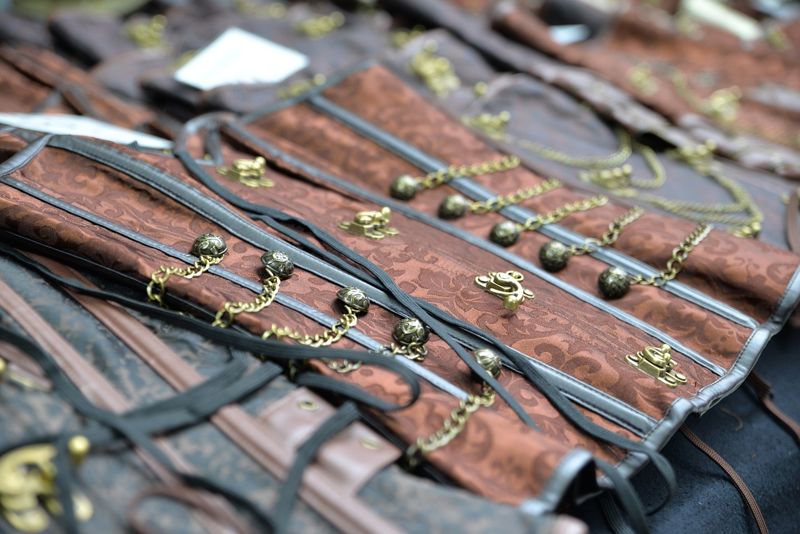
Corset has been a vogue for several reasons. From posture improvement to waist training, the corset has helped women look gorgeous for hundreds of years. There are various types of corsets today, and unlike the ones of olden times, these can even be worn to make a fashion statement. These garments were once used just to enhance the woman’s shape or keep her from jiggling. Today, they are sexy, fun under and outer garments, helping women feel feminine and sensual. They are made from a variety of fabrics and have trimmings such as lace and bows.
Article

Pressures in the apparel industry are complex, multidimensional, and not easy to classify. However, based on the review of experiences shared by the peers in the industry, they are classified into four categories and discussed in the paper.
Article

Textile components are accessories that are used to decorate, strengthen, close, or enhance the appearance of textile products. In this article most commonly used components such as fasteners and others are discussed.
Article

The earliest evidence of textile production in India comes from the Indus Valley, where a complete Urban civilization centred around the two cities of Mahenjodaro and Harappa, thrived between 2500 and 2000 BC. Along with the many figurines and engraved seals, numerous spindle whorls of wool and coarse cotton, some copper sewing needles were found.
The recent discovery of excavated seals at the port town of Lothal on the west coast of Gujarat and Dhula-vira in Kutch, indicate that the sophisticated culture, already engaging in the export trade, was in place before this time. The earliest textile impression found in the subcontinent comes from Mehergarh, an Indus Valley site in Beluchistan. This impression of a woven fabric and a large number of cotton seeds also unearthed, date from 5000 BC. , by which time that appears cotton cultivation and textile weaving were already advanced.
Article

The first known humans to make clothing, Neanderthal man, survived from about 200,000 B.C.E. to about 30,000 B.C.E. During this time the earth’s temperature rose and fell dramatically, creating a series of ice ages throughout the northern areas of Europe and Asia where the Neanderthal man lived. With their compact, muscular bodies that conserved body heat, Neanderthals were well adapted to the cold climate of their day. But it was their large brain that served them best.
Neanderthal man learned to make crude but effective tools from stone. Tools such as spears and axes made Neanderthals strong hunters, and they hunted the hairy mammoths, bears, deer, musk oxen, and other mammals that shared their environment. At some point, Neanderthals learned how to use the thick, furry hides from these animals to keep themselves warm and dry. With this discovery, clothing was born.
Article

Factors affecting online shopping for e-retailers are knowing consumer buying behaviour and the buying pattern of goods, which are identified as demographics, psychographics, and website attributes.
Article
Every record in these registers was sent in by somebody. Submissions are reviewed before they are published.
1,481 machines in the register.Tell us about a missing one 302 event series in the register.Submit a trade fair or conference 3,037 standards tracked in the register.Get the changes by email each week