On 10 October 2026 the European Union’s restriction on PFHxA starts to apply to clothing, footwear and consumer waterproofing sprays. France has banned PFAS in consumer clothing since January, Denmark since July, and California’s limit halves on 1 January 2027. Each rule measures something different, so one test report rarely answers every market.
This page puts every rule on PFAS in textiles in one place for the people who finish the fabric and answer the buyer: what applies in which market, from when, at what limit, how each limit is measured, and what to keep on file. Every dated row below is a record in this site’s regulation register, read from the official text.
PFAS in textiles: the short version
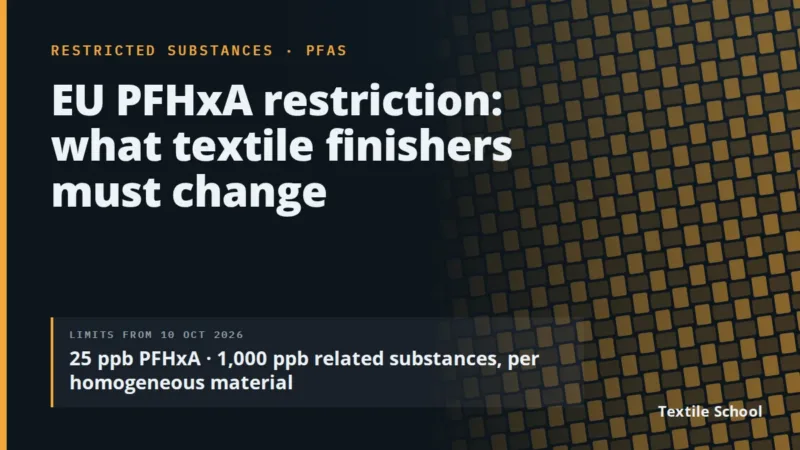
- 10 October 2026, EU: clothing, accessories, footwear and consumer mixtures must stay below 25 ppb PFHxA and 1,000 ppb PFHxA-related substances, measured in each homogeneous material. Home textiles follow on 10 October 2027.
- Already in force: France (since 1 January 2026), Denmark (1 July 2026), Maine (1 January 2026), New York (1 January 2025) and California (1 January 2025).
- 1 January 2027: California’s total organic fluorine threshold falls from 100 ppm to 50 ppm; Washington’s apparel restriction begins.
- 1 January 2028: outdoor apparel for severe wet conditions loses its deferral in California and New York, and Colorado’s ban begins.
- 1 January 2030: France extends its ban to all textiles, home textiles included.
Every PFAS rule for textiles, by date
Generated from the regulation register on 3 October 2026. Each row opens the record, which quotes the official text and links to it. Rows marked ▲ take effect within 90 days of that date.
| From | Market | What applies | Status |
|---|---|---|---|
| 1 Jan 2023 | Maine | Since 1 January 2023 a carpet or rug, and a fabric treatment, containing intentionally added PFAS may not be sold, offered for sale or distributed for sale in Maine. Maine PFAS in products law | In force |
| 1 Jan 2025 | California | From 1 January 2025 no person may manufacture, distribute, sell or offer for sale in California any new, not previously used, textile article containing regulated perfluoroalkyl and polyfluoroalkyl substances (PFAS). Safer Clothes and Textiles Act | In force |
| 1 Jan 2025 | New York | After 1 January 2025 no person may sell or offer for sale in New York apparel containing PFAS as intentionally added chemicals. New York PFAS in apparel law | In force |
| 1 Jan 2026 | France | From 1 January 2026 the manufacture, import, export and placing on the market, paid or free, of clothing textiles, footwear, and waterproofing agents for clothing textiles and footwear intended for consumers that contain PFAS is prohibited, except clothing and footwear designed for the protection and safety of persons, in particular for national defence or civil security missions. France PFAS law | In force |
| 1 Jan 2026 | Maine | From 1 January 2026 a textile article containing intentionally added PFAS, and upholstered furniture containing intentionally added PFAS, may not be sold, offered for sale or distributed for sale in Maine. Maine PFAS in products law | In force |
| 1 Jul 2026 | Denmark | From 1 July 2026 businesses may not import or sell clothing or footwear for private use in which at least one component article contains total fluorine of 50 mg F/kg or more, nor waterproofing agents for such clothing or footwear at or above the same level. Denmark PFAS clothing ban | In force |
| 10 Oct 2026 ▲ | European Union | From 10 October 2026, textiles, leather, furs and hides in clothing and related accessories for the general public, footwear for the general public, and mixtures for the general public may not be placed on the market or used at or above 25 ppb for the sum of PFHxA and its salts, or 1,000 ppb for the sum of PFHxA-related substances, measured in homogeneous material. EU PFHxA restriction | Adopted, applies on this date |
| 1 Jan 2027 ▲ | California | From 1 January 2027 the total organic fluorine threshold in the definition of "regulated PFAS" falls from 100 ppm to 50 ppm, so a textile article at or above 50 ppm total organic fluorine is inside the prohibition and the certificate-of-compliance duty. Safer Clothes and Textiles Act | Adopted, applies on this date |
| 1 Jan 2027 ▲ | New York | One year after DEC adopts its implementing regulations, and no later than 1 January 2027, apparel containing PFAS at or above a level DEC sets in regulation may not be sold or offered for sale in New York. New York PFAS in apparel law | Expected; date or level not fixed |
| 1 Jan 2027 ▲ | Washington | From 1 January 2027 apparel and accessories containing intentionally added PFAS may not be manufactured, sold or distributed in Washington. Washington Safer Products PFAS rule | Adopted, applies on this date |
| 10 Oct 2027 | European Union | From 10 October 2027, the same limits apply to textiles, leather, furs and hides for the general public other than clothing and related accessories, such as carpets, rugs, curtains, blinds, upholstery, textile wall coverings, tablecloths and bed linen. EU PFHxA restriction | Adopted, applies on this date |
| 1 Jan 2028 | California | From 1 January 2028 the deferral for outdoor apparel for severe wet conditions ends, and the prohibition on regulated PFAS applies to that apparel as well. Safer Clothes and Textiles Act | Adopted, applies on this date |
| 1 Jan 2028 | Colorado | From 1 January 2028 textile articles containing intentionally added PFAS, including accessories, apparel, backpacks and handbags, may not be sold, offered for sale or distributed for sale in Colorado; outdoor apparel for severe wet conditions is banned from the same date. Colorado PFAS consumer protection act | Adopted, applies on this date |
| 1 Jan 2028 | New York | On or after 1 January 2028, outdoor apparel for severe wet conditions containing PFAS as intentionally added chemicals or at or above the regulated level may not be sold or offered for sale in New York. New York PFAS in apparel law | Adopted, applies on this date |
| 1 Jan 2029 | Maine | From 1 January 2029 outdoor apparel for severe wet conditions containing intentionally added PFAS may not be sold in Maine unless accompanied by a legible, easily discernible disclosure stating "Made with PFAS chemicals". Maine PFAS in products law | Adopted, applies on this date |
| 1 Jan 2030 | France | From 1 January 2030 the same prohibition extends to every textile product containing PFAS, except textiles needed for essential uses, those contributing to national sovereignty for which no substitute exists, and technical textiles for industrial use. France PFAS law | Adopted, applies on this date |
| 1 Jan 2032 | Maine | From 1 January 2032 any product containing intentionally added PFAS not already prohibited may not be sold in Maine unless the department has determined by rule that the use is a currently unavoidable use. Maine PFAS in products law | Adopted, applies on this date |
Limits at a glance
The same garment can pass one market and fail the next, because the rules count different things.
| Market | What is counted | Limit |
|---|---|---|
| EU — PFHxA (from 10 Oct 2026) | PFHxA and its salts; PFHxA-related substances; per homogeneous material | 25 ppb; 1,000 ppb |
| EU — C9–C14 PFCAs (since 25 Feb 2023) | Sum of C9–C14 PFCAs and salts; related substances (REACH Annex XVII entry 68) | 25 ppb; 260 ppb |
| EU — PFOA (since 4 Jul 2020) | PFOA and its salts; individual or combined PFOA-related compounds (POPs Regulation) | 0.025 mg/kg (25 ppb); 1 mg/kg |
| France | Any single PFAS by targeted analysis; sum of PFAS; PFAS including polymers | 25 ppb; 250 ppb; 50 ppm |
| Denmark | Total fluorine in each component article | 50 mg F/kg |
| California | Intentionally added PFAS, or total organic fluorine | 100 ppm; 50 ppm from 1 Jan 2027 |
| Washington (from 1 Jan 2027) | Intentionally added PFAS; total fluorine above 50 ppm is presumed to be intentional | 50 ppm presumption |
| New York | Intentionally added PFAS now; a level to be set by regulation (not yet set) | — |
| Maine, Colorado | Intentionally added PFAS | No number |
A unit note, because buyers’ specifications mix them: 1 ppb is 1 µg/kg, 1 ppm is 1 mg/kg, and 0.025 mg/kg is 25 ppb.
Three ways a limit is measured, and why one report is not enough
Targeted analysis looks for named substances and reports each one in ppb. This is what the EU and the first two French thresholds use. The textile method is EN 17681-1:2025, which analyses an alkaline extract by liquid chromatography with tandem mass spectrometry; volatile compounds are covered by EN 17681-2. A targeted report only answers for the substances it looked for.
Total fluorine burns the sample and measures all the fluorine in it, whatever its source. Denmark’s 50 mg F/kg and France’s 50 ppm (polymers included) are total-fluorine limits, and Washington uses the same figure as a presumption. The textile method is EN ISO 20999:2026, combustion with ion chromatography. Both the Danish and French texts let an operator show that fluorine came from something that is not PFAS.
Total organic fluorine, which California and Vermont use, excludes inorganic fluorine. No standardised method for it in textiles had been published as at the date of this page, so laboratories adapt combustion methods from other materials. Ask the laboratory which method it applied before relying on the number.
The practical consequence: a fabric can be under 25 ppb PFHxA and still be far over 50 mg F/kg total fluorine, because the targeted list does not see a fluorinated polymer and the total-fluorine test does. Comparing a single result against a limit also needs its measurement uncertainty; the restricted substance limit calculator works through that.
Where PFAS gets into a finished fabric
- The repellent finish itself. Side-chain fluorinated polymers made with short-chain (C6) chemistry, the finishes widely adopted after PFOA was restricted, are the main source of the “PFHxA-related substances” the EU restriction targets. Under the French and Danish rules, which count polymers or total fluorine, a fluorinated repellent does not pass by being short-chain.
- Shared equipment and water. Limits of 25 ppb are contamination levels. Padders, stenters and baths that have run fluorinated finishes, and recycled process water, can carry enough over to matter.
- Auxiliaries. Some softeners, coatings and soil-release agents are fluorinated. Chemical suppliers’ declarations against a list such as the ZDHC MRSL are the usual first check.
- Components. The EU measures each homogeneous material and Denmark each component article, so zip tapes, labels, laminated membranes, coated trims and thread finishes are judged on their own, not diluted by the shell fabric.
- Recycled fibre. Polyester recycled from old repellent-finished garments can carry fluorine into new yarn. France tolerates PFAS in clothing with at least 20% post-consumer recycled material, in proportion to the recycled share; the EU and Denmark have no such exemption.
Performance without fluorine: what the tests show
Fluorine-free repellents (silicone, hydrocarbon and wax-based chemistries) can reach good water repellency, measured by the spray test in ISO 4920 (AATCC 22). They generally do not give oil repellency, so a fabric specified to an oil grade under ISO 14419 or AATCC 118 needs that requirement revisited with the buyer rather than discovered at inspection. Rain protection that depends on a membrane or coating is measured as hydrostatic head under ISO 811, which a repellent finish does not change. Wash durability is the third axis: agree the spray rating after the buyer’s specified number of washes, not only as finished.
PFAS compliance paperwork: what the rules ask you to hold
- California: the manufacturer gives sellers a certificate of compliance. One issued against the 100 ppm figure does not cover the 50 ppm threshold from 1 January 2027.
- New York: a seller relying on a manufacturer’s certificate of compliance has a safe harbour, and DEC can ask to see it.
- Maine: on the department’s request, a certificate that the product contains no intentionally added PFAS, within 30 days.
- France and Denmark: on request, evidence that fluorine above the threshold does not come from PFAS.
- Outdoor apparel for severe wet conditions: a “Made with PFAS chemicals” disclosure in California now, and in Maine from 2029, until the bans reach it.
- For every market: test reports per component and per method, and chemical suppliers’ declarations for each finish and auxiliary.
Also on the map
- EU — C9 to C21 PFCAs: a Commission act adopted on 7 September 2026, under scrutiny by Parliament and Council, extends the POPs listing and is set to apply from 16 December 2026 once published. See the POPs Regulation record.
- EU — universal PFAS restriction: a proposal, not law. ECHA’s risk committee adopted its opinion in March 2026; the socio-economic committee’s final opinion is expected by the end of 2026, after which the Commission drafts a regulation.
- Vermont: textiles and apparel with intentionally added PFAS or at 100 ppm total organic fluorine since 1 January 2026, 50 ppm from 1 July 2027 (Attorney General’s guidance).
- Connecticut: notification and labelling from 1 July 2026 and a ban on intentionally added PFAS in apparel and textile furnishings from 1 January 2028 (Public Act 24-59).
- Minnesota: fabric treatments and textile furnishings since 1 January 2025; apparel only when the all-products ban arrives in 2032.
- California, later: AB 347 (2024) adds manufacturer registration with a statement of compliance by 1 July 2029, with enforcement by the state from 1 July 2030.
Questions finishers and buyers ask
Is PFAS banned in clothing in the EU?
Not as a class, yet. From 10 October 2026 the EU restricts PFHxA, its salts and PFHxA-related substances in clothing, related accessories, footwear and consumer mixtures, at 25 ppb and 1,000 ppb in each homogeneous material. PFOA and the C9–C14 PFCAs were already restricted. A restriction covering all PFAS is still a proposal, not law. France and Denmark go further on their own territory.
What is the PFHxA limit for textiles?
25 ppb (25 µg/kg) for PFHxA and its salts, and 1,000 ppb for PFHxA-related substances, in each homogeneous material of the article. It applies to clothing, accessories and footwear for the general public from 10 October 2026, and to home textiles from 10 October 2027.
Is a C6 water-repellent finish still allowed?
Short-chain (C6) side-chain fluorinated polymers are the main source of the PFHxA-related substances the EU restriction counts, so C6 finishes are what the 1,000 ppb limit is aimed at: a C6-finished article sold in the EU from 10 October 2026 has to come in under it in every homogeneous material. In France and Denmark, which count total fluorine or include polymers, a fluorinated repellent does not pass by being short-chain.
Which test shows a fabric is PFAS-free?
No single test does. Targeted analysis under EN 17681-1 reports named substances in ppb and answers the EU limits and the first two French thresholds. Total fluorine under EN ISO 20999 answers Denmark’s 50 mg F/kg and France’s 50 ppm. California’s total organic fluorine has no standardised textile method yet, so ask the laboratory which method it used.
Does a fluorine-free finish pass the spray test?
It can. Silicone, hydrocarbon and wax-based repellents can reach good spray ratings under ISO 4920 (AATCC 22), but they generally do not give oil repellency, so an oil grade under ISO 14419 or AATCC 118 has to be agreed again with the buyer. Agree the spray rating after the buyer’s number of washes, not only as finished.
How this page is kept
The dated table is generated from the regulation register, where each instrument is a record that quotes the operative text and links to the official source, with a confidence marker on every date. When a record changes, the table is regenerated. This page describes what the instruments say; it is not legal advice for a particular product or shipment. Corrections are welcome through the contact page.