Cashmere is the fine, dehaired undercoat of the cashmere goat. In US law a product may be called cashmere only if that down averages no more than 19 microns (µm), contains no more than 3% by weight of fibres averaging over 30 µm, and has a coefficient of variation of diameter no more than 24% (15 U.S.C. 68b(a)(6); 16 CFR 300.19). The EU lists cashmere in Annex I, No 2 as the hair of the “kashmir goat”, separately from the cashgora goat (Regulation (EU) No 1007/2011). World production was estimated at 25,611 tonnes of greasy fibre in 2024, 69% of it in China (Textile Exchange, Materials Market Report 2025, p. 41).
- Source: the downy winter coat grown under the coarse guard hair; combed out after the spring moult in China and Mongolia, shorn in Australasia and Iran.
- Fineness: 13–19 µm, against 15–27 µm for Merino wool.
- Yield: on average 0.1–0.2 kg of down per goat a year.
- Use: more than 90% is woollen-spun into knitwear.
What cashmere is: the goat, the down and the guard hair
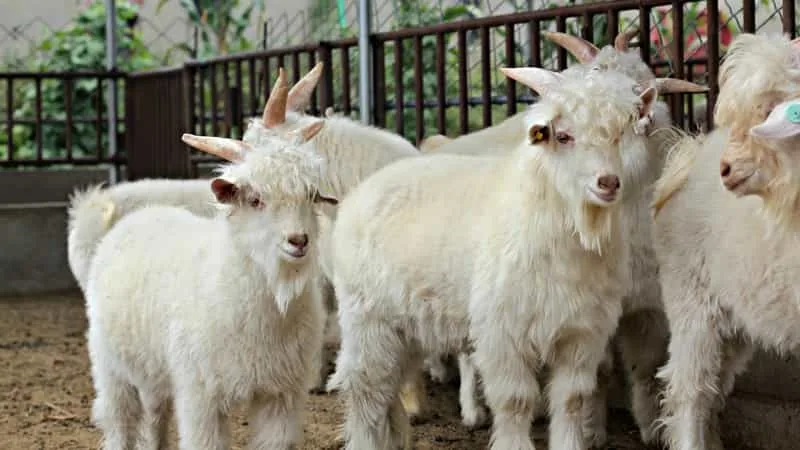
Cashmere is the downy winter fleece grown by Asiatic down-bearing goats of various breeds. In China and Mongolia the down is harvested by combing in late spring after the annual moult; in Australasia, Iran and other parts of Central Asia the whole fleece is shorn (McGregor, Properties, Processing and Performance of Rare Natural Animal Fibres, RIRDC 2012, §2.2.1). The fine fibres grow from the goat’s secondary skin follicles; the coarse, low-value guard hairs from the primary follicles (McGregor, §6.2.2).
Very little of what comes off the goat is cashmere. McGregor gives a typical raw Australian lot as 44.3% guard hair, 28.5% cashmere, 17% moisture, 4.2% suint, 3.0% grease, 2% soil and 0.9% vegetable matter (§2.2.2). The Cashmere and Camel Hair Manufacturers Institute (CCMI) puts the annual yield at up to one pound of fibre per goat, with an average of 0.1 to 0.2 kg of down; fine-wool sheep yield 2.5 to 4 kg (CCMI, “Facts about cashmere, camel and wool”). Production is concentrated: China and Mongolia lead, with Iran and Afghanistan after them (McGregor, table 1.1). The Ladakh goat and its fibre are covered on the site’s pashmina page.
Dehairing: how raw cashmere becomes fibre
CCMI lists five steps from goat to garment: collection, sorting and scouring, dehairing, spinning, and weaving or knitting (CCMI). Dehairing is the one that makes cashmere, and it is essential: it separates the guard hairs from the down (McGregor, §6.2.2).
- The machine. Dawson International invented the first commercial dehairing machinery about 1906. Dehairing relies on centrifugal action, high humidity and repetition, and runs at only 5–10% of the rate at which wool is carded.
- Why diameter decides it. Guard hairs are separated when they are about 3.5 to 4 times the diameter of the down. Below a ratio of 3.5 they are too hard to remove. Dawson’s did not want fibres coarser than 27.9 µm, and fine guard hairs of 28–40 µm are almost impossible to take out.
- Humidity. Static is controlled with relative humidity above 80%, because the fine fibres have a higher electrical resistance than the guard hairs.
- What is left. Commercially dehaired cashmere carries a mean of 0.5% residual guard hair (range 0–3.7%), and cashmere tops 0.4% (§5.6). High-quality dehaired cashmere should have fewer than 0.2% medullated fibres (§3.2).
The dehairing yield is the mass of fine fibre as a percentage of the greasy mass. Laboratories now estimate it, together with the mean diameter of the fine fibre, by measuring the full diameter distribution on an OFDA100 (IWTO-47) or Laserscan and setting a cut-off, typically 27, 30 or 35 µm, between down and guard hair (McGregor, §5.2.2). After dehairing, more than 90% of cashmere is woollen-spun into knitwear, often on mule spinning frames, which give the softest yarns; some is combed into tops and blended with superfine wool for worsted suiting (§2.2.3).
Cashmere micron grades: the legal and trade thresholds
The thresholds that matter are fineness limits written into law and trade practice. Commercial grades such as “Grade A” do not appear in the US or EU texts quoted here; what a buyer can check is the measured mean diameter, its CV and the test method.
| Threshold | Figure | What it means | Source |
|---|---|---|---|
| US legal mean diameter | ≤ 19 µm | A product averaging over 19 µm is misbranded if labelled cashmere | 15 U.S.C. 68b(a)(6)(B); 16 CFR 300.19(a) |
| US coarse-fibre limit | ≤ 3% by weight over 30 µm | Counts fibres, by mass, whose own average diameter exceeds 30 µm | 68b(a)(6)(C) |
| US diameter variation | CV ≤ 24% | The spread around the mean, as a percentage of it | 68b(a)(6); 16 CFR 300.19(a)(2) |
| In force from | 1 January 2007 | Applies to wool products manufactured on or after that date | Public Law 109-428, 20 December 2006, s. 2(b) |
| CCMI definition | Same three figures; “generally non-medullated” | The trade body’s definition, referenced to IWTO Test Method 8 | CCMI, “Definition of cashmere” |
| Origin ranges | China and Mongolia finer than 17 µm; Afghanistan and Iran 17–19 µm | Typical, not legal limits | McGregor 2012, §2.2.1 |
| Processors’ cut-off | Nothing over 27.9 µm | What Dawson’s would accept; 28–40 µm fine guard hair cannot be dehaired out | McGregor, §6.2.2 |
| Cashgora boundary | Down over 18 µm with fibres over 30 µm (1972 usage); traded cashgora 19–23 µm | Goat down outside the cashmere specification | McGregor, §2.5.2 |
| Failing goat fibre | Labelled “wool” | Cashmere-goat fibre that misses the definition | FTC, Cachet of Cashmere, July 2014 |
For scale, the same 2006 Act fixes the “Super S” wool numbers by maximum mean diameter (Public Law 109-428, s. 2(a)). They are wool fabric terms, not cashmere grades, but they place the 19 µm cashmere ceiling on the wool scale:
| Wool term | Maximum mean diameter | Against the cashmere ceiling of 19 µm |
|---|---|---|
| Super 80’s | 19.75 µm | Coarser than cashmere may be |
| Super 90’s | 19.25 µm | Coarser than cashmere may be |
| Super 100’s | 18.75 µm | The first Super number inside the cashmere limit |
| Super 120’s | 17.75 µm | Within the cashmere limit |
| Super 150’s | 16.25 µm | Typical of Chinese and Mongolian cashmere (finer than 17 µm) |
| Super 180’s | 14.75 µm | Near the fine end of cashmere (13 µm) |
So a fine wool and a cashmere can have the same mean diameter. What separates them is the animal, the scale structure and the label, not the micron count alone.
Worked example: does this lot meet the cashmere definition?
The legal test turns on two statistics of the same set of measurements: the mean and the coefficient of variation (CV), which is the standard deviation divided by the mean. The site’s replicate statistics calculator computes both from up to ten readings. A real test measures thousands of fibres: the OFDA100 and Laserscan were adopted because they can test thousands of fibres quickly and report the diameter variation that the old airflow method could not (McGregor, §5.3.1). Ten readings show the arithmetic, not a test result.
Lot A, ten fibre diameters in µm: 13.2, 15.8, 17.1, 14.4, 19.6, 12.7, 16.3, 21.2, 15, 18.1 (open lot A in the calculator). The calculator returns:
- mean 16.34 µm, under 19;
- standard deviation 2.73 µm, so CV 16.68%, under 24;
- 95% confidence half-width ±1.95 µm, built on t = 2.262 for nine degrees of freedom. The mean could be as low as 14.39 µm and as high as about 18.3 µm, still under 19.
Lot B is the same except that two readings are coarse fibres of 27.5 and 29.0 µm, at the edge of the 28–40 µm band that dehairing cannot remove (open lot B):
- mean 18.68 µm: it still passes the 19 µm test;
- standard deviation 5.70 µm, so CV 30.50%: it fails the 24% limit;
- half-width ±4.07 µm, so the true mean could be as high as about 22.8 µm.
The mean alone would have passed lot B. The CV catches the coarse fibres because it measures spread, which is why the definition carries both. The 3% rule is by weight, and weight favours coarse fibres: at equal length and density a fibre’s mass goes with the square of its diameter, so a 29 µm fibre weighs 3.7 times as much as a 15 µm one. In lot B the two coarse fibres are 20% of the count but about 42% of the mass. Neither exceeds 30 µm, so they do not count against the 3% limit; a lot with fibres just over 30 µm would reach 3% by weight at a far smaller share of the count. That is why the coarse-fibre limit needs the full diameter distribution, not a mean.
Cashmere vs wool
Cashmere and sheep’s wool are both keratin fibres, and McGregor concludes that their basic structural components are similar (§3). The differences that matter in use are fineness, scale, length and supply. The site’s wool fibre page covers wool in full.
| Property | Cashmere | Merino wool | Source |
|---|---|---|---|
| Animal | Cashmere goat, Capra hircus laniger | Sheep, Ovis aries | 15 U.S.C. 68b; EU 1007/2011, Annex I |
| Mean fibre diameter | 13–19 µm | 15–27 µm | McGregor, table 2.1 |
| Typical raw length | 3–12 cm | 7–12 cm | McGregor, table 2.1 |
| Cuticle scale height | About 0.3 µm | 0.7–0.9 µm | McGregor, §3.1.1, citing Wortmann and others (1988) |
| Medullation | Low | Trace | McGregor, table 2.1 |
| Felting | Does not felt like wool, so knitted garments can stretch | Felts | McGregor, §7.3 |
| Yield per animal a year | 0.1–0.2 kg of down on average | 2.5–4 kg (fine and superfine wool) | CCMI |
| World output, 2024 | 25,611 t greasy, about 0.02% of all fibre | About 1.1 million t, about 0.9% | Textile Exchange 2025, pp. 11–12, 41 |
On labels the relationship runs one way. In US law cashmere is a wool product, and “cashmere” may replace “wool” in the fibre content when the percentage is stated (16 CFR 300.19(b)). IWTO’s guidelines allow camel hair or cashmere to be described as wool, but forbid describing sheep’s wool as cashmere (McGregor, §1.1). EU law’s “wool” covers sheep’s fleece or a mixture of it with the hairs of the animals listed in No 2, cashmere among them (Annex I, No 1).
Cashmere vs pashmina, cashgora, camel hair, angora and qiviut
| Fibre | Animal | Mean diameter | How it relates to cashmere |
|---|---|---|---|
| pashmina | Cashmere goat | Within cashmere | An Indian word for cashmere; not a fibre name under the US Act, so a label cannot say “100% Pashmina” (FTC) |
| cashgora | Angora goats crossed with down-bearing breeds | 19–23 µm | Coarser goat down; listed under its own name in EU Annex I |
| camel hair | Bactrian camel | 18–26 µm | Also a dehaired undercoat; CCMI covers both fibres |
| angora | Angora rabbit | 11–15 µm | A rabbit fibre, highly medullated; the Angora goat gives mohair |
| Mohair | Angora goat | 22–45 µm | Lustrous hair coat, not a down |
| qiviut | Musk ox | 17.5–18.2 µm | Downy fibre of a distant relative of the goat, dehaired before processing |
How cashmere is tested
Two questions need separate tests: how fine is it, and is it all cashmere?
- Diameter. CCMI’s definition references IWTO Test Method 8 (CCMI). ASTM D2130 is the ASTM method for the diameter of wool and other animal fibres by microprojection (ASTM D2130-22). The OFDA100 (IWTO-47) and Laserscan measure thousands of fibres and report the CV directly (McGregor, §5.3.1).
- Fibre content. ISO 17751-1 (light microscopy) and ISO 17751-2 (scanning electron microscopy) quantify cashmere, wool, other speciality animal fibres and their blends. A burn test cannot separate cashmere from wool; the site’s protein fibres compared page shows why.
Mislabelling is the reason the testing exists. Von Bergen reported that two-thirds of products declared as 100% cashmere in 1955–1958 were wrongly labelled, and 70% of samples analysed for fibre content at the DWI in Aachen in 1990–2003 had incorrect labels. Legal and commercial problems with mislabelling led to the founding of CCMI in 1984 (McGregor, §5.8).
Labelling cashmere in the US and the EU
- US percentages. A blend must state them, for example “80% Wool, 20% Cashmere”; “Cashmere blend” on its own is illegal (FTC). Recycled fibre must say so: “60% cotton-40% recycled cashmere” (16 CFR 300.19(b)).
- US consistency. Once “cashmere” replaces “wool” on the label, the same term must be used wherever the fibre is mentioned (300.19(c)). See the site’s US wool labelling rules.
- EU percentages. Every fibre is named with its percentage by weight, in descending order (Article 9). When fibre composition is calculated, wool and animal hair take an agreed allowance of 17.00% on carded and 18.25% on combed fibre (Annex IX). See the site’s EU textile labelling regulation.
Questions about cashmere
What is cashmere made from?
From the fine down that the cashmere goat grows under its coarse outer hair for winter. The down is combed or shorn, scoured and dehaired; only the fine fibre is cashmere.
Camel hair vs cashmere: what is the difference?
Both are dehaired undercoats, but camel hair comes from the Bactrian camel and is coarser, 18–26 µm against 13–19 µm for cashmere (McGregor, table 1.1). A camel yields about 8–10 kg of hair a year, a cashmere goat 0.1–0.2 kg of down on average (CCMI).
Angora vs cashmere: which is which?
Angora is the hair of the Angora rabbit, 11–15 µm and highly medullated, which makes it lighter. Cashmere is goat down. The Angora goat is a different animal again: it grows mohair.
Qiviut vs cashmere?
Qiviut is the down of the musk ox, measured at 17.5–18.2 µm, so in the coarser part of the cashmere range; its garments are made only in Alaska (McGregor, §2.5.4). See the site’s qiviut page.
What does cashmere fibre look like under a microscope?
Like wool, it is covered in overlapping cuticle scales, but their edges stand only about 0.3 µm high against 0.7–0.9 µm on wool (McGregor, §3.1.1), and the fibre is finer and generally without a medulla. Profiles overlap between fibres, so content is measured to ISO 17751, not judged by eye.
How this page is kept
Last verified: 17 October 2026. The legal thresholds are quoted from 15 U.S.C. 68b and 16 CFR 300.19, the applicability date from Public Law 109-428, and the EU entries from Regulation (EU) No 1007/2011. Production figures are Textile Exchange’s for 2024, which use IWTO’s 2023 figure as a proxy for the world total. Fibre properties come from McGregor’s 2012 RIRDC review. The CCMI pages were read from Internet Archive captures of January 2024, because the CCMI site did not resolve on the day of checking. The worked example’s figures were read from the site’s calculator with the linked inputs and recomputed by the script that builds this page; ten readings illustrate the arithmetic and are not a test. The page explains the fibre and its rules; it is not legal advice or a test report. Corrections are welcome through the contact page.