Schiffli embroidery and its main types
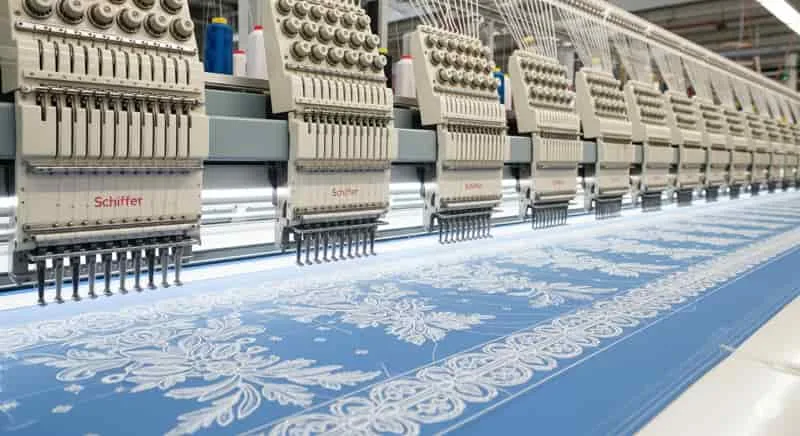
Schiffli embroidery is made by stitching a front thread and a bobbin (back) thread into a base cloth on a Schiffli machine, a long frame machine with many needles working side by side, so the same motif is embroidered many times across the width in one run. Compared with other kinds of machine lace, it allows great freedom of design and raised, three-dimensional effects.
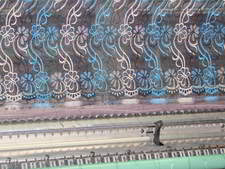
The main types are named by how they are made:
Allover embroidery. The stitching is worked on a base fabric, and the fabric stays in the finished product.
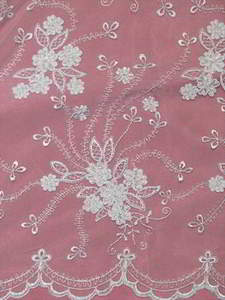
Embroidery on net. The design is stitched onto a net or tulle ground. A soluble fabric can be laid over the net to support the stitching and is dissolved afterwards, leaving the embroidery and the net.
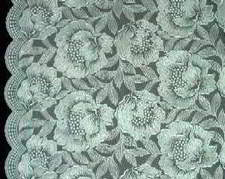
Bored (eyelet) embroidery. A boring tool on the machine pierces holes in the fabric, and the needles stitch around them, as in broderie anglaise.
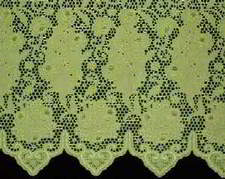
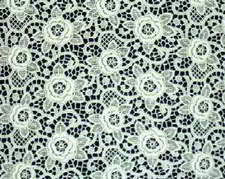
Guipure (chemical lace). The stitching is worked on a base fabric that is dissolved afterwards, so only the embroidery thread remains. The stitches must interlock enough to hold together without a ground, and many styles of lace can be reproduced this way.
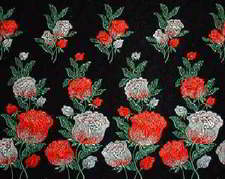
Colour-change embroidery. A colour-change machine carries needles threaded in different colours and brings them into work in turn, so one run produces a multicoloured design.
How Schiffli Machine Works
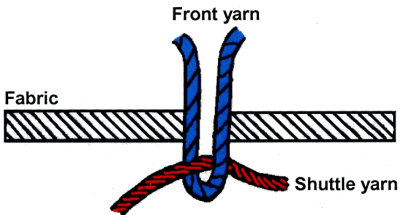
Combination of needle and shuttle form lock of the switch
The Schiffli machine is a variation of the sewing machine. It embroiders with a front thread and bobbin thread (yarn at the back of the cloth) which form together a lock stitch, similar to that of a sewing machine.
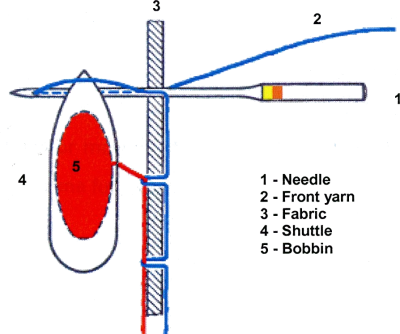
The front yearn is treated with a needle which passes through the goods to a predetermined point. It is then retracted slightly, and the friction of the goods holds the thread, forcing a loop to be formed.
A shuttle containing the yarn which is attached to the previous stitch in the back of the goods is driven through this loop, and the needle is driven again slightly further into the fabric, to allow enough thread for the shuttle to pass through the loop.
The needle is retracted while the shuttle is at its highest point and the shuttle returns to the bottom of the box.
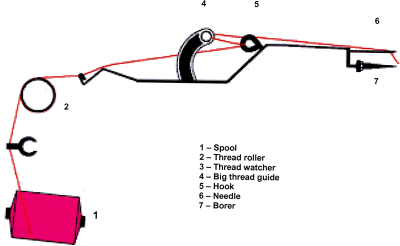
As the needle retracts, tension is applied as the big thread guide tightens the stitch thus formed. The loop is closed with the bobbin thread locked inside.
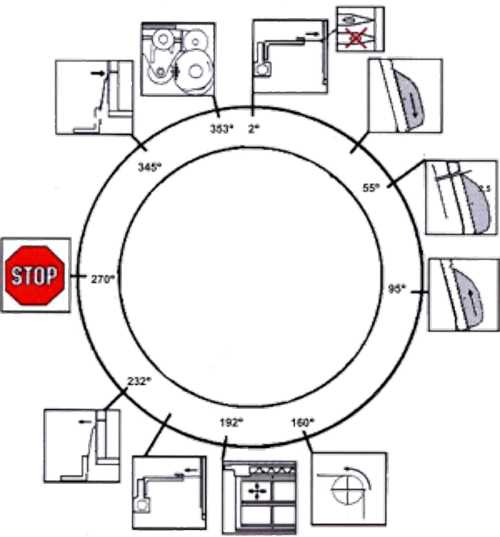
Each stitch forms in the same manner. Between each of these stitches, the frame is moved, stopped for the stitch and moved again, thus forming the embroidery design.
In Austria, each revolution or movement is counted as a half stitch, while most of the world counts each movement as one full stitch.
The spool used for a Schiffli machine is mounted on a shaft to hold a large quantity of yarn. It is placed on an angular spindle; the yarn is drawn off its right side. This way yarn can be prevented from being stuck. The winding of the yarn from full and heavy spools can be facilitated by using metal attachments which are placed in the middle of the tubes of the spools in order to allow a constant front yarn tension.
Sometimes cones are used for big order of one design when the spool would not hold enough yarn for a long run without constant changing. In such cases, the yarn is drawn from the top end through the middle of the cone, which might be placed on the floor or might be fixed on the cone holder device. Unlike spools, cones are fixed on the cone holder device and can therefore not be turned.
Preparing the fabric for the machine
Almost any fabric can be embroidered on a Schiffli machine, including tulle, cotton, polyester and nonwovens. The length and width of the piece depend on the length of the machine and on the article being made.
- Woven fabrics may be torn to length by hand, which follows the grain; all other fabrics are cut with scissors.
- To save time loading and unloading, a few pieces can be sewn together and stretched on the frame at once. The joins must be sewn straight and at even tension, or the fabric wrinkles or the seams tear when it is stretched.
- The seam allowance of each join should face the front (needle side) of the machine, so it cannot catch in the shuttle area at the back.
- Soluble (chemical) base fabrics are joined with sewing thread of the same soluble material, so the seam dissolves with the fabric.
- Clamping the fabric in the upper and lower tension bars uses up some of its width, which cannot then be embroidered. To embroider the full fabric, a strip of extra fabric is sewn to the upper and/or lower edge with a chain-stitch machine and clamped instead.
Finishing after the machine
- Thread trimming. Loose and connecting threads are cut from the front and back of the embroidery with scissors, snips or a trimming machine, without cutting into the stitches or the base cloth.
- Cleaning. Dust, lint and marking residue are removed by gentle washing, spot cleaning or dry cleaning, chosen to suit the base fabric.
- Pressing. The embroidered fabric is pressed or steamed flat at a low temperature, so that delicate grounds such as silk and lace and the embroidery thread are not damaged and the raised stitching is not flattened.
- Inspection. The goods are checked against the design for pattern accuracy, even stitching and thread tension, and for faults such as skipped stitches, broken threads and puckering of the base fabric.