Textile manufacturing continuously evolves with innovations that enhance productivity, quality, and sustainability. Among the various weaving technologies, the water-jet loom stands out for its unique approach to weft insertion using high-pressure water jets. Unlike traditional shuttle or air-jet looms, water-jet looms use a stream of water to carry the weft yarn across the warp, a method particularly suited for heavy fabrics such as upholstery, denim, and industrial textiles. This article explores the comprehensive landscape of water-jet loom technology by delving into its history, technological evolution, global availability, innovations, production process, challenges, real-world applications, end-user impact, market trends, future outlook, and maintenance strategies.
The narrative of water-jet loom technology is not just about machinery; it is a story of ingenuity, adaptation, and continuous improvement. Imagine a textile mill where the rhythmic sound of high-pressure water replaces the clack of a shuttle, where precise water jets enable rapid, smooth, and energy-efficient weft insertion. As the textile industry pushes toward higher productivity and sustainability, water-jet looms emerge as an essential tool, merging advanced hydraulics with modern digital controls to deliver superior performance in challenging heavy fabric applications.

1. Introduction: Unveiling Water-Jet Loom Technology
Water-jet looms have revolutionized the textile industry by introducing an innovative method for weaving heavy fabrics. Unlike conventional looms that rely on mechanical shuttles or air jets, water-jet looms use a controlled jet of water to propel the weft yarn through the warp shed. This mechanism enables faster production speeds and improved fabric quality, particularly for thick, heavy, or densely woven textiles.
The primary appeal of water-jet looms lies in their energy efficiency and ability to reduce mechanical wear. The use of water, rather than a physical shuttle, minimizes friction and mechanical impact, resulting in lower maintenance requirements and extended machine life. Moreover, the water-jet mechanism is highly adaptable, capable of handling different yarn types and fabric structures with precision. This versatility makes water-jet looms a valuable asset in modern textile mills looking to optimize production and meet diverse market demands.
2. Historical Perspectives: From Primitive Weaving to Water-Jet Innovation
2.1 Early Weaving Technologies
The origins of textile production date back thousands of years when humans first spun fibers by hand and wove them on simple looms. Early weaving techniques relied on basic tools and manual labor, producing fabrics that were essential for clothing, shelter, and ceremonial purposes. These early practices laid the foundation for later technological innovations in weaving.
As civilizations evolved, so did their textile techniques. The invention of the shuttle loom during the Industrial Revolution marked a major milestone, enabling mass production and more intricate patterns. However, traditional shuttle looms had inherent limitations in terms of speed, energy consumption, and wear. These limitations eventually spurred further innovations, setting the stage for alternative methods like the water-jet loom to emerge.
2.2 The Advent of Water-Jet Loom Technology
The mid-20th century witnessed a turning point in textile machinery with the introduction of water-jet looms. Engineers sought a method to overcome the mechanical constraints of shuttle looms and the limitations of air-jet systems, particularly in the production of heavy fabrics. Early prototypes of water-jet looms demonstrated that a stream of high-pressure water could effectively carry the weft yarn across the warp shed, resulting in smoother, faster, and more energy-efficient operations.
The development of water-jet technology was influenced by advancements in hydraulic engineering and digital control systems. Researchers conducted extensive experiments to optimize water pressure, nozzle design, and timing, ensuring that the water jet provided consistent weft insertion without damaging delicate yarns. This innovation quickly gained traction in heavy fabric applications, where the unique benefits of water-jet looms—such as reduced mechanical wear and improved energy efficiency—were most pronounced.

2.3 Cultural and Economic Impacts
The evolution from traditional shuttle looms to water-jet looms not only transformed production processes but also had profound cultural and economic impacts. In regions with heavy textile production, mills that adopted water-jet technology experienced significant increases in output and quality, enabling them to meet the growing demands of both domestic and international markets. This shift contributed to economic growth and enhanced competitiveness, as mills could produce high-quality heavy fabrics more efficiently and cost-effectively.
Culturally, the adoption of water-jet looms reflects a broader trend of embracing innovation while preserving the heritage of textile craftsmanship. The integration of modern technology into ancient practices illustrates the dynamic nature of the textile industry—a field that honors tradition while relentlessly pursuing progress.
3. Technological Evolution: Mechanisms and Digital Advancements
3.1 Core Mechanisms of Water-Jet Looms
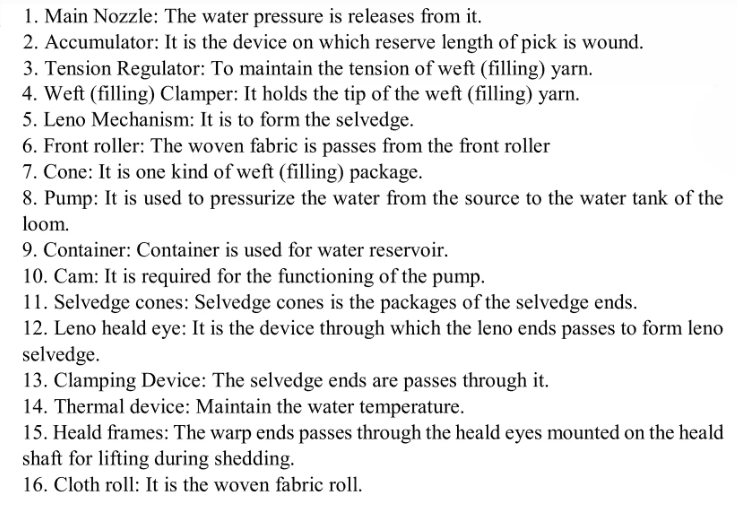
Water-jet looms operate on a unique principle that sets them apart from other weaving systems. The core mechanism involves using a controlled jet of water to transport the weft yarn through the warp shed. This process relies on several critical components:
- High-Pressure Water Supply: A compressor or pump provides the necessary pressure to generate a consistent water jet.
- Precision Nozzles: Nozzles are engineered to deliver precise bursts of water at specific intervals, ensuring that the weft yarn is inserted accurately.
- Digital Timing and Control: Microprocessor-based systems coordinate the opening of the warp shed with the activation of the water jet, synchronizing the entire process.
- Sensors and Feedback Systems: IoT sensors monitor variables such as water pressure, yarn tension, and machine speed, providing real-time data to the control system.
The effectiveness of the water-jet mechanism depends on the precise calibration of these components. By optimizing water pressure and nozzle design, engineers can achieve high-speed weft insertion with minimal energy loss and reduced mechanical wear.
Formula Example:
The efficiency of the water jet can be estimated by considering the kinetic energy imparted to the weft yarn:
where
- is the mass of water and
- is its velocity. Adjusting
- and
is crucial for optimizing weft insertion while conserving energy.
3.2 Digital Integration and Automation
Modern water-jet looms have embraced digital integration to enhance their performance and energy efficiency. Digital control systems manage the precise timing and pressure of the water jet, while IoT sensors provide continuous feedback on machine conditions. This integration enables predictive maintenance and real-time adjustments that ensure optimal operating conditions.
Automation has also streamlined the production process. Digital interfaces allow operators to monitor production metrics on centralized dashboards. Automated alerts and data analytics help identify potential issues before they escalate, reducing downtime and maintenance costs. The combination of automation and real-time monitoring transforms the operation of water-jet looms, making them a cornerstone of modern textile manufacturing.

3.3 Energy Efficiency and Sustainability
Energy efficiency is a primary advantage of water-jet looms. The use of water as a propellant minimizes mechanical friction and reduces wear on moving parts. Advanced control systems ensure that only the necessary amount of water is used, optimizing energy consumption. Moreover, energy-efficient pumps and compressors further contribute to lower operational costs.
Sustainability is another critical aspect. By reducing energy usage and mechanical wear, water-jet looms have a smaller environmental footprint compared to traditional systems. Additionally, many modern water-jet looms are designed with eco-friendly materials and processes, aligning with global trends toward sustainable textile production.
The technological evolution of water-jet looms illustrates how digital integration, automation, and innovative design can drive significant improvements in both performance and sustainability, making them an essential asset for contemporary textile mills.
4. Source and Availability: Global Market for Water-Jet Looms
The global market for water-jet looms is robust and diverse, with manufacturers across the world offering advanced systems tailored to different production needs. Textile mills in regions such as Asia, Europe, and North America have widely adopted water-jet technology for its speed, efficiency, and quality benefits.
4.1 Leading Manufacturers and Suppliers
Several leading companies specialize in the production of water-jet looms. These manufacturers invest in research and development to continuously improve loom design, energy efficiency, and digital integration. Their products are known for their reliability, precision, and ability to handle heavy fabrics. Prominent suppliers showcase their innovations at international trade fairs such as ITMA, where textile mills can evaluate the latest advancements in water-jet loom technology.
Manufacturers have a range of options to choose from. Some models are designed specifically for high-speed production of heavy fabrics, while others offer modular features that allow mills to upgrade gradually. This diversity ensures that textile mills of varying sizes and production capacities can find a system that meets their needs.
4.2 Distribution and Support Networks
Global distribution channels ensure that water-jet looms are readily available to textile mills around the world. Dealers, agents, and online marketplaces offer comprehensive product catalogs and technical specifications, making it easier for mills to compare models and select the best option. Many suppliers also offer financing options, installation services, and robust after-sales support to facilitate a smooth transition to advanced technology.
Technical support and training programs are crucial for successful MES integration. Suppliers often provide detailed manuals, on-site training, and remote support to help mills optimize machine performance and maintain high production standards. These support networks are vital for ensuring that textile mills can maximize the benefits of water-jet loom technology.

4.3 Access to Digital Resources and Training
In addition to physical machinery, access to digital resources is essential for the successful implementation of water-jet looms. Educational platforms like TextileSchool.com offer comprehensive training modules, webinars, and case studies on the operation and maintenance of advanced weaving systems. These resources help textile mills stay updated on the latest technological developments and best practices in digital integration and energy management.
The availability of global MES solutions and technical support ensures that textile mills worldwide can adopt water-jet loom technology seamlessly, driving operational excellence and sustainable growth.
5. Innovations in Water-Jet Loom Technology
Innovations in water-jet loom technology continue to push the boundaries of performance and efficiency in textile production. Recent advancements have focused on enhancing weft insertion precision, reducing energy consumption, and integrating digital monitoring systems.
5.1 Advanced Nozzle Design and Air-Water Dynamics
A critical innovation in water-jet looms is the development of advanced nozzle systems. Engineers have utilized Computational Fluid Dynamics (CFD) to design nozzles that maximize the efficiency of water jets. Variable pressure nozzles adjust the water flow dynamically, ensuring that the optimal amount of water is used for each weft insertion. This precision reduces water wastage and energy consumption, while also improving the accuracy and consistency of fabric formation.
5.2 Integration of IoT and Digital Monitoring
The integration of IoT technology has transformed water-jet loom operation. Sensors embedded within the loom continuously monitor key parameters such as water pressure, temperature, and machine speed. These sensors send real-time data to digital dashboards, allowing operators to track performance and adjust settings instantly. Predictive maintenance algorithms use this data to forecast potential issues, ensuring that maintenance can be performed proactively. This level of digital integration not only enhances operational efficiency but also contributes to energy savings and improved product quality.
5.3 Energy Optimization Technologies
Innovations in energy optimization have been pivotal for water-jet looms. Energy-efficient compressors and pumps, combined with smart control systems, ensure that the energy used for generating water jets is minimized. Advanced energy recovery systems capture excess energy from the loom’s operation and recycle it, further reducing the overall power consumption. These technological advancements have made water-jet looms a sustainable option in textile production, aligning with the industry’s global push toward greener manufacturing practices.
5.4 Digital Twin and Simulation
Digital twin technology is emerging as a transformative innovation in textile machinery. By creating a virtual replica of a water-jet loom, manufacturers can simulate production processes, test different operational settings, and predict maintenance needs without disrupting actual production. This simulation capability allows mills to optimize machine performance and implement changes with confidence, resulting in higher efficiency and better quality control.

Innovations in water-jet loom technology not only enhance performance and energy efficiency but also open new avenues for sustainable and cost-effective textile production. These breakthroughs drive the continuous evolution of weaving technology and help textile mills remain competitive in a rapidly changing market.
6. Production Process: Operation and Maintenance of Water-Jet Looms
The production process in a textile mill that employs water-jet looms integrates advanced technology with traditional weaving principles. This section outlines the step-by-step operation of water-jet looms and highlights the maintenance practices required to keep these systems operating at peak performance.
6.1 Machine Setup and Calibration
Proper machine setup is critical to ensure that water-jet looms function efficiently. Key steps in the setup process include:
- Warp Setup: The warp yarns are arranged on the loom and tensioned uniformly. Digital sensors ensure that the tension is optimal for the upcoming production run.
- Nozzle Calibration: The digital control system calibrates the nozzles to deliver the precise amount of water needed for weft insertion. This calibration involves adjusting water pressure, jet angle, and timing to match the fabric type and production speed.
- System Configuration: Operators program production parameters into the MES platform, including desired fabric density, production speed, and quality standards. This setup ensures that the loom operates within defined limits throughout the production process.
- Safety and Diagnostic Checks: Pre-production inspections verify that all safety features and digital sensors are functioning correctly, minimizing the risk of equipment failure.
A well-calibrated machine setup ensures smooth operations and minimizes initial production errors, setting the stage for efficient, high-quality fabric production.
6.2 In-Production Operation
During production, water-jet looms operate continuously under the guidance of digital control systems:
- Weft Insertion: At a precisely controlled moment, the digital system triggers a burst of water from the calibrated nozzles. This water jet propels the weft yarn through the warp shed, inserting it into the fabric.
- Beat-Up Process: Following weft insertion, the beater pushes the yarn firmly into place, ensuring that the fabric is uniformly constructed. Digital synchronization guarantees that the beat-up action follows immediately after the water jet, maintaining consistent fabric density.
- Real-Time Monitoring: IoT sensors continuously collect data on machine performance, including water pressure, machine speed, and fabric quality metrics. This data is displayed on digital dashboards, allowing operators to monitor the process and make real-time adjustments as necessary.
- Quality Control: Automated systems assess fabric quality during production, identifying any deviations from preset standards and triggering corrective actions if required.
Table: Key Steps in Water-Jet Loom Production Process
| Stage | Process Description | Key Benefits |
|---|---|---|
| Machine Setup | Warp arrangement, nozzle calibration, system configuration | Optimized performance, minimal setup errors |
| Weft Insertion | Precise water jet insertion of weft yarn | High-speed, consistent fabric formation |
| Beat-Up Process | Beater packs the weft into place | Uniform fabric density, improved quality |
| Real-Time Monitoring | Continuous data collection and digital control | Immediate adjustments, predictive maintenance |
6.3 Maintenance Practices
Regular maintenance is essential for the longevity and efficient operation of water-jet looms. Maintenance practices include:
- Preventive Maintenance: Scheduled inspections, cleaning, and calibration of nozzles and compressors ensure that the machinery operates at peak efficiency. Regular checks help identify issues before they escalate.
- Predictive Maintenance: Advanced MES platforms and IoT sensors facilitate predictive maintenance by monitoring machine health in real time. Predictive analytics forecast potential failures, enabling maintenance teams to intervene proactively.
- Component Replacement: Key components such as nozzles, seals, and hoses are subject to wear and require timely replacement. Maintaining an inventory of critical parts minimizes downtime and ensures continuous operation.
- Energy Optimization Checks: Periodic assessments of energy consumption help identify inefficiencies and adjust machine settings to optimize power usage, further enhancing the energy efficiency of the loom.

By integrating robust maintenance practices with advanced digital monitoring, textile mills can achieve high uptime and maintain the energy efficiency and production quality of water-jet looms.
7. Challenges in Implementing and Maintaining Water-Jet Looms
While water-jet looms offer significant advantages, their implementation and maintenance come with specific challenges that manufacturers must address.
7.1 High Capital Investment
The upfront cost of acquiring water-jet looms is substantial. These machines require advanced digital control systems, high-pressure water compressors, and precision-engineered components. For some textile mills, particularly SMEs, the high initial investment can be a barrier, even though the long-term benefits often justify the expense.
7.2 Integration with Existing Production Lines
Many textile mills operate a mix of old and new equipment. Integrating water-jet looms with legacy systems can be challenging due to compatibility issues. Retrofitting older production lines to work seamlessly with modern digital controls and IoT sensors may require custom engineering solutions, which can add to the overall cost and complexity.
7.3 Technical Expertise and Workforce Training
Operating and maintaining advanced water-jet looms demands a skilled workforce. Technicians must be proficient in digital control systems, pneumatic engineering, and predictive maintenance technologies. Continuous training is essential to bridge the skill gap between traditional weaving methods and modern digital practices. Resistance to change among experienced workers can further hinder the adoption of new technology.
7.4 Energy Management and Environmental Concerns
Although water-jet looms are designed for energy efficiency, managing the energy consumption of high-pressure water systems remains complex. Manufacturers must ensure that the energy used to generate the water jet is optimized without compromising fabric quality. Additionally, water recycling and waste management practices must be implemented to address environmental concerns associated with high water usage.
Table: Key Challenges in Water-Jet Loom Implementation
| Challenge | Impact | Mitigation Strategy |
|---|---|---|
| High Capital Investment | Significant upfront costs, budget constraints | Phased implementation, financing options, ROI analysis |
| Integration with Legacy Systems | Compatibility issues, production disruptions | Custom retrofitting, gradual integration, expert consultation |
| Technical Expertise | Skill gaps, training requirements | Continuous training, robust technical support, change management programs |
| Energy Management | Complex energy optimization, water usage concerns | Advanced energy management systems, water recycling, sustainable practices |
Addressing these challenges requires a strategic approach that balances immediate costs with long-term benefits. Manufacturers must invest in training, infrastructure, and digital integration to fully leverage the advantages of water-jet loom technology.
8. Real-World Applications and Case Studies
Real-world case studies provide concrete evidence of the benefits and challenges associated with water-jet looms. Textile mills across the globe have implemented this technology to improve production efficiency, quality, and sustainability.
8.1 Case Study: Enhancing Heavy Fabric Production in an Asian Mill
A leading textile mill in South Korea upgraded its production line with water-jet looms to produce heavy fabrics for upholstery and industrial applications. The mill reported a 40% increase in production speed and a 30% reduction in energy consumption compared to their previous shuttle-based systems. The digital control system enabled real-time monitoring, allowing the maintenance team to perform predictive maintenance that reduced downtime by 25%. This case demonstrates how water-jet looms can drive substantial improvements in efficiency and cost savings.
8.2 Case Study: Sustainability and Energy Efficiency in a European Facility
A European textile manufacturer focused on sustainable production adopted water-jet looms to minimize energy usage and environmental impact. By optimizing water pressure and integrating energy-efficient compressors, the facility achieved a 35% reduction in overall energy consumption. The advanced water recycling system further enhanced sustainability by reusing a significant portion of the water. This transition not only reduced operating costs but also helped the mill secure international eco-certifications, boosting its market reputation.
8.3 Case Study: Hybrid Weaving Strategies in a Multinational Operation
A multinational textile conglomerate implemented a hybrid weaving strategy that combined water-jet looms with traditional shuttle looms. For heavy, durable fabrics, water-jet looms were employed due to their superior speed and energy efficiency. For finer, specialty fabrics, shuttle looms continued to be used for their detailed control. The hybrid approach allowed the conglomerate to tailor production to diverse market demands, resulting in an overall equipment efficiency (OEE) improvement of 20% and increased product quality consistency across its global operations.
These case studies illustrate the transformative potential of water-jet loom technology. Real-world examples highlight the tangible benefits—such as increased production speed, energy savings, and improved sustainability—that can be achieved through the effective implementation of this advanced weaving technology.
9. End-Users and Stakeholders: Who Benefits from Water-Jet Looms
The adoption of water-jet looms impacts a diverse range of stakeholders across the textile industry. Their benefits extend from the production floor to global markets, influencing everything from machine performance to product quality and environmental sustainability.
9.1 Textile Manufacturers and Mill Managers
Manufacturers and mill managers are the primary users of water-jet looms. These advanced machines enable them to increase production efficiency, reduce energy consumption, and deliver high-quality heavy fabrics. The operational improvements translate into lower production costs and higher profitability, providing a competitive edge in the global market.
9.2 Maintenance and Technical Teams
Maintenance teams benefit significantly from the reduced mechanical wear and advanced diagnostic capabilities of water-jet looms. Digital monitoring and predictive maintenance tools help these teams identify issues before they result in costly downtime. The ease of maintenance and lower frequency of mechanical failures reduce the overall workload and extend the lifespan of the equipment.
9.3 Designers and Product Developers
Designers and product developers value the consistency and versatility offered by water-jet looms. The ability to produce heavy fabrics with uniform quality and minimal defects allows for greater creative freedom and innovation. Designers can experiment with various fabric structures and finishes, knowing that the production process will reliably reproduce their designs.
9.4 Global Buyers and End Consumers
Global buyers and end consumers indirectly benefit from the technological advancements in water-jet looms. Consistent product quality, reduced production costs, and sustainable manufacturing practices build trust and enhance brand reputation. High-quality, durable, and eco-friendly textiles meet the demands of international markets and contribute to a positive consumer experience.
Table: Stakeholders and Benefits of Water-Jet Loom Technology
| Stakeholder | Role/Impact | Benefits |
|---|---|---|
| Manufacturers/Mill Managers | Oversee production, improve efficiency, reduce costs | Increased output, energy savings, competitive advantage |
| Maintenance Teams | Monitor and service advanced machinery | Reduced downtime, predictive maintenance, lower repair costs |
| Designers/Product Developers | Create innovative heavy fabrics | Consistent quality, design versatility, rapid prototyping |
| Global Buyers/Consumers | Purchase high-quality, sustainable textiles | Reliable product quality, ethical production, enhanced brand trust |
The benefits of water-jet loom technology resonate across the entire textile value chain, ensuring that every stakeholder—from mill operators to global consumers—enjoys the advantages of enhanced efficiency, quality, and sustainability.
10. Market Trends, Economic Impact, and Global Dynamics
The adoption of water-jet looms has reshaped market dynamics in the textile industry, influencing economic performance and global trade patterns. As textile mills seek to improve efficiency and reduce costs, water-jet looms have become a strategic investment that offers significant competitive advantages.
10.1 Market Trends
Modern textile production is characterized by rapid digital transformation and a growing emphasis on energy efficiency. Water-jet looms are at the forefront of this trend, particularly in heavy fabric production where speed and quality are paramount. Global demand for high-performance, sustainable textiles is driving mills to adopt advanced weaving technologies that minimize energy consumption and reduce environmental impact. This trend is reinforced by consumer preferences for eco-friendly products and the increasing adoption of international sustainability standards.
10.2 Economic Impact
The economic benefits of water-jet loom technology are significant. By enhancing production speed and reducing downtime, these machines contribute to higher throughput and lower unit costs. Energy-efficient operation translates into substantial cost savings, while advanced digital controls reduce maintenance expenses. Economic analyses have shown that textile mills equipped with water-jet looms achieve a higher return on investment (ROI) compared to those relying on older technologies. The overall efficiency gains boost profitability and support long-term growth in a highly competitive market.
10.3 Global Trade Dynamics
Global textile trade is highly sensitive to production quality and efficiency. Mills that implement advanced technologies like water-jet looms can meet international quality standards more consistently, facilitating smoother export operations. Enhanced production processes and lower operational costs enable mills to offer competitive pricing, which is crucial in global markets. International trade agreements and harmonized safety and quality standards further boost the marketability of textiles produced with water-jet technology, fostering stronger trade relationships and expanding market reach.
The market trends, economic impact, and global trade dynamics underscore the strategic importance of water-jet loom technology in modern textile production. As competition intensifies and production demands evolve, mills that invest in advanced, energy-efficient technologies are poised to lead the industry.
11. Future Trends and Emerging Opportunities in Water-Jet Loom Technology
The future of water-jet loom technology promises further advancements driven by digital innovation, sustainability imperatives, and market demand for high-quality textiles. Emerging trends will continue to shape the landscape of textile production, creating new opportunities for efficiency and environmental responsibility.
11.1 Enhanced Digital Integration
Future water-jet looms will feature even more advanced digital integration. Developments in AI, machine learning, and IoT will enable real-time optimization of machine performance, predictive maintenance, and adaptive control systems. Digital twins will allow mills to simulate production scenarios and fine-tune machine settings without disrupting actual operations, driving continuous improvement and reducing downtime.
11.2 Increased Sustainability
Sustainability will remain a critical focus for textile manufacturers. The next generation of water-jet looms will incorporate further innovations to reduce energy consumption and environmental impact. Advances in renewable energy integration, water recycling systems, and low-emission components will enhance the green credentials of textile mills. Manufacturers will increasingly prioritize eco-friendly technologies, meeting regulatory requirements and appealing to environmentally conscious consumers.
11.3 Hybrid and Modular Systems
The future may see the emergence of hybrid and modular weaving systems that combine the strengths of water-jet technology with other weaving methods. These adaptable systems will allow textile mills to tailor production processes to specific fabric types and market demands. Modular designs will enable SMEs to adopt advanced technology in phases, making the transition more cost-effective and scalable.
11.4 Global Standardization and Collaborative Innovation
International collaboration and standardization will continue to shape the future of water-jet loom technology. Global textile associations and regulatory bodies are working to develop standardized protocols for digital textile manufacturing, ensuring that advanced technologies are interoperable and meet international quality benchmarks. Such global standardization will facilitate smoother trade and drive widespread adoption of energy-efficient weaving systems.

The future of water-jet loom technology is bright, with emerging opportunities that promise to further enhance production efficiency, reduce energy consumption, and drive sustainability in textile manufacturing. As mills embrace these innovations, they will be better positioned to meet the demands of a dynamic global market and secure a competitive edge.
12. Summary and Conclusion
Global textile production is continuously evolving, and water-jet looms represent a significant leap forward in weaving technology for heavy fabrics. This comprehensive article has provided an in-depth exploration of water-jet loom technology, focusing on its pros, cons, and maintenance requirements.
We began by introducing the role of water-jet looms, emphasizing their unique mechanism of using high-pressure water jets for weft insertion. Historical perspectives traced the evolution from traditional shuttle looms to the innovative water-jet systems, highlighting the cultural and economic shifts that drove this transformation. The technological evolution section detailed the core mechanisms—advanced pneumatic systems, digital integration, and energy optimization—that underpin modern water-jet looms.
We discussed global sources and the availability of water-jet looms, noting how leading manufacturers and robust support networks enable textile mills worldwide to adopt this technology. Innovations in nozzle design, digital controls, and energy management were explored, illustrating how these advancements contribute to superior production efficiency and sustainability.
The production process was examined in detail, from machine setup and calibration to in-production operation and post-production analysis. We compared the advantages and disadvantages of water-jet looms, discussing the specific challenges such as high capital investment, integration with legacy systems, technical expertise requirements, and energy management. Real-world applications and case studies demonstrated how textile mills in different regions have successfully implemented water-jet looms to achieve increased speed, reduced energy costs, and improved fabric quality.
Stakeholders across the textile value chain—from manufacturers and maintenance teams to designers and global buyers—benefit from the implementation of water-jet loom technology. Market trends and economic analyses underscored the competitive advantages and cost savings associated with these systems. Looking forward, future trends such as enhanced digital integration, increased sustainability, modular production systems, and global standardization promise to further transform the textile industry.
In conclusion, water-jet loom technology offers a compelling blend of high-speed production, energy efficiency, and superior fabric quality. Its innovative mechanisms and digital integration set a new standard for heavy fabric production. As the textile industry embraces further technological advancements and sustainability initiatives, water-jet looms will play a pivotal role in shaping the future of textile manufacturing, ensuring operational excellence and competitive success on a global scale.