Shedding, Picking, and Beat-up are the mechanisms which are essentially required on a weaving machine for the operation to be carried out. Shedding motion is one of the basic motions in a weaving machine.
Types of shedding mechanism
There are three major types of shedding mechanism’s namely Tappet, Dobby, and Jacquard. Based on their technical and operational characteristics on should decide which shedding mechanism to be used.
Tappet Shedding System
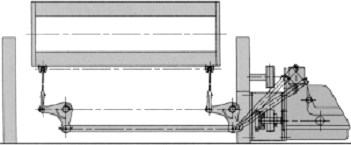
The tapping shedding system is a motion of tappets and cams that cause shafts to be raised to form the shed. The mechanical arrangement of this system occupies so much of space that it can accommodate a maximum of eight shafts and that is why its eight shafts represent maximum size of its weave repeat. This limits to the weaving of plain weaves, simple twills and simple sateen and satin weaves. In case, the repeat of the desired design requires more than eight shafts, then a dobby loom has to be used. Fig. shows tappet shedding with roller reversing.
Dobby Shedding System
A mechanism for controlling the heald shafts of a loom. It is required when the number of heald shafts or the number of picks in a repeat of pattern or both is beyond the capacity of tappet shedding This is a shedding system capable of having up to 32 shafts. Being able to accommodate up to 32 shafts, a much greater weave repeat and complicated design is possible.
Jacquard Shedding System
This shedding system has no shafts. A harness consisting of as many cords as there are ends in the warp sheet connects each end individually to the Jacquard machine situated high above the loom. Therefore, each warp can weave independently of all the others. Since each warp yarn can be controlled individually, the greatest weave repeat is possible. This enables most intricate designs to be woven.
How cam, dobby and Jacquard machines form the shed
The shed is the opening between the warp ends that are raised and those left down. It must open wide enough for the shuttle, rapier, projectile or jet to carry the weft through. Cam and dobby machines form it by moving heald frames, each frame carrying every end drawn into it; a Jacquard moves each end, or small group of ends, separately.
Cam motions: positive and negative
In a negative cam motion the cams drive the heald frames in one direction only, and springs return them. In a positive motion the cams drive the frames both up and down. Positive motions use conjugate cams: two complementary cams per frame on a common shaft, each read by a roller on the same lever, so that while one cam pushes its roller up the other pushes in the opposite direction. The frame is controlled through the whole cycle, which reduces vibration and suits high loom speeds.
There is one cam unit for each working heald frame, and the cam shaft turns once per weave repeat. For a weave that repeats on n picks, the cam shaft runs at 1/n of the loom speed, and each pick takes 360/n degrees of the cam’s turn: 180 degrees for plain weave, 90 degrees for a four-pick twill.
Kinds of dobby
Dobbies are classified by mechanism, by drive and by how they read the pattern. Lever dobbies, such as the Hattersley type, move the frames through rods and rocking levers; rotary dobbies raise and lower them through rotating eccentrics. Either can be positive (frames driven both ways) or negative (returned by springs). The pattern is read from a pegged or punched pattern chain on mechanical dobbies and from an electronic controller on modern ones.
The rotary dobby is the type now built for fast looms. Its main shaft is turned in half-turns by a modulator that holds it still briefly at the end of each half-turn. Each heald frame has an eccentric that drives the frame’s levers. During each pause a key is moved in or out, according to the pattern, to lock that eccentric to the shaft or leave it free; an engaged eccentric moves its frame on the next half-turn. More on dobby looms is in dobby loom technology.
Electronic Jacquard
An electronic Jacquard keeps the hooks and harness but selects the hooks electromagnetically under program control instead of from punched cards. Current machines are double-lift. Compared with mechanical Jacquards they have fewer moving parts, a modular construction that is easier to service, less vibration at high speed, and a much shorter pattern change, since no cards have to be cut or loaded. See how a Jacquard machine works.
Standard Properties of Woven fabrics
Weight Range
| Very heavy | > 13 oz/yd2 |
| Heavy | > 6 – 13 oz/yd2 |
| Medium | > 4 – 6 oz/yd2 |
| Light | > 2 – 4 oz/yd2 |
| Very light | < 2 oz/yd2 |
Width range
| Broadloom | 108” |
| Medium or average | 45, 54, 60, 72” |
| Narrow | 27 – 36” |
| Very narrow | < 12” |