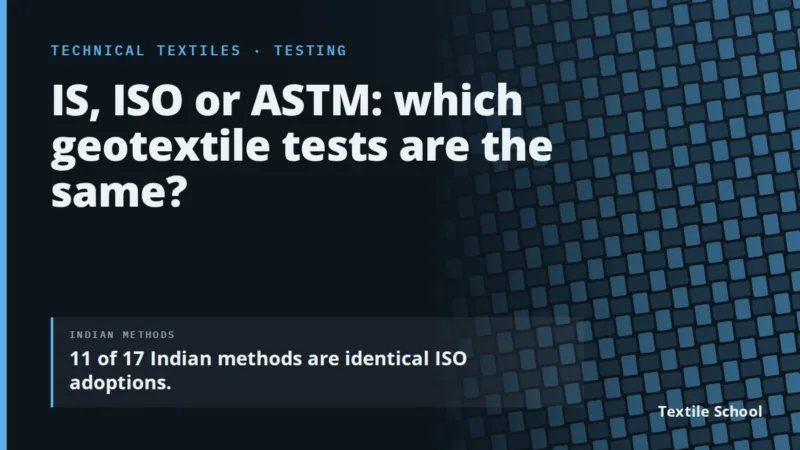
Most of India’s geotextile testing standards are now identical copies of ISO methods, and ASTM’s are separate tests. Of the 17 Indian methods in the table below, BIS classes 11 as identical to an ISO standard and one as technically equivalent. The other five, for grab strength, trapezoid tear, dry-sieved opening size, UV resistance and abrasion, are Indian methods with no ISO counterpart, and BIS lists no ASTM equivalent for any of the 17. For opening size, water flow through the fabric, thickness and installation damage, the ASTM method works differently from the ISO one, so a result from one cannot be checked against a limit written for the other.
This page lines up the Indian, ISO and ASTM method for each property a buyer specifies, gives the current edition of each, and says whether two of them are the same test. Designations, titles, editions and equivalences were read on 3 October 2026 from the Bureau of Indian Standards' standards portal, ISO's catalogue for its geosynthetics committee and ASTM’s product pages; none of the standards’ text is reproduced here. For textile testing standards in general, see the site’s Introduction to Textile Testing Standards (ISO, AATCC, ASTM).
- 11 of 17 Indian methods are identical ISO adoptions. One more, mass per unit area, is technically equivalent.
- ISO has no geosynthetics method for grab strength, tear or weathering. Its general fabric grab test, ISO 13934-2, says in its own scope that it is not normally applicable to geotextiles.
- Three Indian methods were reissued in March 2026 as identical ISO adoptions: wide-width tensile (IS 16635:2026), wet-sieved opening size (IS 16237:2026) and cone drop (IS 13162 (Part 4):2026).
- ISO revised the CBR puncture test in May 2026. India’s IS 16078:2013 adopted the earlier edition.
- A BIS licence under IS 16362:2024 tests grab, seam, tear, CBR puncture and abrasion on every control unit, opening size and water flow monthly, and UV resistance yearly, by BIS’s product manual of November 2025.
Geotextile testing standards by property: IS, ISO and ASTM
The last column uses four terms. Identical and technically equivalent are BIS’s own classifications of an Indian Standard against an ISO one. Not declared equivalent means the methods share a principle but no standards body says one result can stand in for the other. Different method means the published scopes show the tests work differently; the cell says how. In Europe the ISO methods are adopted unchanged as EN ISO standards (EN ISO 10319, EN ISO 12956, EN ISO 11058 and so on), so a European report to an EN ISO method is the ISO test of the same year.
| Property | Indian Standard | ISO (EN ISO) | ASTM | Same test? |
|---|---|---|---|---|
| Mass per unit area | IS 14716:2021 | ISO 9864:2005 | ASTM D5261-10(2024) | IS and ISO: technically equivalent (BIS classes the IS as modified). ASTM: same quantity, not declared equivalent. |
| Thickness | IS 13162 (Part 3):2021 | ISO 9863-1:2016, amended 2019 | ASTM D5199-25 | IS and ISO: identical. ASTM: different method. ISO gives thickness at specified pressures; ASTM gives one nominal thickness. |
| Wide-width tensile strength | IS 16635:2026 | ISO 10319:2024 | ASTM D4595/D4595M-24 | IS and ISO: identical. ASTM: same wide-strip principle, not declared equivalent. Stiffness is reported differently: ISO gives secant stiffness; ASTM initial, offset and secant modulus and breaking toughness. |
| Grab strength and elongation | IS 16342:2015 | None for geosynthetics; ISO 13934-2:2014 excludes geotextiles | ASTM D4632/D4632M-15a(2023) | IS and ASTM: same grab principle, not declared equivalent. BIS lists the IS as an Indian method. |
| Static (CBR) puncture | IS 16078:2013 | ISO 12236:2026 | ASTM D6241-22a | IS and ISO: identical, but the IS adopted the edition before ISO’s May 2026 revision. ASTM: same plunger principle, not declared equivalent. |
| Dynamic perforation (cone drop) | IS 13162 (Part 4):2026 | ISO 13433:2025 | None found | IS and ISO: identical. ASTM’s catalogue has no cone-drop method for geosynthetics. |
| Trapezoid tear | IS 14293:2024 | None for geosynthetics; ISO 9073-4:2021 is the nonwovens method | ASTM D4533/D4533M-15(2023) | IS and ASTM: same trapezoid principle, not declared equivalent. |
| Apparent opening size (AOS), dry sieving | IS 14294:2024 | None | ASTM D4751-21a | IS and ASTM: both dry-sieve, not declared equivalent. ASTM also allows a capillary porometer, but only after pre-qualifying it against sieving. |
| Characteristic opening size, wet sieving | IS 16237:2026 | ISO 12956:2019 | None | IS and ISO: identical. Different method from the row above: a graded granular material washed through the fabric with water, not dry beads. |
| Water permeability normal to the plane | IS 14324:2025 | ISO 11058:2019 | ASTM D4491/D4491M-22 | IS and ISO: identical. ASTM: different method. It reports permittivity and adds an air-flow procedure; the ISO result is a velocity index. |
| In-plane flow (transmissivity) | IS 17179 (Part 1):2025, index test; IS 17179 (Part 2):2025, performance test | ISO 12958-1:2020; ISO 12958-2:2020 | ASTM D4716/D4716M-22 | IS and ISO: identical, part for part. ASTM: one method used as an index or a performance test, reporting flow rate per unit width and transmissivity; not declared equivalent. |
| Resistance to UV and weathering | IS 13162 (Part 2):2024 | None in ISO; Europe uses EN 12224:2000 | ASTM D4355/D4355M-21 | IS and ASTM: both xenon arc, not declared equivalent. EN 12224: different method, using fluorescent UV lamps. |
| Seam strength | IS 15060:2018 | ISO 10321:2008 | ASTM D4884/D4884M-22 | IS and ISO: identical. ASTM: a wide-specimen test for sewn or bonded seams, not declared equivalent. |
| Abrasion | IS 14714:2024 | ISO 13427:2014 | ASTM D4886-23 | None declared equivalent. ISO uses a sliding block; ASTM sandpaper and a sliding block. |
| Installation damage | IS 17420:2020 | ISO 10722:2019 | ASTM D5818-22 | IS and ISO: identical. ASTM: different method. ISO is a laboratory index test under repeated loading; ASTM D5818 is a practice for exposing and retrieving samples from a field trial. |
| Sampling and test specimens | IS 14706:2024 | ISO 9862:2023, amended 2026 | ASTM D4354-26 | IS and ISO: identical. ASTM: a sampling practice with separate procedures for the maker’s own control and for a purchaser’s lot testing. |
Which editions changed since 2024?
Several of these methods were reissued in the last two years, and a laboratory report names the edition it was made to. The dates below are publication dates; withdrawal dates are as BIS’s catalogue records them.
| Date | Standard | What changed |
|---|---|---|
| October 2024 | ISO 10319:2024 | Fourth edition of the wide-width tensile test, replacing the 2015 edition. |
| 19 November 2024 | IS 16362:2024; IS 14706:2024 | Second revision of the product standard for drainage, separation, stabilisation, filtration and erosion-control fabrics. IS 14706 became identical to ISO 9862:2023. |
| 3 and 10 December 2024 | IS 14294, IS 13162 (Part 2), IS 14714 and IS 14293, all :2024 | First revisions of the dry-sieved AOS, UV, abrasion and trapezoid tear methods. All four remain Indian methods. |
| 21 January 2025 | IS 14324:2025 | Now identical to ISO 11058:2019. The 1995 edition it replaced was titled a permittivity method; BIS withdrew it on 8 August 2025. |
| 26 March 2025 | IS 17179 (Part 1) and (Part 2):2025 | Identical to ISO 12958-1 and ISO 12958-2:2020. The single-part 2019 edition was withdrawn on 22 September 2025. |
| June 2025 | ISO 13433:2025 | Second edition of the cone drop test. |
| 17 March 2026 | IS 16635:2026; IS 16237:2026 | Identical to ISO 10319:2024 and ISO 12956:2019. BIS withdrew the 2017 and 2014 editions on 17 September 2026. |
| 27 March 2026 | IS 13162 (Part 4):2026 | Identical to ISO 13433:2025. It replaced a 2025 edition, withdrawn on 27 September 2026. |
| May 2026 | ISO 12236:2026 | Third edition of the CBR puncture test. BIS still lists IS 16078:2013, adopted from the earlier edition. |
| 2025 and 2026 | ASTM D5199-25; ASTM D4354-26 | Revised thickness method and sampling practice. |
Which results cannot be swapped between IS, ISO and ASTM?
Opening size: dry sieving or wet sieving
ASTM D4751 and IS 14294 sieve dry glass beads through the fabric; ASTM’s scope describes the result as roughly the largest opening soil can pass through. ISO 12956:2019 and India’s identical IS 16237:2026 wash a graded granular material through the fabric with water. The two give different numbers for the same fabric: on more than 50 nonwoven polypropylene geotextiles, dry sieving gave consistently larger openings, on average 30 to 35% larger for the coarsest pore sizes compared and twice as large for the median (Atmatzidis and others, 2006). Why that matters for a filter specification, and how to choose an opening size from a soil grading, is set out in the article on geotextile QCOs and choosing a filter fabric. India now has both methods; IS 16362 asks for the dry-sieved AOS.
Water flow through the fabric: permittivity or velocity index
ASTM D4491 reports permittivity, with constant-head, falling-head and air-flow procedures. ISO 11058:2019 specifies constant-head and falling-head methods; BSI's catalogue description of its earlier 2010 edition gives the control result as a velocity index at a 50 mm head loss. Since January 2025 IS 14324 is an identical adoption of the ISO method. BIS’s product manual for IS 16362 still calls the property “permittivity” and names IS 14324 for it, so ask the laboratory which quantity its report gives.
Thickness: specified pressures or one nominal value
ISO 9863-1:2016, and India’s identical IS 13162 (Part 3):2021, measure thickness at specified pressures and load-plate areas, for data sheets and for use inside hydraulic tests. ASTM D5199 gives a nominal thickness and says it does not give values under varying compressive stress. Quote the pressure with any thickness figure.
Strength: wide-width or grab
IS 16362 specifies grab strength by IS 16342. ISO’s geosynthetics committee has no grab test, and its general fabric grab method, ISO 13934-2:2014, says it is not normally applicable to geotextiles. ISO’s tensile test for geosynthetics is the wide-width strip (ISO 10319:2024, now IS 16635:2026). ASTM has both, ASTM D4632 for grab and ASTM D4595/D4595M-24 for wide-width, and the grab standard itself says there is no simple relationship between grab and strip results, because the fabric’s construction decides how much the material beside the jaws helps. A grab figure cannot be converted into a wide-width one.
UV resistance: xenon arc or fluorescent lamps
IS 13162 (Part 2):2024 and ASTM D4355 expose specimens to light, moisture and heat in a xenon-arc apparatus; ASTM’s scope measures the loss of tensile strength. Europe’s EN 12224:2000 uses fluorescent UV lamps to ISO 4892-3 and is described as an index test that separates products with little or no weathering resistance from those that have it. ISO has no weathering method for geosynthetics. A retained-strength figure can only be compared with a limit written for the same method and exposure.
CBR puncture: same principle, new ISO edition
ISO 12236:2026 pushes a flat-ended plunger through the specimen; ISO’s May 2026 edition covers most geosynthetics but not products with apertures larger than 10 mm. ASTM D6241 uses a 50 mm cylindrical probe and notes that its test is commonly called the CBR puncture test. India’s IS 16078:2013 is identical to an earlier ISO edition, so check which edition a report cites.
Which tests does India’s QCO standard IS 16362 call for?
Geotextiles for subsurface drainage, subgrade separation and stabilisation, filtration and erosion control in hard armour systems are made to IS 16362:2024 under India’s geotextile Quality Control Order, with the BIS Standard Mark. BIS’s product manual for IS 16362:2024 (PM/IS 16362/5, November 2025, revised after the standard’s Amendment No. 1) sets out the tests a licensee runs and how often BIS recommends running them. The licence covers woven and nonwoven fabrics in polyolefins, polyesters and polyamides, in classes 1H, 2H, 3H, 1R and 2R. A control unit is one day’s production of one type, class, strain grade and material for one application. The order’s dates and product list are in the QCO article named above.
| Test | Method named | BIS’s recommended frequency |
|---|---|---|
| Grab strength, and elongation at break | IS 16342 | Every control unit |
| Sewn seam strength | IS 15060 | Every control unit |
| Trapezoid tear strength | IS 14293 | Every control unit |
| CBR puncture strength | IS 16078 | Every control unit |
| Abrasion | IS 14714 | Every control unit |
| Apparent opening size | IS 14294 (dry sieving) | Once a month |
| Permittivity, or water flow rate normal to the plane | IS 14324 | Once a month |
| UV stability: strength retained after 500 hours | IS 13162 (Part 2) | Once a year, and on a change of raw material or supplier |
| Installation damage: strength retained | IS 17420 | Once in five years, and on a change of raw material or supplier |
| Retained tensile strength for a 100-year life (filtration and separation fabrics) | Annexes C and D of IS 16362 | Once a year, and on a change of raw material or supplier |
| Roll length and width | IS 1954 | Inspection of each roll |
Three things follow. First, the tests are the Indian methods, and five of them (grab, tear, dry-sieved AOS, UV and abrasion) have no ISO twin, so a European data sheet does not answer them, and an ASTM report is a different standard even where the principle is the same. Second, mass per unit area, thickness, wide-width strength, cone drop and in-plane flow are not on the manual’s schedule, although BIS’s cross-reference list for IS 16362:2024 names the cone-drop, in-plane flow and sampling methods. Third, the manual says tests are run by the methods the standard gives, in the licensee’s own laboratory or, for tests it marks for subcontracting, in a BIS-recognised laboratory or one with NABL accreditation.
This page has checked the test schedule of IS 16362:2024 only. The other product standards under the geotextile orders (geomembranes, geobags, jute and coir products, geogrids, geostrips, geocells, and IS 17880 for rope gabions) name their own tests; this page lists methods by property, not by product specification.
Which calculator uses which test result?
- Opening size. The soil gradation retention calculator works out the largest opening a soil grading tolerates, and the geotextile AOS and permittivity calculator checks a fabric’s AOS against the soil’s D85. Both take the dry-sieved AOS (IS 14294 or ASTM D4751); a wet-sieved ISO 12956 figure is not the same input.
- Water flow. The AOS calculator returns permittivity from the fabric’s permeability and thickness, and the geotextile tensile strength and permeability calculator works the other way. Permittivity is the ASTM D4491 quantity; with an IS 14324 or ISO 11058 report, ask the laboratory for permittivity or permeability rather than entering a velocity index.
- Tensile strength. The geotextile tensile strength calculator starts from wide-width strength (IS 16635, ISO 10319 or ASTM D4595), with elongation and thickness. Do not enter a grab figure.
- Mass per unit area. The geomembrane puncture calculator sizes the cushion geotextile under a liner by its mass per unit area (IS 14716, ISO 9864 or ASTM D5261). The liner’s own puncture figure there is a geomembrane index test, ASTM D4833, not one of the geotextile tests above.
- Pullout. The geogrid pullout calculator needs an interaction coefficient from pullout tests on the actual grid and backfill, which the table does not cover.
How should a specification name the test?
- Give the method and its year with every property, not the property alone: “grab strength by IS 16342:2015”, not “tensile strength”.
- For opening size, say dry sieving (IS 14294, ASTM D4751) or wet sieving (IS 16237, ISO 12956).
- For water flow, say which quantity: permittivity (ASTM D4491) or the ISO 11058 result (IS 14324:2025).
- Where an IS is identical to an ISO edition, an ISO or EN ISO report of that edition is the same test. Check the year: IS 16078:2013 and ISO 12236:2026 are different editions.
- For goods under the QCO, the BIS licence decides: its tests are the IS methods in the product manual.
How this page is kept
Last verified: 3 October 2026. Indian designations, titles, publication and withdrawal dates and degrees of equivalence are from BIS’s standards portal, checked against its older Know Your Standards catalogue, which labels the two parts of IS 17179 inconsistently; this page follows the newer portal. ISO editions and scopes are from ISO’s catalogue, ASTM editions and scopes from ASTM’s product pages, and EN 12224 from the Estonian standards body’s catalogue. The QCO test schedule is from BIS’s product manual for IS 16362:2024 and BIS’s circular of 26 November 2025 on its Amendment No. 1. ISO designations link to this site’s standards register where it holds a record. This page describes the standards and BIS’s certification documents; it is not advice on certifying a particular product. Corrections are welcome through the contact page.