

A zipper, also called a zip or a slide fastener, closes an opening with two rows of interlocking teeth, each row fixed to a fabric tape. A slider runs along the rows: pulled one way it meshes the teeth into a closed chain, pulled the other way it parts them. Zippers are sorted by their teeth, which are metal, moulded plastic or a continuous plastic coil (an invisible zipper is a coil zipper whose teeth hide behind the seam), and by how they end: a closed-end zipper stays joined at the bottom, an open-end zipper comes fully apart, and a two-way zipper has two sliders. The size number, such as #3, #5 or #10, stands for the width of the closed chain, which is close to that many millimetres: the larger the number, the heavier and stronger the zipper.
The parts, the types and the sizes come first below, then how to choose a zipper for a garment and how to look after one. After that comes the depth a buyer or a laboratory needs: the test standards, the strength classes, crosswise strength worked through on the site’s calculator, length tolerances, and the European limit on nickel release from metal zippers.
Last verified: 5 October 2026. Sources are linked where they are used and listed at the end.
Parts of a zipper
Every zipper has the same few parts, whatever its teeth are made of. Japan’s zipper standard, JIS S 3015:2019, defines the teeth, which it calls elements, as the interlocking parts of metal or plastic fixed to the tape, and divides them into separate elements and continuous elements, such as a coil. The American terms are set by ASTM D2050, the terminology standard for fastener subassemblies.
- Tape. The strip of woven or knitted fabric on each side, which is sewn into the garment. It is “usually made of polyester”, YKK says, though cotton, vinyl and other synthetic tapes are made for particular uses (YKK Americas). The tape left beyond the teeth at each end is the top or bottom extension, which the seam catches.
- Teeth, or elements. The interlocking parts along the inner edge of each tape: separate metal or moulded plastic teeth, or a continuous plastic coil. A tape with its row of teeth is a stringer. When the two rows mesh they form the chain, and the width of the closed chain is what the size number describes.
- Slider. The part that runs along the chain. Inside it a Y-shaped channel brings the two rows together at an angle so that they mesh, and parts them again when it moves the other way; the Y-shaped channel is already in Gideon Sundback’s patent of 1917 (US 1,219,881).
- Pull, or pull-tab. The tab hung from the slider, which you hold. A locking slider uses the pull to hold itself in place on the chain (see the slider types below).
- Top stops. Small stops fixed at the top of each stringer, so that the slider cannot run off the end.
- Bottom stop. On a closed-end zipper, one stop across both stringers at the foot, which holds them together and stops the slider.
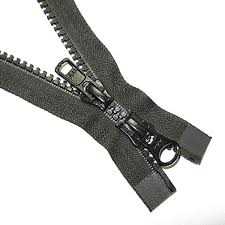
- Insertion pin and retainer box. On an open-end (separating) zipper the bottom stop is replaced by a pin on one stringer and a box on the other. The pin is pushed fully into the box, which holds the two stringers level so that the slider can start them meshing; drawing the pin out separates the zipper. YKK warns that pulling the slider up before the pin is firmly in the box can break the open end (YKK fastening catalogue, p. 66).
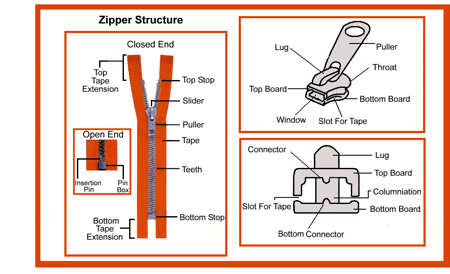
Slider types. YKK’s catalogue names the basic ones (YKK fastening catalogue, p. 2). A non-lock slider has no locking mechanism and runs freely. On an automatic lock slider the lock works by itself when the pull-tab is released, which is why YKK recommends it for a garment front that “comes down on its own”. On a semi-automatic slider the lock works when the pull-tab is snapped down flat, and YKK’s jeans slider is of this kind. A reversible slider has a pull that swings round so that the zipper can be worked from either side, as on a reversible jacket, and a double-pulled slider has a pull on each face.
Types of zippers by their teeth
There are three kinds of teeth, and a fourth type, the invisible zipper, built from one of them. The materials below are the makers’ own descriptions.
| Type | Teeth | Strengths and limits | Typical uses |
|---|---|---|---|
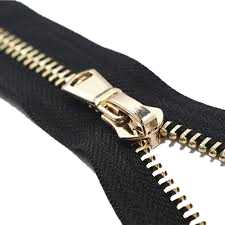
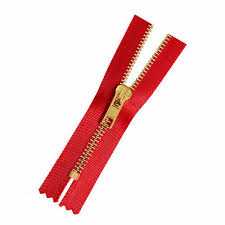
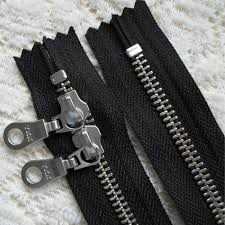
| Metal | Separate teeth clamped on the corded edge of the tape. Coats, which makes Opti zips, says its metal zips are normally brass teeth on polyester tape, with aluminium for lighter zips; YKK lists brass, aluminium and nickel among its metals | The most traditional type, strong and hard-wearing. Brass can discolour in washing and storage, nickel can cause skin allergy, and aluminium reacts to acids and alkalis | Jeans and trousers, jackets, bags and leather goods |
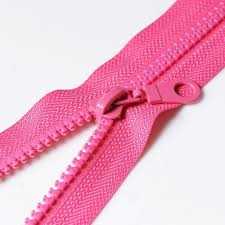
| Moulded plastic | Separate teeth injection-moulded from plastic, usually polyacetal (POM), on polyester tape; polypropylene for clear teeth (Coats). YKK’s moulded zipper is VISLON | Lighter than metal of the same size, YKK says, and made in a wide range of colours. Polyacetal is damaged by strong acids, and it takes less heat than a coil: YKK sets 130 °C as its ironing limit | Outerwear and sportswear, cold-weather and outdoor gear |
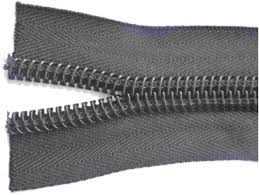
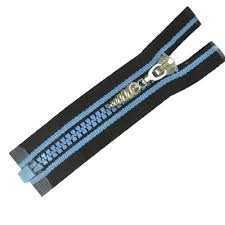
| Coil | One continuous plastic monofilament wound into a spiral, “such as polyester or nylon” (YKK). Coats describes a coil of monofilament, normally polyester, wrapped round a polyester cord and sewn onto two tapes; in a spiral zip the monofilament is woven into the tape as it is made | The most flexible, flat and round curves, and the softest of the three. Still called “nylon zips” from the material once common, Coats explains, though most are now polyester | Skirts, trousers and dresses, bags, tents and sleeping bags |
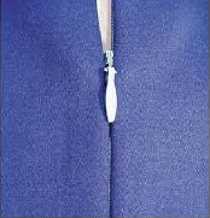
| Invisible (concealed) | A coil zipper with the tape folded behind the coil, so that from the front only the seam shows. It is sewn with a special foot (Coats). YKK’s is CONCEAL | Not for heavy use: YKK does not recommend it for backpacks, luggage or marine use, and says the slider must be pulled straight along the teeth, not at an angle | Dresses and skirts |
Sources for the table: YKK’s descriptions of its metal, VISLON, coil and CONCEAL zippers and its note on aluminium in the YKK Digital Showroom, its article on coil and CONCEAL zippers, and the YKK fastening catalogue, pp. 66 to 67; Coats’ answers on metal, moulded, sewn coil and spiral zips, on why coil zips are called nylon zips, and on invisible zips. The clamped metal tooth on a corded tape edge goes back to Sundback’s 1917 patent.

Types of zippers by function
Any of the tooth types can be made up in one of three ways, which decide what the zipper does at its ends. YKK’s codes show the same split: C for closed-end, O for open-end and M for a two-way zipper (YKK zipper nomenclature).
- Closed-end. A single bottom stop joins the two stringers at the foot, so the zipper opens only as far as the stop and never comes apart. It is the zipper of trouser and jeans flies, skirts, dresses, cushions and most bags.
- Open-end, or separating. The foot has an insertion pin and a retainer box instead of a bottom stop, so the two halves come fully apart. It is used where a garment must open completely, as on jackets and coats. The pin can be on the left or the right; YKK codes the two as open-end left insert and right insert.
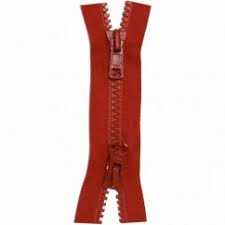
- Two-way. Two sliders on one chain, so the zipper can be opened from either end. A two-way separating zipper has a box at the foot that takes the lower slider, so that a long coat can be opened from the bottom and still come fully apart. A two-way zipper that does not separate has its sliders either meeting in the middle when closed (head to head), as on bags and luggage, or at the two ends when closed (tail to tail).
Zipper sizes: what #3, #5, #8 and #10 mean
The size number is the width of the closed chain. YKK states that “zippers are classified according to their chain width (i.e. the width of the engaged elements)” (YKK fastening catalogue, p. 45), and Coats that “the chain width also denotes the size of the zip” (Coats). The number is close to the width in millimetres but not equal to it, and the same number is not exactly the same width from one maker or tooth type to another. One European maker, KOH-I-NOOR of Prague, gives the widths of its own metal zippers as 5.0, 6.0 and 8.0 mm for the sizes it names MS5, MS6 and MS8, and its moulded PH8 as 9.0 mm (KOH-I-NOOR zip catalogue, p. 3). The chain width is measured with the zipper closed, by ASTM D2060 among other methods (ASTM).
JIS S 3015 sorts chains into six weight classes by width, and YKK lists which of its sizes falls in each, so the class is the honest way to read a size number:
| JIS class | Chain width | YKK sizes in the class |
|---|---|---|
| Ultra light | 2.5 to under 4.0 mm | #2 coil |
| Light | 4.0 to under 5.5 mm | #3 and #4: metal, moulded and coil; #4.5 coil |
| Medium | 5.5 to under 7.0 mm | #5: metal, moulded and coil; #7 metal |
| Medium-heavy | 7.0 to under 8.5 mm | #8: metal, moulded and coil |
| Heavy | 8.5 to under 12.0 mm | #10: metal, moulded and coil |
| Ultra heavy | 12.0 mm | #15 moulded |
So a #5 zipper is a medium zipper, with a chain 5.5 to 7 mm wide, and a #10 a heavy one. A zipper is ordered by the whole description, not the number alone: YKK’s own example of the standard form is “Size 3 standard coil, painted automatic lock slider, closed-end zipper” (YKK zipper nomenclature), followed by the length. A slider fits only its own size and type of chain; Coats’ first check for a slider that will not close the chain is that “the slider and chain are from the same zip supplier and are the correct sizes to match one another” (Coats).
How to measure a zipper’s length, and the tolerance
Measure the zipper completely closed and laid flat. The length is taken from the top of the slider, not from the end of the tape, as YKK’s instruction manual sets out (YKK Zipper Usage Instruction Manual, p. 2):
| Zipper | Length | Top extension | Bottom extension |
|---|---|---|---|
| Closed-end | Top of the slider to the end of the bottom stop | Top stop to the end of the tape | Bottom stop to the end of the tape |
| Open-end | Top of the slider to the end of the box | Top stop to the end of the tape | None |
| Two-way open-end | Top of the slider to the end of the reinforced tape | Top stop to the end of the tape | None |
| Closed-end with the top stop left exposed | Top stop to the end of the bottom stop | Top stop to the end of the tape | Bottom stop to the end of the tape |
No zipper is made to an exact length. The same manual gives the length tolerance YKK applies, based on JIS S 3015: within ±5 mm for a zipper up to 30 cm long, ±10 mm over 30 cm and up to 60 cm, ±15 mm over 60 cm and up to 120 cm, and ±2.0% of the specified length above 120 cm. Other makers set their own: KOH-I-NOOR allows ±0.5 cm up to 25 cm, ±1 cm from 26 to 100 cm, ±1% from 101 to 500 cm and ±5 cm beyond (KOH-I-NOOR zip catalogue, p. 2). In the United States the dimensions and length tolerances for each size are set by ASTM D3657, the specification for zipper dimensions (ASTM). A specification should name the table it uses, because the limits differ at the same length.
How to choose a zipper for a garment
- Decide what the opening must do. If it must come fully apart, as on a jacket front, it needs an open-end zipper; if it must open from the bottom as well, a two-way separating one. Everything else, from a fly to a cushion cover, takes a closed-end zipper.
- Choose the teeth for the fabric and the use. Coil for light fabrics, curved seams and anything that should stay soft; an invisible zipper where the closure should disappear, as on a dress or skirt; moulded plastic where the zipper is exposed to weather or must be light for its size; metal where strength and look matter, as on jeans and bags. YKK’s own advice for sportswear is “a VISLON zipper for outdoor cold weather sports” and “a coil zipper for a sleeping bag or tent”, and it notes that “polyester tape has better UV resistance than nylon” (YKK Americas). For handbags it says luxury bags often use metal “because of their durability”, and a coil zipper will “lighten the weight of a bag” (YKK Americas).
- Choose the size for the load. A heavier class is a wider, stronger chain (see the strength classes). Light fabrics take #3 or #4, and YKK warns that a #3 zipper used in thick material can break at the open end: “When using thick materials, please use zippers above No. 4” (YKK fastening catalogue, p. 66).
- Choose the slider. An automatic lock slider for a front or a fly that must not creep open; a non-lock slider where the zipper should run freely; a reversible slider for a reversible garment.
- Check the finishing route. A garment that will be garment-dyed, stone-washed or bleached after the zipper is sewn in needs a zipper made for it. YKK recommends particular metal and slider types for such washes, and says residual chemicals must be neutralised, rinsed out and dried quickly to stop discoloration and corrosion (YKK fastening catalogue, p. 66). ASTM’s guide to choosing zippers for care-labelled garments, ASTM D3692, looks at shrinkage, colour fastness and ironing deformation.
- For a metal zipper sold in Europe, check nickel. Zippers in garments fall under the EU limit on nickel release; see nickel release below.
- Measure the opening and order the length by the rules above. YKK’s instruction for an invisible zipper sewn into an opening already closed at its end is to “prepare a zipper approx. 30mm longer than the actual garment opening” (YKK fastening catalogue, p. 61).
Care, and fixing a slider
- Close it before washing. YKK: “Be sure to close the zipper before washing, drying, or dry cleaning”; repeated washing or hot drying with the zipper open bends it. Its manual shows teeth pulled out of line and a slider forced off where an open zipper was strained sideways in the wash (YKK manual, p. 16). Coats adds that a fly zipper should be washed with its button fastened (Coats).
- Iron through a cloth, at a limited heat. YKK gives the ironing limits as 160 °C for coil and CONCEAL zippers and 130 °C for VISLON moulded zippers, and asks for the zipper to be closed, the pull lying flat and a cloth laid over it; ironing directly on the zipper “may cause melting, deformation and/or color change” (YKK manual, p. 4).
- A stiff slider: lubricate, do not force. Forcing a slider that does not run smoothly can damage the teeth. YKK’s advice is to rub paraffin wax or a zipper lubricant on the front and back of the teeth and work the slider up and down several times (YKK Americas).
- Use the pull. Forcing a locking slider open without its pull-tab can tear moulded teeth off, and an invisible zipper’s slider must be drawn straight along the teeth: pulled up at an angle, the teeth warp and the zipper stops working (YKK fastening catalogue, p. 67).
- A chain that opens behind the slider is often a broken bottom stop rather than a worn slider. Coats’ answer is that the bottom stop “should be protected with a bar tack to prevent direct strain on the zip” (Coats). A replacement slider must be the same make and size as the chain.
- Keep metal zippers dry and away from rubber. Brass can corrode and stain in damp, sealed storage. YKK advises storing garments with some ventilation, not tying zippers with rubber bands, whose sulphur discolours the teeth and yellows the tape, and keeping moulded polyacetal teeth away from bleach and strong acids (YKK fastening catalogue, pp. 66 to 67). A zipper can also mark the fabric it is stored against: the lubricant on metal teeth collects metal dust that can soil light or absorbent fabric, so YKK suggests lining the contact area with paper, and it warns that prolonged contact with PVC or polyurethane can make the colour of its water-repellent zippers run (YKK manual, p. 21).
How zippers are tested: the standards
Three families of standards cover zippers for clothing: the European specification EN 16732, the Japanese JIS S 3015, and a set of ASTM test methods. A buyer’s specification usually names one of them and the performance level it expects. There is no ISO standard for zippers in clothing: JIS S 3015 notes that no corresponding international standard has been published (JIS S 3015:2019, foreword). ISO does have seven test methods for slide fasteners, all written by its footwear committee, ISO/TC 216, and all titled “Footwear”; among them are ISO 10750 for the attachment strength of the top and bottom stops, ISO 10751 for resistance to repeated opening and closing, ISO 10734 for the strength of the puller, and ISO 10764 for the lateral strength of a closed zipper (ISO catalogue, ICS 61.060).
- EN 16732, Slide fasteners (zips): Specification. The current edition, EN 16732:2025, replaced the 2015 edition in 2025. It sets performance levels and test methods for the strength of the puller attachment, the bottom stop of a closed-end zipper, the top stops, the box of an open-end zipper, the reciprocating (opening and closing) mechanism and the slider lock, and for colour fastness and dimensional stability to washing and dry cleaning. It does not cover specialist zippers such as the pressure-sealed zippers of diving suits (Estonian Centre for Standardisation listing). The first edition, EN 16732:2015, was the first Europe-wide zipper standard and was based largely on the British Standard it replaced, BS 3084 (Intertek, 2016); BSI withdrew BS 3084:2006 on 7 August 2017 (BSI).
- JIS S 3015, Slide fasteners. First issued in 1958 and revised in January 2019, it covers general-purpose zippers for clothing, bags and similar goods. Its tests include the crosswise strength of the chain, the strength of the top stops, bottom stop and box, the slider’s strength and lock, the twisting strength of the pull, a repeated opening and closing test, dimensional change in washing, corrosion of plated parts, colour fastness, and how to measure a zipper’s dimensions (JIS S 3015:2019, contents).
- The ASTM zipper methods, from ASTM subcommittee D13.54. ASTM D2061 covers the strength tests: of the chain and its elements, the stops, the separable unit, the slider under compression and deflection, the pull under twisting and pulling off, and the slider lock (ASTM). ASTM D2062 covers operability: opening and closing, how the separator works, and sticking at the stops (ASTM). ASTM D2060 measures the dimensions and ASTM D3657 sets them for each size, as above. ASTM D4465 is the performance specification for the fly zippers of jeans, dungarees and work trousers made from heavy denim of about 475 g/m² (ASTM), and ASTM D3692 the guide to choosing zippers for care-labelled goods (ASTM). Others test the colour fastness of zippers to laundering, dry cleaning, light and crocking, and resistance to salt spray (D2057, D2052, D2053, D2054 and D2059).
The strength classes
JIS S 3015 sets a minimum strength for each class. YKK reproduces the requirements in its catalogue and states that “all standard YKK zippers meet JIS requirements”. The first and most important is the crosswise strength of the chain, in newtons:
| Chain crosswise strength, minimum | Ultra light | Light | Medium | Medium-heavy | Heavy | Ultra heavy |
|---|---|---|---|---|---|---|
| Separate teeth (metal, moulded), synthetic tape | 150 N | 230 N | 300 N | 390 N | 490 N | 690 N |
| Separate teeth, reinforced synthetic tape, for garments needing higher durability | 300 N | 400 N | 500 N | 600 N | 700 N | 800 N |
| Separate teeth: other tapes, knitted tape, or aluminium alloy teeth | 100 N | 150 N | 200 N | 250 N | 300 N | none |
| Coil, synthetic tape | 200 N | 250 N | 450 N | 540 N | 590 N | none |
| Coil, other tapes or knitted tape | 150 N | 200 N | 200 N | 300 N | 350 N | none |
Crosswise strength, worked through
The load a closed zipper meets in wear is mostly across the chain, trying to pull the two rows of teeth apart: a tight waistband, a full bag, a jacket pulled across the chest. That is why the crosswise test of the chain comes first in JIS S 3015’s list of tests, and why the first method in ASTM D2061 is the strength of the chain and its elements. YKK, which tests to both, describes it: “An engaged zipper chain is pulled crosswise” at a constant speed, in clamps 25 mm wide moving at 300 mm a minute, and the result is given per 2.5 cm of chain (YKK Americas, product testing methods). ASTM D4465 includes crosswise chain strength among its requirements for jeans zippers.
Worked example. A #5 metal zipper on polyester tape is in the medium class, so JIS S 3015 asks for a chain crosswise strength of at least 300 N. Three specimens burst at 420, 455 and 398 N. (These three results, and the 4 teeth per centimetre below, are assumed figures for the example.) The zipper lateral pull calculator gives a mean of 424.33 N, a standard deviation of 28.75 N and a coefficient of variation of 6.77%. The mean clears the 300 N minimum by 124.33 N; put the other way, the minimum is 70.70% of the result. With 25 mm of chain in the clamps at 4 teeth per centimetre, 10 teeth carry the load, 42.43 N each on average. That average flatters the chain: a burst starts at one tooth and runs on from there, so the lowest specimen, 398 N here, is the better guide to how the zipper will behave in a garment, and it should be reported beside the mean. The same zipper with coil teeth would be held to 450 N, and these results would fail it.
Nickel release from metal zippers
Some metal zippers contain nickel, in the teeth or in the finish of the teeth and slider, and nickel touching the skin can cause an allergic reaction; YKK’s own catalogue lists it among the problems it is asked about (YKK fastening catalogue, p. 66). In the European Union, entry 27 of Annex XVII to the REACH Regulation names zippers outright. Nickel “shall not be used” in articles intended to come into direct and prolonged contact with the skin, a list that includes “rivet buttons, tighteners, rivets, zippers and metal marks, when these are used in garments”, if the nickel released from the parts touching the skin is greater than 0.5 μg/cm² a week. A part with a nickel-free coating must keep its release within that limit for at least two years of normal use, and such articles may not be placed on the market unless they comply (Regulation (EC) No 1907/2006, consolidated text, Annex XVII, entry 27). The entry says that CEN’s standards are the test methods. They are EN 1811:2023, the reference method for nickel release from articles in direct and prolonged contact with the skin, and EN 12472:2020, which simulates accelerated wear and corrosion on a coated item before its nickel release is measured; the Commission published both as the references for entry 27 in December 2023 (Communication C/2023/1604). The site’s record of the REACH Regulation covers the rest of the regulation.
The usual answers are aluminium teeth or a nickel-free specification. YKK advises that “when a silver-colored metal zipper is required, choose an aluminum zipper” (YKK Americas), and codes its nickel-free products N-ANTI, which its nomenclature describes as meeting the European nickel requirement (YKK zipper nomenclature). Aluminium has limits of its own: YKK notes that it is sensitive to acids and alkalis and cannot be combined with copper-alloy sliders (YKK Digital Showroom).
A short history
The first patents were for shoes. Whitcomb L. Judson was granted two dated 29 August 1893, one titled “Clasp locker or unlocker for shoes” (US 504,038) and one “Shoe-fastening” (US 504,037). The zipper as it is still made is Gideon Sundback’s “Separable fastener”, filed on 27 August 1914 and granted on 20 March 1917 to the Hookless Fastener Company (US 1,219,881). Its aims were to “decrease the weight and bulk” and “increase the flexibility and security of locking”. Its locking members “are all alike, and therefore interchangeable”, clamped on the corded edge of a fabric tape so that each one nests in the recess of the next, and a slider with a Y-shaped channel locks them by moving one way and unlocks them by moving the other.
The name came from rubber boots. The Smithsonian’s National Museum of American History credits the boot maker B. F. Goodrich with coining “zipper”, and notes that the zipper “wasn’t widely used on clothing until the 1930s, when it replaced buttons as men’s fly closures” (Sundback patent model, NMAH). Goodrich registered “Zipper” as a trade mark for footwear, but in 1931 the Exchequer Court of Canada refused to register the word for fasteners, holding that it had become “descriptive of slide fasteners generally” (Lightning Fastener v. Canadian Goodrich). In Japan, YKK was founded as a zipper maker in 1934 by Tadao Yoshida; its name is the initials of Yoshida Kogyo Kabushikikaisha (YKK Americas). In Britain the trade term is “fastener” or “slide fastener”, YKK Europe notes, while “zipper” and “zip fastener” began in the United States and “zip” imitates the sound a zipper makes (YKK Europe).
Related on this site
- Zipper lateral pull calculator: crosswise strength from three specimens, as worked above.
- Types of plackets, including how a zipper placket is made, and apparel construction guidelines.
- Trims and accessories and textile components: zippers among the other fastenings.
- Zip manufacturers and hook-and-loop and other fastener makers.
Sources and corrections
Every figure on this page was read at its source on 5 October 2026. Makers’ catalogues describe their own products and are quoted as such.
- Standards: Japanese Standards Association, JIS S 3015:2019, Slide fasteners (preview: foreword, contents, definitions); ASTM International, D2061-07(2021), D2062-03(2021), D2060-14(2022), D3657-03(2021), D4465-05(2021) and D3692-89(2021); Estonian Centre for Standardisation, EN 16732:2025, EN 1811:2023 and EN 12472:2020; BSI, BS 3084:2006; Intertek, EN 16732:2015 published, 10 February 2016; ISO, ICS 61.060 (footwear slide-fastener methods).
- Law: Regulation (EC) No 1907/2006 (REACH), consolidated text of 1 January 2025, Annex XVII, entry 27; European Commission, Communication C/2023/1604, references of standards under entry 27.
- Makers: YKK, fastening catalogue, Zipper Usage Instruction Manual, zipper nomenclature, product testing methods, YKK Americas FAQ, YKK Europe FAQ, the structure of a zipper, and product descriptions in the YKK Digital Showroom; Coats, zips FAQ (pages 2, 6, 10, 11, 13, 14 and 15); KOH-I-NOOR a.s., zip catalogue.
- History: US patents 504,037, 504,038 and 1,219,881; Smithsonian National Museum of American History, patent model for Sundback’s separable fastener; Exchequer Court of Canada, Lightning Fastener Co. v. Canadian Goodrich Co., 1931.
Change log. 5 October 2026: rewritten in full, with the site’s shorter pages on the parts of a zipper and on zipper sizes folded in. Corrected from the previous versions: the size table, whose rows contradicted one another, is replaced by the JIS chain-width classes; the length tolerances now give YKK’s band edges and their basis in JIS S 3015; the length is measured from the top of the slider, not from stop to stop; coil zippers are no longer listed as a kind of moulded plastic zipper; the definitions of the top and bottom stops, which were swapped, are put right; and the history now gives the patent dates, 1893 and 1917, in place of “around 1917 and 1920s”.
Found an error? Please tell us through the contact page, naming the section and the source that disagrees.







E&T Fastener Components offers a complete line of plastic fasteners and machined metal fasteners.
Nice information about Zip Varieties for designers. Technology has improved fashion designing world to some height.
Thanks for the information. The need for fashion software and app updates Visit Fashion Dot will really help you a lot.