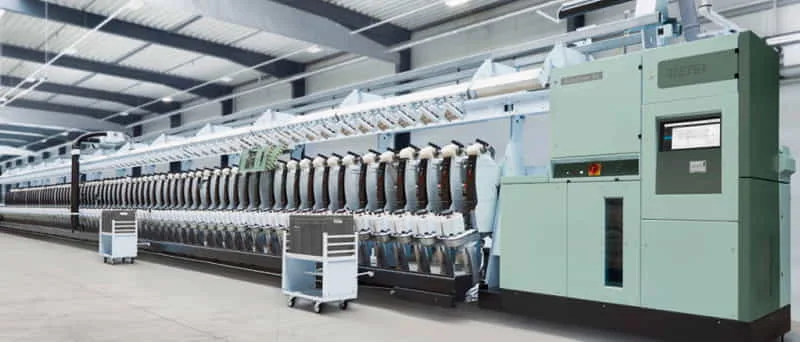
This article serves as a technical resource for professionals in the textile industry, focusing on spun yarn calculations critical for process control and quality assurance. It includes formulas for yarn count determination, twist per inch, spinning production rates, and waste percentages, supported by detailed examples and authoritative references. The content emphasizes precision in spinning operations, offering insights into optimizing yarn properties for various applications, such as weaving, knitting, and technical textiles.
1. Yarn Count Calculations
1.1 English Cotton Count (Ne)
The English Cotton Count (Ne) measures yarn fineness as the number of 840-yard hanks per pound.
Example: For 16,800 yards of yarn weighing 2 pounds: Ne = (16,800 / 2) ÷ 840 = 10 Ne
Reference: ISO 2060:1994
1.2 Tex
Tex measures yarn weight in grams per 1,000 meters.
Example: For 50 grams of yarn over 2 kilometers: Tex = 50 / 2 = 25 Tex
1.3 Denier
Denier measures yarn weight in grams per 9,000 meters.
Example: For 50 grams over 2 kilometers: Denier = (50 / 2) × 9000 = 225,000 Denier
1.4 Conversion Between Systems
Ne to Tex:
Example: For Ne = 10: Tex = 590.5 / 10 = 59.05 Tex
Tex to Denier:
Example: For Tex = 59.05: Denier = 59.05 × 9 = 531.45 Denier
Reference: Textile Institute, Yarn Count Systems
2. Twist Calculations
2.1 Twist per Inch (TPI)
Twist per inch measures the number of twists in one inch of yarn, affecting strength and texture.
Example: For 300 twists over 10 inches: TPI = 300 / 10 = 30 twists/inch
2.2 Twist Multiplier (TM)
The twist multiplier relates twist level to yarn count for consistent yarn properties.
Example: For TPI = 30, Ne = 16: TM = 30 / √16 = 30 / 4 = 7.5
2.3 Twist Angle
The twist angle indicates the helix angle of fibers in the yarn.
Where:
- θ = Twist angle
- d = Yarn diameter (inches)
Example: For d = 0.01 inches, TPI = 30, Ne = 16: tan θ = (3.1416 × 0.01 × 30) / √16 ≈ 0.2356; θ ≈ arctan(0.2356) ≈ 13.3°
Reference: Textile Research Journal, Yarn Twist Analysis
3. Yarn Strength Calculations
3.1 Tenacity
Tenacity measures yarn strength relative to its linear density (grams per Tex).
Example: For a breaking load of 500 grams, Tex = 25: Tenacity = 500 / 25 = 20 g/Tex
3.2 Breaking Length
Breaking length is the theoretical length of yarn that would break under its own weight.
Example: For breaking load = 500 grams, weight per km = 25 grams: Breaking Length = 500 / 25 = 20 km
Reference: ASTM D2256-21
4. Spinning Production Calculations
4.1 Production Rate
Production rate calculates the amount of yarn produced per hour.
Example: For spindle speed = 15,000 RPM, efficiency = 0.95, length per twist = 0.025 m, Tex = 25, 100 spindles: P_r = (15,000 × 60 × 0.95 × 0.025) / 25 × 100 ≈ 85,500 m/hour
4.2 Yarn Weight Produced
Where:
- W_p = Weight produced (kg/hour)
Example: For P_r = 85,500 m/hour, Tex = 25: W_p = (85,500 × 25) / 1000 ≈ 2,137.5 kg/hour
5. Spinning Efficiency and Waste
5.1 Spinning Efficiency
Where:
- E_s = Spinning efficiency (%)
- T_a = Actual running time (hours)
- T_t = Total time (hours)
Example: For T_a = 7 hours, T_t = 8 hours: E_s = (7 / 8) × 100 = 87.5%
5.2 Waste Percentage
Example: For 3 kg waste from 100 kg fiber: Waste = (3 / 100) × 100 = 3%
6. Drafting Calculations
6.1 Draft Ratio
The draft ratio measures the reduction in fiber thickness during spinning.
Where:
- D_r = Draft ratio
- L_i = Input sliver length (m)
- L_o = Output yarn length (m)
Example: For L_i = 100 m, L_o = 2,000 m: D_r = 100 / 2,000 = 0.05
6.2 Total Draft
Where:
- D_t = Total draft
- D_main = Main draft
- D_break = Break draft
Example: For D_main = 20, D_break = 1.2: D_t = 20 × 1.2 = 24
Reference: Textile Institute, Spinning Technology
7. Yarn Evenness and Imperfections
7.1 Coefficient of Variation (CV%)
The coefficient of variation measures yarn unevenness.
Where:
- σ_w = Standard deviation of yarn weight
Example: For σ_w = 0.5 g, mean weight = 10 g: CV% = (0.5 / 10) × 100 = 5%
7.2 Imperfection Index
The imperfection index counts defects like thick places, thin places, and neps per kilometer.
Example: For 50 thick places, 30 thin places, 20 neps per km: II = 50 + 30 + 20 = 100 imperfections/km
Reference: Uster Statistics
8. Cost Estimation in Spinning
8.1 Fiber Cost per Kilogram of Yarn
Example: For fiber price = $2/kg, fiber weight = 1.03 kg, waste = 3%: C_f = (2 × 1.03) / (1 – 0.03) ≈ $2.12/kg
8.2 Total Production Cost
Example: For C_f = $2.12/kg, processing cost = $0.50/kg: C_t = 2.12 + 0.50 = $2.62/kg
9. Practical Applications and Examples
9.1 Cotton Yarn Production
For a cotton yarn with:
- Ne = 20
- TPI = 25
- Spindle speed = 12,000 RPM
- Efficiency = 0.90
- Spindles = 200
Tex Calculation:
Tex = 590.5 / 20 = 29.525 Tex
Production Rate:
P_r ≈ (16,200 / 29.525) × 200 ≈ 109,737 m/hour
Weight Produced:
W_p ≈ 3,239.5 kg/hour
9.2 Polyester-Cotton Blend
For a 50:50 polyester-cotton blend with:
- Ne = 30
- TPI = 20
- Fiber cost = $2.5/kg
- Waste = 4%
Tex Calculation:
Tex = 590.5 / 30 ≈ 19.68 Tex
Fiber Cost:
C_f = 2.6 / 0.96 ≈ $2.71/kg
10. Error Analysis in Spinning Calculations
10.1 Yarn Count Variation
Example: For σ_w = 0.5 g, length = 2 km: ΔTex = 0.5 / √2 ≈ 0.3536 Tex
10.2 Twist Variation
Example: For σ_twist = 2 twists, length = 100 inches: ΔTPI = 2 / √100 = 0.2 twists/inch
11. Summary Table of Key Spun Yarn Formulas
| Category | Formula | Example |
|---|---|---|
| Yarn Count (Ne) | Ne = (Length (yards) / Weight (pounds)) ÷ 840 | (16,800 / 2) ÷ 840 = 10 Ne |
| Tex | Tex = Weight (grams) / Length (kilometers) | 50 / 2 = 25 Tex |
| Denier | Denier = (Weight (grams) / Length (kilometers)) × 9000 | (50 / 2) × 9000 = 225,000 Denier |
| Count Conversion | Tex = 590.5 / Ne; Denier = Tex × 9 | Tex = 590.5 / 10 = 59.05 Tex; Denier = 59.05 × 9 = 531.45 |
| Twist per Inch | TPI = Total Twists / Length (inches) | 300 / 10 = 30 twists/inch |
| Twist Multiplier | TM = TPI / √Ne | 30 / √16 = 7.5 |
| Twist Angle | tan θ = (π × d × TPI) / √Ne | (3.1416 × 0.01 × 30) / √16 ≈ 0.2356; θ ≈ 13.3° |
| Tenacity | Tenacity = Breaking Load (grams) / Tex | 500 / 25 = 20 g/Tex |
| Breaking Length | Breaking Length (km) = Breaking Load / Weight per km | 500 / 25 = 20 km |
| Production Rate | P_r = (Spindle Speed × 60 × Efficiency × Length per Twist) / Tex × Spindles | (15,000 × 60 × 0.95 × 0.025) / 25 × 100 ≈ 85,500 m/hour |
| Weight Produced | W_p = (P_r × Tex) / 1000 | (85,500 × 25) / 1000 ≈ 2,137.5 kg/hour |
| Spinning Efficiency | E_s = (T_a / T_t) × 100 | (7 / 8) × 100 = 87.5% |
| Waste Percentage | Waste (%) = (Waste Weight / Total Fiber Weight) × 100 | (3 / 100) × 100 = 3% |
| Draft Ratio | D_r = L_i / L_o | 100 / 2,000 = 0.05 |
| Total Draft | D_t = D_main × D_break | 20 × 1.2 = 24 |
| Coefficient of Variation | CV% = (σ_w / Mean Weight) × 100 | (0.5 / 10) × 100 = 5% |
| Imperfection Index | II = N_thick + N_thin + N_neps | 50 + 30 + 20 = 100 imperfections/km |
| Fiber Cost | C_f = (Fiber Price × Fiber Weight) / (1 – Waste (%)/100) | (2.5 × 1.03) / (1 – 0.03) ≈ $2.12/kg |
| Total Production Cost | C_t = C_f + Processing Cost | 2.12 + 0.50 = $2.62/kg |
| Yarn Count Variation | ΔTex = σ_w / √Length (km) | 0.5 / √2 ≈ 0.3536 Tex |
| Twist Variation | ΔTPI = σ_twist / √Length (inches) | 2 / √100 = 0.2 twists/inch |
12. Conclusion
The spun yarn calculations provided in this guide offer a comprehensive framework for optimizing spinning processes in textile production. By mastering these formulas, professionals can ensure consistent yarn quality, improve production efficiency, and reduce costs. The practical examples and references facilitate practical application and further study.