
Optimizing textile production for circular fashion involves rethinking every step of the value chain—from eco-friendly material choices to post-consumer recycling. This article breaks down the technologies, strategies, and trends reshaping how textiles are made in a world that values longevity and sustainability.
Introduction
The fashion industry is at a crucial crossroads. Faced with mounting waste, carbon emissions, and overconsumption, brands and manufacturers are reimagining how garments are made, worn, and reused. Enter circular fashion, a sustainable approach designed to close the loop on production and consumption. At its heart is optimized textile production, where every fiber, dye, and stitch is engineered to reduce waste and promote longevity.
Circular fashion models reject the traditional linear economy of “take, make, dispose.” Instead, they embrace reuse, recycling, and regeneration. To support this transformation, textile production processes must evolve—from material selection and dyeing to manufacturing and post-consumer recovery. This article explores how the textile sector can align with circular fashion models by leveraging innovation, collaboration, and data-driven efficiency.
A Brief History of Circularity in Fashion
Historically, textiles were more circular than linear. Before industrialization, garments were custom-made, repaired, passed down, or repurposed. However, the rise of mass production and fast fashion led to exponential waste. Today, only 1% of textiles are recycled into new clothing, and over 92 million tons of textile waste are generated annually.
The concept of circular fashion re-emerged in the early 2000s, inspired by Cradle to Cradle design principles and the Ellen MacArthur Foundation’s circular economy framework. Brands began experimenting with closed-loop models, but significant transformation only started in the past decade with advances in fiber recovery, digital traceability, and sustainable business incentives.
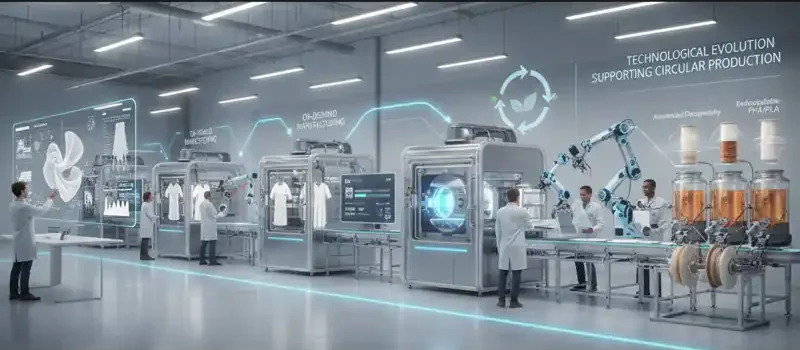
Technological Evolution Supporting Circular Production
To enable circularity, textile production must incorporate technologies that extend product life, reduce environmental impact, and facilitate recycling. Key innovations include:
- Digital Fabric Modeling: Simulates fabric performance, reducing the need for physical sampling
- On-Demand Manufacturing: Produces garments only after purchase to minimize overproduction
- Waterless Dyeing: Uses CO₂ or plasma to color fabrics without water or chemicals
- Automated Disassembly: Robotics and smart stitching allow garments to be easily taken apart for recycling
- Biodegradable Polymers: Replace synthetic fibers with compostable alternatives like PHA or PLA
These advancements make it easier to align design with end-of-life recovery and remanufacturing.
Production Process Reimagined for Circularity
Optimizing production for circular fashion requires rethinking every step of the value chain:
1. Material Selection
Choose mono-materials or compatible fiber blends to facilitate recycling. Prioritize natural, regenerative, or recycled inputs.
2. Eco-Design Principles
Design for disassembly, durability, repairability, and modular upgrades.
3. Low-Impact Manufacturing
Adopt renewable energy, closed-loop water systems, and chemical-free processes.
4. Smart Labelling
Use digital product passports with QR codes to store fiber content, production history, and care instructions.
5. Post-Consumer Integration
Incorporate take-back programs and textile-to-textile recycling capabilities into business models.
| Stage | Traditional Model | Circular Model |
|---|---|---|
| Design | Trend-based, short lifecycle | Durable, recyclable, versatile |
| Manufacturing | High-waste, batch-based | On-demand, resource-efficient |
| End-of-Life | Landfill/incineration | Recycling, upcycling, composting |
Key Innovations in Circular Textile Production
Circular textile production benefits from several cutting-edge technologies:
- Chemical Recycling of Cellulose: Recovers cotton fibers without downgrading quality (e.g., Infinited Fiber)
- Fiber Blending Automation: Machines identify and separate different fiber types for pure recycling
- Natural Dye Bio-Engineering: Produces pigments from bacteria or algae with no environmental runoff
- Blockchain Supply Chains: Ensures traceability and material authentication from fiber to fashion
These tools improve efficiency, transparency, and material purity, which are crucial for successful circular operations.
Circular Textile Types and Material Strategies
Not all materials are equally suited to circular systems. The most common categories include:
| Type | Description |
|---|---|
| Monomaterial Garments | Made from a single fiber type for easy recycling |
| Biodegradable Textiles | Compostable under industrial or home conditions |
| Recycled Fibers | Produced from post-consumer or industrial waste (e.g., rPET, recycled wool) |
| Regenerative Fibers | Grown using farming practices that restore soil and sequester carbon (e.g., regenerative cotton) |
Blends like polyester-cotton are currently difficult to recycle, but chemical solutions are emerging to separate and reclaim their components.
Real-World Applications
Leading examples demonstrate the potential of circular textile production:
- Patagonia: Accepts worn gear for recycling and repairs, and uses regenerative organic cotton
- H&M’s Looop: An in-store machine that turns old clothes into new garments within hours
- Eileen Fisher Renew: Resells, remakes, or recycles worn garments to extend product life
- Re:newcell: Uses enzymatic processes to recycle used cotton and viscose into new pulp
These brands show how circularity can drive customer loyalty, environmental benefits, and innovative business models.
Market Landscape and Consumer Expectations
As sustainability becomes a key purchasing factor, circular fashion is reshaping market dynamics. Consumers are:
- Seeking transparency and traceability
- Demanding repair, resale, and rental services
- Prioritizing durability over disposability
Circular textile production supports these values by aligning supply chains with ethical and regenerative outcomes.
The global circular fashion market is projected to reach over $30 billion by 2030, driven by Gen Z and millennials who demand accountability from brands.
Challenges to Circular Textile Optimization
Despite its promise, several obstacles remain:
- Infrastructure Gaps: Lack of recycling facilities and post-consumer collection systems
- Cost Barriers: Circular practices often have higher upfront costs
- Material Complexity: Multicomponent fabrics hinder recycling
- Legislation and Standards: Inconsistent policies across countries
- Consumer Participation: Circular models rely on return and reuse behaviors
Solving these challenges requires collaboration across the value chain, from farmers to brands to consumers.
Policy, Regulation, and Incentives
Governments play a vital role in accelerating circular practices:
- Extended Producer Responsibility (EPR): Holds brands accountable for product end-of-life
- Tax Breaks and Subsidies: Support R&D and infrastructure development
- Eco-Labeling Requirements: Mandate clear sustainability disclosures
- Green Public Procurement: Governments prioritize circular textiles in purchasing
The EU Strategy for Sustainable Textiles is one example aiming to make all textile products durable, repairable, and recyclable by 2030.
Future Trends in Circular Textile Production
Looking ahead, we can expect:
- Textile-to-Textile Recycling at Scale: Commercial viability of fiber regeneration systems
- Regenerative Farming Integration: Sourcing from carbon-negative farms
- AI for Circular Design: Generative tools that optimize patterns for zero waste
- Digital IDs and Product Passports: To track garments throughout their lifecycle
- Circular Design Education: Curriculum shifts in fashion and textile schools
These trends will help build a resilient textile system that thrives within planetary boundaries.
Summary
Circular fashion isn’t a trend—it’s an industrial and cultural transformation. Optimizing textile production for circularity means redesigning systems from the ground up. It requires collaboration, transparency, innovation, and bold leadership. Brands and manufacturers who embrace circular principles will not only reduce their environmental footprint but also unlock new business value and customer trust.
The future of textiles is circular, and the time to rethread the industry is now.
References
- Ellen MacArthur Foundation – Circular Economy in Fashion: https://ellenmacarthurfoundation.org/topics/fashion/overview
- Fashion for Good – Textile Recycling Innovation: https://fashionforgood.com/our-innovation-platform/innovations/
- European Commission – EU Strategy for Sustainable Textiles: https://environment.ec.europa.eu/strategy/textiles-strategy_en




Thank you for this insightful post on optimizing textile production for circular fashion! It truly resonates with my experience in sustainable design. I recently implemented some eco-friendly practices in my own projects that align with circular models. It’s inspiring to see the industry’s shift towards more responsible practices! speedstars
I really appreciated your insights on optimizing textile production for circular fashion! It’s so encouraging to see how sustainability is being prioritized. I recently upcycled some old clothes into new styles—such a fun project! Also, the link to space waves is intriguing; it’s great to tie gaming with sustainability concepts!
You mentioned that mono-material garments are easier to recycle than blended fabrics. How do brands balance that with the need for performance features like stretch, Block Blast durability, or moisture-wicking, which often rely on fiber blends?