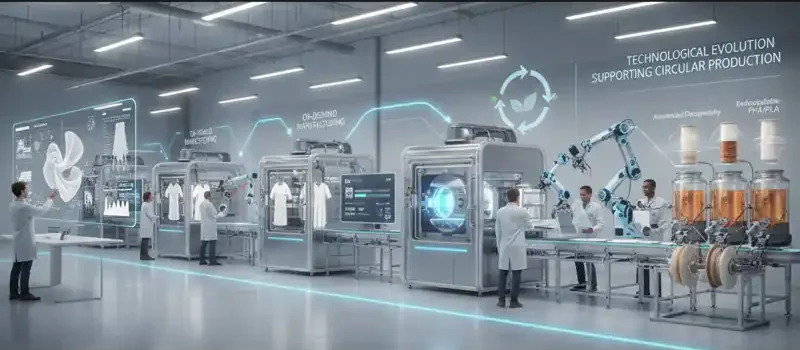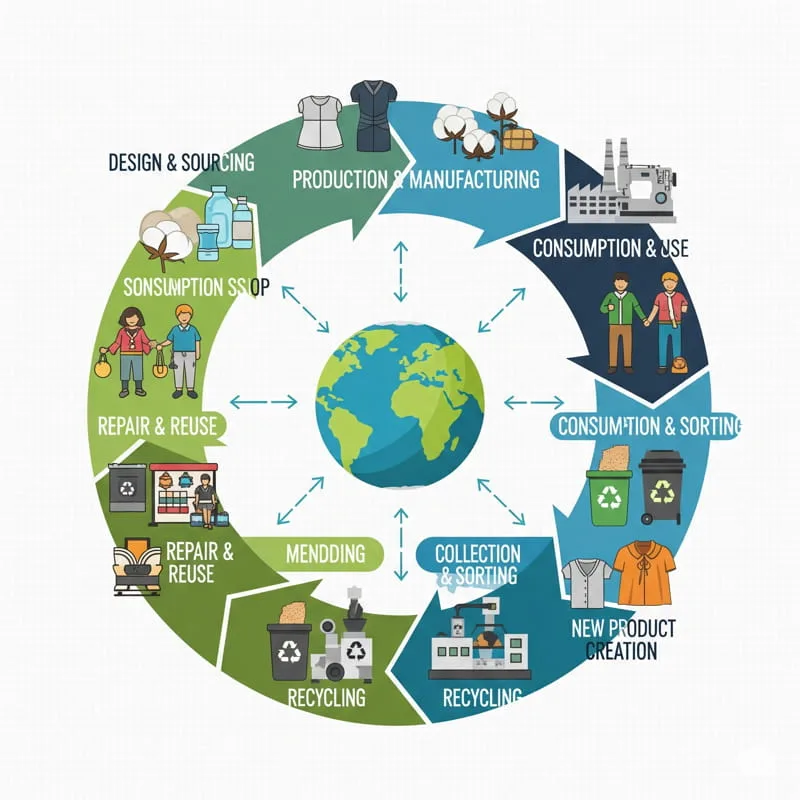
A circular economy in textiles replaces the linear “take-make-waste” model with one that designs out waste and pollution, keeps products and materials in use, and regenerates natural systems. In practice that means garments built for longevity, repair and recycling: mono-material fabrics such as 100% cotton or polyester that are easier to recycle, biodegradable fibers like lyocell and hemp, and take-back programs that feed used clothing into reuse and fiber-to-fiber recycling.
The textile industry, a cornerstone of global commerce and culture, has long been associated with environmental degradation and resource depletion. The traditional linear model of textile production—extracting raw materials, manufacturing garments, and discarding them after use—generates significant waste, pollution, and social inequities. The circular economy offers a transformative solution, reimagining how textiles are designed, produced, used, and repurposed to minimize environmental impact and maximize resource efficiency. This article provides a comprehensive exploration of the circular economy in textiles, highlighting innovative practices, global and regional initiatives, challenges, and the path forward for a sustainable fashion industry.
Understanding the Circular Economy in Textiles
The circular economy is a systemic approach that seeks to eliminate waste and promote the continual use of resources. In textiles, this means designing products for longevity, repairability, and recyclability, keeping materials in circulation, and regenerating natural systems. Unlike the linear “take-make-waste” model, the circular economy emphasizes three core principles: designing out waste and pollution, keeping products and materials in use, and regenerating natural systems, as outlined by the Ellen MacArthur Foundation (https://ellenmacarthurfoundation.org/topics/circular-economy-introduction/overview).
In practice, circular textiles involve strategies such as using mono-material garments (e.g., 100% cotton or polyester) to simplify recycling, adopting biodegradable fibers like lyocell or hemp, and implementing take-back programs for reuse and recycling. These approaches aim to reduce the industry’s environmental footprint, which accounts for 10% of global carbon emissions and significant water and chemical pollution, according to the United Nations Environment Programme (https://www.unep.org/news-and-stories/story/tackling-textile-industrys-environmental-footprint).
Innovative Materials for Circular Textiles
The choice of materials is central to circular textile production. Mono-materials, such as garments made entirely of one fiber type, simplify recycling processes by eliminating the need to separate blended fabrics. For example, brands like H&M are exploring mono-material collections to facilitate fiber-to-fiber recycling, where used textiles are broken down and spun into new yarns (https://hmgroup.com/sustainability/circularity/).
Biodegradable fibers are another cornerstone of circularity. Lyocell, derived from sustainably sourced wood pulp, is produced in a closed-loop process that recycles water and solvents, making it both eco-friendly and compostable. Banana fiber, a byproduct of agricultural waste, is gaining popularity in regions like India, where it is transformed into textiles for sustainable livelihoods. Similarly, Piñatex, made from pineapple leaf fibers, offers a biodegradable alternative to leather, reducing reliance on resource-intensive materials (https://www.ananas-anam.com/pinatex/).
Recycled materials are also critical. Recycled polyester, sourced from post-consumer plastic bottles, reduces the demand for virgin petroleum-based fibers. Patagonia has been a leader in this space, using recycled polyester in its apparel since the 1990s (https://www.patagonia.com/stories/recycled-polyester/). Recycled cotton, though more challenging due to fiber degradation, is being explored by brands like Eileen Fisher through take-back and remanufacturing programs (https://www.eileenfisher.com/renew).
Design Strategies for Circularity
Designing for circularity involves creating garments that are durable, repairable, and recyclable. Zero-waste pattern cutting, which optimizes fabric layouts to minimize scraps, is a key technique. Designers like Zero Waste Daniel use this approach to create unique garments from fabric remnants, reducing waste at the production stage (https://zerowastedaniel.com/).
Modular design is another strategy, allowing garments to be disassembled and repaired or reconfigured. For instance, brands like Unspun use 3D weaving technology to produce custom-fit jeans with minimal waste, enabling easier recycling due to their mono-material construction (https://unspun.io/). Repair programs, such as those offered by Nudie Jeans, provide free repair kits and services to extend garment lifespans, encouraging consumers to value durability over disposability (https://www.nudiejeans.com/sustainability/repair).
Upcycling, the process of transforming byproducts or discarded textiles into new products, is gaining traction. Designers like Bethany Williams repurpose textile waste into high-fashion pieces, blending creativity with sustainability (https://bethanywilliams.london/). These strategies align with the circular principle of keeping materials in use for as long as possible.
Circular Manufacturing Processes
Manufacturing processes play a critical role in circular textile production. Eco-friendly dyeing techniques, such as waterless dyeing and natural dyes, reduce pollution and resource consumption. AirDye technology, for example, uses sublimation to transfer dye onto fabric, eliminating water use and reducing energy consumption by up to 95% compared to traditional dyeing (https://www.airdyesolutions.com/). Natural dyes, derived from plants and minerals, offer a biodegradable alternative to synthetic dyes, which often contain toxic chemicals.
Renewable energy adoption in textile factories is another key component. Brands like Aditya Birla Fashion and Retail in India are transitioning to solar and wind power to reduce their carbon footprint, aligning with global initiatives like the Science Based Targets (https://sciencebasedtargets.org/). Digital printing, which applies dyes precisely and minimizes waste, supports small-batch production and aligns with circularity by reducing overproduction.
Textile Recycling and Closed-Loop Systems
Textile recycling is a cornerstone of the circular economy, enabling materials to be reused rather than discarded. Mechanical recycling, which shreds fabrics into fibers for reuse, is widely used for cotton and wool but often results in lower-quality fibers. Chemical recycling, a more advanced technique, breaks down synthetic fibers like polyester into their molecular components, producing high-quality yarns. Worn Again Technologies is pioneering chemical recycling for blended fabrics, addressing a major challenge in the industry (https://wornagain.co.uk/).
Closed-loop systems, where textiles are recycled into new garments, are gaining momentum. Brands like Teemill operate circular supply chains, allowing customers to return used garments for recycling into new products (https://teemill.com/circular-economy/). These systems reduce landfill waste, which is critical given that less than 1% of textiles are currently recycled into new garments, according to the Ellen MacArthur Foundation.
Regional Initiatives: India’s Role in Circular Textiles
India, one of the world’s largest textile producers, is embracing circularity through innovative programs. In the Garo Hills of Meghalaya, waste-to-wealth initiatives are transforming agricultural byproducts like banana and pineapple fibers into sustainable textiles. These projects, supported by organizations like the North East Slow Fashion Network, provide livelihoods for local communities while reducing waste (https://www.nesfas.org/). Such initiatives align with India’s broader sustainability goals, including reducing textile waste and promoting renewable materials.
Larger players like Aditya Birla Fashion and Retail are integrating circular practices across their value chains. Through partnerships with development agencies, they are exploring sustainable sourcing, eco-friendly production, and consumer education campaigns. The Indian government’s Textile Ministry is also promoting circularity through policies like the National Technical Textiles Mission, which emphasizes sustainable innovation (https://texmin.nic.in/).
Ethical and Social Dimensions
Circularity in textiles extends beyond environmental benefits to include social responsibility. Ethical labor practices are essential to ensure that the transition to circular models does not exploit workers. The Fair Wear Foundation collaborates with brands to ensure fair wages and safe working conditions, addressing issues highlighted by events like the 2013 Rana Plaza collapse (https://www.fairwear.org/).
Transparency is critical to building consumer trust. Brands like Everlane provide detailed supply chain information, allowing consumers to trace garments from source to store (https://www.everlane.com/about). Blockchain technology is also being explored to enhance traceability, ensuring accountability and reducing greenwashing.
Challenges to Circular Textile Production
Despite its promise, the circular economy in textiles faces significant challenges. Limited recycling infrastructure, particularly for chemical recycling, hinders scalability. Blended fabrics, which combine natural and synthetic fibers, are difficult to recycle, requiring costly and complex processes. Fast fashion’s dominance, driven by low prices and rapid production cycles, continues to fuel overconsumption and waste.
Consumer awareness remains a barrier. While demand for sustainable fashion is growing, many consumers prioritize cost and convenience over environmental concerns. Educating consumers about the benefits of circular textiles—such as supporting repair programs or choosing second-hand options—is critical to driving change.
Regulatory gaps also pose challenges. While the European Union’s Strategy for Sustainable and Circular Textiles sets ambitious goals for 2030, similar frameworks are less developed in other regions, including India (https://ec.europa.eu/environment/strategy/textiles-strategy_en). Harmonizing global standards and incentivizing sustainable practices through policy is essential for widespread adoption.
The Role of Consumers and Brands
Consumers are pivotal to the success of circular textiles. By choosing brands that prioritize sustainability, supporting resale platforms like ThredUp, and embracing repair and rental models, consumers can reduce demand for fast fashion (https://www.thredup.com/). Campaigns like Fashion Revolution’s “Who Made My Clothes?” empower consumers to demand transparency and accountability (https://www.fashionrevolution.org/).
Brands must lead by example, investing in circular design, sustainable materials, and transparent supply chains. Collaborations with organizations like the Sustainable Apparel Coalition, which developed the Higg Index to measure environmental and social impacts, help brands benchmark their progress (https://apparelcoalition.org/higg-index/). By aligning with these initiatives, brands can drive industry-wide change.
The Future of Circular Textiles
The future of circular textiles lies in continued innovation and systemic change. Emerging technologies, such as lab-grown fibers and 3D knitting, promise to further reduce environmental impact. Bolt Threads’ bioengineered silk, for example, offers a sustainable alternative to traditional silk with minimal resource use (https://boltthreads.com/). 3D knitting enables on-demand production, reducing waste by creating garments with precise fit and minimal cutting.
Policy interventions will play a critical role. Extended Producer Responsibility (EPR) schemes, which hold brands accountable for their products’ lifecycle, are gaining traction in regions like the EU. These policies incentivize brands to design for durability and recyclability, embedding circularity into business models.
Consumer behavior is also evolving. Younger generations, particularly Gen Z and Millennials, prioritize sustainability, driving demand for rental platforms like Rent the Runway and resale markets (https://www.renttherunway.com/). As these trends grow, the textile industry will face increasing pressure to adopt circular practices.
Conclusion
The circular economy in textiles represents a paradigm shift toward a sustainable, resilient fashion industry. By prioritizing eco-friendly materials, innovative design, and closed-loop systems, the industry can significantly reduce its environmental and social footprint. Initiatives like India’s waste-to-wealth programs and global advancements in recycling technology demonstrate the potential for circularity to transform textiles. While challenges like limited infrastructure and consumer behavior persist, collaboration among brands, consumers, and policymakers can drive systemic change. As the industry embraces circularity, it paves the way for a future where fashion respects both people and the planet.
Citations
- Ellen MacArthur Foundation. “Circular Economy Introduction.” Ellen MacArthur Foundation, ellenmacarthurfoundation.org/topics/circular-economy-introduction/overview. Accessed 18 July 2025.
- United Nations Environment Programme. “Tackling the Textile Industry’s Environmental Footprint.” UNEP, www.unep.org/news-and-stories/story/tackling-textile-industrys-environmental-footprint. Accessed 18 July 2025.
- H&M Group. “Sustainability: Circularity.” H&M Group, hmgroup.com/sustainability/circularity/. Accessed 18 July 2025.
- Ananas Anam. “Piñatex: Sustainable Textile Innovation.” Ananas Anam, www.ananas-anam.com/pinatex/. Accessed 18 July 2025.
- Patagonia. “Recycled Polyester.” Patagonia, www.patagonia.com/stories/recycled-polyester/. Accessed 18 July 2025.
- Eileen Fisher. “Renew: Circular Design.” Eileen Fisher, www.eileenfisher.com/renew. Accessed 18 July 2025.
- Zero Waste Daniel. “Zero Waste Fashion.” Zero Waste Daniel, zerowastedaniel.com/. Accessed 18 July 2025.
- Unspun. “Sustainable Denim Innovation.” Unspun, unspun.io/. Accessed 18 July 2025.
- Nudie Jeans. “Sustainability: Repair Program.” Nudie Jeans, www.nudiejeans.com/sustainability/repair. Accessed 18 July 2025.
- Bethany Williams. “Sustainable Fashion Design.” Bethany Williams, bethanywilliams.london/. Accessed 18 July 2025.
- AirDye Solutions. “Eco-Friendly Dyeing Technology.” AirDye, www.airdyesolutions.com/. Accessed 18 July 2025.
- Science Based Targets. “Corporate Climate Action.” Science Based Targets, sciencebasedtargets.org/. Accessed 18 July 2025.
- Worn Again Technologies. “Textile Recycling Innovation.” Worn Again, wornagain.co.uk/. Accessed 18 July 2025.
- Teemill. “Circular Economy in Fashion.” Teemill, teemill.com/circular-economy/. Accessed 18 July 2025.
- North East Slow Fashion Network. “Sustainable Textiles in India.” NESFAS, www.nesfas.org/. Accessed 18 July 2025.
- Ministry of Textiles, Government of India. “National Technical Textiles Mission.” Texmin, texmin.nic.in/. Accessed 18 July 2025.
- Fair Wear Foundation. “Ethical Garment Production.” Fair Wear, www.fairwear.org/. Accessed 18 July 2025.
- Everlane. “Transparency in Fashion.” Everlane, www.everlane.com/about. Accessed 18 July 2025.
- European Commission. “EU Strategy for Sustainable and Circular Textiles.” European Commission, ec.europa.eu/environment/strategy/textiles-strategy_en. Accessed 18 July 2025.
- Fashion Revolution. “Who Made My Clothes?” Fashion Revolution, www.fashionrevolution.org/. Accessed 18 July 2025.
- Sustainable Apparel Coalition. “Higg Index.” Sustainable Apparel Coalition, apparelcoalition.org/higg-index/. Accessed 18 July 2025.
- Bolt Threads. “Bioengineered Fibers.” Bolt Threads, boltthreads.com/. Accessed 18 July 2025.
- Rent the Runway. “Fashion Rental for Sustainability.” Rent the Runway, www.renttherunway.com/. Accessed 18 July 2025.
- ThredUp. “Secondhand Fashion Marketplace.” ThredUp, www.thredup.com/. Accessed 18 July 2025.