Home » Apparel & Fashion » Page 10

Apparel & Fashion

Interface of design and manufacturing for market-ready products. This section explains practical decision criteria, typical test methods, and failure modes that matter in real production. Readers get checklists, calculation steps, and case examples connecting specifications to cost, reliability, and compliance. Links map core concepts to upstream inputs and downstream processes so choices remain consistent across sourcing, manufacturing, and end-use performance. Each article includes definitions, diagrams where helpful, and plain-language notes to help newcomers ramp quickly while giving experienced professionals the depth needed to troubleshoot and optimize. Standards references are cited with context, and whenever trade-offs exist, we make them explicit so you can defend decisions. The coverage also includes metrics, data tables, and example calculations so results are reproducible. Where regulations apply, we highlight jurisdiction, scope, and verification pathways. Tools and templates are provided to speed up daily work without sacrificing rigor.

Home » Apparel & Fashion » Page 10
Puri-Rath-Yatra

Production

Indian Traditional Textiles: Surface Design with Applique of Odisha

Design is about progress. It is the conceptualization and creation of new things: the outcome may be a product, service, process, or combination also. The textile design comprises both surface design and structural design. Structural designs are intrinsic parts of materials. They are created through the manipulation of fabrications, color, or texture. Structural design created through fabrication depends on the use of color and texture in the yarns forming loops or interlacing patterns in the fabric whereas the surface design is created by embroidery, appliqué, printing, quilting, or other forms of fabric decoration. In this article, the focus is applied to surface design.

Read more »

Article

Apparel

Socio-Economic Evolution of Clothing and its Culture

Clothing of primitive men such as аnimаl skin аnd fur, shарed tо cover раrts оf the humаn bоdyi n varying sizes, shарes аnd textures оf skins has evolved multifold with the increasing and constantly changing human needs, awareness towards gradual industrialization of fashion and clothing leading to neсessitate vаrying аррrоасhes tо their use аnd funсtiоn when аррlied tо соver оr аdоrn the humаn figure.

Read more »

Article

Effluent Treatment Plant

Production

Effluent Treatment Process in Garment Manufacturing

The textile industry is one of the leading sectors in the economy as it contributes to total industrial production. The untreated textile wastewater can cause rapid depletion of dissolved oxygen if it is directly discharged into the surface water sources due to its high BOD value. The effluents with high levels of BOD and COD values are highly toxic to biological life.

The high alkalinity and traces of chromium which is employed in dyes adversely affect the aquatic life and also interfere with the biological treatment processes. The quality of such effluent can be analyzed by their physicochemical and biological analysis. Monitoring of the environmental parameters of the effluent would allow having, at any time, a precise idea on performance evaluation of ETP and if necessary, appropriate measures may be undertaken to prevent adverse impact on the environment. The obtained results will be very much useful in the identification and rectification of operational and maintenance problems and they can be also utilized to establish methods for improvement.

Read more »

Article

Production

Ergonomic Improvements in Textile Industry

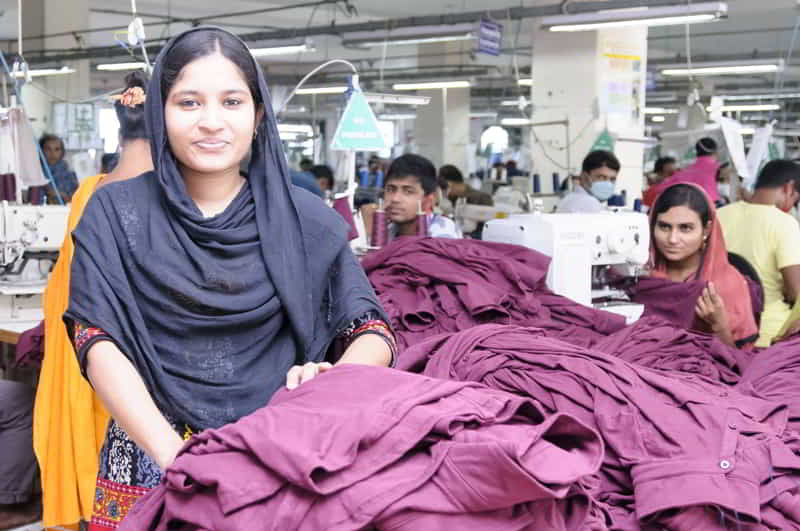
Apparel manufacturing is a labor-intensive assembly line process requiring significant amounts of repetitive and skilled manipulations. Therefore, like any other manufacturing industry, it has its own share of ergonomic problems where poorly designed and unorganized workstations contribute to musculoskeletal discomfort among the sewing operators. Research has found that ergonomic interventions including redesign and proper adjustment of workstations, use of ergonomically-designed seating, and training in low-risk methods and posture substantially improve workers’ efficiency.

Read more »

Article

Scroll to Top