yarn quality

Home » yarn quality
sheep

The Role of Crimp in Wool Spinning

This article delves into the vital role of crimp in wool spinning. It explores how crimp influences fiber elasticity, yarn strength, and fabric quality. By integrating advanced measurement techniques, digital technology, and sustainable practices, the article offers comprehensive insights and practical guidelines for textile professionals.

The Role of Crimp in Wool Spinning Read More »

ring-spinning-machine

Optimum Drafting Conditions of Polyester and Viscose Blend Yarns

In this study, we used an experimental design to investigate the influence of the total draft, break draft, the distance between the aprons (Clips) and production roller pressure on yarn quality in order to obtain optimum drafting conditions for polyester and viscose (PES/CV) blend yarns in ring spinning frame. We used PES fibres (1.4 dtex × 38 mm long) and CV fibres (1.6 dtex × 38 mm long) to spin a 20 Tex blend yarn of PES (70%)/CV (30%) blend ratio.

When the break draft, adjustment of distance between of aprons and roller pressure is not reasonable, controlling and leading of the fibres is not sufficient for proper orientation of the fibres in the yarn structure to produce a high-quality yarn. Experimental results and statistical analysis show that the best yarn quality will be obtained under drafting conditions total draft of 38, 1.2 break draft, 2.8 mm distance between of aprons and maximum pressure of the production top roller (18daN).

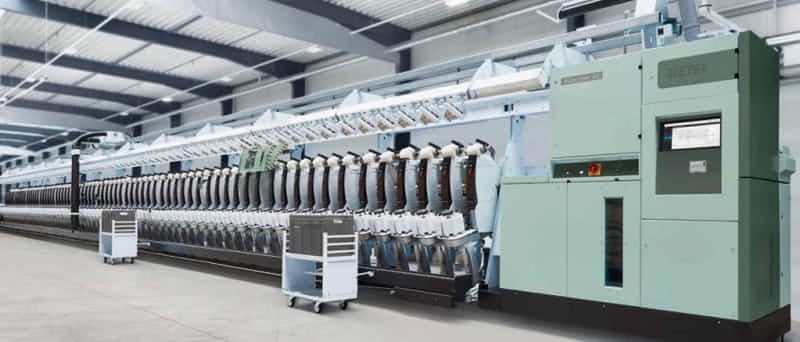
Optimum Drafting Conditions of Polyester and Viscose Blend Yarns Read More »

lap-former

Lap Former Process in Yarn Spinning

The lap former process transforms carded slivers into a consistent lap for combing in yarn spinning. By consolidating slivers, ensuring uniformity, aligning fibers, and controlling quality, this process enhances yarn strength and quality. Specialized lap former machines achieve these objectives, making it a critical step in textile production.

Lap Former Process in Yarn Spinning Read More »

Speed Frame in Yarn Spinning

The speed frame process in yarn spinning converts slivers into roving through drafting, twisting, and winding, preparing fibers for ring spinning. By ensuring uniformity, strength, and quality, this process is critical for producing high-quality yarn. Advanced speed frame machines achieve these objectives, enhancing textile production efficiency.

Speed Frame in Yarn Spinning Read More »

Scroll to Top