
The manufacturing cost of yarn
In today’s competitive conditions, competing with other manufacturers depends on producing high-quality yarns with reasonable costs. Nowadays, the free market determines the price of products irrespective of the administration of spinning mills. For this reason, gaining more profit depends on minimizing the manufacturing cost of yarns. Especially, cheaper yarns that are produced by Far East countries such as China, Indonesia, draw the attention of consumers. This affects other countries’ yarn manufacturers negatively and subjects such as cost calculation and cost minimization become primarily important.
The cost of yarn consists of several factors such as raw material energy or power, labor, capital etc. The cost of yarn excluding raw material is termed manufacturing cost. The share of the factors in manufacturing cost changes according to the yarn properties, machine operational properties and economical situation of the spinning mill. For the capital, loan and profit side of a new mill, see costing for setting up a spinning plant.
Manufacturing cost factors for the chosen countries
The table illustrates general shares of cost factors for 20 tex combed cotton yarn the among the chosen countries. Raw material (fiber) forms nearly half of the yarn’s total cost and other cost factors such as labor, energy, the capital cost of machines, auxiliary material cost and waste make up the remaining part. After raw material, capital and energy costs have the highest proportions of the total The power or energy cost takes 9% share of the specific yarn total cost in Turkey. This share increases to 17% if the raw material cost is excluded. Since the unit price of energy and labor change independently from spinning mill conditions, reducing these costs depends on minimizing energy usage and labor wages. Since twisting is accomplished by the rotation of the spindle and bobbin, the energy consumption of ring spinning is higher than the other spinning systems. In the ring spinning system, energy is used for feeding the roving to the machine, An Investigation on Energy Consumption in Yarn Production with Special Reference to Ring Spinning drafting and rotation of the spindle. At least, 85% of the total power requirement of a ring frame is consumed in driving the spindles, depending on details such as yarn count, package size and spindle speed and the remainder are consumed by drafting and lifter mechanisms.
| Countries | Manufacturing Cost Factors For Chosen Countries (2003), % | ||||||
|---|---|---|---|---|---|---|---|
| Brazil | China | India | Italy | Korea | Turkey | USA | |
| Raw material | 50 | 61 | 51 | 40 | 53 | 49 | 44 |
| Waste | 7 | 11 | 7 | 6 | 8 | 8 | 6 |
| Labor | 2 | 2 | 2 | 24 | 8 | 4 | 19 |
| Energy | 4 | 8 | 12 | 10 | 6 | 9 | 6 |
| Auxiliary material | 4 | 4 | 5 | 3 | 4 | 4 | 4 |
| Capital | 32 | 14 | 23 | 17 | 21 | 26 | 21 |
| Total | 100 | 100 | 100 | 100 | 100 | 100 | 100 |
Where the energy goes in a ring spinning mill
A spinning mill uses energy to run its production machines, to air-condition and light the rooms where yarn is made, and to drive the compressors that supply compressed air to the line. Two kinds of energy are used. Electrical energy runs the machines, the air conditioning, the lamps and the compressors. Thermal energy is used by the air conditioning and by processes such as the fixation (setting) of yarn, and is usually obtained from coal, diesel oil, fuel oil, natural gas or steam.
The table shows the electricity used by each production step for a combed ring yarn in a modern mill, for a line of 1,000 spindles. Of the 221.1 kWh total, 61% is used by the machines and 39% by air conditioning. Ring spinning is the largest single user, at 30% of the total.
| Production step | kWh per 1,000 spindles | Share, % |
|---|---|---|
| Blowing room | 16.7 | 7.5 |
| Carding | 17.7 | 8 |
| Combing | 10.9 | 5 |
| Drawing and roving | 9.1 | 4 |
| Ring spinning | 66.1 | 30 |
| Yarn finishing treatments | 14.7 | 6.5 |
| Machines, subtotal | 135.2 | 61 |
| Air conditioning | 85.9 | 39 |
| Total | 221.1 | 100 |
Energy for 20 tex ring and open-end yarn by country (2003)
For the same seven countries as the cost table above, a 20 tex combed ring yarn needed between 3.49 and 3.62 kWh/kg, and a 20 tex open-end yarn between 2.44 and 2.58 kWh/kg. The consumption is close from country to country; the energy cost per kilogram differs because the price of electricity differs. The prices are 2003 figures and are shown only to explain the cost column.
| Country | Electricity price, $/kWh | Ring yarn (combed), kWh/kg | Ring yarn energy cost, $/kg | Open-end yarn, kWh/kg | Open-end yarn energy cost, $/kg |
|---|---|---|---|---|---|
| China | 0.066 | 3.49 | 0.23 | 2.58 | 0.17 |
| India | 0.084 | 3.57 | 0.30 | 2.50 | 0.21 |
| Turkey | 0.070 | 3.57 | 0.25 | 2.57 | 0.18 |
| Brazil | 0.031 | 3.54 | 0.11 | 2.58 | 0.08 |
| South Korea | 0.047 | 3.62 | 0.17 | 2.55 | 0.12 |
| USA | 0.045 | 3.56 | 0.16 | 2.44 | 0.11 |
| Italy | 0.105 | 3.52 | 0.37 | 2.57 | 0.27 |
Calculating the energy used to make one yarn
The specific energy consumption of a yarn (kWh per kg) can be worked out machine by machine. For each step, find how much material the machine must process, how long it runs to do so, and multiply the running time by its actual power. The same calculation is repeated for every machine in the line, then compressed air, air conditioning and lighting are added. The formulas below are written for the first machine, the bale opener.
- Raw material to process: R1 = M × (1 + WTot), where M is the mass of yarn to be made (kg) and WTot is the total waste ratio of the line, as a fraction.
- Running time: t1 = R1 / (L1 × η1 × n1), where L1 is the production rate of one machine (kg/h), η1 its mechanical efficiency and n1 the number of machines.
- Machine energy: E1 = t1 × N1 × ηE1 × n1, where N1 is the installed power of one machine (kW) and ηE1 the energy efficiency factor that turns installed power into actual power.
- All machines: EM = (E1 + … + En) + ECa + ED + ECo + ER + ES + EW, the blowing-room machines plus carding, drawing, combing, roving, spinning and winding.
- Compressed air for a machine: EA1 = t1 × NA × C1 × n1, where C1 is the compressed air the machine needs (m³/h) and NA is the compressor’s energy per cubic metre of air (kWh/m³): its installed power divided by its air capacity. Summing over every machine that uses air gives ETA.
- Air conditioning: EC = E′C × M / G, where E′C is the air-conditioning plant’s energy for one month and G is the mill’s yarn production in that month (kg).
- Lighting: Eil = E′il × M / G, where E′il is the monthly energy used by the lamps.
- Total: ETot = EM + ETA + EC + Eil. Dividing ETot by M gives the specific energy consumption in kWh/kg.
Worked example: 3,000 kg of 20 tex combed ring yarn
The method above was applied in one mill to 3,000 kg of 100% cotton, 20 tex (Ne 30) combed ring yarn, spun at 17,500 rpm with a twist factor (αtex) of 3,828. The mill’s compressors needed 0.12 kWh to supply one cubic metre of compressed air. The blowing-room machines are linked, so their compressed air was calculated together, over a running time of 6.6 hours.
| Machine | Number | Production rate, kg/h per machine | Actual power, kW per machine | Compressed air, m³/h | Running time, h | Machine energy, kWh | Compressed-air energy, kWh |
|---|---|---|---|---|---|---|---|
| Bale opener | 1 | 950 | 6.00 | 14.45 (whole line) | 4.02 | 24.1 | 11.3 (whole line) |
| Cleaner | 1 | 950 | 6.75 | 4.00 | 27.0 | ||
| Mixer | 1 | 617.5 | 5.25 | 6.10 | 32.0 | ||
| Fine opener | 1 | 570 | 9.00 | 6.60 | 59.4 | ||
| Condenser | 1 | 570 | 4.00 | 6.50 | 26.0 | ||
| Carding | 4 | 42.0 | 14.50 | 9.10 | 22.40 | 1,299.2 | 97.8 |
| Drawing (breaker) | 1 | 181.6 | 7.50 | 0.48 | 20.23 | 151.7 | 1.2 |
| Lap former | 1 | 381.5 | 11.00 | 3.30 | 9.60 | 105.6 | 3.8 |
| Combing | 3 | 47.0 | 5.50 | 2.40 | 25.62 | 422.7 | 22.1 |
| Drawing (finisher) | 1 | 109.0 | 8.25 | 0.56 | 28.80 | 237.6 | 2.0 |
| Roving | 1 | 116.6 | 11.40 | 0.40 | 26.73 | 305.0 | 1.3 |
| Ring spinning | 3 | 26.5 | 34.00 | 36.25 | 38.73 | 3,950.5 | 505.4 |
| Winding | 1 | 84.7 | 13.50 | 30.00 | 35.60 | 480.6 | 124.6 |
| Total | 7,121.5 | 769.5 |
Each machine’s energy is the number of machines × actual power × running time; for carding, 4 × 14.5 kW × 22.4 h = 1,299.2 kWh. Ring spinning used 55.5% of the machine energy and carding 18.2%. The table compares these shares with the same calculation for a finer 10 tex yarn (αtex 3,828, 16,000 rpm) and with published figures for 10 tex yarn, which do not include winding. The finer the yarn, the larger the share taken by the ring frame.
| Process | 20 tex, calculated, % | 10 tex, calculated, % | 10 tex, published, % |
|---|---|---|---|
| Blowing room | 2.4 | 1.1 | 3.37 |
| Carding | 18.2 | 8.5 | 6.52 |
| Combing (with lap former) | 7.4 | 3.5 | 3.52 |
| Drawing | 5.5 | 2.6 | 2.09 |
| Roving | 4.3 | 3.0 | 5.77 |
| Ring spinning | 55.5 | 75.8 | 78.73 |
| Winding | 6.7 | 5.5 | not included |
| Total | 100 | 100 | 100 |
Air conditioning and lighting were allocated from the mill’s records for May: 234,000 kWh of air conditioning and 43,200 kWh of lighting for 401,580 kg of yarn. For 3,000 kg that is 1,748.0 kWh and 322.7 kWh.
| Use | Energy, kWh | Share, % |
|---|---|---|
| Machines | 7,121.5 | 71.5 |
| Compressors | 769.5 | 7.7 |
| Lighting | 322.7 | 3.2 |
| Air conditioning | 1,748.0 | 17.5 |
| Total | 9,961.7 | 100 (rounded) |
The specific energy consumption is 9,961.7 kWh ÷ 3,000 kg = 3.32 kWh/kg. That is a little below the 3.49 to 3.62 kWh/kg given for the same yarn in the country comparison, a difference attributed to machine type, waste ratio, speed and energy efficiency.
How yarn count and type change the energy needed
- Count. For every type of yarn, a finer count needs more energy per kilogram, because the ring frame produces fewer kilograms per hour.
- End use. At the same count, weaving yarn needs more energy than knitting yarn. It carries more twist, so it is spun at a lower delivery speed.
- Combed or carded. At the same count, combed yarn needs more energy than carded yarn, because combing (and lap forming before it) is an extra step.
In the worked example, the ring frames used 3,950.5 kWh for 3,000 kg of yarn, or 1.32 kWh/kg: about 40% of the yarn’s total of 3.32 kWh/kg. Across a whole year in the same mill, which spins many counts on both ring and open-end machines, the monthly average ranged from 3.23 to 3.76 kWh/kg; the machine-by-machine figures for that mill are on the page on the energy consumption of the chosen spinning mill.
Conclusion
Compared the calculated cost of 20 tex ring, open-end and Vortex (MVS) yarns were compared with each other. It was found that the energy cost of 1 kg of ring yarn is the highest of the three. The cost factors which make up the total product cost for the textile industry including spinning, weaving and finishing and the product cost of chosen ring yarn by using empirical formulas, taking into regard specific operating conditions and selected machine parameters
Energy is necessary for each step of spinning processes to drive machines, air conditioning, and lighting, but the highest energy consumption occurs during the spinning process in spinning machines. Another study which handled energy conservation in the textile industry focused on the electricity consumption of each step of ring spinning for the modern and traditional factory. Electrical energy consumption of 1 kg of yarn changes between 2.7 kWh/kg and 4 kWh/kg. Additionally, it was pointed out that thermal energy alternating between 1.1 MJ/kg and 4.7 MJ/kg is necessary for processes such as fixation besides electrical energy needs. General assessment for energy consumption and conservation in fiber-producing and textile industries was done while determining the power requirement of a specific ring and open-end spinning machine with chosen machine parameters.
Since the highest power is required in spinning machines, many studies have been carried out to determine the power demand of spinning machines. It was found that in the coarse yarn range (tex>60) the open-end rotor machine needed less energy per kg of yarn than the ring frame for warp yarns, for finer yarns (tex<30), on the other hand, the oe-rotor machine demanded more energy per kg of yarn than ring frame. It was reported that the factors affecting the power demand of the ring system were ring diameter, balloon height, spindle speed and traveler mass.
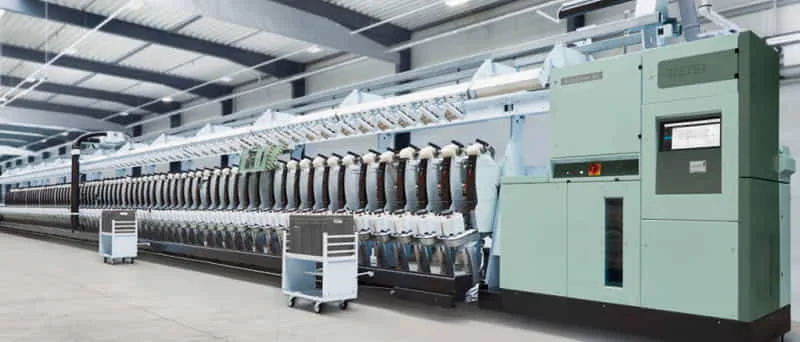





Power consumption in rotor spinning by absorption or Electric chillers used for humidification to maintain at 28-30 deg c is about 100 kWh, which can be tried to reduce about 50 kWh.