The ZDHC MRSL is a list of substances banned from intentional use in the chemicals that go into a dyehouse: dyes, auxiliaries, detergents, finishes, even the chemicals in the effluent plant. It sets no limit for the fabric that comes out. So a buyer who asks for “ZDHC compliance” is not asking for a fabric test. It wants a monthly chemical inventory checked against the ZDHC Gateway, wastewater tested twice a year by an approved laboratory and, more and more often, a Supplier to Zero assessment. ZDHC launched MRSL V4.0 on 29 October 2026, and the move from V3.1 runs until 1 June 2028.
The figures to know: MRSL V4.0 is current; formulators recertify their products between 1 February and 1 November 2027; V3.1-certified formulations may still be bought until 1 November 2027 and used up until 1 June 2028, after which InCheck shows only V4.0-certified chemicals as conformant; a chemical product conforms at Level 1, 2 or 3; the inventory is reported monthly; wastewater is sampled before 30 April and before 31 October; new wastewater guidelines apply from 1 December 2026; and Supplier to Zero V2 is mandatory for new assessments from 1 February 2027.
ZDHC MRSL: the short version
- An input list, not a product list. Its formulation limits are concentrations in “commercial chemical formulations available from chemical manufacturers” (MRSL V4.0, Scope). A product restricted substances list (RSL) limits what is left in the article.
- The dyehouse shows its side in two ZDHC Gateway modules: InCheck for its inventory, ClearStream for its wastewater.
- It is not law. ZDHC calls the MRSL “a voluntary industry guidance tool” that “does not constitute legal advice” (V4.0, Disclaimer).
- V4.0 is stricter than V3.1: lower limits for APEOs, new PFAS limits, and four new groups, among them bisphenols and formaldehyde. Products that cannot be recertified have to be replaced by 1 June 2028.
What the MRSL covers, and what it does not
| Question | ZDHC MRSL | A product RSL | The law, such as REACH Annex XVII |
|---|---|---|---|
| What it limits | Substances in chemical formulations as sold | Substances left in the finished material or article | Substances in articles and mixtures placed on that market |
| Who meets it | The formulator, by certification; the dyehouse, by buying conformant products | The supplier of the article, by testing it | Whoever places the goods on the market |
| How it is shown | A conformance level on the ZDHC Gateway | A test report against the buyer’s list | Test reports and declarations |
| Binding? | Through the buyer’s contract | Through the buyer’s contract | Yes |
Its scope is wider than most dyehouses assume: cleaners, adhesives, paints, inks, detergents, dyes, auxiliaries, coatings and finishing agents, and the chemicals for machinery maintenance, wastewater treatment, sanitation and pest control (V4.0, Background). Its limits allow for “reasonable expected manufacturing impurities”; they are not zero. It has three chapters:
| Chapter | What it holds | In V4.0 |
|---|---|---|
| 1. The MRSL | Substances banned from intentional use, each with supplier guidance, a formulation limit and test methods, by substrate: textile, leather, polymers (rubber, foams, adhesives) | 23 groups: alkylphenols and their ethoxylates (APEOs); antimicrobials and biocides; chlorinated paraffins; chlorobenzenes and chlorotoluenes; chlorophenols; allergenic disperse dyes; carcinogenic dyes and dyes of equivalent concern; flame retardants; glycols, glycol ethers and glycol esters; halogenated solvents; organic solvents; organotin compounds; other chemicals; PFAS; phthalates; polycyclic aromatic hydrocarbons (PAHs); amines cleavable from azo colourants; total metals; UV absorbers; bisphenols; aldehydes and ketones; polychlorinated biphenyls (PCBs); oxidising and reducing agents |
| 2. Candidate List | Substances that may be restricted in the next version, because safer alternatives are lacking at scale or more information is needed; not tested for conformance | C.I. Disperse Orange 61; phenol; methanol; vinyl chloride; drometrizole |
| 3. Archived substances | Substances “without strong evidence of current use in industry, but with clear evidence of historical use”; not to be reintroduced | carcinogenic dyes; a navy blue colourant; other chemicals (auramine hydrochloride, respirable silica); solvents (bis(chloromethyl) ether, carbon tetrachloride) |
Two entries a dyehouse meets daily. V4.0 says APEOs can be used in or found in detergents, scouring agents, spinning oils, wetting agents, softeners and dispersing agents for dyes and printing formulations. Potassium permanganate, a candidate in V3.1, is now banned from intentional use (group 1W), and ZDHC says water curtains, extraction, protective equipment and robotised spraying “are not sufficient” because they do not address its environmental risks, among them its classification as very toxic to aquatic life. The full limits are in MRSL V4.0; see also the ZDHC MRSL record in this site’s standards register.
The current version: V4.0, and the transition from V3.1
V3.1 was released in 2023, and the PDF ZDHC serves is labelled “V3.1 Jul 2025”. V4.0 is dated October 2026, and ZDHC expects V5.0 in 2028, on a two-year cycle. Its implementation approach (Table 1) sets five dates:
| Date | What happens | What the dyehouse does |
|---|---|---|
| 1 November 2026 | The transition begins | Go through the chemical inventory with each supplier: which products will be recertified unchanged, which will be replaced, which are uncertain. Find any EC* substances (below) |
| 15 December 2026 | Certifiers can apply for V4.0 approval | No action; V4.0 certificates start only once ZDHC has approved certifiers, from 1 February 2027 |
| 1 February 2027 | Formulators begin recertifying to V4.0; ZDHC publishes the approved certifiers; InCheck shows V3.1 and V4.0 conformance side by side | Prefer V4.0-certified products for new purchases; start trials of replacements; use up stock of products that will not conform |
| 1 November 2027 | Recertification ends; only V4.0-certified formulations can be newly uploaded to the Gateway | Buy only products whose V4.0 conformance shows on the Gateway; keep using stock of an unchanged product once its supplier confirms the V4.0 certificate covers it, and keep running down the rest |
| 1 June 2028 | The supply-chain period ends; V3.1-certified formulations are archived and unpublished on the Gateway | Every product in use is V4.0-certified; anything else is listed as non-conformant in your InCheck report |
ZDHC archives formulations certified only to MRSL V3.1 on 1 June 2028. Until 1 November 2027 V3.1-certified formulations may still be bought, and until 1 June 2028 their stock may be used up, so a product does not have to leave the shelf on 1 November 2026. ZDHC tells brands to let suppliers use up V3.1 stock by 1 June 2028 “rather than dispose of” chemicals not recertified by 1 November 2027 (Section 6), and tells suppliers to avoid replacing a product until its V4.0 status is clear (Section 5).
EC* substances. Some V4.0 entries carry EC*, “Emissions and Exposure Control”: among them the solvents DMAC, DMF, NEP and NMP, and potassium permanganate. Their use is always non-conformant. Where no alternative exists yet, ZDHC may temporarily tolerate continued use in specific processes, after 1 June 2028 too, if the facility records it in the inventory, controls emissions and worker exposure, and keeps a phase-out plan with dates, which the Supplier to Zero V2 evaluation can review. EC* tolerance still never makes it conformant: such use shows as non-conformant in InCheck.
What changed from ZDHC MRSL V3.1 to V4.0
From ZDHC’s change log and the two lists (V3.1 and V4.0). Limits are for textile formulations as sold, in mg/kg unless stated. ZDHC counts 16 substances new to the list.
| Group | V3.1 | V4.0 | Where a dyehouse meets it |
|---|---|---|---|
| 1A APEOs (NPEO and OPEO) | 250 | 100; test method ISO 18218-1:2023 added | Detergents, scouring and wetting agents, softeners, dye dispersing agents |
| 1N PFAS | Named marker substances, mostly 25 to 1,000 µg/kg each; a total fluorine screen at the certifier’s discretion | 25 µg/kg for any individual PFAS on AFIRM’s list, 250 µg/kg for their sum, and a 50 mg/kg total-fluorine threshold. Above it the source of the fluorine must be disclosed, and a product over it whose target PFAS are under the limits goes to investigation, not an outright fail. Level 1 testing is mandatory | Water, oil and stain repellents, soil-release agents, coating and laminating agents |
| 1T Bisphenols (new group) | BPA at 100, under other chemicals; BPF, BPS and BPAF candidates | BPA 100; BPF, BPS and BPB 1,000 each; BPAF counted as a PFAS, 25 µg/kg | Dye after-treatments for polyamide, PVC prints, polymeric finishes |
| 1U Aldehydes and ketones (new group) | Formaldehyde a candidate, no limit | Free formaldehyde 1,000 in formaldehyde-based formulations, those used for wrinkle and crease resistance, shrink proofing, dye retention, stain and water repellency and durability (fixing and dispersing agents, binders, resins, crosslinkers) and permanent flame-retardant finishing for cotton; 250 in all others | Easy-care and crease-resistant resins, fixing agents, binders, crosslinkers |
| 1V PCBs (new group) | Not listed | 10; organic dyes and pigments 25; silicon-based formulations 50 | Specialised textile coatings, or as a contaminant from synthesis |
| 1W Oxidising and reducing agents (new group) | Potassium permanganate a candidate | Permanganates 1,000, tested as total manganese; no intentional use, EC* | Denim spray bleaching |
| 1D Chlorobenzenes and chlorotoluenes | 1,2-dichlorobenzene 500; others, sum 200, with tri- and tetrachlorotoluene 10 each (ZDHC’s change log says 500) | 1,2-dichlorobenzene 20 (pigments 200); others, sum 20 | Carriers for dyeing polyester and wool/polyester, levelling agents; an impurity in disperse dyes |
| 1E Chlorophenols | Mono-, di- and trichlorophenols, sum 50 | Sum 25 | Preservatives and pesticides |
| 1K Organic solvents | Cresols 500; DMAC, DMF, NEP and NMP 1,000 each, EC* | Cresols 100; DMAC, DMF, NEP and NMP 500 each, still EC* | Cleaning, coating and finishing, adhesives |
| 1S UV absorbers | UV-328 1,000 | UV-328 100; UV-326 and UV-329 added | Light-stable formulations and UV-protective finishes |
The rest of the change log. In leather formulations naphthalene now counts in the sum of PAHs; in textile formulations it already did (1P). “Total heavy metals” becomes “total metals”, adding zinc, iron and manganese (1R). Halogenated flame retardants stay banned, now screened by total halogen at 1,000 mg/kg (1H). New in group 1M: triphenyl phosphate and 1,4-dioxane, at 1,000 mg/kg in textile formulations, and OBSH, dicumyl peroxide and styrene, which apply to polymers only (“Textiles: Not applicable”). Solvent Green 1 acetate joins the carcinogenic dyes (1G). ZDHC’s launch post adds that titanium dioxide has been removed, after a change in its regulatory classification; the change log does not mention it. Unchanged: the allergenic disperse dyes (1F), the 150 mg/kg limit for each amine cleavable from azo colourants (1Q), and D4, D5 and D6 at 1,000 mg/kg each, where only the test method changed. On the Candidate List, Disperse Orange 61 and vinyl chloride are meant for V5.0; respirable silica and carbon tetrachloride are archived.
The MRSL limits the chemical, not the fabric. For PFAS in finished articles by market, see PFAS in textiles: limits and dates by market.
Conformance levels: what each one checks
| Level | What a ZDHC Approved MRSL Certifier checks | Builds on |
|---|---|---|
| Level 1 | The safety data sheet, for MRSL substances, and analytical testing of the formulation, reported by an ISO 17025-accredited ZDHC Approved Laboratory; screening by GC/MS, LC/MS or ICP can support it. The certifier chooses the test parameters, not the formulator | Nothing |
| Level 2 | An on-site assessment of the formulator’s management systems | Level 1’s principles |
| Level 3 | An on-site assessment of the formulator’s capability to assess chemical hazards | Levels 1 and 2 |
- The rules are in Chemicals to Zero – Foundational, the document ZDHC used to call the MRSL Conformance Guidance (V2.1, April 2024). Under V4.0, PFAS testing is mandatory at Level 1; at Levels 2 and 3 it may not be, if the on-site assessment satisfies the certifier that Level 1’s principles are followed (V4.0, 1N).
- Validity is set by each certifier. A lapsed product shows as “Expired” on the Gateway for eight weeks and is then unpublished; expired is not a level.
- “Level 0” still appears on ZDHC’s MRSL web page: a supplier’s own declaration, with no third-party review. The conformance document defines Levels 1 to 3 only, and the Gateway hosts only those. A chemical supplier’s “ZDHC compliant” letter is at best Level 0, and it does not count as conformant in your InCheck report.
- Chemicals to Zero is a second scale. Foundational means Level 1, 2 or 3. Progressive is meant to add a check of RSL risks in the finished article, because ZDHC says MRSL conformance “may not cover all RSL risks in terms of product safety”. Since 1 December 2025, new products are placed at Foundational only, and none is newly labelled Provisionally Progressive, a label given in a transitional phase to Level 2 and 3 products certified by schemes such as OEKO-TEX ECO PASSPORT.
Three different Level 1s. MRSL Level 1 belongs to a chemical product, Verified InCheck Level 1 to your inventory records, Supplier to Zero Level 1 to your facility. Ask the buyer which one it means.
From each chemical supplier, ask for the product name exactly as published, its ZDHC product ID, its ChemCheck report showing level and expiry, a current safety data sheet, and, from now to November 2027, whether the product will be recertified to V4.0 unchanged and when. Since November 2025 a formulator can print a QR code on the drum that opens the product’s Gateway record: its name, product ID, status, expiry date and conformance level. The safety data sheet is not part of it. Our guide to eco-friendly textile chemicals and dyes covers the chemistry behind the choice.
What a dyehouse does, and how often
| Task | How often | Done by | What the buyer sees |
|---|---|---|---|
| Chemical inventory list | Kept current; reported monthly | Your chemical responsible person | Your records, at verification and assessment |
| Performance InCheck report | Monthly, within 42 days of the month’s end | A ZDHC Approved Performance InCheck Provider | The InCheck report, shared on the Gateway |
| Verified InCheck Level 1 | Once a calendar year | A ZDHC Approved InCheck Reviewer | A check mark on your Gateway profile for 12 months |
| Wastewater and sludge testing | Twice a year, at least three months apart | A ZDHC Approved Wastewater Laboratory | A ClearStream report per cycle |
| Supplier to Zero | Valid one year | You, or a ZDHC Approved Supplier to Zero Assessor | A certificate with your level, if a third party assessed you |
The Gateway was relaunched on 20 August 2026; older guidance calls the same tools the Chemical and Wastewater Modules. Registering is free for a supplier; ClearStream needs an annual reporting subscription plus the laboratory’s fees, and InCheck a subscription with a solution provider.
1. Keep a chemical inventory list
ZDHC’s Chemical Purchasing chapter asks for MRSL-conformant chemicals, solvents included, and a chemical inventory list for all production chemicals, kept by a named chemical responsible person. Its CIL template has sheets for formulations, commodity chemicals, solvents and others. For each formulation: the name as on the drum or the Gateway, formulator and distributor, application, opening stock, deliveries, closing stock and usage in kilograms, lot numbers, purchase date, the safety data sheet and its date, the ZDHC product ID and level, and the hazardous ingredients from the data sheet. Commodity chemicals such as acetic acid, Glauber’s salt, hydrogen peroxide and soda ash are recorded as virgin or non-virgin, with the seller’s declaration and an evaluation of the seller, as the Commodity Chemicals Guide describes. ZDHC also asks for the lot number on each batch’s recipe sheet, so a failure can be traced to a drum. Until June 2028, add a column for each product’s V4.0 status: confirmed, to be replaced, or uncertain, with the supplier’s date. ZDHC’s implementation approach starts the transition from this list.
2. Generate a Performance InCheck report every month
The InCheck Reporting chapter covers facilities using on average more than 10 formulations and more than 100 kg of them a month, which takes in almost any dyehouse. For the Performance InCheck report, upload every chemical bought or used that month, not only one brand’s; report by delivery or by usage (opening stock plus deliveries minus closing stock) and keep to one; list unused products at zero; and submit within 42 days of the month’s end (temporarily 90, says ZDHC’s knowledge base). Commodity chemicals, and those for boilers, maintenance, pest control and the laboratory, are outside the report, though inside the MRSL’s scope. The report shows the share of formulations published on the Gateway and the share conformant at any level, by count and by weight; from 1 February 2027, against V3.1 and V4.0 side by side. Nobody verifies the inventory behind it; step 3 does.
Worked example: one month, by count and by weight
The dyehouse is invented; the arithmetic is the report’s.
| Formulations | Products | Kilograms used | Status |
|---|---|---|---|
| Dyes | 18 | 2,600 | Level 1, 2 or 3 on the Gateway |
| Pretreatment and dyeing auxiliaries | 12 | 9,000 | Level 1, 2 or 3 on the Gateway |
| Finishing auxiliaries | 5 | 2,400 | Level 1, 2 or 3 on the Gateway |
| Softener, not on the Gateway | 1 | 4,000 | Not conformant |
| Detergent, certificate expired | 1 | 1,200 | Expired: not conformant |
| Binder, fixing agent and defoamer, not on the Gateway | 3 | 800 | Not conformant |
| Total | 40 | 20,000 |
| Scenario | Conformant by count | Conformant by weight |
|---|---|---|
| As reported | 35 of 40, 87.5% | 14,000 of 20,000 kg, 70.0% |
| Softener switched to a Gateway-listed one | 36 of 40, 90.0% | 18,000 of 20,000 kg, 90.0% |
| Detergent certificate renewed as well | 37 of 40, 92.5% | 19,200 of 20,000 kg, 96.0% |
By count the dyehouse looks nearly done. By weight, 30.0% of what went into its machines came from products that do not count as conformant, and one softener, 4,000 kg, is 66.7% of that gap. The last 3 products weigh 800 kg, 4.0%. Work down the list by kilograms. If a supplier is not on the Gateway, invite it through your account, or search the Gateway for a listed alternative: ZDHC’s report for 2025 counts 166,915 MRSL-conformant products published there.
The same month on 1 June 2028. Suppose the 5 finishing auxiliaries, 2,400 kg, come from one formulator that does not recertify them to V4.0. The as-reported month then falls to 30 of 40 products, 75.0% by count, and 11,600 of 20,000 kg, 58.0% by weight, with nothing changed in the dyehouse. That is why the V4.0 status column belongs in the inventory now, and why a product’s recertification date is a purchasing question in 2027.
3. Have the inventory verified once a year
Verified InCheck Level 1 is an on-site spot check by a ZDHC Approved InCheck Reviewer, a third party or a brand checking its own suppliers, after three consecutive InCheck reports of the same inventory type. With fewer than 30 different chemicals, every one is checked; with 30 or more, a 30-point checklist applies. The pass mark is 80%, and the check mark lasts 12 months. An invented visit:
| Check | Points | Scored |
|---|---|---|
| 10 random products from your uploads: in the stores, or documented as used or delivered | 10 | 9 |
| 5 seen on the walk-through: in your uploads | 5 | 4 |
| 5 from purchase orders or delivery notes: in your uploads | 5 | 5 |
| 5 from recipe sheets: in your uploads | 5 | 3 |
| 5 from the chemical ledger for one month: in that month’s upload | 5 | 3 |
| Total | 30 | 24, or 80.0% |
24 of 30 is exactly the pass mark. One more recipe-sheet chemical missing from the uploads gives 76.7%, a fail, and a new attempt needs three new consecutive reports.
4. Test wastewater twice a year
Until 30 November 2026 the rules are the digital Wastewater and Sludge Guidelines V1, which ZDHC maps to its PDF Wastewater Guidelines V2.2 (September 2024). A ZDHC Approved Wastewater Laboratory samples twice a calendar year, before 30 April and before 31 October, at least three months apart, and uploads the results. You generate a ClearStream report for each cycle, which scores the results out of 100, and upload a root cause analysis and corrective action plan for any non-conformity. Local legal limits still apply as the minimum. See also this site’s ZDHC Wastewater Guidelines record.
What is tested depends on discharge type and average flow: annual industrial wastewater divided by working days, with any domestic wastewater mixed into it counted as industrial. At 4,500 m³ over 300 working days a unit averages 15.0 m³ a day and is in the larger group, which starts at 15; ZDHC names a typical dyehouse as an example of that group. At or above 15 m³ a day:
| Discharge type | Untreated wastewater | Discharged wastewater | Sludge |
|---|---|---|---|
| Direct: your own treatment plant, discharging to land, water or a municipal sewer | MRSL parameters | Heavy metals; conventional parameters and anions | Tested for its main disposal route |
| Indirect, to a common plant, after pretreatment that makes sludge | MRSL parameters | Arsenic, cadmium, chromium VI, lead and mercury only | Tested for its main disposal route |
| Indirect, after pretreatment without sludge | MRSL parameters | The same five metals only | — |
| Indirect, no pretreatment | MRSL parameters, and the five metals | — | — |
| Zero liquid discharge | MRSL parameters | — | Tested for its main disposal route |
Below 15 m³ a day, only direct dischargers test, for metals and conventional parameters in the discharged wastewater. MRSL substances are tested in untreated wastewater only, to catch intentional use or contaminated inputs, so a detection sends you back to the inventory. In ClearStream’s “Determine test type” step you declare your discharge type and volume yourself, and wrong answers can mean wrong tests. Our library explains how a textile effluent treatment plant works; for the volume side of the same meters, see Water consumption in dyeing.
What changes on 1 December 2026
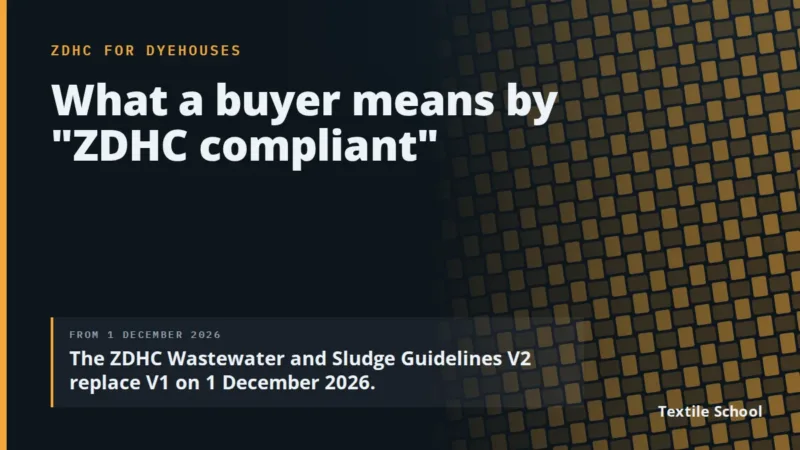
The ZDHC Wastewater and Sludge Guidelines V2 replace V1 on 1 December 2026. Version 2 is published on ZDHC’s Suppliers Roadmap to Zero, and its change log lists the changes:
- Semi-announced sampling (V2’s testing page): the laboratory asks for a 10-day production window, weekends included and public holidays not; you name your peak days, and the sampler may come on any of them unannounced.
- New MRSL parameters in wastewater, among them several PFAS (PFHxA and related substances, PFBS, fluorotelomer alcohols), more flame retardants and phthalates, the siloxanes D4 to D6, and the solvents DMAC, NMP, NEP and DMF; some are sample-and-report.
- Sludge is tested for PFAS, flame retardants and phthalates as well.
- Tighter foundational limits for ammonium nitrogen, AOX and sulphite.
- Clearer verdicts. An MRSL detection is not a failure but triggers a root cause analysis; exceeding a foundational limit is a non-conformance; and a corrective action plan must be completed within its stated timeline, with records the next testing cycle checks.
- Definitions. “Direct discharge” now means to natural water bodies or land only, not to sewers feeding a common effluent plant, and the five metals become sample-and-report for indirect dischargers.
V1 applies until that date. Ask your laboratory which version it will test your April 2027 cycle against.
5. Supplier to Zero
Supplier to Zero assesses a facility’s chemical management across input, process and output. Version 2 was published on 31 July 2026; both versions run until 31 January 2027, and from 1 February 2027 every new assessment is against V2, while V1 certificates last until they expire. Level 1 needs every applicable Level 1 criterion; Levels 2 and 3 need their mandatory criteria and 80% of the rest in each focus area, and the overall level is the lowest of the three. A self-assessment earns an acknowledgement without a level; a certified level needs a ZDHC Approved Supplier to Zero Assessor, by desktop review or on site, and lasts one year as standard; an on-site certificate at Level 2 can be extended once, and at Level 3 twice, by a desktop assessment completed before it expires. It is also where a facility shows its phase-out plan for any EC* substance. ZDHC calls the scheme not mandatory but says most signatory brands require it; its report for 2025 counts more than 2,600 active V1 certificates.
Reading a buyer’s “ZDHC compliant” request
| The buyer writes | What it can mean | What to send |
|---|---|---|
| “Use ZDHC MRSL compliant chemicals” | Formulations published on the Gateway at Level 1, 2 or 3 | Last month’s InCheck report, shared on the Gateway, and a dated plan to replace the rest, heaviest first |
| “Move to MRSL V4.0”, or “the ZDHC MRSL in its latest version” | The wording ZDHC’s implementation approach gives brands for their supplier requirements | Your inventory with each product’s V4.0 status and the supplier’s date; from February 2027, the InCheck report showing V3.1 and V4.0 side by side; your plan to be V4.0-conformant by 1 June 2028 |
| “Send your ZDHC reports” | InCheck, ClearStream, or both | The latest InCheck report and the latest ClearStream report, with any corrective action plan |
| “Are you ZDHC certified?” | Usually Supplier to Zero. MRSL certificates belong to chemical products; we found no ZDHC scheme that certifies a fabric or garment | Your Supplier to Zero certificate, with its level, assessment type and date |
| “Test the fabric to the ZDHC MRSL” | A misunderstanding: MRSL limits apply to chemical formulations, not to fabric | The fabric’s test report against the buyer’s RSL or the law, and the conformance of the chemicals behind it |
| “ZDHC wastewater compliant” | Tested by an approved laboratory in both cycles, with foundational limits met | ClearStream reports for the last two cycles, and evidence that any corrective action was completed |
How this page is kept
Last verified: 31 October 2026, from ZDHC’s own publications, each linked where it is used: MRSL V4.0, its change log and implementation approach, MRSL V3.1, Chemicals to Zero – Foundational, the wastewater guidelines, the Suppliers Roadmap to Zero, the knowledge base, news posts and the annual report for 2025. The inventory and the verification scores are invented. Mainly the limits that changed between V3.1 and V4.0 are quoted, with a few unchanged ones for context; check the current list before relying on any of them. This page is independent of the ZDHC Foundation and not endorsed by it. It is not legal advice: your buyer’s requirements, your discharge consent and ZDHC’s current documents govern your reporting. Corrections are welcome through the contact page.
More on restricted substances: Banned azo dyes in textiles.