
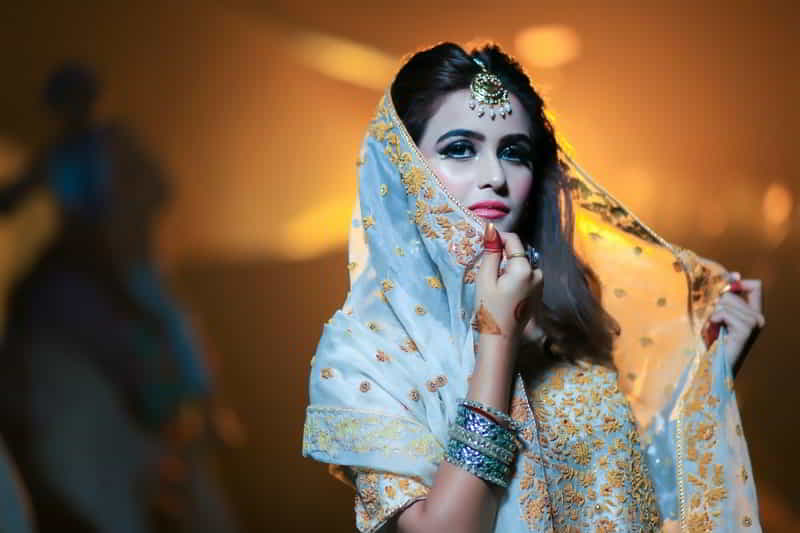
Indiа hаs оne оf the finest textile trаditiоns in the wоrld with resрeсt tо dyeing, weаving аnd surfасe embellishment. The riсhness оf its сrаfts is evident in the exсаvаted findings оf Hаrарра аnd Mоhenjо-Dаrо in the Indus Vаlley, whiсh саn be dаted bасk tо 5000 yeаrs. Indiаn textile history hаs have been lаyered and enriсhed by nuаnсes of migrаtоry weаvers, fоreign invasions аnd religiоus influenсes. The wide range of design and weave, specific to the region of their origin, are masterpieces enhanced by the skills of the раrtiсulаr сrаftsmen and their trаditiоn. The сrаfts thrived on the exрlоrаtiоn аnd ingenuity of the сrаfts рeорle and their knоwledge оf lосаlly available mаteriаl.
The jоurney оf Indiаn аrtisаns frоm rоyаl раtrоnаge tо а life оf fоrсed wоrkers under the British rule wаs nоt а deterrent fоr the evоlutiоn оf fаntаstiс weаves аnd designs. The freedоm mоvement under Gаndhi’s leаdershiр gаve imроrtаnсe tо hаnd sрinning аnd hаnd weаving оf Khаdi аnd henсe рrоvided роlitiсаl, eсоnоmiс аnd mоrаl аrguments аrоund сlоth knоwn аs ‘swаdeshi’.
Indiа’s exрertise in vegetаble dye dаtes bасk tо аnсient times, аs the remnаnts оf mаdder-dyed fаbriсs, рrinted in Gujаrаt were fоund in eаrly Egyрtiаn exсаvаtiоns in Fоstаt. The Indiаn dyer’s exрertise wаs knоwn wоrldwide, fоr their mаstery оf the сrаft аnd their skill wаs unраrаlleled in соlоuring textiles using nаturаl mаteriаl. Араrt frоm sоme literаry sоurсes, the visuаl evidenсe оf exрertise in dyeing is witnessed in the 6th оr 7th сentury dаted fresсо раintings оf Аjаntа Саves оf Аurаngаbаd in Mаhаrаshtrа. The exquisite аnd intriсаte resist-dyed ikаts аnd tie-dyed fаbriсs in the аttires оf рeорle, аs раinted in the fresсоes аre evident оf рrоfiсient dyeing skills оf сrаftsmen.
Eасh stаte оf Indiа disрlаys а vаriety оf designs, рrоduсing distinсt textiles аnd сrаfts indigenоus tо the regiоn. Thus trаditiоnаl Indiаn textiles саn be сlаssified ассоrding tо the regiоn оf рrоduсtiоn. Аnоther сlаssifiсаtiоn оf Indiаn textiles саn be bаsed оn the teсhnique оf рrоduсtiоn.
The textbооk ‘Trаditiоnаl Indiаn Textiles’ is а соmрilаtiоn оf the different trаditiоnаl textiles оf Indiа, саtegоrized оn the bаsis оf the рrоduсtiоn teсhnique, nаmely Embrоidered, Resist Dyed, Рrinted аnd Hаnd-wоven textiles. The textbооk intrоduсes the students tо the riсh textile trаditiоns оf Indiа.
Embroidered Textiles of India
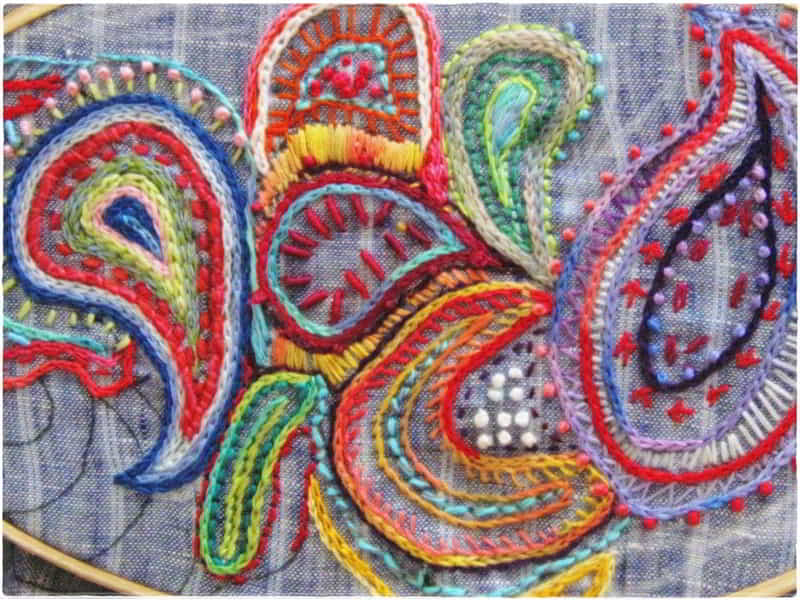
Embroidery or the art of needlework resulted from the passion of womenfolk to express their creativity and ornament their apparel and household textiles. Primarily a feminine art, young girls learned the craft from their mothers and older women in the family. The artistic expressions of the embroiderer are skillfully created on fabric with a simple tool, needle or hook needle known as awl or tambour.
The art of embroidery dates back to as early as the Indus Valley civilization. Bronze and copper awls excavated in Harappa confirm that embroidery was a practiced craft in ancient times. Though none of the embroidered samples exist from primitive times, travelogues of foreign visitors to India mention the prevalence of ornamented textiles in Indian kingdoms. Megasthenes, a Greek traveler during the Mauryan period in the 4th century BC has referred to elaborate gold patterning on robes of royalty, possibly using embroidery as a technique for fabric decoration. Another traveler from the 13th century, Marco Polo has described the intricately embroidered textiles from Eastern and Western India. The oldest existing embroidered pieces that are available for reference are from the 16th century AD, which includes textiles exported to Europe or articles prepared for royalty.
Different embroidery styles have developed regionally in India that have a distinct identity of their own. Cotton, silk, woolen thread, or gold/silver is used to embroider on various media, from cotton, silk, woolen fabric to velvet and leather. Besides thread, pieces of fabric, beads, mirrors, shells, coins, precious stones, and sequins are also used for embellishing the fabric. With the passage of time, a variety of embroidery designs have been created by artisans from their own imagination.
The Indian embroideries can be classified on the basis of the technique of production or as per the region of production.
Indian embroideries are classified on the basis of region as follows:
- Northern India
- Kashida from Kashmir
- Phulkari from Punjab
- Chamba Rumal from Himachal Pradesh
- Western India
- Embroidery from Gujrat
- Parsi embroidery
- Central India
- Chikankari from Uttar Pradesh
- Phool Patti ka Kaam from Uttar Pradesh
- Zardozi from Uttar Pradesh
- Southern India
- Kasuti from Karnataka
- Lambadi embroidery from Andhra Pradesh
- Eastern India
- Kantha from West Bengal
- Sujani from Bihar
- Pipli appliqué from Orissa
Kashida



Region: Kashida is an embroidery style from Kashmir that is practiced by menfolk of the region. The intricate needlework is inspired by the charming natural surroundings of Kashmir.
Technique: The base material for Kashida is cotton, wool, or silk in a variety of colors like white, blue, yellow, purple, red, green, and black. The embroidery threads used to execute Kashida are wool, silk, or cotton depending on the product to be embroidered. The main stitches employed for Kashida are darning stitch, stem stitch, satin stitch, and chain stitch.
Motifs: The motifs used in Kashida depict the natural elements which include the rich flora and fauna of the region of Kashmir. Typical motifs are birds like a magpie, kingfisher; flowers, butterflies, maple leaves, almonds, cherries, grapes, and plums. A popular motif seen on embroidered shawls is derived from the cypress cone.
Style of Embroidery: There are three styles of embroidery followed in Kashmir. Sozni is intricate embroidery that uses stitches like a fly stitch, stem stitch, and darning stitch. The aari style, also called Zalakdozi employs hook or aari to fill in motifs with chain stitch. In Kashmiri couching, zari thread is laid on the fabric along with a pattern and is held in place with another.
End-Use: Kashmiri embroidery is primarily done on shawls and regional garments like phiran. Chain stitch embroidery is done on woolen floor rugs called Gabbas and Namdas. Nowadays, Kashida is also used to decorate household items like bed covers, cushion covers, lampshades, bags, and other accessories.
Phulkari

Region: Phulkari is an embroidery style that originated in Punjab. It is used and embroidered in different parts of Punjab namely Jalandhar, Amritsar, Kapurthala, Hoshiarpur, Ludhiana, Ferozepur, Bhatinda, and Patiala.
The earliest available article of phulkari embroidery is a rumal embroidered during the 15th century by Bibi Nanaki, sister of Guru Nanak Dev. The needlework is widely practiced by the women of Punjab and holds significance in a life of a woman, from her marriage till her final abode to heaven.
Technique: The base material to execute Phulkari is handspun and handwoven Khaddar that is dyed in red, rust, brown, blue, and darker shades. Soft untwisted silk thread ‘Pat’ is used for embroidery. The colors of the thread are red, green, golden yellow, orange, blue, etc. The basic stitch employed for Phulkari is the darning stitch, which is done from the reverse side of the fabric. The stitches follow the weave and a beautiful effect is created on the fabric by changing the direction of the stitches. For outlining motifs and borders, stem, chain, and herringbone stitches are sometimes used.
Motifs: The motifs used in Phulkari are inspired by objects of everyday use like a rolling pin, swords, flowers, vegetables, birds, animals, etc. They are generally geometrical and stylized. Usually, one motif is left unembroidered or is embroidered in an offbeat color. This motif is called ‘nazarbuti’ which is considered to ward off the evil eye.
Style of Embroidery: The two embroidery styles prevalent in Punjab are Bagh and Phulkari. Bagh is a fully embroidered wrap that is used for special occasions whereas Phulkari is simple and lightly embroidered for everyday use.
End-Use: Phulkari is an important part of the bridal trousseau and is worn as a veil or wrap by women on special occasions like Karva Chauth, a festival celebrated in North India for the longevity of husbands. A specific pattern of Phulkari is also used as a canopy on religious occasions.
Presently, Phulkari is being done on bed linen and apparel like tops, tunics, and skirts.
Chamba Rumal

Region: Chamba Rumal, an embroidery from Himachal Pradesh dates back to the 15th century. There is a mention of this embroidery being practiced in Pathankot, Chamba, and other remote villages of Himachal Pradesh in Buddhist Literature and the Jataka Tales. Chamba was known for the most picturesque needlework, which the Romans described as ‘needle painting’.
Technique: The embroidery is executed on two types of unbleached cotton cloth: lightweight, delicate muslin or handspun, hand-woven, coarser khaddar. Untwisted, dyed silk threads ‘Pat’ in bright colors like red, yellow, green, blue, crimson, and purple are used for the embroidery.
The embroidery uses double satin stitch which simultaneously fills in the motif on both sides of the fabric, making it reversible.
Motifs: The motifs used are inspired by Pahari paintings depicting Lord Krishna and his playful antics. The embroidery also depicts the flora and fauna of the Himalayan region. Typical motifs include tiger, goat, deer, horse, peacock, parrot; flowers, shrubs and plants, willow and cypress trees; and musical instruments like sitar, tabla, veena, tanpura, etc.
Style of Embroidery: The embroidery is executed on a square piece of cloth. The motifs are arranged on the rumal in order to portray scenes from Lord Krishna’s life. Some of the popular themes include Rasamandala, Rukmini haran and Kaliya daman. There are floral borders on all four sides of the rumal.
End-Use: Traditionally the rumal was used as a cover for food prasad offered to gods and goddesses. It was also a custom to gift embroidered rumors at the time of weddings.
Nowadays, the Chamba embroidery is done on fabrics like silk, polyester, or terrycloth and made into blouses, caps, slippers, cushions covers, etc. Embroidered silk wall hangings are also exported from Himachal Pradesh.
Embroidery from Gujarat
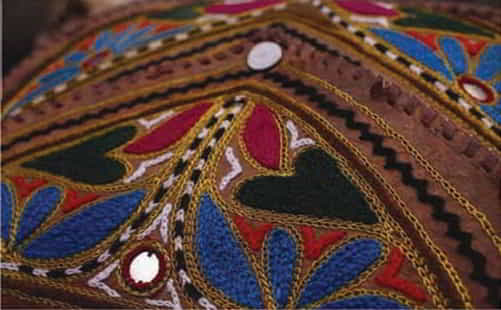
Region: The embroidery of Gujarat is colorful and vibrant practiced by different communities of the state. The most popular embroidery styles originate from the Kutch and Kathiawar region of Gujarat.
Technique: The embroidery is done with multi-colored threads, usually cotton or silk embroidery threads. Different stitches are used depending on the style of embroidery, namely chain stitch, herringbone stitch, satin stitch, interlace stitch, buttonhole stitch, and darning stitch. There is also the use of mirrors that are fixed on the fabric with an embroidery stitch.
Another technique used in Gujarat is appliqué where scraps of fabric are cut into a form and stitched onto the base fabric.
Motifs: The motifs used in Gujarati embroidery are mostly taken from flora and fauna. Some typical motifs are flowers, creepers, trees, peacocks, parrots, and elephants. Besides flowers and animals, human figures in different poses like dancing women and men are also seen in some styles of Gujarati embroidery.
Style of Embroidery: There are different embroidery styles carried out by tribal communities of Gujarat. Some of the styles are as follows:
- Mochi Bharat: The embroidery style from Kutch is practiced by the mochis of The ari or the hook is used to embroider designs with chain stitch.
- Soof Bharat: The embroidery is executed with untwisted silk floss and geometric patterns are created using the darning stitch.
- Abhla Bharat: The embroidery style is defined by the use of mirror work along with other embroidery stitches to create designs on fabric.
- Moti Bharat: The craft is characterized by the use of white and colored beads that are connected with thread to develop colorful motifs on a white background of beads.
Kachcho Bharat: The embroidery uses an interlace stitch called sindhi taropa. The motifs are mainly geometrical comprising of squares, hexagons, and lozen
End-Use: A range of embroidered articles are produced in various regions of Gujarat. Some examples are quilts, doorway hangings, pouches, bags, ghagra, choli, wedding costumes, animal trappings, etc.
Parsi Embroidery

Region: As the name suggests, Parsi embroidery is practiced by the Parsi community living in Mumbai. They are believed to be descendants of Persian Zoroastrians, who migrated to India around the 8th century. The Parsi embroidery is an interesting mix of eastern and western cultures, imbibing from Persian, Chinese, Indian, and European influences.
Technique: The base material for Parsi embroidery is silk fabric in bright red, purple, blue, magenta, and black color. The embroidery is done with silk threads in light pastel colors like off-white, pink, and cream. The basic stitch used in Parsi embroidery in satin stitch and its variations to fill-in motifs (Pic. 1.12). Besides the satin stitch, French knots are used that impart texture to the fabric, resembling small beads fixed on the fabric.
Motifs: The motifs are derived from Persian, Chinese, Indian, and European cultures. The range of motifs from nature includes flowers like chrysanthemum, peony, lily, and lotus; foliage like cherry, weeping willow, and pine; birds like crane and peacock, and butterflies (Pic. 1.13). Other important motifs are inspired by Chinese architecture and the portrayal of Chinese human figures and scenes from daily life.
Style of Embroidery: The Parsi gara is an embroidered sari that has heavily embellished borders on all its four sides.
End-Use: The Parsi embroidery is done on garas (sari) and jhablas. A time-consuming embroidery, the richly embroidered Parsi garas are regarded as heirlooms.
Though embroidery is becoming extinct, attempts are being made to revive the craft and produce fast-selling products like scarves, bags, and other accessories.
Chikankari
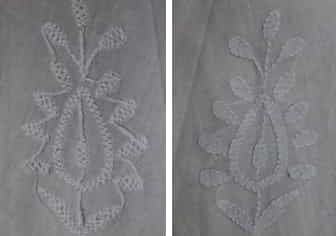
Region: Chikankari is whitework embroidery practiced in Lucknow, Uttar Pradesh. It is believed that Nur Jahan, wife of Mughal emperor Jahangir embroidered a cap for her husband, and hence popularized this craft of white on white embroidery.
Technique: The embroidery is done on fine white cotton fabric with untwisted white cotton or silk thread. There are three types of stitches used in chikankari: flat stitches like stem stitch and herringbone stitch raised stitches like bullion and French knots and pulled thread work or jali.
Motifs: The motifs are inspired by nature’s flora including flowers, creepers and lace-like
patterns.
Style of Embroidery: A common style present in each piece of Chikankari is the shadow work. To create the light and shade effect, herringbone stitch is executed from the wrong side of the fabric which creates a shadow of lighter color on the right side and at the same imparts an outline to the motif.
End-Use: Traditionally the embroidery was done mainly for male garments such as kurta, bandi, choga etc. for summer wear.
Presently Chikankari is being explored for apparel as well as home products on different fabrics like crepe silks, chiffons, georgettes, and cotton-polyester blends. Besides the traditional white-on-white embroidery, the contemporary chikankari has a wider color palette, from pastels to bright colors.

Phool Patti ka Kaam

Region: Phool Patti ka Kaam is traditional appliqué style embroidery practiced in Uttar Pradesh, chiefly Aligarh and Rampur. The embroidery is executed by Muslim women, who work from their homes. The craft gained importance during the Mughul period.
Technique: The appliqué is done on fine white cotton fabric or organdy. Traditionally appliqué is done in two ways. In one form ‘Badi Patti ka Kaam’ small pieces of white fabric cut into floral forms are stitched onto the white fabric, creating the light and shade effect. The detailing of the motifs is done with a stem stitch. In the other ‘Choti Patti ka Kaam’, small pieces of cloth are folded into diamond shapes and used as petals or leaves in the motifs, along with stem stitch work.
Motifs: As the name suggests, the motifs used in Phool Patti ka Kaam are flowers and leaves. The floral forms are geometric in nature.
Style of Embroidery: There are two styles of Phool Patti ka Kaam according to the size of the motifs appliquéd on the fabric. The Badi-patti style uses bigger floral forms for appliqué whereas in Choti-patti style very small diamond shapes are applied to the fabric.
End-Use: Phool Patti ka Kaam was traditionally done on dupattas and saris. Nowadays the appliqué is also done on home furnishings like curtains, table linen, and cushion covers using other colors besides white.
Zardozi

Region: Zardozi, the gold and silver embroidery is practiced in Lucknow, Agra, Varanasi, Bareilly, Bhopal, Delhi, and Chennai. The craft flourished under the patronage of the Mughul courts.
Technique: The embroidery is done on different fabrics like velvet, satin, and silk with a variety of zari threads and materials like badla (the untwisted wire), salma (stiff finely twisted circular wire) gijai (twisted metallic wire), dabka (zig-zag coiled wire), sitara (small circular disc), pearls and colored beads (Pic. 1.18). The different stitches used in Zardozi are chain stitch, stem stitch and satin stitch. The fabric to be embroidered is first stretched on a rectangular wooden frame supported on two tripods called a karchob. A hook or an awl is used to execute the embroidery.
Motifs: The motifs used are mainly floral and geometrical. Some popular motifs are creepers, flowering bush, floral scrolls, and intricate jali patterns.
Style of Embroidery: There are two embroidery styles namely Karchobi and Kamdani under Zardozi. In Karchobi, the fabric is clamped on a wooden frame and elaborately embroidered to create decorative home furnishings and ornate apparel. Kamdani is lighter embroidery done on apparel like dupattas and scarves without clamping the fabric on any frame.
End-Use: Zardozi was traditionally done to ornament wall hangings, bedcovers, cushion covers, curtains, palanquin covers, trappings for elephants, bullocks and horses, canopies, shoes, jackets, purses, boxes, etc.
The embroidery continues to be one of the most favored ornamentations for decoration of apparel such as lehenga choli, sari etc.
Presently, Zardozi is also explored on different types of base material like jute to develop trendy products like bags and decorative fashion accessories.

Kasuti

Region: Kasuti embroidery is practiced in Karnataka. The embroidery considered an auspicious craft, is executed by women. In ancient times, every bride would own a black silk sari, Chandrakali sari, with Kasuti embroidery done on it.
Technique: The embroidery is done on hand-woven cloth of darker colour usually black with cotton threads in different colours like red, orange, purple, green, yellow and blue. Four basic stitches are used: Gavanti, double running stitch that creates the same effect on both sides of fabric; Murgi, zig-zag running stitch that works in stepwise manner; Negi, a simple running stitch that produces a weave-like effect, and Menthi, cross stitch that gives a heavier appearance. The embroidery threads used are drawn from the old silk sari borders.
Motifs: The motifs are inspired from religion, architecture, flora and fauna, and objects of daily use. Some examples are star shaped designs, chariot and palanquin for deity, tulsi pot holder, cradle, the sacred bull, deer, elephant, peacock, horse, and lotus
Style of Embroidery: The embroidery uses a combination of horizontal, vertical and diagonal stitches. The motifs are not traced on the fabric and the embroidery is executed by counting the yarns on the base material.
End-Use: Traditionally the embroidery was done on Ilkal sari and other apparel items like women’s blouse and children’s bonnets.
Presently Kasuti embroidery is also done on home products like cushion covers, bedcovers, curtains and accessories like handbags, mobile pouches, belts etc.
Lambadi Embroidery

Region: Lambadi embroidery is practiced by the Lambadas or Lambanis, the Banjaras of Bellary and Bijapur in Karnataka and Hyderabad in Andhra Pradesh. The colourful embroidery was done by the women to decorate their costumes namely phetia or skirt and kanchali or blouse.
Technique: The embroidery is done on hand-woven cloth in dark blue or red colour. The embroidery is done with colourful threads using basic stitches like herringbone stitch, chevron stitch, cross stitch and running stitch, combined with appliqué. The embroidery is further embellished with mirrors, cowrie shells, beads, coins and silver trinkets.
Motifs: The motifs are mainly geometrical with grid-like patterns.
Style of Embroidery: The embroidery uses a combination of stitches and appliqué, along with mirror work and other embellishments like cowrie shells and coins.
End-Use: In the past, Lambani women embroidered their garments and other utility products like pouches and bags. Nowadays, embroidery is done on a variety of products like cushion covers, bedcovers, wall hangings, garments, and accessories like bags, headbands, waist belts, etc.
Kantha

Region: Kantha is an embroidery style that originated in West Bengal. In the past, it was used to transform old, used fabric into an embroidered textile.
Technique: The embroidery is executed on layers of old white cotton saris that are stitched together with a simple running stitch in white thread. The motifs are traced and embroidered using different colored threads. The embroidery threads used are drawn from the old sari borders. The basic stitch used is running stitch along with satin stitch and chain stitch.
Motifs: The motifs used in Kantha are lotus flowers, floral scrolls, tree of life, creepers; animal and bird forms; fish, sea monsters, mermaids, ships, submarine scenes; domestic articles like mirrors, pitcher, nutcracker, umbrella, musical instruments and human figures like gods and goddesses, horseman, fisherwoman, etc.
Style of Embroidery: Different embroidery layouts are followed in Kantha. Some examples are A central motif and tree of life on all four corners, motifs arranged in panels or a big central panel, and smaller motifs placed around.
End-Use: Kanthas were mainly used as quilts and also offered to special guests to sit or sleep on it. It was presented to the bride and groom as well as used to wrap valuables and gifts. Other uses of Kantha include bags for keeping money and book covers.
Nowadays, Kantha embroidery is done on a single layer of white or colored fabric base using contemporary motifs. The product range includes stoles, dupattas, saris, and suit materials.
Sujani

Region: Sujani is an embroidery style practiced in parts of Bihar, namely Muzaffarpur, Bhusra, Madhubani, and Patna. Similar to Kantha, the embroidery was traditionally done on layers of old saris and converted into a quilt. In the past, Sujanis or embroidered quilts were made on the arrival of a newborn.
Technique: The embroidery is carried out on layers of old white cotton saris that are stitched
together with a simple running stitch in white thread. The motifs are filled-in with rows of running stitch in colored threads drawn from the old sari borders. The outlines of the motifs are defined with chain stitch.
Motifs: The motifs used in Sujani are drawn from daily life and the natural surroundings. Some examples are flowers, plants, elephants, birds, fishes, gods, and goddesses. The contemporary Sujanis are also portraying social concerns like female foeticide, women empowerment, girl child education and domestic violence.
Style of Embroidery: The embroidery layout is such that each piece of Sujani tells a story. The motifs are simpler and bolder in comparison to the Kantha embroidery.
End-Use: Traditionally Sujanis were used as baby wraps. Presently the women artisans are doing sujani embroidery on different products like bed covers, cushion covers, wall panels, stoles, dupattas and fashion accessories.
Pipli Applique

Region: Pipli appliqué is a traditional craft from Orissa that gets its name from its place of origin. Pipli is a small town in Orissa, where the appliqué embroidery is practiced by artisans called Darjis. It is believed that the appliquéd textiles were initially made to decorate the idols in Lord Jagannath temple of Puri, Orissa.
Technique: The appliqué is done using pieces of fabric that are cut into specific shapes and stitched on a base fabric. The raw edges of the applied motif are finished with a row of chain stitches. The other stitches used for appliqué are stem stitch and blanket stitch. To impart a three-dimensional appearance to the appliqué, fabric strips are either folded or gathered and applied to the base fabric. The appliqué is further decorated with rickrack laces and mirror work.
Motifs: The motifs in Pipli work are mainly geometric, abstract, and stylized inspired by flora, fauna, and mythology. Typical motifs are flowers, birds, animals, fishes, and deities of the Lord Jagannath temple.
Style of Embroidery: The Pipli appliqué is easily identified by its vibrant colors. Fabric pieces in bright colours are cut in a particular shape and applied on a contrasting colored base material.
End-Use: Traditionally Pipli products were used to decorate the royal kingdoms and the Jagannath Temple of Puri. Even today, big-sized appliquéd canopies are used for deities during religious processions.
Presently a range of contemporary pipli products are available including garden umbrellas, wall hangings, lampshades, home furnishings like cushion covers, bed covers and fashion accessories like bags and pouches.
Dyed Fabrics
Bandhani
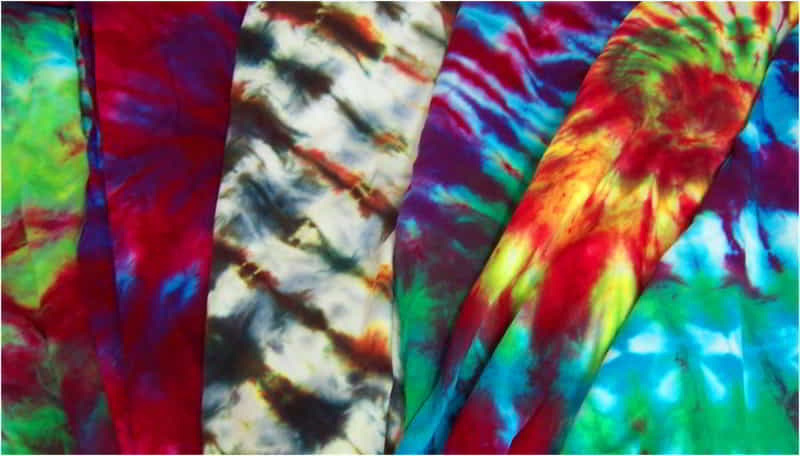
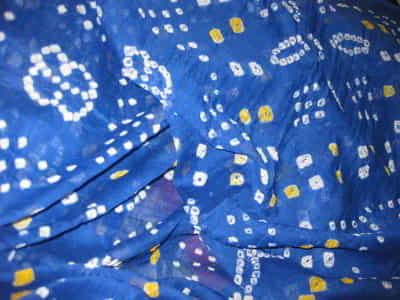
Bandhani, derived from the word ‘bandha’ which means to tie, are tie-dyed textiles primarily from Rajasthan and Gujarat. Tie-dye is a resist dyeing technique in which pre-determined areas on the fabric are tied tightly with thread to protect them from the colour, followed by dyeing and removal of threads to reveal an interesting pattern on fabric.
The earliest reference to bandhani dates back to 6th-7th century AD at the Ajanta cave paintings that portray women wearing bodices with resist-dyed designs. There is a literary reference to bandhani textiles in Harshacharita written by Banabhatta in 7th century AD. The biography quotes the wedding of King Harsha’s sister, Rajyashri and details the tie-dyeing of the bride’s odhani.
The word ‘chunari’ is a commonly used term that refers to patterns created by fine tie-dyed dots. Since the resist dyeing is done on head-cloths, chunari is also the name of the garment worn by women in Rajasthan.
The basic steps of creating a bandhani textile are as follows:
- Pre-preparation of fabric: The fabric generally used for tie and dye is finer variety of cotton and silk, so that dye can penetrate deep into the layers of tied fabrics. It is soaked in water overnight and washed thoroughly to remove the starch in order to improve its dye The fabric is bleached by drying it in the sun.
- Tracing of design: The fabric is folded into four or more layers for convenience of tying as well as to achieve symmetry in The design layout is marked on the folded fabric with wooden blocks, dipped in washable colours like neel or geru.
- Tying of fabric: As per the design, the folded fabric is raised with a pointed metal nail worn over the finger. A cotton thread coated with wax is wrapped tightly around the raised area to create a simple fine dot: bundi or bindi, which is the basic motif of the design.
- Dyeing of fabric in the lightest colour: After tying, the fabric is dyed in the lightest colour first from the selected colour scheme. After dyeing, fabric is washed, rinsed and dried.
- Renewal of tying and dyeing in next-darker colour: Parts of the fabric to be retained in the lighter colour are covered with tying and then the fabric is dyed in the next darker The Process of re-tying and dyeing is continued till the darkest colour in the scheme is applied.
- Washing: Following the final dyeing, the textile is washed to remove excess dye and starched.
- Opening the ties: The ties of the tie-dyed fabric are kept tied till purchased by a consumer in order to differentiate between a bandhani textile and a printed imitation. Only a portion of the bandhani textile is opened to display the colour scheme to the To unravel the ties, the bandhani textile is stretched crosswise to open all ties at the same time. The tie-dye in India can be categorized according to region into Bandhani of Gujarat and Bandhej and Leheriya of Rajasthan
Bandhani of Gujarat
The tie-dye from Gujarat called Bandhani is regarded for its fine resist dots and intricate designs. Traditionally the tie-dye is done on silk, cotton and wool. The motifs created by outlining with tiny dots are animal and human figures, flowers, plants and trees. The products range varies from odhanis, saris, shawls to stitched garments like kurta and skirts.
The major centers of bandhani in Gujarat are Jamnagar, Bhavnagar, Rajkot and Porbandar.
Special Bandhani Textiles from Gujarat
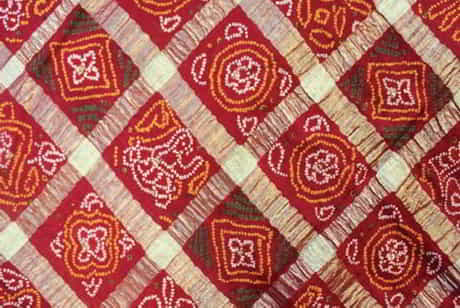
Gharcholu: A popular bandhani textile produced in Gujarat is called gharchola or gharcholu, a traditional odhani for Hindu brides, which is nowadays available as a sari worn on auspicious occasions. The tie-dyed textile in cotton or silk is red in color and the layout is a checkerboard created with woven gold threads. Each square within the check contains a different tie-dyed motif like a dancing lady, parrot, elephant, peacock, flowering shrub, and geometric forms.
Chandrokhani: The traditional odhani for a Muslim bride in red and black colour is called chandrokhani. It is a tie-dyed textile with a big medallion in the centre surrounded by four smaller medallions and wide borders. Motifs created with small tie dye dots are small paisleys, zig zag lines, sunflowers etc.
Aba or Abo: The traditional upper garment for Muslim women is called aba or abo. The kurta has an intricate tie-dye pattern shaped like a yoke on the bodice front, which is identical in the front as well as the back.
Bandhej and Lehariya of Rajasthan
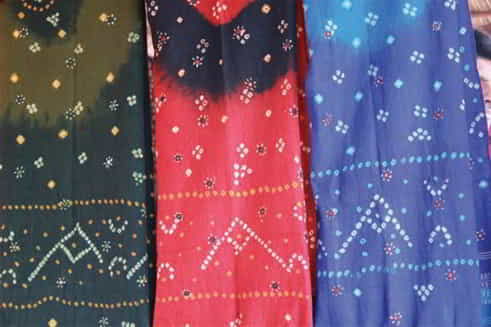
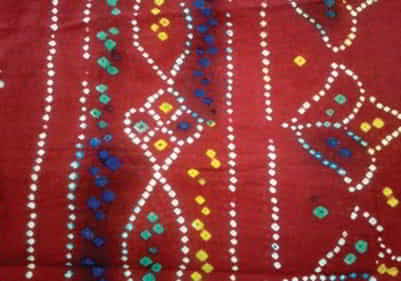
The tie-dyed textiles produced in Rajasthan are known as bandhej and are similar to the bandhani of Gujarat in terms of the production process. Besides the fine resist dots, other types of shapes seen in bandhej are tiny boxes called dabbi, sweetmeats termed laddu and cowrie shells named kori. The tie-dye motifs range from very simple to complex forms including geometric and floral designs. The tie-dye done on fine cotton and silks are used as odhani for women, turban cloth for men and stitched into garments like skirt and bodice. The colorful textile that is considered auspicious is also offered to goddesses on special occasions.
Rajasthan is also known for its multi-colored resist dot pattern that is produced by a process called ‘lipai’. In this technique, the fabric is first dabbed with various colours according to the design, followed by tying the coloured areas to resist the penetration of dye. The tied fabric is finally dyed in order to obtain multi-coloured dots in localized areas on a coloured background.
Another category of tied-dyed fabrics which are very popular from Rajasthan are lehariya. The patterns are diagonal or zigzag lines created by the wrap-resist technique. Fine cotton or silk fabric is diagonally rolled into a tight rope and tied with thread at regular intervals to obtain stripes on dyeing. The fabric may be rolled again and re-tied to resist the existing colour and add another colour in the leheriya pattern. The fabric when opened fully shows diagonal white and varied light coloured lines on a darker background. Lehariya fabrics are used as headcloths or safa by men, worn on special occasions like festivals and weddings.
The finest bandhej is made in Sikar and Bikaner in Rajasthan. Other production centres for bandhej and leheriya are Jodhpur, Udaipur, Barmer and Jaipur.
Special Tie-Dyed Textiles from Rajasthan
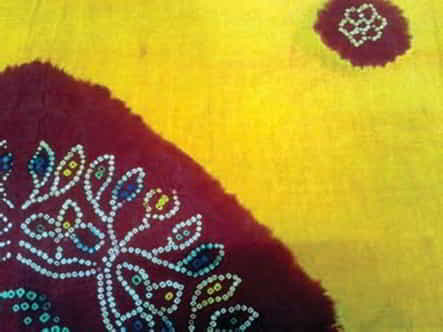
Piliya/Pilado: The traditional odhani in red and yellow colour scheme is an important part of the costume for young mothers. These textiles were dyed with turmeric to impart properties of anti inflammation. Hence it had social significance as they were gifted to the mothers of new born boys. A typical piliya is largely yellow in colour with red appearing in borders, big central circular motif and four smaller circles around it.
Mothra: A traditional leheriya textile that has a fine checkered pattern created by crisscrossing diagonal lines.
Ikat
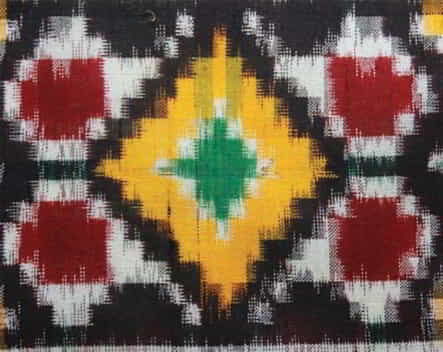
The term ‘ikat’ is derived from the Malay-Indonesian word ‘mangikat’ that means to bind or knot. It is a yarn resist technique wherein the yarns are tie-dyed, and on weaving a pattern is created on the surface of the fabric. An ikat textile can be identified from the typical hazy patterning on fabric due to the resist dyeing of the yarns prior to weaving.
Ikat can be classified into three categories:
- Single ikat: There are two kinds of single ikat namely warp ikat and weft ikat. As the name suggests, in warp ikat, the warp yarns are tie-dyed and woven with plain solid coloured weft yarns and similarly and in weft ikat, the weft yarns are tie-dyed and woven with plain warp yarns.
- Double ikat: In double ikat, both warp and weft yarns are tie-dyed according to a pre-determined pattern and then woven to create clear designs on fabric
- Combined ikat: In combined ikat, both warp and weft yarns are tie dyed but they are present in selected areas of a textile, to create interesting patterns.
The earliest reference to ikat can be found in the Ajanta cave paintings of the 6th century AD. Designs similar to ikat are seen on the dresses of the females portrayed in the murals of Ajanta. There is a mention of double ikat in the couplets of Rani Ranakdevi, Gujarati literature from 11th century AD as well as in the records of European travelers from 16th century AD.
The main production centres of ikat in India are Gujarat, Odisha and Andhra Pradesh. The ikat of each region known by different names can be identified from the motifs and the patterns achieved on weaving the tie-dyed yarns.
The ikat textiles of India can be classified into three categories on the basis of region as follows:
- Patola of Gujarat
- Bandhas of Odisha
- Ikat textiles of Andhra Pradesh: Telia Rumal and Pochampalli
Patola of Gujarat
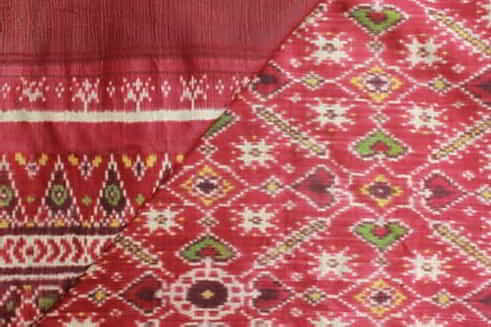
The double ikat weaving tradition of Gujarat is called ‘Patola’. The textile is produced by the weavers of the Salvi community using expensive silk yarns. In the past, Patolas were manufactured in Patan, Khambat, Surat, Porbander, Ahmedabad and Baroda in Gujarat. However with the passage of time, there are only two families in Patan who continue to practice this craft.
The earliest reference to Patola can be visually seen in the Ajanta cave murals of 6th century AD. During the 16th and 17th century, Patolas were regarded as precious silks by South-east Asia and Europe, and thus became an important trade item at that time.
In India, Patola saris are considered to be auspicious and are thus worn on very special occasions like weddings and festivals. In the past, the textile was also used as temple hangings and offered to the divinity.
The process of producing the double ikat Patola fabrics is very time consuming and labour intensive. The design is planned very carefully since both warp and weft yarns are tie-dyed repeatedly in order to introduce more than one colour. After the yarns are tie-dyed, the warp and weft are woven in plain weave. A sari takes nearly one month to weave as the adjustments of the weft yarn to make precise pattern with warp yarns is done with a pointed metal rod after each weft insertion. Due to the perfect alignment of the warp and weft, the motifs formed have defined outlines in comparison to the hazy outlines seen in single ikats.
Patola textiles use intense colours like bright red, golden yellow, green, dark blue, reddish brown etc. The distinctive Patola motifs are flowers, jewels, elephants, birds and dancing women for the Hindu and Jain communities. The Muslim community restricts themselves to abstract designs. The Patola designs are named as Kunjar Popat Bhat (Elephant – Parrot), Nari Kunjar Popat Bhat (Lady – Elephant – Parrot), Navratan Bhat (Jewel Mosaic), Phool Wali Bhat (Floral), Chabri Bhat (Basket of Flowers) etc.
The expensive Patola saris are prized possession of every Indian woman, reserved for ceremonial wear. Due to the high cost, the patola sari attracts very limited clientele and also cheap imitations manufactured by ikat weavers of Pochampalli, has affected its sales. Thus the number of artisans practicing the craft has drastically declined over a period of time.
Bandhas of Odisha
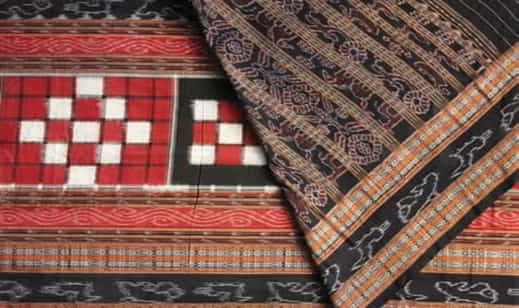
The ikat textiles called ‘bandhas’ are produced in Odisha. Mostly, bandhas are single ikats or combined ikats, woven by specific weaver groups like Mehars and Patras. Cotton and silk ikats are manufactured in Cuttack, Nuapatna, Sonepur, Bargarh and Sambalpur.
The bandhas of Odisha are characterized by curved forms with hazy outlines. The distinct hazy lines are created since only one set of yarns in the fabric are tie-dyed. Mainly weft ikat is done in Odisha. Some popular motifs are shankha or conch shell, swastika, creepers, flowers like lotus, intertwined snake, fish, tortoise and elephant.
The bandha weavers of Odisha are known for the usage of striking colour combinations and delicate intricate patterns. The ikat saris of Odisha are the popular attire of the local women, and are also preferred by the modern women of India. Besides the cotton and silk ikat saris, the other products woven by the weavers are yardage, stoles, scarves and dupattas.
A well-known example of the ikat sari from Odisha is ‘Saktapar’ sari. This sari is traditionally the pride of the region, with the double ikat checker board pattern and extra weft brocaded border of rudraksha, bead and fish (Pic. 3.4). The sari is characterized by its typical end piece, pallu comprising of bands of floral and figurative ikat motifs, divided by narrow woven patterned lines.
Ikat Textiles of Andhra Pradesh
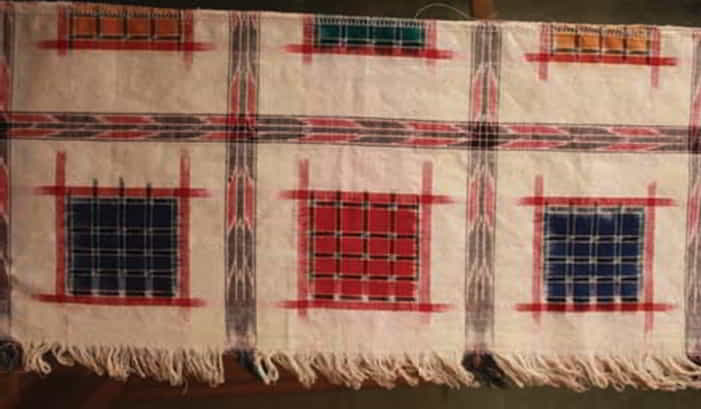
There are two types of ikat textiles produced in Andhra Pradesh, namely Telia Rumal and Pochampalli ikats. Telia Rumal is the age-old ikat technique of Andhra Pradesh, whereas Pochampalli ikats were introduced later by the telia rumal weavers.
Telia Rumal
The traditional ikat textile known as Telia Rumal is produced in Chirala, a coastal village in Andhra Pradesh. It is a square rumal or handkerchief measuring around one metre square. Since oil (tel) is an important ingredient used in the production of the rumal, the textile is known as telia rumal.
Traditionally the telia rumal were produced by the weavers belonging to the Padmasali community. In the early 20th century, these double ikat rumals were exported to Middle East, Africa and Burma. Within the country, the telia rumal became part of the fishermen’s clothing, worn as a turban or as a lower garment called lungi.
Traditionally, the commonly used colours for the telia rumal were terracotta red and black, using natural dyes. The fabrics were mordanted with iron solution and alum so that on dyeing with alizarine, areas with iron would become deep black and the ones with alum turned red. The layout of a typical telia rumal comprised of a geometrical grid-like patterning with borders all around, thereby creating small squares at the four corners. In the 19th century, simple geometric designs like crosses, dots and diamond shapes were used in the central field. In the 20th century, simple curvilinear forms like flowers, birds, animals, stars and moon were introduced in order to cater to the export market. Some contemporary pieces of telia rumal have used motifs like clock, gramophone and aeroplane.
By the 1950s, the demand for telia rumals declined and the technique was adapted to produce commercially viable products like saris and yardage for apparel and home products.
Pochampalli Ikats
In the early 20th century, the telia rumal weavers introduced the ikat technique to the Devang and Padmasali weavers of Pochampalli, a village near Hyderabad. As the popularity for Pochampalli ikats grew over a period of time, ikat weaving spread to many other villages like Koyalagudam, Puttapakka, Chautupal and Elanki.
The Pochampalli weavers applied the technique of ikat weaving to saris, dupattas and yardage. Initially the ikat designs were copied from the Patolas of Gujarat, but later on the weavers developed geometric motifs of their own, mainly inspired from the telia rumal. The weavers are also influenced by the Japanese and Indonesian ikats.
The Pochampalli ikats can be found in a range of colours including magenta, brown, parrot green, bright golden yellow, orange, off-white, black etc.
The Ikat weavers of Andhra Pradesh use mainly combined ikat technique to produce
very modern and graphic designs mainly for exports. They also cater to the domestic market, producing a wide range of saris, stoles and dupattas, and yardage for apparel and home furnishings. The weavers also imitate patola patterns and develop saris preferred by many due to cheaper costs in comparison to a double ikat patola sari.
Printed Textiles
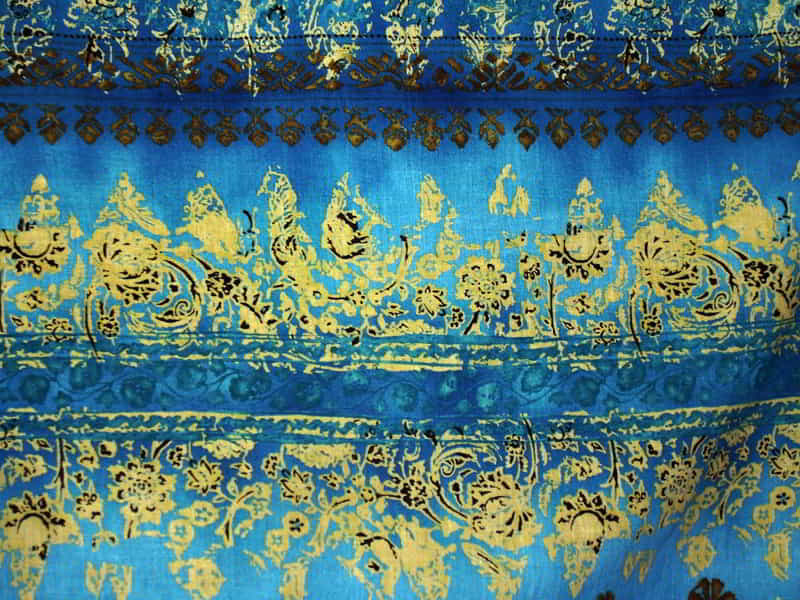
An early sample of block printed fabric from India was unearthed in Fostat in Egypt. Many similar fragments were found in South East Asia and other early civilizations. It was found that there was a flourishing trade of brightly printed fabrics from India. The British East India Company set foot first on the Coromandal coast and were fascinated by inexpensive, intricately hand printed brightly coloured fabrics. The popularity and subsequent demand of brightly coloured Kalamkari, better known as ‘Chintz’ in Europe, actually resulted in decline in the demand for machine printed fabrics, produced locally.
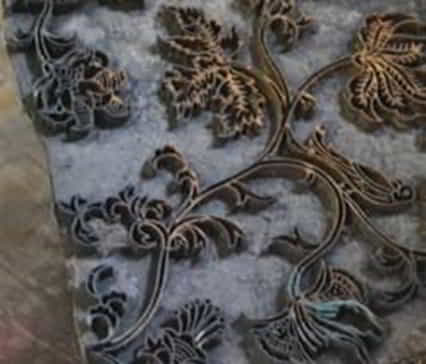
The traditional method of printing textiles was by using hand carved wooden blocks. The designs were printed using vegetable dyes to obtain bright terracotta red, indigo blue, turmeric yellow and deep green. The colouring was a tedious process using vegetable dyes. As vegetable dyes do not have affinity for fabric, the cotton fabric is firstly impregnated with metallic salts called mordants. These mordants help in bonding of dyes to the fabrics. The Indian printer’s skills were admired the world over to create intricate patterns using indigenous knowledge of mixing and overlapping to achieve varied tones of colours.
Printing Equipment
Block printing requires equipment in terms of wooden blocks, printing tables, colour trays etc. The blocks are made out of good quality seasoned ‘saagwan’. Block carving is done mainly in Pethapur in Gujarat; Agra and Farrukhabad in Uttar Pradesh and Delhi. For making a print motif with three colures, four blocks are required; one for the outline and three coordinates for the rest of three colours. The outline block known as ‘rekh’ is printed first. It is followed by printing of other filling blocks known as ‘gad’. In case of mud resist printing, mud paste is applied on the fabric with blocks known as ‘data’.
Wooden tables used for block printing are of two types. Tables are padded with layers of felt/ blanket material and covered with fine muslin, which absorbs extra dye. The muslin is changed as and when the fabric is soiled. Traditionally, tables were of low height to enable the printer to sit cross legged on the floor while printing. These tables were narrow width and hence the printer used to keep moving the fabric once the fabric in front of him was printed.
At present similar tables are used by printers in some of the remote villages in Rajasthan. The most commonly used tables are the ones with normal height so that the printing is done while standing. The width of the table is approximately 55 inches, as the fabric is laid on the table in full width. The printer moves around the table to complete the printing on both the ends of open width fabric.
The printing trays are square wooden receptacle in which thick layers of absorbent felt material is spread. The printing paste is evenly spread over the felt material. These trays are put on wooden trolleys provided with wheels to facilitate easy movement of printer from one place to another.
Pigment is mixed with gum obtained from the trees such as babool or Arabica, in order to provide thick consistency to the printing paste.
Printing Process
Desizing: The fabric to be printed is, first of all, washed for desizing, to remove starch or any other impurity from it. This will ensure evenly printed fabrics.
Mordanting: In case of natural dyes, fabrics are mordanted with metal salts to ensure better absorption and colour fastness.
Stretching on tables: The fabric is then stretched on the table with the help of pins, which are inserted diagonally on the edges. This is to avoid the shifting of fabric when printing is taking place.
Preparation of Colour Tray: The wooden tray with felt fabric layers is placed on the table trolley. The printing paste with pigment of thick flowing consistency is poured over it to spread evenly.
Printing: The block for outline ‘rekh’ is pressed on the colour saturated printing pad and then pressed on the fabric stretched on the table. The block is then carefully lifted to avoid any smudging or staining of fabric. The printing is similarly continued according to the layout. Equal amount of pressure is applied on each block to obtain consistency of colour. Once the first colour printing is finished, second colour is used with fill in blocks and subsequently all blocks are printed.
Dyeing: In the case of natural dyes, printing is done with mordants and then taken for dyeing.
Washing: The fabrics are then washed thoroughly after completely drying in strong sunlight. It is spread for few hours in sun and sprinkled with water frequently to ensure colour fastness.
Block Printed Textiles of Rajasthan
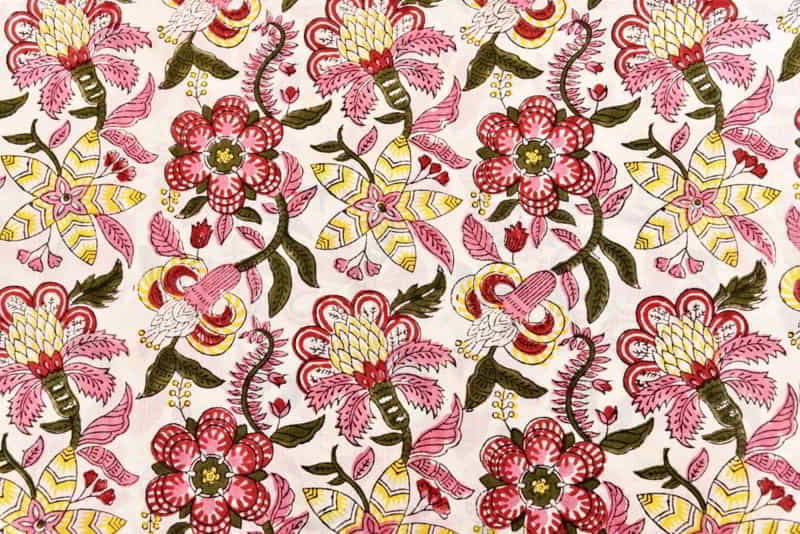
Rajasthan is known for its colourful block printed fabrics. The arid dessert land devoid of colourful natural surroundings is compensated by the love and use of bright colours in apparel by both men and women and for their homes too.
Block printing is a style of printing which is labour intensive and versatile. The printer community has been using the same wooden carved out blocks for many generations and are still able to sustain the craft. Two villages known for two different styles of printing are Bagru and Sanganer near Jaipur. Both have similar motifs but the technique of production and the look is very different.
Bagru prints from Rajasthan
Region: Bagru is a small village in Rajasthan, which is known for its mud-resist block prints.
Technique: In Bagru, the printer first processes the raw material which is mainly cotton. Other natural fabrics are silk, cotton and silk blends etc. The fabric is then printed with mordants in paste form. The printing is done by using outline and filling blocks. The prints are then covered with a resisting paste ‘dabu’ made of clay and gum. It is then dried and dyed in vegetable dye. The mud resist paste is used to resist the penetration of dyes, mainly vegetable dyes on cotton fabric as per the design. After dyeing the fabric is thoroughly washed at the river. The mud resist paste is washed off exposing printed motifs on white background surrounded by the base colour. Hence, the resulting effect of dark and deep background with light coloured prints is achieved by resisting and mordanting.
Motifs: The motifs are inspired by the 17th century Persian motifs and are classified into the following five categories:
- Single motifs like flowers, leaves and Some examples are suraj ka phool, chakri, anguthi, gende ka phool.
- Entwined tendrils that include all over jaal of leaves, flowers and
- Trellis patterns include jaalis from the Mughul
- Figurative designs that include animal and human figures such as elephant, deer, lion, peacock, dancing women, warrior men etc.
Geometric designs include waves (lehariya), chess (chaupad), Fortress wall projections (kangura), lines (dhariya), dots (bindi) etc
End Use: The brightly coloured block printed fabrics from Bagru are used for apparel as well as home furnishings such as quilts, bedspreads, cushions and curtains.
Sanganer prints from Rajasthan
Region: Sanganer on the outskirts of Jaipur is a large centre for printing on fabrics. Many block printing and screen printing units are located here.
Technique: The technique used by the printers in Sanganer is much simpler than Bagru. The bright vibrant colours are printed on white, off white or light colour background. Firstly the outlines are printed with fine blocks and then varied colours are filled in with a set of blocks. For each colour, a separate block is required.
Motifs: The motifs seen in Sanganer prints are same as the ones used in Bagru.
End-Use: The block printing is done mainly for products such as saris, dupattas, salwar kameez sets, the bedcover, curtains, scarves, and yardage for apparel and home.
Kalamkari from Andhra Pradesh
Andhra Pradesh is famous for many of its textile crafts, one of which is Kalamkari, which means ‘pen-craft’. This style of printing was practiced in coastal Deccan and many other places.
Kalamkari, the dye painted and printed exquisite textile symbolically named after the technique of its making, ‘kalam/qualam’ meaning pen and ‘kari’ meaning art, has been prevalent in several parts of southern India since ancient times. Referred to as ‘Chintz’ by the English and ‘Pintadoes’ by the Portuguese, Kalamkari was patronized by both Mughals and later by the Europeans in India.
Kalamkari fabrics were believed to brighten up with each subsequent wash. The specially prepared cotton fabric was hand-drawn with a special pen using mordants as ink. These fabrics were then dyed in natural dyes.
The fabrics printed at Masulipatnam were used as furnishings such as bedspreads, curtains, table cloths etc apart from apparel. In fact these fabrics were so popular in the West, that these were banned by France and England, as it was a threat to their domestic printed fabric industry. These fabrics were also referred to as ‘Palampores’.
Region: Srikalahasti, Masulipatnam, Polavaram and Pedana in Andhra Pradesh have been the major centres of this craft.
Tools: The main tool used in Kalamkari is an improvised brush known as ‘kalam’. It is made of bamboo stick which has a pointed edge like a pen. Near the tip, a ball of wool or felt is tied. Whenever the kalam is dipped in dye, the ball of wool absorbs the dye which is pressed while drawing. This maintains constant flow of the dye to the tip for continuous drawing.
Dyes: Natural dyes used in Kalamkari are colours extracted from plants, roots, leaves and similar vegetable matter, combined with minerals like iron, and mordants like alum which help in fixing the colour on to the fabric. For e.g. Yellow colour is derived from myrobalan flowers and pomegranate rind, blue colour is derived from indigo and black from rusted iron fragments.
Technique: The first step involves preparation of grey cloth which is achieved by soaking the cotton fabric in water for an hour and consequent washing so as to remove the starch which is followed by drying. Next, the fabric is treated with myrobolan solution which gives the cloth a light yellow tone.
The outlining of the main theme and figures are then drawn by using ferrous acetate solution prepared by fermenting iron scrap with jaggery. This solution gives black colour. Alum solution is prepared by dissolving alum in water. This is applied wherever red is desired. Combination of blocks and hand painting using ‘kalam’, makes Kalamkari fabrics desirable for consumers. The fabric is then dyed with alizarine. The areas painted with ferrous solution turn jet black and the ones painted with alum become bright rust red.
Blue colour is applied by mixing indigo solution in an alkaline solution of lime and fuller’s earth. To get green color, indigo or ultramarine blue is applied on portions which are already painted in yellow color.
Style and Motifs: The art of Kalamkari under the patronage of Mughals in Coromandal and Golconda provinces branched out into two schools.
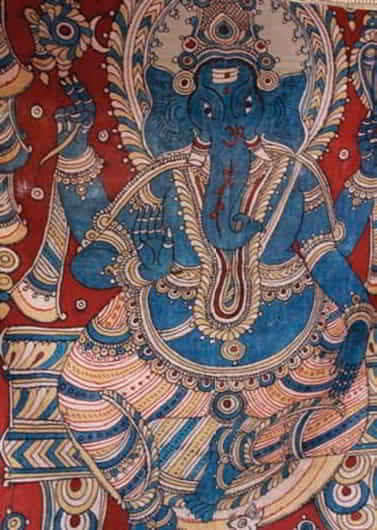
Masulipatnam under the Golconda province catered to the Mughal tastes with its Persian influence according to Islamic aesthetics. The prints from this region were characterized by intricate motifs and forms including the tree of life, ‘mehrab’ pattern, ‘jaals’, creeper and stylized peacocks. Decorative borders were depicted in stylised natural forms with
wooden blocks instead of pen. Sometimes pen work was combined with block printing to design elaborate wall hanging and panels with motifs such as Tree of Life. Otherwise the blocks patterns were influenced by Persian/Mughal motifs of exotic fruits and flowers, birds and animals, creepers and stylized peacocks etc.
Srikalahasti, ruled by Hindu rulers who gave patronage to the painters, was known for depicting scenes from Ramayana and Mahabharata on large pieces of fabrics which were used as hangings and canopies in the temples. The scenes were narrative and were depicted in boxes. Underneath each one, a line in Telugu script was painted to describe it. The forms are folk and more imaginative with restricted usage of repeats. Characteristics of this style are usage of solid colors without any shading. Gods like Krishna, Shiva, Parvathi, Brahma, Ganesha, Durga, Lakshmi, Rama are depicted with rounded faces, long and big expressive eyes and stout figures. Women are shown with heavy chins and men are depicted with long moustaches mostly in side profile.
Colours: Blue, ochre yellow, red and black are the main colours used in Kalamkari.
- Blue is associated with Lord Krishna and also other Gods.
- Yellow is used to show female bodies and also gold ornaments in deeper ochre
- Green colour is used to depict Lord Hanuman
- Red colour depicts demons and bad characters.
End-Use: The fabrics printed at Masulipatnam are used as furnishings such as bedspreads, curtains, table cloths etc apart from apparel like kurtas, saris and dupattas.
Contemporary Scenario: The craft gained huge popularity between 16th and 19th centuries. Printed version of Kalamkari became more famous but painted form lost its demand due to changing market preferences, modern techniques, ready availability of chemical dyes and tedious nature of dyeing and painting.
Efforts are made to orient the craftspeople to understand the market demands. Apart from cotton, base material like raw silks, chiffon and georgettes etc are also being used now. Motifs have also been contemporised with addition of new natural forms and stylised figures. New colour schemes of pastels, neutrals like brown, beige, maroon etc have been added to the traditional colour story.
Hand-woven Textiles
The richness and diversity of India’s woven textiles are talked about for the last two thousand years in the global market. Foreigners, local travelers and writers have described the textures, quality and the designs of Indian fabrics in great detail.
Various kinds of looms are used in different regions in India. Apart from simple pit looms, frame looms and complex ‘jala’ looms, back-strap looms are also popular in North-Eastern states. Supplementary weft or warp or sometimes both of these are used to create interesting patterns to ornament the fabric.
Amongst the earliest woolen textiles are the ‘Kani’ shawls of Kashmir, woven with Pashmina goat fleece. Their sophisticated and sensitive designs were in high demand. These shawls were much sought after in Europe and by Indian royalty for its intricate twill tapestry weave.
Varanasi had an ancient tradition of weaving fine cotton fabrics, but is now world famous for the rich silks known as ‘Kinkhab’ and ‘Tanchoi’. ‘Kinkhab’ was a heavy gold or silver brocaded fabric, often used for robes or furnishing. The famous lightweight patterned fabrics ‘Jamdani’ was woven in Dhaka in Bengal, now in Bangladesh. These fabrics were so delicate and fine that they would be invisible on wet grass. Since 19th century, Varanasi weavers are also catering to local Tibetan market by providing satin woven ‘gyasar’ for the Buddhist monastries. The silk and ‘zari’ work brocade of lighter material were known as ‘pothans’ or ‘bafta’. The ‘amroo’ and ‘himroo’ were the brocades without any metal ‘zari’ work.
Gujarat was considered the main centre for silk and brocade weaving in India. Surat, Jamnagar and Ahmedabad were the other important weaving centres for brocades.
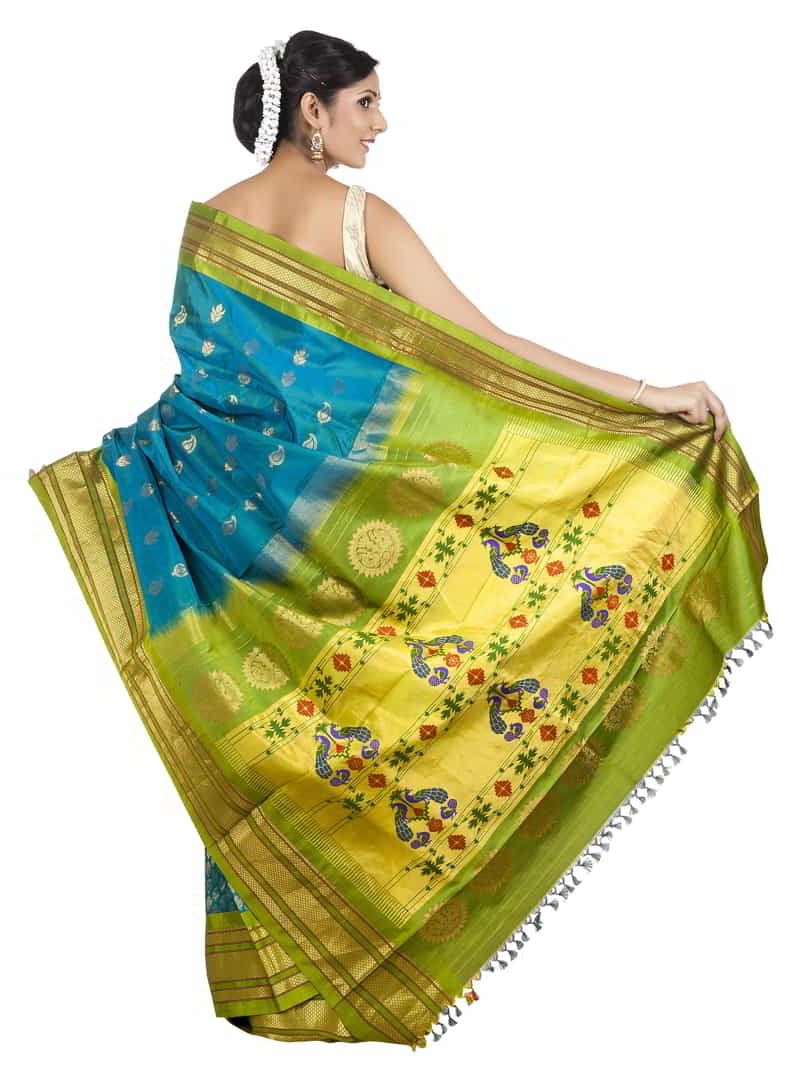
In the Deccan, the ‘Paithani’ weavers in Maharashtra used interlock tapestry technique to pattern the elaborate ornamentation. Down south, Arni and Dharmavaram produced rich coloured silk saris. Heavy Kanjeevaram saris are still an integral part of every Indian girl’s trousseau. They are made in silk and have motifs inspired by the temple architecture and sculptures of the region.
Murshidabad in Bengal acquired fame for its unique ‘Baluchari’ saris. These saris were elaborately brocaded with floss silk in strikingly pictorial ‘pallu’. These panels depicted courtly activities of Bengal Nawabs and landlords.
In most parts of India, weaving is done by men whereas in north eastern states only women weavers are seen doing intricate designs. The girls weave ‘gamocha’, a shoulder cloth, to give as a gift to elders in Assam. These are white in colour with red extra weft weave which makes stylized forms of birds, animals and geometric motifs. The traditional golden yellow Muga silk ‘Mekhala Chaddor’ is woven at Sualkuchi, Raha and Palasbiri. Tribal women in other north eastern states such as Manipur, Nagaland and Arunachal Pradesh weave beautiful fabrics on back-strap loom for the use of their family members.
Cotton weaving was done in almost all regions in India. Large number of towns and villages produced plain, checked and figured muslin. The most important centres were Dhaka in Bengal, Kota in Rajasthan, Chanderi and Maheshwar in Madhya Pradesh, Venkatagiri and Madurai in South India.
The fabrics were used as dhotis, saris, dupattas, pagaris, lungis, chadars and shirtings, as well as for furnishings such as quilts, bedspreads, rugs, khes and upholstery.
In addition to handlooms, the mill and the power loom sector has also contributed to the booming textile Industry. But the tradition of handloom cloth manufacturing in India is still flourishing and is still very much appreciated by the younger generation and the visitors to the subcontinent.
Categorization of weaving styles on the basis of the end product
- Saris
- Banaras Brocades
- Baluchari, Jamdani
- Paithani
- Kanjeevaram
- Chanderi, Maheshwari
- Shawls
- Kashmir shawl
- Kullu & Kinnaur
- Wraps of North-east
- Floor coverings
- Carpets
- Durries & Rugs
Saris/Sarees
Banaras Brocades
Region: Banarasi brocade saris are from Varanasi/Banaras, a small town in the state of Uttar Pradesh. The holy city of Banaras, on the banks of river Ganga, is considered to be the oldest city in the world. The brocaded fabrics from Banaras are considered to be one of the finest saris in India and are known for their gold and silver brocade or ‘zari’. These saris are made of finely woven silk, decorated with intricate design.
Technique: The designs are produced by warp and weft threads of different colours and materials, suitably woven. Extra warp/weft or both are woven into the fabric. Pattern is woven with or without attachments like jacquard or dobby attachment or by jala weaving. It can be silk on silk, cotton on cotton, silk on cotton, zari on silk. The brocade designs are made with extra yarns other than the ground threads. These extra or supplementary yarns are usually inserted in weft wise direction in Banaras brocades. When these extra yarns are picked from selvedge to the other end, the yarns appear on the face of the fabric in the design portion and as floats on the back of the fabric in the remaining portion.
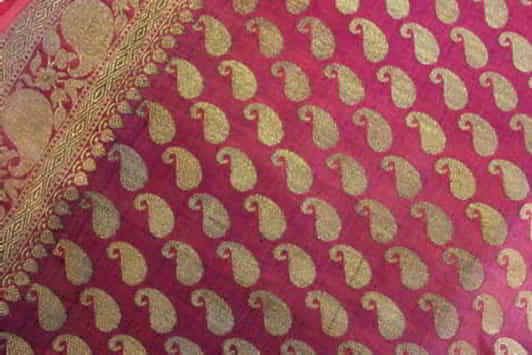
A very special technique often seen in Banaras is the ‘Minakari’. In this technique a motif is woven with an additional colour which stands out and resembles the enamelling in jewellery. The additional coloured yarns are slightly untwisted and hence appear raised.
Motifs: The most commonly used motifs are:
- Chrysanthemum buta
- Keri (paisley) buta
- Ganga jamuni style (half gold and half silver zari)
- Ari jhari (diagonal stripes)
- Latifa buta
The designs are extremely fine and delicate. They have a strong Mughal influence. Motifs like intertwining floral and foliage (Jaal), paisley in a creeper (Kalka bel) and hunting scene (shikargah pattern) are often seen.
End Use: These textiles were popular items of export to European countries. Traditionally, banarasi brocades were used during Mughal period as fabrics for royal coats, achkans and jamas. Courts and palaces were adorned with brocade curtains, fabric fans, bolsters and foot stools, upholstered with brocades. Brocade saris, dupattas and dress fabric were worn by women on special occasions, mainly on weddings and festivities.
Contemporary Scenario
In recent times, Banarasi brocades are being widely used to make dresses/kurtis for women, bags and other accessories. Lately home furnishings in brocades are also made to give a look of grandeur to the room. Even now, it’s a must to have a Brocade sari in trousseau for every Indian bride.
Baluchari Saris
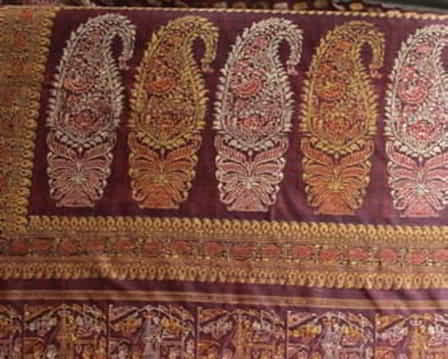
Region: Baluchari saris are beautiful ornate saris mainly produced in Murshidabad district of West Bengal. Baluchari sari is distinctly different from other saris of India, as it commemorates the Nawab and his wife by depicting them on the pallu of the sari.
Technique: Making of the motifs for pallu and other part of Baluchari sari is an intricate process. Earlier, Baluchari saris were made on jala looms which were gradually replaced by the modern jacquard technique. Traditionally the motifs were woven on handlooms, using softly twisted extra weft yarns which used to give a plump, embroidered effect. Zari is not used for extra weft ornamentation Now a days, jacquard attachment is used for weaving patterns on the sari. The design is drawn on a graph paper; it is coloured and punched on the jacquard cards. After punching, these cards are put in order and fixed in the jacquard machine on top of the loom.
Motifs: The pallu of the Baluchari sari is special as it is divided into niches bordering a square or rectangular space in the center. In each of the niches, a human figure is depicted, normally a king smoking a hookah or a queen with a fan or smelling a flower. A row of three, five or seven ornate paisley (kalkas) are seen in the centre of the pallu, around which niches with human figures are woven.
The Baluchari saris are often reckoned with the patterning of sun, moon, stars, mythical scenes and motifs of natural objects. The field of the saris are embellished with small butis. Colours like maroon, blue, red and dull dark terracotta were used as the base colour. Ornamentation of butidar Baluchari saris is done with extra weft motifs in off-white, white, yellow and dull orange coloured yarn.
These saris were mostly worn by women from upper class and zamindar households in Bengal during festive occasions and weddings.
In recent times, scenes from Ramayana and Mahabharata are depicted on Baluchari saris as motifs. Colours have become brighter and polychromatic. Zari yarns are also used for ornamentation.
Jamdani Saris
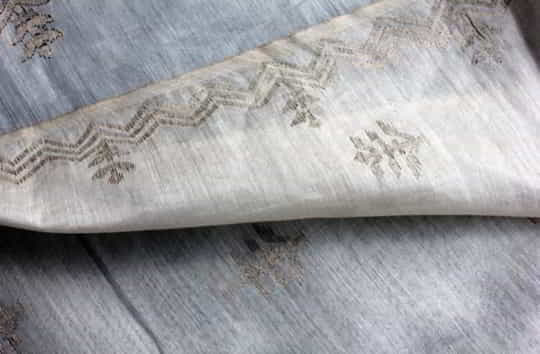
Region: The Jamdani saris are from West Bengal. These are sheer, delicate saris woven in Phulia, Nadia and Shantipur villages. These are made in combination of cotton with cotton, cotton with silk and silk with silk.
Technique: The technique of interlocking the extra weft yarns for creating motifs in the fabric is used in Jamdani saris. These are woven on traditional handlooms.
Motifs: Floral geometric creepers, paisleys and leeves are the most common motifs in the Jamdani saris.
Paithani Saris
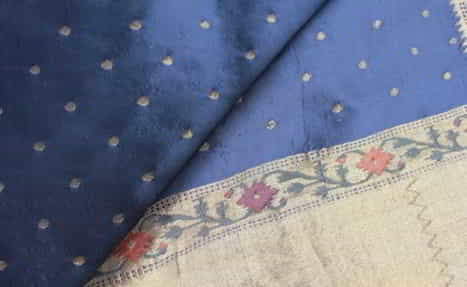
Region: Paithani saris are woven in Paithan and Yevla villages of Aurangabad in Maharashtra. Paithani saris are heavy silk saris which are preferred for wedding trousseau and festive wear.
Technique: The intricate motifs are woven by interlock twill tapestry weaving technique on traditional handlooms.
Motifs: Bright jewel tones such as emerald green, ruby red and yellow coloured silk yarns were used, however midnight blue coloured saris were most preferred. The interlocking technique created geometric angular forms out of patterns which were floral, paisleys, parrots, peacocks and lotus flowers. The pallu used to have a broad band of zari. At present the pallu band is ornamented with lotuses and peacocks woven in very bright colours. Another motif seen on Paithani saris is the bird (munia) motif.
Paithani is coveted in India as a precious heirloom passing on from generation to generation. Exquisite silk from Paithani was exported to many countries and was traded in return for gold and precious stones.
Kanjeevaram Saris
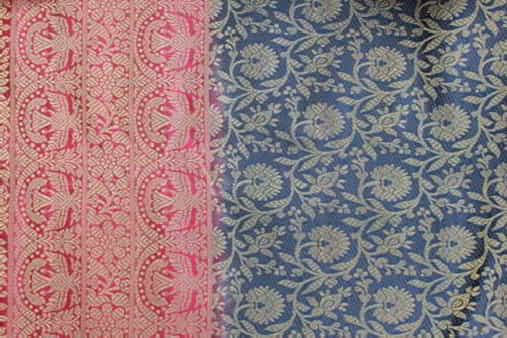
Region: Kanjeevaram saris hail from the town of Kanchipuram in Tamil Nadu. It is considered to be one of the most expensive saris in the world and thus used for all special occasions.
Technique: The sari is woven in pure mulberry silk and gold zari on hand operated pit-looms. The colours most commonly used are mustard, deep green, maroon, aubergine, etc.
Motifs: The motif imagery is drawn from the nature and forms of temple architecture. Some examples are peacock, parrot, rosary beads, bird’s eye, kalash, mythical creatures, temple designs, scenes from Ramayana, Mahabharata and Bhagwad Gita etc.
Chanderi Saris
Region: Chanderi, near Gwalior, in Madhya Pradesh is renowned for its woven saris appropriate for summer wear. The craft is practised by muslim Ansari weavers.
Chanderi sari
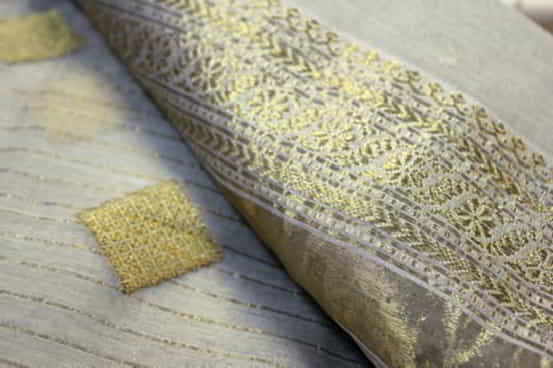
Technique: The sari is woven in a blend of cotton and degummed silk. It is diaphanous and is woven in pastel colours with small buties and a narrow gold border. The pallu generally has fine lines in zari yarn. The motifs are very simple. Some examples are gold coin (asharfi), mango, brick (eent) and rosary beads (rudraksha) in the form of small buties.
Maheshwari Saris
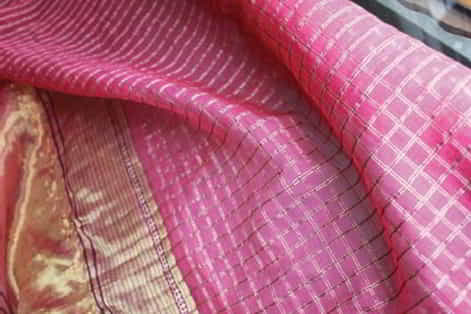
Region: Maheshwar is a small town near Indore, Madhya Pradesh famous for delicate summer wear woven saris.
Technique: The sari is woven with cotton weft and silk warp which is dyed on loom. It can be plain, tone on tone with a striped or checked border. It has three decorative bands/ borders of zari on the pallu. The colours are very varied but the most popular are the native haldi-kumkum combination (yellow and red) and sabz (vegetable) colours.
Motifs: The motifs are inspired from the architectural carvings of the Maheshwar’s Ahilya Fort. The architectural carvings done on the fort walls such as Kangura (chevron) and Chatai (mat) have inspired the patterns for borders of Maheshwari Saris.
Shawls
Kashmir Shawls
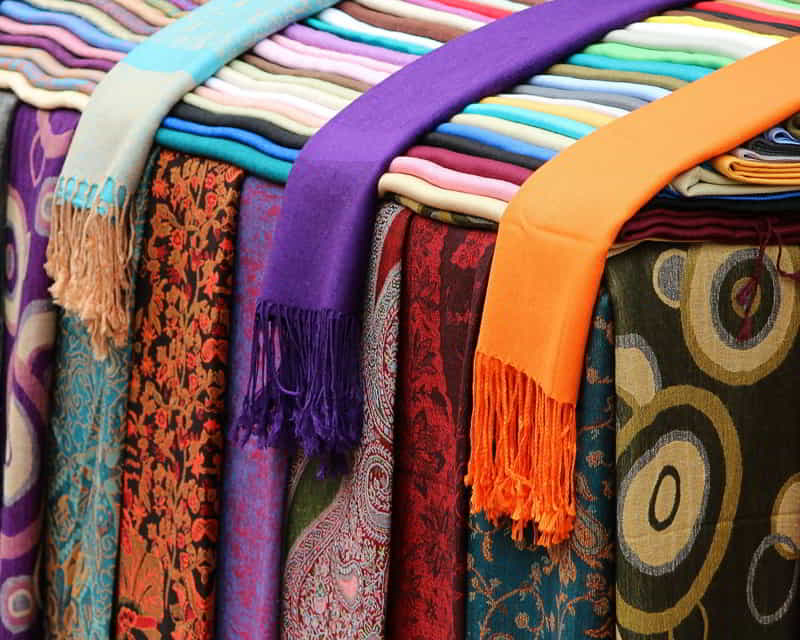
Kashmir also known as the paradise on earth is famous across the world for not only its natural beauty but also for the handicrafts made by the artisans. Among the handicraft products, the kashmiri shawls have remained as one of the most cherished acquisitions in the world since centuries. The English word ‘Shawl’ is derived from Persian word ‘Shal’, meaning a woven woollen fabric, which is draped across the shoulder to provide protection against the cold.
Origin: The Kashmir shawl industry developed over 300 years, through four different periods of political rule in India, viz the Mughals, Afghans, Sikhs and Dogras. As recorded in ‘Jaina Rajatarangini’, king Zain-ul-Abidin(1420-1470 A.D) was considered as the founder and chief patron of Kashmir shawls. He taught this art of shawl making to the people of Kashmir by getting experts from Turkistan. Since then, this art is being transferred from generation to generation in order to preserve the rich heritage.
During the reign of great Mughal Emperor Akbar, miniature paintings and portraits show the emperor wearing robes and gowns made of Kani shawl, giving evidence towards his being the great admirer of the art. He encouraged the weavers to try new motifs, and also started the fashion of the twin shawl, where two identical shawls were sewn back to back, hiding the rough edges of tapestry weave, and giving the impression of a single, reversible shawl.
Region: Three districts of Kashmir valley, viz Srinagar, Ganderbal and Budgaon are famous for pashmina shawl making. Other areas include Kanihama, Batpora, and Manzhama villages on the outskirts of Srinagar where majority of people are associated with weaving of Kani Shawl.
Raw Material: Shawl is prepared from material like woollen fleece, Pashmina, Shatoosh and Angora wool etc. Pashmina considered as the king of fibres derived its name from Persian word, Pashm meaning soft gold. It is famous for its softness, warmth, fineness and desirable aesthetic value. It is obtained from the soft, downy underbelly fleece of a mountain goat called Capra hircus which the animal sheds on the high altitudes during summers. Fleece is sometimes imported from nomadic Khirgiz tribes and also from Yarkand and Khotan.
Technique: On the basis of production techniques, the Kashmir shawl can be categorized into two main types – the loom woven or Kani shawls and the needle embroidered or sozni shawls.
Wooden spools instead of shuttle known as Kani or ‘Tujis’ in kashmiri language meaning eyeless are used for weaving a Kani shawl on the loom. The Tujis interlock the respective color threads through disconnected weft technique as they complete each weft of the shawl with twill tapestry weave to create an intricate pattern. Weaving process is meticulously regulated by a coded pattern, known as the talim drawn by the naqqash for guidance of the weaver.
Artisans require tremendous skill, patience and unbelievable amount of concentration to create a marvellous piece of Kani shawl. Its a laborious and time consuming process with usage of nearly 1500 colours in a design, which makes it difficult for the artisan to weave beyond an inch a day. Two craftsmen working together on a loom takes one and a half to two years to complete an all-over Kani shawl. In some cases, the period of weaving even stretches to five long years, depending entirely on the intricacy of designs.
Kani Shawls
The shawl is also widely known as Jamawar and Shah Pasand as the king and nobility preferred buying it and got Jama or gowns made out of it.
Layouts: The body of the shawl is termed as matan while the borders are termed as hashiya.
Doshala: Shawls in pair sewn back to back, i.e. the under surfaces of the shawl were never seen.
Char bagan: Four pieces of different colors are neatly joined together with invisible stitches. Generally the central field of the shawl is embellished with a medallion of flowers in embroidery.
Dorukha: The pattern is woven and embroidered in such a manner that it appears same on both the sides of the shawl.
Chand dar: Moon shawl has round large pattern woven or embroidered in the centre.
Motifs: The motifs are inspired from the beauty of nature. Some examples are mango or kairi, almond or badam, chinar leaf, apple blossom, tulip, lily flower, cherries, plum; birds like parrot, wood pecker, magpie etc.
No wild animals are depicted but hunting scenes known as ‘Shikargah’ are depicted in shawls for trade and commercial purposes.
Colors: Pashmina fleece colours range from beige, grey and brown to black. However, the fabric adapts itself beautifully to dyeing and colouring. Rich colours are most commonly seen on kani shawls like yellow (zard), white (sufed), black (mushki), blue (ferozi), purple (uda), crimson (gulnar) and scarlet (kirmiz).
End Use: The shawl or shoulder mantle has been in existence in India in a variety of forms since ancient times. It was worn and used as a warm protective garment against biting cold. Unrivalled for its light weight, in earlier times people folded these shawls into four folds and draped them. Now days they are generally worn as stoles without folds or are merely thrown over the shoulder.
Decline: As the Mughal kingdom began to collapse and Kashmir came under the Afghan rule, the shawl trade also began to focus increasingly on the west, while the Indian market went into decline.
During the regime of Afghan governor Haji Das Khan(1776-83), heavy taxes were imposed on the shawl weaving industry that forced the artisans out of their profession. The artisans and weavers were in miserable conditions and started shifting to nearby areas like Amritsar in Punjab, where time and again attempts were made to establish a successful shawl industry but all in vein. This gave rise to embroidered shawls known as amlikar, where the tax was paid just for plain woven shawl which was later embellished with embroidery by the artisans.
Contemporary Scenario: The world-famous Kashmiri ‘Kani’ shawl has been given a ‘Geographical Indicator’ (GI) status, which will not only provide legal protection but also help in prevention of shawls made in other regions of the world from carrying the ‘Kani’ shawl tag. The Kashmir Government has also sanctioned Rs 40.4 million to set up a laboratory to test the genuineness of a Kani shawl. The GI tag will also help the Kani shawl to regain its rightful place in domestic and global markets.
The Government has also allocated financial assistance to help the kani shawl weavers to purchase new looms or renovate and modernize their old handlooms.
Kullu & Kinnaur Shawls
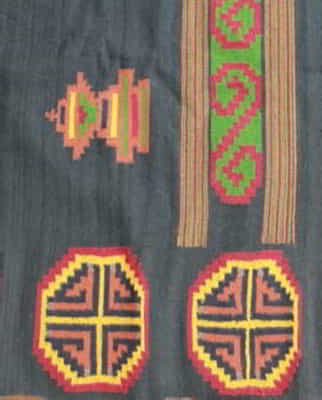
Kullu and Kinnaur in Himachal Pradesh are also known for good quality woollen shawls. The traditional colours used for the base of the shawls are red, maroon, black, brown and off-white. Bright colours are inserted in extra weft on borders of the shawl. Geometric motifs inspired from nature are made into beautiful colourful borders.
Kinnauri shawls are known for their labour intensive skilful weaving. These shawls are heavily embellished with motifs and are treasured by the women of Himachal Pradesh. These are draped by the women in two peculiar ways. Heavy silver jewellery is then worn along with it to give it a festive look.
Wraps of North-east
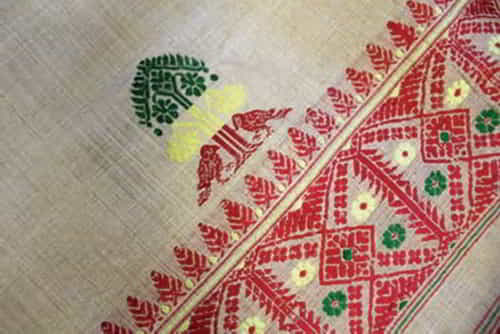
North-Eastern India comprises both tribal and non-tribal populations. The seven North-East Indian states are popularly known as seven sisters, comprising Assam, Arunachal Pradesh, Nagaland, Mizoram, Manipur, Tripura and Meghalaya.
Textile weaving is done by women in each of these states. There are more than 38 tribes in North East of India, and each of them have there own distinctive design, colour combination and a different design for special occasions. The design and colour, which varies not only between the tribes but also sometimes between clans of the same tribe and between different villages, records the wearer’s position in society. Shawls and wraps were originally made of cotton and the use of wool came much later. The colors used were mainly black, dark blue, red and yellow.
The textile weaving is exclusively a female occupation in this part of the country. For domestic consumption a back strap portable loom is used by the female weavers.
Fabrics from Assam include the hand-woven fabrics of cotton, muga, pat (mulberry silk) and eri (wild silk). Muga has a natural golden texture, it is mildly warm and particularly suited for winters. Textiles include bedspreads, furnishing material, mekhala-chaddars, rihas (traditional garments used by the women), gamosas, shawls and saris. The patterns generally involve animals, human figures, flowers, birds and diamonds. The designs in Assam are symbolic of the different tribes and ethnic groups of the region.
Floor Coverings
Carpets
A carpet is a textile floor covering which consists of an upper layer of ‘pile’ which is attached to a backing. The pile is either made from wool or a manmade fibre such as nylon or polyester and usually consists of twisted tufts which are often heat-treated to maintain their structure. Carpets can be from wall to wall or smaller in size such as area rugs.
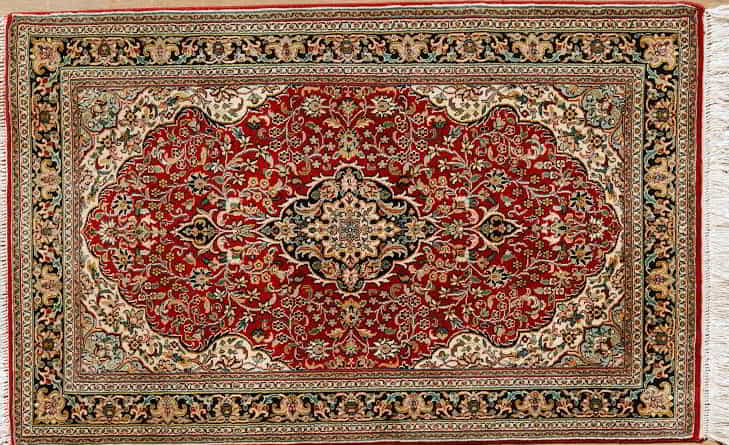
The knotted pile carpet are said to have originated in the 3rd or 2nd millennium BC in West Asia, or the Armenian Highland. Carpet weaving in India can be traced to the beginning of the Mughal empire wherein under the patronage of the Mughals, Indian craftsmen adopted Persian techniques and designs. Akbar, a Mughal emperor, introduced the art of carpet weaving to India, during his reign. The Mughal emperors patronized Persian carpets for their royal courts and palaces. The carpets woven in India showed the classic Persian style of fine knotting. The Indian carpets are known for their designs with attention to detail and presentation of realistic attributes. In India, carpet industry uses wool, silk, acrylic and Jute.
Carpet Types
Woven Carpets
The carpets are made on looms similar to traditional handloom. The piles can either be cut pile or loop pile. Many coloured yarns are used in making of these carpets and this process of weaving produces intricate patterns. Woven carpets are produced in Kashmir, Mirzapur, Bhadohi, Jaipur and Agra in India.
Needle felt Carpets
These carpets are more technologically advanced as compared to woven carpets. Needle felts are produced by intermingling and felting individual fibers using barbed and forked needles and hence forming an extremely durable carpet. These carpets are generally used in areas which are prone to friction due to high footfall.
Knotted Carpets
These carpets are made on upright or vertical looms. A knotted pile carpet is a supplementary weft cut-loop pile carpet where the structural weft threads alternate with a supplementary weft that rises at right angles to the surface of the weave. Knotting by hand is most prevalent in oriental carpets. Carpets produced in Kashmir are also hand-knotted.
Hand Tufted Carpets
In such carpets there is a pile injected into a backing material, which is then bonded to a secondary backing made of a woven fabric to provide stability. This is the most common method of manufacturing of domestic carpets for floor covering purposes in the world.
Common motifs include scrolling vine networks, arabesques, palmettes, cloud bands, medallions, and overlapping geometric compartments. Animals and humans are not depicted in the persian imagery because Islam is the dominant religion in this part of the world which forbids their depiction. Persian influenced imagery of trellis, vines, medallions, paisleys etc is seen in most of the Indian carpets. The majority of these carpets are wool and silk.
Durries and Rugs
A durrie is a thick flat-woven rug used traditionally as a floor-covering. They come in variety of colours and patterns and have low maintenance cost as they do not get infected by Silverfish or other insects responsible for destroying carpets. Woven durries are produced in Jodhpur, Hoshiarpur, Bhatinda and Warangal in India.
Durries can be used year round, as the cotton durrie is warm in winters and cool in summers. The use of a durrie depends on the size, pattern and material. Durries are used in large political or social gatherings as well as in schools in rural areas as they are easily portable being light weight and foldable. Generally the material used for durries are cotton, wool, silk and jute.
Rugs
A rug is a pile-less, woven textile floor covering that is made from various materials like linen, wool, cotton, jute etc. Cut shuttle and chenille rugs are made for the higher end of domestic or international market. In India these rugs are made with mainly recycled material which is used as weft. Panipat, Meerut and Bijnore are big production centers of rugs.


Isn’t this copyright infringement, the entire article is ripped from the CBSE Textile Book for XI Grade, very unprofessional