Introduction to Blockchain in Textiles
Blockchain technology, a decentralized digital ledger, records transactions across multiple computers, ensuring they cannot be altered retroactively. In the textile industry, it tracks products from raw materials to final goods, enhancing transparency and traceability. This is crucial for verifying authenticity, ensuring ethical practices, and meeting consumer demands for sustainability.
Benefits for Industry Professionals
For textile professionals, blockchain offers improved supply chain visibility, reducing fraud and ensuring compliance with standards. It enables real-time tracking, automates processes via smart contracts, and supports circular economy initiatives. An unexpected detail is its potential to create digital twins, allowing consumers to scan QR codes for product histories, boosting brand trust.
Challenges and Adoption
Despite benefits, challenges include high implementation costs, technological immaturity, and lack of interoperability. Adoption is still nascent, with many pilot projects but limited large-scale use, as seen in recent studies from 2023. This complexity suggests a gradual integration, requiring industry collaboration and standardization.
Introduction: The Need for Transparency in Textiles
The textile industry, a global economic powerhouse, faces increasing scrutiny for transparency, sustainability, and ethical practices. Consumers demand verifiable information about product origins, production processes, and environmental impact. Blockchain technology, first conceptualized in 1991 by Stuart Haber and W. Scott Stornetta and popularized with Bitcoin in 2008, offers a solution. It is a decentralized, immutable ledger that records transactions across multiple computers, ensuring data integrity. In textiles, blockchain tracks the entire supply chain, from raw material sourcing to final distribution, addressing issues like counterfeiting, greenwashing, and supply chain opacity.
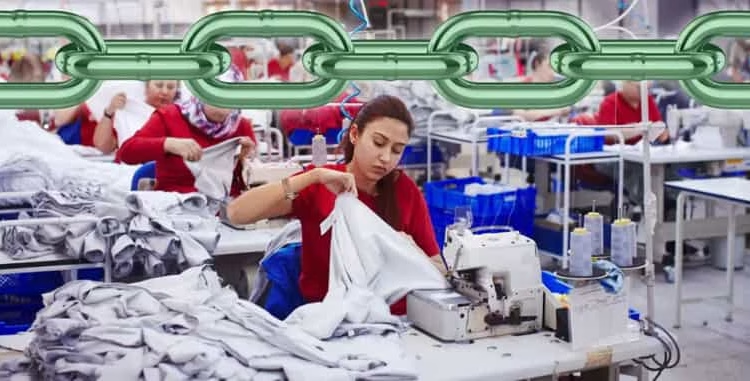
History: Blockchain’s Journey in Textile Supply Chains
Blockchain’s roots trace back to 1991, with its global debut in 2008 via Bitcoin by Satoshi Nakamoto. Its application in supply chains began around 2016, with academic research exploring its potential. In textiles, early adopters like Provenance and IBM started experiments by 2018, notably with IBM’s cotton industry blockchain consortium with The Seam. A 2023 systematic review highlighted growing research, with 23 articles published in 2020 and over 50% from 2018–2022, yet adoption remains limited, mostly in pilot phases. The United Kingdom and United States lead research, with 25% and 24% of studies respectively, indicating global interest.
| Year | Milestone in Textile Blockchain Adoption |
|---|---|
| 1991 | Blockchain concept introduced by Haber and Stornetta |
| 2008 | Bitcoin launch popularizes blockchain |
| 2016 | Academic research on blockchain in supply chains begins |
| 2018 | IBM launches cotton industry blockchain consortium with The Seam |
| 2020 | 23 articles published on blockchain in textiles |
| 2023 | Systematic review notes limited industry adoption |
Technological Evolution: Adapting Blockchain for Textiles
Blockchain’s evolution in textiles has seen public ledgers like Bitcoin give way to private and consortium blockchains for better privacy and control. Key features include:
- Integration with IoT and AI: IoT devices collect real-time data, recorded on the blockchain, while AI analyzes it for insights, enhancing efficiency.
- Smart Contracts: Automate processes like payments and compliance, reducing manual errors. For example, a smart contract can release payment only after delivery confirmation on the blockchain.
- Digital Twins: Virtual product representations allow consumers to scan QR codes or NFC tags for detailed histories, ensuring authenticity and transparency.
- Decentralized Marketplaces: Enable direct supplier-buyer transactions, reducing intermediaries and costs, especially for SMEs.
Recent advancements include decentralized autonomous organizations (DAOs) for supply chain governance and asset tokenization for easier tracking, promising more sophisticated applications.
Source and Availability: Accessing Blockchain Solutions

Textile companies can access blockchain through specialized platforms like TextileGenesis, Provenance, and FibreTrace, which track materials and verify sustainability. Industry consortia, such as the Aura Blockchain Consortium founded by LVMH, offer solutions for luxury goods. IBM’s Food Trust and open-source frameworks like Hyperledger Fabric provide adaptable options. Consulting firms assist with implementation, ensuring scalability, security, and compliance with standards.
Innovations: Transforming Supply Chain Management
Blockchain innovations include:
- End-to-End Traceability: Records every transaction, creating an immutable record from raw material to consumer, ensuring authenticity and sustainability.
- Smart Contracts for Automation: Automate payments, quality checks, and inventory management, streamlining operations.
- Decentralized Marketplaces: Reduce costs by enabling direct transactions, benefiting SMEs.
- Circular Economy Support: Tracks product lifecycles for recycling and upcycling, aligning with sustainability goals.
- Consumer Engagement: Digital twins and QR codes allow consumers to verify product histories, fostering trust.
These innovations address industry challenges like counterfeiting, costing USD 1.77 trillion in 2015, and enhance operational efficiency.
Production Process: Integrating Blockchain
Integrating blockchain involves mapping stages like raw material sourcing, spinning, weaving, dyeing, and distribution, identifying data points for recording, such as origins, factory details, and energy use. IoT devices automate data collection, ensuring real-time transparency. This data verifies compliance, markets sustainable products, and reduces paperwork. Challenges include high costs and supplier participation, especially in regions with limited infrastructure, but benefits like enhanced consumer trust make it worthwhile.
Challenges: Barriers to Adoption
Despite potential, challenges include:
- Technological Immaturity: Many solutions are experimental, with scaling issues for global supply chains.
- High Costs: Implementation requires significant investment in technology and training, prohibitive for SMEs.
- Lack of Standardization: Different platforms may not interoperate, fragmenting supply chains.
- Decentralization Risks: Managing consensus among stakeholders is complex in decentralized systems.
- Regulatory Compliance: Navigating varying global data privacy and trade laws adds complexity.
These barriers suggest a gradual adoption, requiring collaboration and standardization efforts.
Real-World Applications: Case Studies
Real-world examples include:
- LVMH and Aura Blockchain Consortium: Ensures luxury goods’ authenticity, allowing consumers to verify origins via unique identifiers.
- H&M Group and TextileGenesis: Tracks organic cotton, verifying sustainability claims, enhancing consumer trust.
- Inditex (Zara): Explores blockchain for transparency, though still experimental.
- FibreTrace: Traces natural fibers like wool and cotton, aiding brands in verifying origins.
These cases demonstrate blockchain’s practical benefits in enhancing transparency and sustainability.
Types of Blockchain: Choosing the Right Fit
Blockchain types include:
- Public Blockchain: Open to all, less suitable for textiles due to privacy concerns.
- Private Blockchain: Restricted to one organization, offering control but limited decentralization.
- Consortium Blockchain: Controlled by a group, ideal for textiles, balancing decentralization and privacy.
Consortium blockchains are promising, enabling collaboration among stakeholders while maintaining oversight.
End-Users and Market: Who Benefits and How Big Is It?

End-users include brands, retailers, consumers, regulators, suppliers, and manufacturers. Brands use blockchain for authenticity and sustainability, consumers for verified information, and regulators for compliance. The market for blockchain in manufacturing, including textiles, was USD 931.79 Million in 2022, projected to reach USD 70058.50 Million by 2030 at a 71.60% CAGR, indicating significant growth potential[^i^].
Future: Trends and Predictions
The future sees:
- Tech Integration: Blockchain with AI and IoT for predictive analytics and real-time monitoring.
- Standardization: Emerging protocols for interoperability and compliance.
- Consumer Demand: Driving adoption as transparency becomes a competitive edge.
- Circular Economy: Tracking lifecycles for recycling, supporting sustainability.
As barriers are addressed, blockchain is set to become standard in textiles, aligning with global sustainability goals.
Summary: The Transformative Impact
Blockchain enhances textile supply chain transparency by providing traceable, immutable records, improving efficiency, reducing counterfeiting, and supporting sustainability. Despite challenges like high costs and limited adoption, real-world applications by H&M and LVMH show promise. With a growing market and consumer demand, blockchain is poised to revolutionize the industry, offering industry professionals tools for ethical and efficient supply chain management.
Key Points
- Research suggests blockchain enhances transparency in textile supply chains by providing traceable, immutable records.
- It seems likely that blockchain improves efficiency, reduces counterfeiting, and supports sustainability, appealing to industry professionals.
- The evidence leans toward challenges like high costs and lack of standardization limiting widespread adoption.
Key Citations:
- [Exploring the potential of blockchain technology within the fashion and textile supply chain with a focus on traceability, transparency, and product authenticity: A systematic review](https://doi.org/10.3389/fbloc.2023.1044723)
- [Blockchain in Manufacturing Market Size | Industry Report, 2030](https://www.vantagemarketresearch.com/industry-report/blockchain-in-manufacturing-market-1343)
- [Blockchain Technology Market Size | Industry Report, 2030](https://www.grandviewresearch.com/industry-analysis/blockchain-technology-market)
- [How fashion brands are taking advantage of blockchain apparel](https://everledger.io/how-fashion-brands-are-taking-advantage-of-blockchain-apparel/)
- [Blockchain Can Revolutionise The Textile Industry. Here’s How.](https://www.textilesphere.com/2022/06/blockchain-in-textile-industy.html)