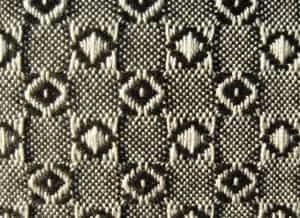
Fancy entwining twill effects are obtained by omitting one or more twill lines from each section and continuing the remaining twill lines of each section until they meet these of the other section. By this it means that two blank spaces are made in the weave, in which other weaves may be inserted. Curved twills are those in which the twill lines have a wavy, or curved, nature instead of being perfectly straight as in an ordinary twill weave. There are two methods of constructing these weaves,
The fancy twill is formed by placing small spots between the main lines of twill. The first end of the weave should be a continuation of the last end and the first pick should be a continuation of the last pick, so that the weave will continue perfectly when repeated in either direction.
Derivatives Formed by Rearranging Ends or Picks- The number of what may be termed fundamental weaves is comparatively small, but the weaves that may be derived from them are innumerable. Thus, if a simple twill weave is shown out in design paper, several other weaves may be obtained from it by rearranging either the ends or the picks. Designs thus obtained are termed derivatives.
The angle of twill weave is determined by the amount of shift in the points of interlacing.A one pick one end shift twill weaves called 45-degree will.A twill weave which has more than one pick shift and one end shift is called steep twill; if the shift is more than one end and one pick it is called reclining twill.
A broken twill weave composed of vertical sections which are alternately right hand and left hand in direction. In Broken Twills, twills are constructed by breaking the continuity of any continuous twill weave. They are formed by reversing the pattern part way through the repeat. The Break can be achieved in different ways.
Broken twill weaving transforms traditional patterns into intricate designs that balance aesthetics with performance. Advanced techniques, modern machinery, and sustainable practices drive this dynamic textile innovation.
Combination twills find extensive use in the worsted industry in the production of garment fabrics, as these weaves are capable of producing compact textures. These twills are constructed by two methods 1. End and end combination 2.Pick and pick combination. In the first method the twill weaves are combined end way and in the second method twill weaves are combined in pick way. In combination with twill weaves two different types of continuous twills are combined together alternately.