Textile arts and crafts have been an integral part of human culture for centuries. From intricate embroidery to modern digital fabric design, the world of textiles offers endless possibilities for creativity and innovation. This article delves into the fascinating world of textile arts and crafts, providing in-depth tutorials, showcasing modern textile art, offering DIY project ideas, and featuring renowned textile artists and their creative processes.
Introduction
Textile arts and crafts encompass a wide range of techniques and practices that involve the creation and manipulation of fabrics and fibers. These techniques include embroidery, quilting, lace-making, weaving, and more. Textile arts have evolved over time, incorporating new technologies and materials, and have become a vibrant and dynamic field that attracts artists, designers, and hobbyists alike.
History of Textile Arts and Crafts
The history of textile arts and crafts dates back to ancient civilizations. Early humans used natural fibers such as wool, cotton, and flax to create clothing and other essential items. Over time, textile techniques became more sophisticated, with the development of weaving, dyeing, and embroidery. The Industrial Revolution brought significant advancements in textile production, with the invention of machines that could spin, weave, and dye fabrics on a large scale.
In the 20th century, textile arts experienced a resurgence as artists and designers began to explore new materials and techniques. The rise of the Arts and Crafts movement in the late 19th and early 20th centuries emphasized the importance of handmade craftsmanship and inspired a renewed interest in traditional textile techniques. Today, textile arts and crafts continue to evolve, incorporating digital technologies and innovative materials.
Technological Evolution in Textile Arts
The technological evolution in textile arts has transformed the way artists and designers create and manipulate fabrics. Digital fabric design software, such as Adobe Photoshop and Illustrator, allows artists to create intricate patterns and designs with precision and ease. 3D printing technology has also made its way into the textile industry, enabling the creation of complex and innovative textile structures.
One of the most significant advancements in textile technology is the development of smart textiles. These textiles are embedded with electronic components, such as sensors and actuators, that can monitor and respond to environmental changes. Smart textiles have applications in various fields, including healthcare, sports, and fashion, and offer exciting possibilities for the future of textile arts.
In-Depth Tutorials
Embroidery
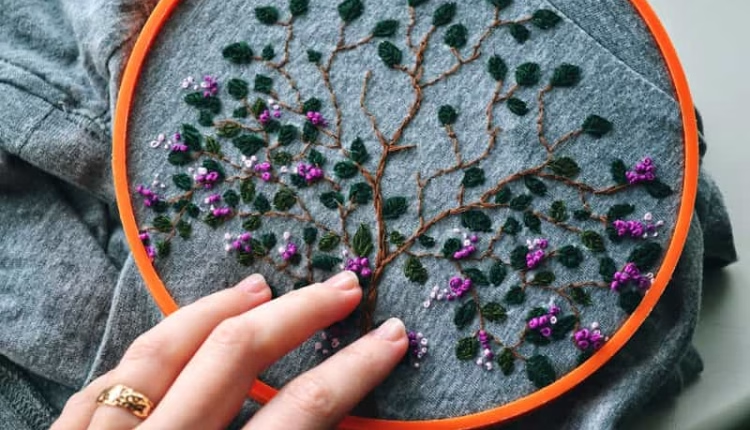
Embroidery is a timeless textile art that involves decorating fabric with needle and thread. Here is a step-by-step guide to get you started with basic embroidery techniques:
- Choose Your Fabric and Thread: Select a fabric that is suitable for embroidery, such as cotton or linen. Choose embroidery floss in your desired colors.
- Prepare Your Fabric: Stretch the fabric in an embroidery hoop to keep it taut while you work.
- Transfer Your Design: Use a water-soluble pen or transfer paper to trace your design onto the fabric.
- Thread Your Needle: Cut a length of embroidery floss and thread it through the needle. Knot the end of the thread.
- Start Stitching: Begin with basic stitches such as the backstitch, satin stitch, and French knot. Practice these stitches to create your design.
- Finish Your Embroidery: Once your design is complete, remove the fabric from the hoop and gently wash it to remove any transfer marks.
Quilting
Quilting is a textile art that involves sewing together layers of fabric to create a padded, decorative textile. Follow these steps to create a simple quilt:
- Choose Your Fabrics: Select a variety of fabrics in coordinating colors and patterns.
- Cut Your Fabric: Cut the fabric into squares or other shapes, depending on your quilt design.
- Arrange Your Pieces: Lay out the fabric pieces in your desired pattern.
- Sew the Pieces Together: Use a sewing machine to sew the fabric pieces together, creating the quilt top.
- Layer the Quilt: Place the quilt top, batting, and backing fabric together, and pin them in place.
- Quilt the Layers: Sew through all three layers to secure them together. You can use straight lines, free-motion quilting, or other quilting techniques.
- Finish the Quilt: Trim the edges and add binding to complete your quilt.
Lace-Making
Lace-making is a delicate and intricate textile art that involves creating lace patterns using thread. Here is a basic guide to lace-making:
- Choose Your Thread: Select a fine thread, such as cotton or silk, for lace-making.
- Prepare Your Pattern: Use a lace-making pattern or create your own design.
- Set Up Your Lace-Making Tools: Use a lace pillow and bobbins to hold and manipulate the threads.
- Start Weaving: Follow the pattern to weave the threads together, creating the lace design.
- Finish Your Lace: Once your lace is complete, carefully remove it from the pillow and trim any excess threads.
Modern Textile Art
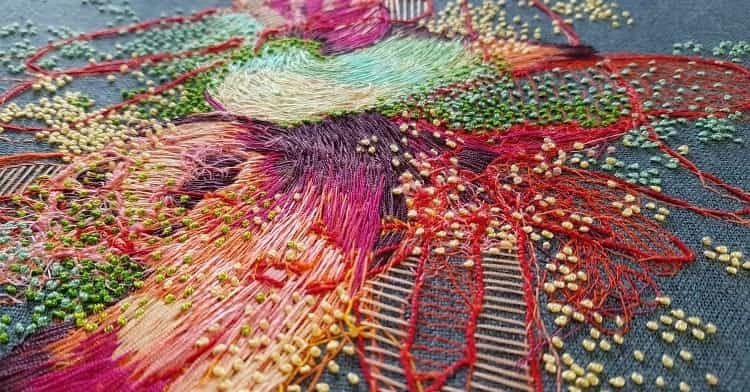
Modern textile art is characterized by the use of innovative materials and techniques to create unique and contemporary textile pieces. Digital fabric design and 3D-printed textiles are two examples of how modern technology is transforming textile art.
Digital fabric design allows artists to create intricate patterns and designs using computer software. These designs can be printed onto fabric using digital printing technology, resulting in vibrant and detailed textile pieces. Digital fabric design offers endless possibilities for creativity and allows artists to experiment with colors, patterns, and textures.
3D-printed textiles are another exciting innovation in modern textile art. Using 3D printing technology, artists can create complex and intricate textile structures that would be impossible to achieve with traditional techniques. 3D-printed textiles can be used to create fashion garments, accessories, and even home decor items.
DIY Projects
DIY textile projects are a great way for hobbyists and crafters to explore their creativity and create unique textile pieces. Here are some beginner-friendly DIY project ideas:
Embroidered Tote Bag
Create a personalized tote bag with embroidery:
- Choose Your Tote Bag: Select a plain canvas tote bag.
- Transfer Your Design: Use a water-soluble pen to trace your design onto the tote bag.
- Embroider Your Design: Use basic embroidery stitches to create your design on the tote bag.
- Finish Your Tote Bag: Once your embroidery is complete, gently wash the tote bag to remove any transfer marks.
Quilted Pillow Cover
Make a cozy quilted pillow cover:
- Choose Your Fabrics: Select a variety of fabrics in coordinating colors and patterns.
- Cut Your Fabric: Cut the fabric into squares or other shapes, depending on your design.
- Sew the Pieces Together: Use a sewing machine to sew the fabric pieces together, creating the quilt top.
- Layer the Quilt: Place the quilt top, batting, and backing fabric together, and pin them in place.
- Quilt the Layers: Sew through all three layers to secure them together.
- Finish the Pillow Cover: Trim the edges and add a zipper or buttons to complete your pillow cover.
Lace Bookmark
Create a delicate lace bookmark:
- Choose Your Thread: Select a fine thread, such as cotton or silk, for lace-making.
- Prepare Your Pattern: Use a lace-making pattern or create your own design.
- Set Up Your Lace-Making Tools: Use a lace pillow and bobbins to hold and manipulate the threads.
- Start Weaving: Follow the pattern to weave the threads together, creating the lace design.
- Finish Your Bookmark: Once your lace is complete, carefully remove it from the pillow and trim any excess threads.
Artist Profiles
Featuring renowned textile artists and their creative processes can provide inspiration and insight into the world of textile arts. Here are a few notable textile artists:

Sheila Hicks
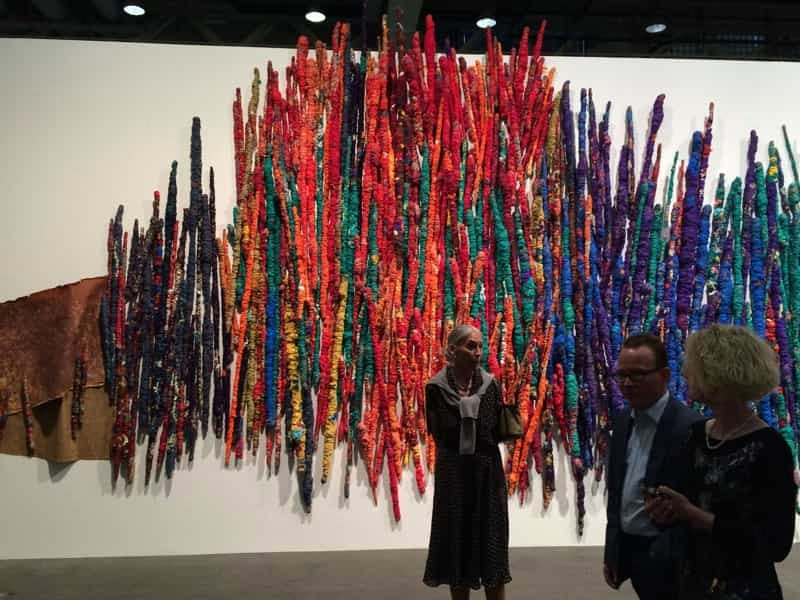
Sheila Hicks is a renowned textile artist known for her innovative use of color and texture. Her work often incorporates a variety of materials, including yarn, fabric, and found objects. Hicks’ creative process involves experimenting with different techniques and materials to create unique and dynamic textile pieces.
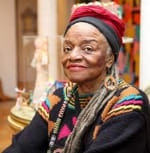
Faith Ringgold
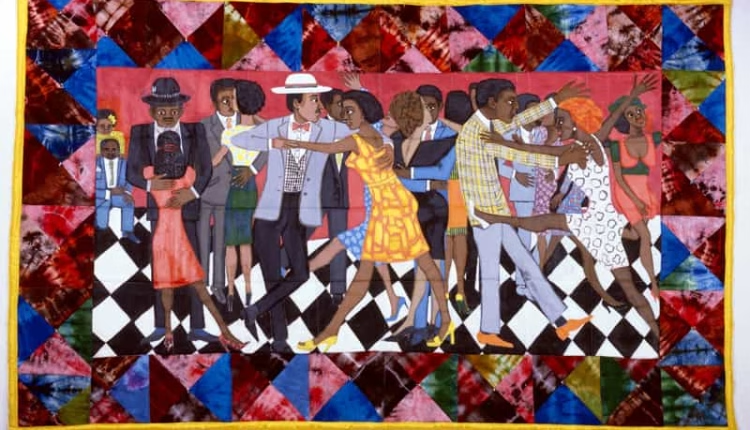
Faith Ringgold is an artist and activist known for her narrative quilts. Her quilts often tell stories of African American history and culture, combining traditional quilting techniques with painting and storytelling. Ringgold’s creative process involves extensive research and planning, as well as a deep understanding of textile techniques.
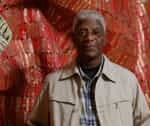
El Anatsui
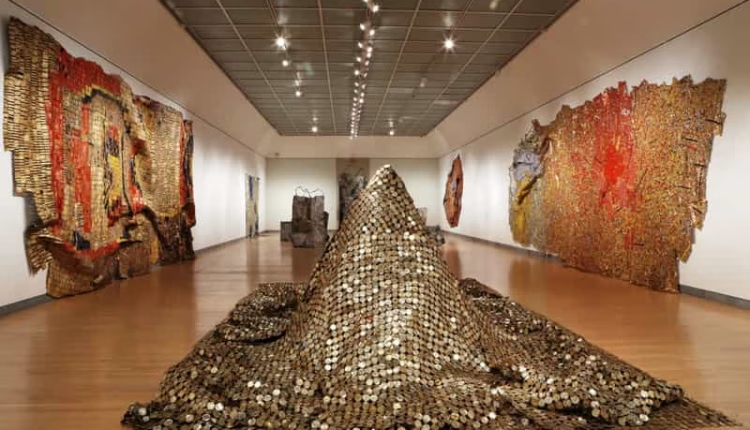
El Anatsui is a Ghanaian artist known for his large-scale sculptures made from discarded materials, such as bottle caps and aluminum cans. His work explores themes of transformation and sustainability, and his creative process involves collecting and repurposing materials to create intricate and powerful textile sculptures.

Anni Albers
Anni Albers (1899–1994) was a Bauhaus master and pioneer in modern textile design and weaving. Joining the Bauhaus in 1922, she transformed the field with geometric patterns and innovative techniques, blending art and function. After moving to the U.S. in 1933, she taught at Black Mountain College and Yale, influencing textile education. Her book On Weaving (1965) solidified her legacy as a visionary artist.

Magdalena Abakanowicz
Magdalena Abakanowicz (1930–2017) was a Polish artist famed for her monumental woven forms and fiber sculptures, known as “Abakans.” Emerging in the 1960s from the Academy of Fine Arts in Warsaw, she used sisal and other fibers to create abstract works reflecting human fragility and war’s impact. Her later bronze and burlap figures further solidified her influence, revolutionizing fiber art and contemporary sculpture.

Louise Gardiner
Louise Gardiner (1972–2023) was a British textile artist known for her innovative free-machine embroidery. With a BA from Goldsmiths and an MA from Manchester Metropolitan University, she blended stitching, appliqué, and painting to create striking artworks, including the “Cape of Empowerment” for Pukka Tea. Her organic designs, featured at the Saatchi Gallery and Liberty London, evolved into luxury silk scarves and velvet furniture, produced in Cheshire. A passionate educator and media figure, she passed away from cancer at 51, leaving a lasting impact on textile art.

Rozanne Hawksley
Rozanne Hawksley (1931–2021) was a British textile artist known for her innovative, emotive works blending craft and fine art. Trained at the Royal College of Art and Goldsmiths College, she used materials like velvet, gloves, and bones to explore themes of war, loss, and love, shaped by her wartime childhood. Notable pieces include Pale Armistice (1986–87) and The Seamstress and the Sea (2006–07), held in collections like the Imperial War Museum. Featured in the 1988 Subversive Stitch exhibition, she continued creating in Newport, Pembrokeshire, until her 80s, leaving a lasting legacy despite personal losses.

Jenny Hart
Jenny Hart (born 1972) is an American textile artist renowned for her innovative hand embroidery. Raised in rural Illinois and later based in Los Angeles, she began embroidering in 2000, using the medium to create expressive portraits of notable figures. In 2001, she founded Sublime Stitching, a company that introduced contemporary embroidery patterns and kits, revitalizing the craft’s popularity. Her work, featured in exhibitions like “40 Under 40: Craft Futures” at the Smithsonian American Art Museum, and her seven books for Chronicle Books, have earned her international recognition. Hart’s contributions extend to commercial projects for clients like MTV and The Metropolitan Museum of Art, cementing her influence in modern textile art.

Karen Barbé
Karen Barbé is a Chilean designer and embroiderer based in Chicago, recognized for her contributions to hand embroidery since 2012. With a background in design and a certification from the Royal School of Needlework (2015), she founded her design studio in Santiago in 2009 and teaches accessible color theory to address students’ frustrations with palette choices. Her book Colour Confident Stitching (2017), published in multiple languages, and her Domestika online class offer practical methods for creating textile palettes, reflecting her passion for traditional crafts and innovative design.

Ajrakh Abdul Jabbar Khatri
Ajrakh Abdul Jabbar Khatri is a renowned Indian textile artisan from Kutch, Gujarat, celebrated for his mastery of Ajrakh block printing, a traditional craft spanning ten generations in his Khatri family. Based in Ajrakhpur, a village he helped establish after the 2001 Bhuj earthquake displaced the community from Dhamadka, Khatri innovates with natural dyes and intricate geometric patterns, adapting to urban markets while preserving double-sided printing techniques on cotton and silk. Working with his sons, Adam and Nomad, and collaborating with designers like Sabyasachi Mukherjee, he produces saris, dupattas, and home furnishings, earning recognition for maintaining the craft’s authenticity amidst modern challenges like water quality issues.

Gopika Nath
Gopika Nath is an Indian embroidery-based textile artist, writer, and teacher known for her poetic and conceptual style. A Fulbright Scholar and alumna of Central Saint Martins, London, she has worked with textiles since 1976, evolving from a designer to an artist who redefines the medium through hand-crafted narratives. Her works, such as Ember Remains and Whispers of Freedom, blend traditional Indian embroidery with contemporary themes, using thread as a metaphor for life and healing. Influenced by her rural craft revival projects in Bastar and Kashmir, and exhibited at venues like Gallery Art Positive, her art explores personal and universal emotions with layered textures and stitches.

Shelly Jyoti
Shelly Jyoti (born 1957) is an Indian visual artist, fashion designer, poet, and independent curator renowned for her textile-based works that explore India’s colonial history and Gandhian philosophy. Based in Gurgaon and New Delhi, she holds an MA in English Literature from Punjab University and a degree in Fashion Design from the National Institute of Fashion Technology, New Delhi. Her notable series, such as “Indigo Narratives” (2009–2013) and “Salt: The Great March” (2013–2015), use khadi fabric and Ajrakh printing to address themes of non-violence, self-reliance, and social unity, often referencing Gandhi’s Champaran Satyagraha. Her works, held in collections like TAPI and IGNCA, have been exhibited globally, including at the South Asia Institute and National Gallery of Modern Art, reflecting her commitment to reviving traditional crafts and fostering cultural dialogue.

Nasreen Mohamedi
Nasreen Mohamedi (1937–1990) was a pioneering Indian modernist artist renowned for her minimalist drawings, photographs, and textile-inspired works. Trained at St. Martin’s School of Art, London, and influenced by Bauhaus principles, she developed a distinctive style featuring precise geometric lines and abstract patterns, often evoking the texture and structure of woven fabrics. Based in Mumbai, her work reflected a meditative approach, blending Indian aesthetics with Western modernism. Exhibited globally, including at the Tate Modern, her legacy as a visionary who bridged art and textile sensibilities endures despite her early death from Parkinson’s disease.

Wasim Ahmed
Wasim Ahmed (born 1976) is a prominent Pakistani contemporary miniature painter and visual artist based in Lahore. Graduating with honors from the National College of Arts, Lahore in 2000, he blends traditional Mughal techniques with modern themes, using gouache, pigments, and gold leaf on wasli paper. His work, inspired by socio-political issues and daily interactions with common people, has been exhibited globally, including at the Museum für Asiatische Kunst in Berlin and the British Museum. A key figure in the contemporary miniature movement, he has served as a Visiting Assistant Professor at NCA since 2001 and participated in notable residencies, such as the 2014 Humboldt Lab Dahlem project.

Rimzim Dadu
Wasim Ahmed (born 1976) is a prominent Pakistani contemporary miniature painter and visual artist based in Lahore. Graduating with honors from the National College of Arts, Lahore in 2000, he blends traditional Mughal techniques with modern themes, using gouache, pigments, and gold leaf on wasli paper. His work, inspired by socio-political issues and daily interactions with common people, has been exhibited globally, including at the Museum für Asiatische Kunst in Berlin and the British Museum. A key figure in the contemporary miniature movement, he has served as a Visiting Assistant Professor at NCA since 2001 and participated in notable residencies, such as the 2014 Humboldt Lab Dahlem project.

William Morris
William Morris (1834–1896) was a British textile designer, poet, and social reformer, a key figure in the Arts and Crafts movement. Trained as an architect, he founded Morris & Co. in 1861, revolutionizing design with handcrafted wallpapers, fabrics, and furnishings inspired by medieval art and nature. His intricate patterns, such as “Strawberry Thief” and “Willow Boughs,” emphasized craftsmanship and rejected industrialization’s mass production. A committed socialist, Morris advocated for art’s accessibility, influencing modern design while leaving a lasting legacy through his writings and the preservation of traditional textile techniques.
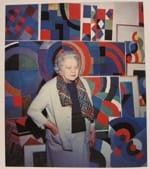
Sonia Delaunay
Sonia Delaunay (1885–1979) was a Ukrainian-born French artist known for her vibrant, abstract designs. A pioneer of Orphism, she blended art with fashion and textiles, creating bold, geometric patterns. Her work bridged fine art and applied design, making her a key figure in modern textile art.

Lenore Tawney
Lenore Tawney (1907–2007) was a groundbreaking American textile artist who transformed weaving into fine art. Known for her sculptural, open-warp weavings, she merged fiber with spirituality and minimalism, influencing the modern fiber art movement. Her legacy continues to inspire artists across disciplines for her boundary-breaking vision and poetic approach to fiber.
Challenges in Textile Arts and Crafts
Despite the many opportunities for creativity and innovation, textile arts and crafts also face several challenges. One of the main challenges is the high cost of materials and equipment. Quality fabrics, threads, and tools can be expensive, making it difficult for artists and hobbyists to access the resources they need.
Another challenge is the time and skill required to master textile techniques. Many textile arts, such as embroidery and lace-making, require a high level of precision and patience. Learning these techniques can be time-consuming, and it may take years of practice to achieve a high level of proficiency.
Finally, the textile industry faces environmental challenges. The production of textiles can have a significant impact on the environment, from the use of water and chemicals in dyeing processes to the disposal of textile waste. Artists and designers are increasingly exploring sustainable practices and materials to reduce the environmental impact of their work.
Real-World Applications of Textile Arts
Textile arts and crafts have a wide range of real-world applications, from fashion and home decor to healthcare and technology. In the fashion industry, textile artists create unique and innovative garments that push the boundaries of traditional fashion design. Textile arts are also used in home decor, with artists creating everything from quilts and tapestries to rugs and curtains.
In the healthcare field, smart textiles are being developed to monitor and improve patient health. These textiles can be embedded with sensors that track vital signs, such as heart rate and body temperature, and can even deliver medication or provide therapeutic benefits.
In the technology sector, textile artists are exploring the possibilities of wearable technology. From clothing that can charge your phone to fabrics that change color in response to environmental changes, the intersection of textiles and technology offers exciting possibilities for the future.
Types and Varieties of Textile Arts
Textile arts encompass a wide range of techniques and practices, each with its own unique characteristics and applications. Here are some of the most common types of textile arts:
Embroidery
Embroidery involves decorating fabric with needle and thread. It can be used to create intricate designs and patterns on clothing, accessories, and home decor items.
Quilting
Quilting involves sewing together layers of fabric to create a padded, decorative textile. Quilts can be used as bed coverings, wall hangings, and more.
Lace-Making
Lace-making involves creating delicate and intricate patterns using thread. Lace can be used to embellish clothing, accessories, and home decor items.
Weaving
Weaving involves interlacing threads to create fabric. It is one of the oldest textile techniques and can be used to create a wide range of textiles, from clothing to rugs.
Knitting and Crocheting
Knitting and crocheting involve creating fabric by interlocking loops of yarn. These techniques can be used to create clothing, accessories, and home decor items.
End-Users and Market for Textile Arts
The market for textile arts and crafts is diverse and includes a wide range of end-users. Artists and designers use textile techniques to create unique and innovative pieces. Hobbyists and crafters explore textile arts as a creative outlet and a way to make personalized items. The fashion industry relies on textile artists to create garments and accessories that stand out in a competitive market.
The market for textile arts is also influenced by trends in sustainability and technology. Consumers are increasingly seeking out eco-friendly and ethically produced textiles, and artists and designers are responding by exploring sustainable materials and practices. The integration of technology into textiles is also creating new opportunities for innovation and growth in the market.
Future Trends in Textile Arts and Crafts
The future of textile arts and crafts is bright, with exciting trends and innovations on the horizon. One of the most significant trends is the integration of technology into textiles. Smart textiles, wearable technology, and digital fabric design are all areas of growth and innovation in the textile industry.
Sustainability is another important trend in textile arts. Artists and designers are increasingly exploring eco-friendly materials and practices, such as using organic fibers, natural dyes, and upcycling textile waste. The demand for sustainable textiles is expected to continue to grow, driven by consumer awareness and environmental concerns.
Finally, the rise of DIY culture is influencing the textile arts market. More people are exploring textile arts as a hobby, and there is a growing demand for beginner-friendly projects and tutorials. This trend is creating new opportunities for artists and designers to share their knowledge and inspire others to explore the world of textile arts.
Summary
Textile arts and crafts offer endless possibilities for creativity and innovation. From traditional techniques like embroidery and quilting to modern innovations like digital fabric design and 3D-printed textiles, the world of textiles is constantly evolving. This article has provided an in-depth look at the history, techniques, and future trends in textile arts, as well as practical tutorials and project ideas for hobbyists and crafters. Whether you are an artist, designer, or hobbyist, the world of textile arts has something to offer for everyone.