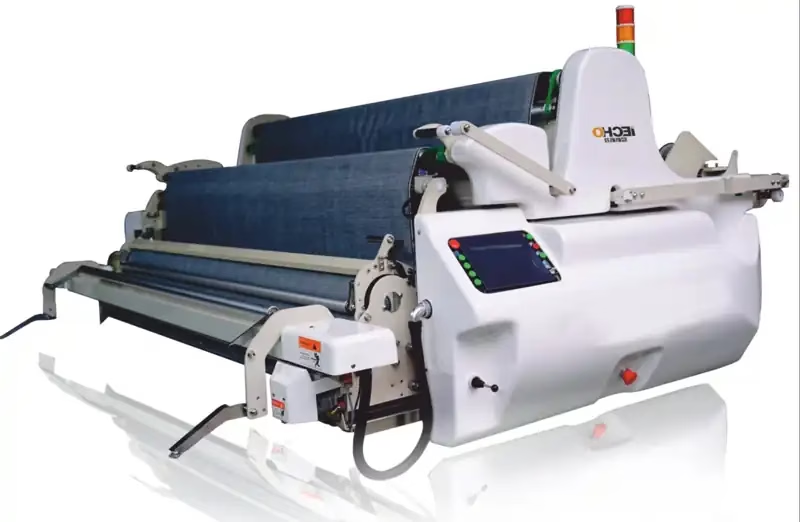
This article profiles the top eight textile cutting and spreading machinery manufacturers leading the global industry in 2025, emphasizing their contributions to sustainable textile production. Companies like Lectra (France), Eastman Machine Company (USA), Pathfinder (Australia), Morgan Tecnica (Italy), Bullmer (Germany), OMNI CNC (China), IMA (Italy), and Tukatech (USA) dominate with advanced automated cutting and spreading solutions, including CNC, laser, and ultrasonic technologies. These manufacturers integrate automation, energy-efficient designs, and Industry 4.0 solutions to meet the demand for eco-friendly textiles. The global textile cutting machinery market, valued at USD 1.5 billion in 2024, is expected to reach USD 2 billion by 2030 at a CAGR of 4.8%, while the spreading machinery market is projected to grow from USD 744.6 million in 2024 to USD 1.34 billion by 2034 at a CAGR of 6.1%. The article details major machine types, unique features, registered office countries, contact links, market trends, challenges, and future prospects for sustainable textile cutting and spreading.
Introduction to Textile Cutting and Spreading Machinery in the Textile Industry
Textile cutting and spreading machinery is critical for preparing fabrics for apparel, home textiles, and technical applications, ensuring precision and efficiency in production. In 2025, the global textile market, valued at USD 1.79 trillion, is driven by rising demand for sustainable textiles, such as organic cotton, recycled polyester, and biodegradable materials. Cutting machines, including CNC (30% market share), laser (25%), and ultrasonic (15%), and spreading machines, including manual (20%), semi-automatic (30%), and fully automatic (50%), are essential for minimizing fabric waste and enhancing productivity.
The push for sustainability, supported by regulations like the EU’s Green Deal, has led manufacturers to innovate with energy-efficient, waste-reducing technologies. These advancements align with the growing demand for eco-friendly textiles in fast fashion, automotive, and medical sectors. This article profiles the top eight textile cutting and spreading machinery manufacturers worldwide, detailing their major machine types, unique features, registered office countries, and contact information, while exploring their role in advancing sustainable textile production.
The Importance of Textile Cutting and Spreading Machinery in Sustainable Textile Production
Textile cutting and spreading machinery ensures precise fabric preparation, reducing material waste by up to 20% and energy consumption by 25% compared to traditional methods. Modern machines support sustainable materials like recycled polyester and organic cotton, aligning with circular economy principles. Features like automated nesting software and laser cutting minimize fabric waste, while IoT-enabled systems optimize production efficiency.
The global demand for sustainable textiles, particularly in apparel (60% of cutting machinery applications) and technical textiles (20%), drives the market for advanced cutting and spreading solutions. The rise of e-commerce, with platforms like Amazon reporting a 15% increase in custom apparel sales in 2024, further fuels demand for automated machinery. Manufacturers integrating Industry 4.0 technologies, such as AI and IoT, enhance precision and sustainability, making these machines critical for monetizable eco-friendly textile production.
Top Textile Cutting and Spreading Machinery Manufacturers in 2025
1. Lectra (Paris, France)
Founded in 1973, Lectra is headquartered in Paris, France, a global leader in automated cutting and spreading solutions. Contact: https://www.lectra.com/en/contact.
Major Machine Types: CNC cutting machines (Vector series), laser cutting machines, automated spreading machines (VectorAuto), cutting room software (Kaledo).
Special Features: The Vector iX6 cutting system offers high-speed cutting (up to 90 m/min) with 20% energy savings via servo motors. Its AI-powered nesting software reduces fabric waste by 15%. Lectra’s VectorAuto spreading machines feature automated fabric alignment, saving 10% material. The systems support sustainable fabrics like recycled polyester.
Competitive Edge: Lectra’s AI-driven solutions surpass Eastman’s manual options, with a stronger focus on Industry 4.0 integration compared to Pathfinder’s mechanical systems.
Lectra’s innovation and sustainability focus drive its market leadership in 2025.
2. Eastman Machine Company (Buffalo, USA)
Established in 1888, Eastman is based in Buffalo, New York, USA, renowned for durable cutting solutions. Contact: https://www.eastmancuts.com/contact-us/.
Major Machine Types: Automated cutting systems (Eagle C135), manual cutting machines (Blue Streak), ultrasonic cutting systems, spreading machines (ES-660).
Special Features: The Eagle C135 offers computer-controlled cutting with 25% energy efficiency via dynamic software. Eastman’s ultrasonic cutting system reduces fraying on sustainable fabrics like hemp, saving 15% material. The ES-660 spreading machine supports multi-layer spreading, optimizing fabric use.
Competitive Edge: Eastman’s versatility across manual and automated systems outperforms Morgan Tecnica’s digital focus, with a stronger U.S. presence compared to Bullmer’s European base.
Eastman’s reliability and eco-friendly solutions solidify its market position in 2025.
3. Pathfinder Cutting Technology (Melbourne, Australia)
Founded in 1994, Pathfinder is headquartered in Melbourne, Australia, specializing in automated cutting. Contact: https://www.pathfinder.com.au/contact-us/.
Major Machine Types: Single-ply CNC cutting machines (M-Series), multi-ply cutting machines (Mx-390), spreading machines.
Special Features: The Mx-390 integrates a solvent pigment-based inkjet for pattern marking, reducing waste by 10%. Its high-speed cutting (100 m/min) saves 20% energy. Pathfinder’s spreading machines feature automated tension control, supporting sustainable fabrics like organic cotton.
Competitive Edge: Pathfinder’s single-ply precision surpasses Bullmer’s multi-ply focus, with cost-effective solutions compared to Lectra’s premium systems.
Pathfinder’s automation and sustainability focus enhance its market presence in 2025.
4. Morgan Tecnica S.p.A. (Brescia, Italy)
Established in 1998, Morgan Tecnica is based in Brescia, Italy, known for integrated cutting solutions. Contact: https://www.morgantecnica.com/en/contact/.
Major Machine Types: Single-ply cutting machines (PLY1), multi-ply cutting machines (Next 2), automated spreading machines (Spazio).
Special Features: The PLY1 offers multi-head cutting for soft and hard textiles, reducing energy use by 20%. Its Smart Nesting software cuts fabric waste by 15%. Morgan’s Spazio spreading machine supports high-volume production with automated fabric alignment, ideal for eco-friendly materials.
Competitive Edge: Morgan’s multi-head systems outperform OMNI CNC’s single-head focus, with a stronger emphasis on automation compared to IMA’s traditional systems.
Morgan Tecnica’s innovative solutions drive its market strength in 2025.
5. Bullmer GmbH (Mehrstetten, Germany)
Founded in 1935, Bullmer is headquartered in Mehrstetten, Germany, specializing in CNC cutting. Contact: https://www.bullmer.de/en/contact.
Major Machine Types: Multi-ply CNC cutting machines (Premiumcut), single-ply cutting machines, spreading machines (ProfiSpread).
Special Features: The Premiumcut offers high-precision cutting (0.1 mm accuracy) with 20% energy savings via servo drives. Bullmer’s ProfiSpread machine features automated fabric tensioning, reducing waste by 10%. Its systems support sustainable fabrics like recycled polyester.
Competitive Edge: Bullmer’s multi-ply cutting precision surpasses Tukatech’s software focus, with a stronger European presence compared to OMNI CNC’s Asian base.
Bullmer’s eco-friendly technology ensures its prominence in 2025.
6. OMNI CNC Technology Co., Ltd. (Jinan, China)
Founded in 2009, OMNI CNC is based in Jinan, China, known for cost-effective cutting solutions. Contact: https://www.omnicnc.com/contact-us/.
Major Machine Types: CNC fabric cutting machines (OMNI1625FS), laser cutting machines, spreading machines.
Special Features: The OMNI1625FS offers high-speed cutting (120 m/min) with 15% energy savings via servo motors. Its automated nesting reduces fabric waste by 20%. OMNI’s spreading machines support large-scale production, ideal for sustainable fabrics like hemp.
Competitive Edge: OMNI’s affordability outperforms Lectra’s premium systems, with a focus on high-volume production compared to Pathfinder’s precision systems.
OMNI CNC’s cost-effective, sustainable solutions drive its market growth in 2025.
7. IMA S.p.A. (Bologna, Italy)
Established in 1961, IMA is headquartered in Bologna, Italy, specializing in automated cutting and spreading. Contact: https://www.imacutting.com/en/contact/.
Major Machine Types: CNC cutting machines (Gemini), spreading machines (Sigma), ultrasonic cutting systems.
Special Features: The Gemini cutting system offers high-speed cutting (80 m/min) with 20% energy savings. Its automated spreading machines reduce fabric waste by 15% via tension control. IMA’s ultrasonic systems support sustainable nonwovens for medical applications.
Competitive Edge: IMA’s ultrasonic technology outperforms Morgan Tecnica’s mechanical systems, with a focus on technical textiles compared to Eastman’s apparel focus.
IMA’s sustainable innovations enhance its market position in 2025.
8. Tukatech Inc. (Los Angeles, USA)
Founded in 1995, Tukatech is based in Los Angeles, California, USA, known for integrated CAD/CAM solutions. Contact: https://www.tukatech.com/contact/.
Major Machine Types: Automated cutting machines (TUKAjet), spreading machines, CAD/CAM software (TUKAcad).
Special Features: The TUKAjet offers high-precision cutting (0.2 mm accuracy) with 15% energy savings. Its TUKAcad software optimizes nesting, reducing fabric waste by 20%. Tukatech’s spreading machines support eco-friendly fabrics like organic cotton with automated alignment.
Competitive Edge: Tukatech’s software integration surpasses Bullmer’s hardware focus, with cost-effective solutions for SMEs compared to Lectra’s enterprise systems.
Tukatech’s digital and sustainable solutions ensure its relevance in 2025.
Market Trends and Innovations in Textile Cutting and Spreading Machinery
The textile cutting machinery market, valued at USD 1.5 billion in 2024, is projected to reach USD 2 billion by 2030 at a CAGR of 4.8%, while the spreading machinery market is expected to grow from USD 744.6 million in 2024 to USD 1.34 billion by 2034 at a CAGR of 6.1%. Key trends include:
- Sustainability: Energy-efficient machines and compatibility with recycled fibers reduce environmental impact.
- Automation and Industry 4.0: IoT and AI integration, as in Lectra’s nesting software, enhance efficiency by 25%.
- Asia-Pacific Dominance: The region holds 40% market share, led by China and India.
- Technical Textiles Surge: Demand for automotive and medical textiles drives specialized machinery.
Challenges and Opportunities in the Textile Cutting and Spreading Machinery Market
Challenges: High initial costs (e.g., USD 30,000–60,000 for automated systems) and skilled operator shortages limit adoption, particularly for SMEs. Opportunities: Growing demand for sustainable textiles and technical applications, such as geotextiles, offers expansion potential.
The Future of Textile Cutting and Spreading Machinery and Sustainable Textiles
The future emphasizes zero-waste production, AI-driven automation, and bio-based fabrics. Leaders like Lectra and Eastman will drive circular textile innovations, focusing on closed-loop systems and biodegradable materials.
Conclusion
The top eight textile cutting and spreading machinery manufacturers advance sustainable textiles through innovative, eco-friendly technologies. Visit Textile School for more insights on sustainable textile production.
Citations
- Future Market Insights. “Fabric Cutting Machines Market Growth & Trends 2025 to 2035.” futuremarketinsights.com, 4 Jun. 2025.
- Sourcify China. “Top 10 Fabric Cutting Machine Manufacturers in the World 2025.” sourcifychina.com, 14 Feb. 2025.
- Future Market Insights. “Fabric Spreading Machine Market Poised for Significant Growth.” fmiblog.com, 13 Mar. 2025.
- Online Clothing Study. “7 Brands for Automatic CNC Fabric Cutting Machines.” onlineclothingstudy.com, 2025.
- Mordor Intelligence. “Textile Machinery Market Size & Share Analysis – Growth Trends.” mordorintelligence.com, 2025.