Key Points
- 3D-printed fabrics are transforming textile design with innovative, sustainable solutions.
- Research suggests significant growth in adoption by 2025, particularly in fashion and technical textiles.
- The technology offers customization and waste reduction but faces scalability challenges.
- Emerging 4D printing could introduce dynamic, shape-changing textiles, expanding applications.
Overview
3D-printed fabrics are revolutionizing the textile industry by enabling designers to create customized, sustainable, and functional textiles with minimal waste. By 2025, advancements in materials and printing technologies are expected to make these fabrics more accessible, offering solutions for fashion, sportswear, and medical applications. This technology allows for intricate designs and on-demand production, aligning with consumer demand for eco-friendly and personalized products.
Why It Matters
The rise of 3D-printed fabrics addresses critical industry challenges, such as environmental impact and production inefficiencies. Unlike traditional methods, 3D printing generates little to no waste, supporting sustainable fashion initiatives. It also empowers designers to experiment with complex structures, enhancing both aesthetics and functionality. As consumer awareness of sustainability grows, brands adopting this technology can gain a competitive edge.
Looking Ahead
By 2025, 3D-printed fabrics are likely to become mainstream, with 4D printing introducing textiles that adapt to environmental changes. While challenges like high costs persist, ongoing research suggests these barriers will diminish, making 3D-printed textiles a cornerstone of future textile design.
Introduction
The textile industry stands at the threshold of a transformative era, propelled by the advent of 3D printing technology. As we approach 2025, 3D-printed fabrics are poised to redefine textile design, offering unprecedented opportunities for customization, sustainability, and innovation. These fabrics, created through additive manufacturing, enable designers to produce intricate patterns, reduce waste, and integrate smart functionalities, aligning with the growing demand for eco-friendly and personalized products. This article provides a comprehensive exploration of 3D-printed fabrics, examining their historical development, technological advancements, production processes, innovative applications, challenges, market dynamics, and future trends. Crafted for professionals, students, and enthusiasts on TextileSchool.com, this analysis incorporates industry-specific terminology and SEO-optimized keywords, such as “3D-printed fabrics,” “sustainable fashion,” and “textile innovation,” to enhance visibility and relevance.

Historical Development
The origins of 3D printing in textiles trace back to the 1980s, when Hideo Kodama and Chuck Hull pioneered stereolithography, a process for rapid prototyping. Initially used in industrial applications, 3D printing gained traction in the textile industry in the early 21st century as designers sought sustainable alternatives to fast fashion. By minimizing waste and enabling on-demand production, the technology addressed environmental concerns associated with traditional textile manufacturing. Early adopters, such as Iris Van Herpen, showcased 3D-printed garments on global runways, demonstrating the potential for intricate, architectural designs. Over time, advancements in materials and printing techniques have expanded the technology’s applications, setting the stage for its widespread adoption by 2025.
Technological Advancements
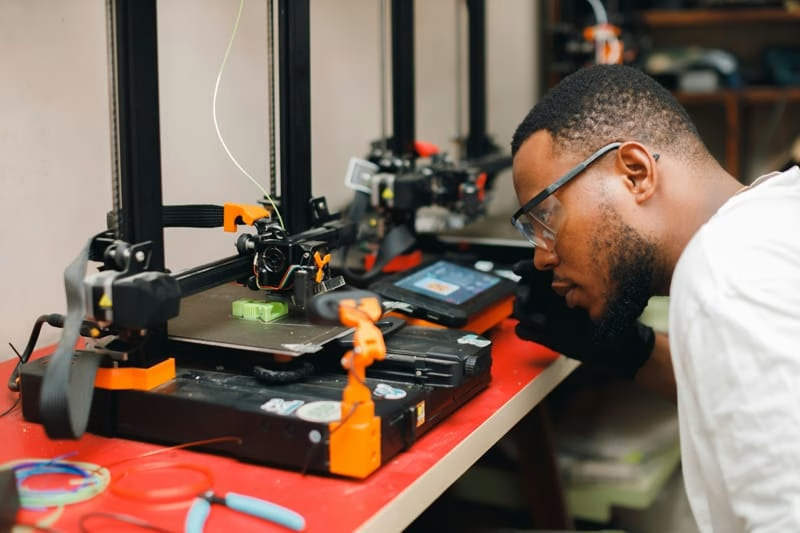
The evolution of 3D printing in textiles has been driven by significant advancements in materials and printing technologies. Thermoplastic polyurethane (TPU) has emerged as a preferred material due to its flexibility, durability, and wear resistance, making it suitable for apparel, sportswear, and medical textiles. Polylactic acid (PLA), a biodegradable and recyclable filament, is also widely used for its environmental benefits. Printing technologies, including Fused Deposition Modeling (FDM), Selective Laser Sintering (SLS), and PolyJet, have enhanced the precision and versatility of 3D-printed fabrics. FDM is cost-effective and widely accessible, while SLS and PolyJet offer superior detail and material diversity. By 2025, these technologies are expected to support the production of multifunctional fabrics with enhanced aesthetic and functional properties.

Production Process
The production of 3D-printed fabrics involves a streamlined process that integrates digital design with additive manufacturing. Designers utilize specialized software, such as Rhino or CLO3D, to create digital models of fabrics or garments. These models are translated into instructions for the 3D printer, which deposits layers of material—typically TPU or PLA—to construct the final product. Post-processing techniques, such as finishing or dyeing, may be applied to improve texture, durability, or appearance. This process enables the creation of hybrid fabrics that combine 3D-printed elements with traditional textiles, offering versatility and innovation. For instance, companies like Polymaker and Covestro have developed processes to print thin layers (2–5) of TPU-based fabrics, which are then integrated into conventional production lines for products like shoes and bags.
Innovations in Design
3D printing has unleashed a wave of innovation in textile design, enabling rapid prototyping and customization. Designers can create intricate patterns and complex structures, such as lattice designs, which enhance performance in sportswear and functionality in medical textiles. The technology also facilitates the integration of smart textiles, embedding electronic components and sensors directly into fabrics. This enables the development of interactive garments, such as temperature-regulating clothing or biometric-monitoring sportswear. Additionally, the emergence of 4D printing—textiles that change shape or function in response to external stimuli like temperature or light—promises to further revolutionize the industry by 2025.
Challenges and Limitations
Despite its transformative potential, 3D printing in textiles faces several challenges. The technology requires significant investment in specialized equipment and materials, which may be prohibitive for smaller manufacturers. Scaling production to meet large-scale demand remains a logistical and cost-related hurdle, as current methods are better suited for small-batch or bespoke production. Furthermore, ongoing research is needed to enhance the durability, comfort, and aesthetic appeal of 3D-printed fabrics to meet consumer expectations. However, advancements in materials and printing technologies are steadily addressing these limitations, paving the way for broader adoption.
Real-World Applications
3D-printed fabrics are making significant impacts across multiple sectors. In fashion, designers like Iris Van Herpen, Chiara Giusti, and Julia Koerner are redefining aesthetics with architectural and sustainable designs. Van Herpen’s collections feature intricate 3D-printed structures, while Koerner emphasizes biodegradable materials and localized production. In sportswear, 3D-printed textiles offer customized fit and performance-enhancing features, such as breathable lattice structures. Medical textiles benefit from 3D printing through advanced wound care solutions and rehabilitation aids. Companies like Polymaker and Covestro are pioneering waste-free 3D-printed fabrics, producing TPU-based textiles for shoes, bags, and hats with minimal environmental impact.
| Application | Description | Example |
|---|---|---|
| Fashion | Intricate, customizable designs for high-fashion garments | Iris Van Herpen’s collections |
| Sportswear | Performance-enhancing fabrics with breathable structures | Lattice-designed running shoes |
| Medical Textiles | Functional textiles for wound care and rehabilitation | 3D-printed orthotic supports |
| Accessories | Sustainable, on-demand production for bags, hats, and shoes | Polymaker’s TPU-based shoe uppers |
Types and Varieties
3D-printed fabrics vary widely based on materials and printing techniques. TPU is favored for its flexibility and durability, while PLA is valued for its eco-friendliness. Other polymers, such as nylon and polyester, are explored for specialized properties, including flame resistance and antimicrobial qualities. Printing techniques like FDM produce soft, flexible fabrics, while SLS and PolyJet create rigid, structured textiles. This diversity enables 3D-printed fabrics to serve a broad range of applications, from high-fashion garments to technical textiles, catering to both aesthetic and functional needs.
Market Dynamics and End-Users
The market for 3D-printed fabrics is expanding rapidly, driven by consumer demand for personalized and sustainable products. Fashion enthusiasts seek unique, customized designs, while industries like sportswear, medical textiles, and automotive require high-performance fabrics. The global market for 4D printing, which includes shape-changing textiles, is projected to grow at a compound annual growth rate (CAGR) of 42.1% from 2021 to 2027, with textiles contributing a significant share (Fashion and Textiles). By 2025, 3D-printed fabrics are expected to become a mainstream solution, supported by advancements in scalability and cost-efficiency.
Future Trends
As we look toward 2025, several trends are poised to shape the future of 3D-printed fabrics. The rise of 4D printing will introduce textiles that adapt to environmental conditions or user needs, such as shape-changing garments or temperature-regulating fabrics. For example, Mitsubishi’s Diaplex® SMPU membrane changes shape at low temperatures and reverts above 10°C, offering potential for adaptive clothing. The integration of artificial intelligence (AI) and Industry 5.0 principles will enhance production efficiency, sustainability, and human-centric design. Sustainability will remain a priority, with 3D printing reducing waste and enabling localized, on-demand manufacturing. Advancements in materials and printing technologies will further improve accessibility and scalability, positioning 3D-printed fabrics as a cornerstone of textile innovation.
Conclusion
The rise of 3D-printed fabrics marks a pivotal moment in the textile industry, blending innovation, sustainability, and customization to redefine textile design. From their origins in the 1980s to their projected advancements by 2025, these fabrics offer solutions to pressing industry challenges, including waste reduction and consumer demand for personalization. As technologies like 4D printing and AI-driven manufacturing continue to evolve, 3D-printed fabrics are set to transform fashion, sportswear, medical textiles, and beyond. For textile professionals, students, and enthusiasts, understanding this technology is essential to navigating a future defined by creativity, efficiency, and environmental responsibility.
Key Citations
- 3D Printing in Textile Industry – Textilesphere
- Revolutionising textile manufacturing: 3D and 4D printing – Fashion and Textiles
- 3D Printing for Textiles – AATCC
- Polymaker and Covestro debut waste-free 3D printed fabrics – 3D Printing Industry
- Exploration of 3D printing for sustainable fashion – Fashion and Textiles
- Top 10 Inspirational 3D-Printed Clothes for 2025 – Parametric Architecture