Knit structures are the arrangements of interlocking loops that make a knitted fabric, and they come in two families. Weft knit structures are built on four base structures, single jersey (plain), rib, interlock and purl, varied by three stitches (knit, tuck and float) into derivatives such as pique, ponte di Roma, French terry, fleece and jacquard. Warp knit structures are built from the laps of two or more guide bars: pillar, tricot, locknit, sharkskin, queenscord, satin and atlas on tricot machines; Milanese, built on atlas laps; and power net, lace and nets on raschel machines. The structure decides how a fabric stretches, whether it curls, which end it unravels from, and how much yarn a square metre takes.
Last verified: 17 October 2026. Structure descriptions come from university course material and a cotton industry body, named where they are used and listed at the end. The weights in the worked example are computed in the site’s knitted fabric GSM calculator.
Knit structures at a glance
Each row is one structure. A dash means the sources used here do not state it, so the table leaves it blank rather than guess. “Unravels from” is the end a cut fabric can be pulled apart from, course by course.
| Structure | How it is knitted | Looks like | Curls when cut | Unravels from | Stretch | Typical uses |
|---|---|---|---|---|---|---|
| Single jersey (plain) | Weft; one needle bed; knit stitch on every needle at every course | Columns of Vs on the face, rows of loop heads on the back | Yes | Either end | Width-way about twice length-way | T-shirts, underwear, swimwear, hosiery |
| 1×1 rib | Weft; two beds, rib-gaited; face and back wales alternate | The same on both sides until stretched | No | End knitted last only | The most width-way stretch of the four bases | Cuffs, waistbands, neck trims, sock tops |
| Interlock | Weft; two beds, interlock-gaited; two feeds make one course | Smooth plain face on both sides | No | End knitted last only | Less width-way than rib | Close-to-body garments, baby clothes, turtlenecks |
| Purl (links-links) | Weft; double-ended needles, or rib loop transfer on a V-bed | Loop heads on both sides | – | – | The most length-way stretch of the four bases | – |
| Single pique | Single jersey; four feeds; two all-knit, two alternating knit and tuck | Small cells (micro-mesh) on the face | – | – | – | Polo shirts, active wear |
| Ponte di Roma | Double jersey; two interlock feeds, then one jersey feed on each bed | Same both sides, slight horizontal rib | – | – | More stable than interlock | Structured garments |
| French terry and fleece | Single jersey face with a second yarn held in as floats on the back | Jersey face; loops on the back, napped for fleece | – | – | – | Sweatshirts, sweatpants, cold-weather wear |
| Locknit | Warp; two guide bars on a tricot machine, front bar on a two-needle underlap | – | Near the selvedge, until heat set | Not course by course | High elasticity | Lingerie and intimate wear |
| Sharkskin and queenscord | Warp; two bars, a longer back-bar underlap (sharkskin) or a front-bar pillar (queenscord) | Queenscord shows a cord along the wales | – | Not course by course | Rigid | Print bases (sharkskin) |
| Raschel power net and lace | Warp; raschel machine; stitch-forming bars plus an elastane inlay for power net | Open mesh | – | Not course by course | Elastic (power net) | Bra wings, inserts in leggings and swimwear, lace |
| Milanese | Warp; atlas laps | Fine rib on the face, diagonal pattern on the back | – | – | More elastic than tricot | – |
Sources for each cell: the K.S. Rangasamy College of Technology knitting course notes (KSRCT), the IIT Delhi knitting course on NPTEL (module 2), Cotton Incorporated’s guide to single and double knits, and Karl Mayer on power net. Each is quoted in the section below its row. For the named knitted fabrics built on these structures, from cable and pointelle to velour and sliver knit, see the site’s list of knitted fabrics and their types.
Courses, wales and the technical face
A course is a row of loops across the fabric and a wale is a column of loops along it. The side the new loops are pulled towards is the technical face; the other is the technical back. On a weft knit made of simple loops, the technical back shows the curved needle and sinker loops, and the technical face shows the short, nearly parallel loop legs (NPTEL, module 1). A fabric made on one set of needles is single jersey; one made on two sets is double jersey (KSRCT). How the needles form each loop, and how weft and warp knitting differ in the way the yarn travels, is set out on the page on weft vs warp knitting; the terms themselves are fixed in ISO 4921, the knitting vocabulary.
The three stitches: knit, tuck and float
Every weft knit structure is made from three stitches. A knit stitch is made when a needle takes a new loop and knocks over the old one. A tuck stitch is made when a needle holding its old loop also takes the new yarn but does not knock the old loop over; the new loop is tucked in behind it and shows on the back as an inverted U. A float, or miss, stitch is made when a needle holding its old loop does not take the new yarn at all, so the yarn floats past it on the back (KSRCT). Cotton Incorporated calls knit, tuck and float the three core stitches from which single knits are built (Cotton Incorporated).
The two held-loop stitches change the fabric in opposite ways. Floats draw the wales together, so a fabric with floats is narrower, less elastic across its width and more stable; tucks make it wider and thicker (KSRCT; NPTEL, module 2). Tuck stitch fabrics show a faint diagonal line on the surface, float stitch fabrics faint horizontal lines. There are limits: under normal tension a needle can hold about four successive tucks or four successive floats, and tucks or floats across more than about six adjacent needles start to snag (KSRCT).
Weft knit structures
Single jersey, rib, interlock and purl are the base structures from which all weft knitted fabrics are derived (KSRCT). Knitted from the same yarn to the same loop length, IIT Delhi’s course ranks interlock as the thickest and heaviest, rib as the narrowest with the most width-way stretch, and purl as the stretchiest lengthways; the full ranking is on the weft vs warp knitting page.
Single jersey (plain knit)

Single jersey is the simplest weft knit: one set of needles knits every loop towards the same side. It is the stocking stitch of hand knitting, also called stockinette (KSRCT). The face is smooth, with the loop legs forming columns of Vs; the back shows the loop heads as columns of interlocking semi-circles. It is the simplest and cheapest weft structure to knit and has the most covering power, and it normally has a potential recovery of 40% in width after stretching (KSRCT). Its width-way stretch is about twice its length-way stretch, and when it is cut across, it curls and runs (Cotton Incorporated).
Two faults belong to this structure. A plain knit can be unravelled from the course knitted last or from the course knitted first, and a broken yarn lets the loops come apart down and up the wale, which is a ladder; it is worst in fine hosiery, where smooth filament loops are held under tension (KSRCT). Its edges curl because the yarn stores bending energy as it is formed into loops, so a higher-twist yarn curls more (NPTEL, module 2). Plain knits can also show spirality, wale lines that run on a slant; on a multi-feeder circular machine it can be adjusted to cancel the fabric’s skew (NPTEL, module 4), and rib does not show it at all (NPTEL, module 2).
Rib (1×1, 2×2 and wider)
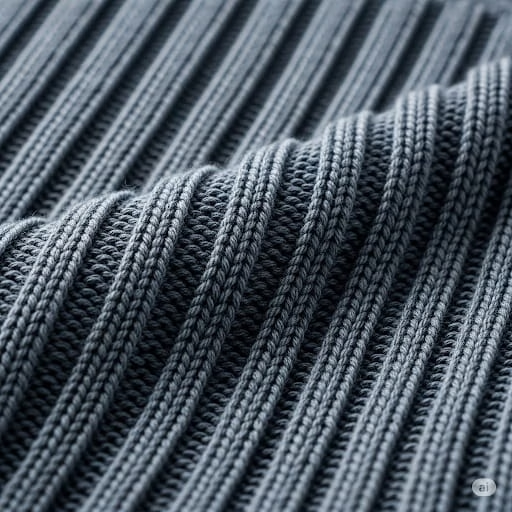
Rib needs two sets of needles set between each other (rib gaiting), so that wales of face loops and wales of back loops alternate across the fabric. In 1×1 rib they alternate one by one; in 2×2 rib, two by two (Cotton Incorporated). The face wales move in front of the back wales, so a relaxed 1×1 rib looks like the face of plain fabric on both sides until it is stretched (KSRCT). Stretched across its width it opens like an accordion, which is why rib is used for neck, wrist and waist trims (Cotton Incorporated). IIT Delhi’s course puts the high width-way stretch down to the torque at each sinker loop pulling neighbouring wales together, and notes that 3×3 rib is thicker than 2×2 because each wider strip curls more (NPTEL, module 2).
Compared with an equivalent plain fabric, relaxed 1×1 rib is theoretically twice as thick and half as wide, with twice the width-way recoverable stretch; in practice it relaxes by about 30% from its knitting width. It is balanced, so it lies flat when cut. It can be unravelled only from the end knitted last, which together with its elasticity suits it to sock tops, cuffs and garment borders. It is heavier and dearer to knit than plain, and a rib machine needs a finer yarn than a plain machine of the same gauge (KSRCT).
Interlock and eight-lock
Interlock is two 1×1 ribs knitted into each other. The cylinder and dial needles stand directly opposite each other (interlock gaiting), and to stop them clashing only half of them knit at each feed: one feed knits odd cylinder and even dial needles, the next feed the others. Two feeds therefore make one visible course, where 1×1 rib needs one (Cotton Incorporated). The result shows the plain face on both sides, and unlike rib it cannot be stretched open to show the back wales, because the wales on each side are locked exactly opposite each other (KSRCT).
Interlock is balanced, smooth and stable and lies flat without curling. Like rib it will not unravel from the end knitted first, but it is thicker, heavier and narrower than rib of the same gauge, and it needs a finer, better and dearer yarn. It relaxes by 30 to 40% or more from its knitted width: the course notes give a 30-inch machine whose tube opens to 94 inches and finishes 60 to 66 inches wide. It knits at half the productivity of rib, its courses per inch are often double the machine gauge, and it was first knitted almost wholly in cotton on 20-gauge machines for underwear, typically at 5 ounces per square yard (about 170 g/m²) from 1/40s cotton. Eight-lock is a 2×2 version of interlock, softer and fuller, with more width-way relaxation and more elasticity (KSRCT). IIT Delhi’s course explains the fine yarn: the rib knitted at one feed must leave room for the rib from the next feed to squeeze into the same plane (NPTEL, module 4).
Purl (links-links)
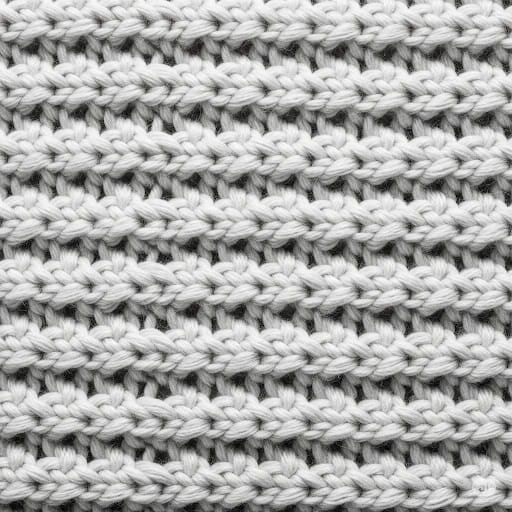
Purl is the only base structure in which a single wale holds both face and reverse loops. That needs double-ended latch needles, which pass from one bed to the other and knit with whichever hook faces outwards, or a V-bed flat machine with rib loop transfer. The loop heads stand out on both sides, which is why purl fabrics and machines are called links-links, from the German for left; the name was once spelt pearl, after the look of the surface (KSRCT). Knitted from the same yarn to the same loop length as the other bases, purl has the most elastic stretch along the wale (NPTEL, module 2).
Pique: single, double and six-feed
Pique is a knitted construction that contains both knit and tuck stitches; the simple form, single pique or single cross-tuck, alternates knit and tuck in alternate feeds and knits every needle at the others (Cotton Incorporated glossary). In single pique, the first and third of four feeds knit plain jersey, while the second and fourth alternate knit and tuck, offset by one needle, so that one repeat takes four feeds. The tucks open small cells in the fabric, a micro-mesh that suits warm weather, polo shirts and active wear, and single pique is most of the pique sold because it is the fastest to knit. Double pique holds loops over two feeds, which makes it thicker, and has no all-jersey feed, which makes it the slowest to knit; its technical back is usually the selling face; six-feed pique stacks two tuck courses to make a more defined cell (Cotton Incorporated).
Ponte di Roma and other double knits
Double knits are two fabrics joined in the knitting, so they use more yarn, are heavier, are more stable and curl less than single knits; rib, interlock, ponte di Roma and double-knit jacquards are the common ones. Ponte di Roma is an interlock variation: two feeds knit interlock, the third knits jersey on the cylinder needles only, the fourth jersey on the dial needles only, so four feeds make two visible courses. It looks the same on both sides with a slight horizontal rib, and it is thicker and more stable than interlock (Cotton Incorporated). Across single and double knits, KSRCT’s comparison holds: double knits look alike on both sides, do not curl, unravel only from the end knitted last and knit more slowly.
French terry, fleece and jacquard
These use the float. French terry is a two-end fabric: one yarn knits plain jersey for the face, the other is held in on the back as floats, in Cotton Incorporated’s example over three stitches. Strictly it is an un-napped fleece, not a terry, because floats rather than a terry sinker make the loops. Napping those back loops turns it into two-end fleece, where the back yarn is usually coarser and lower in twist so that it raises well. Three-end fleece uses three yarns, a face yarn, a tie-in yarn and a pile yarn, and is the most stable and fullest fleece. In a single-knit jacquard the colour not wanted on the face floats on the back, so the fabric has little natural stretch (Cotton Incorporated). The site’s fleece and terry loop length calculator works out the yarn split for these fabrics.
Warp knit structures
In warp knitting a guide bar wraps a whole sheet of yarns round the needles at once. Each guide makes an overlap (round the front of a needle) and an underlap (across the back, to the next needle it laps), and the structure is the sequence of those laps, written as a chain notation such as 1-0/2-3, where the dash is an overlap and the slash an underlap (KSRCT). One guide bar can make a fabric, but it is weak, unstable and distorted, so commercial warp knits use at least two; the front bar’s yarns dominate both faces (KSRCT). Warp knits cannot be unravelled course by course, which makes them resistant to ladders, as set out on the weft vs warp knitting page.
The laps: pillar, tricot, cord, satin, velvet and atlas
- Pillar (chain) stitch: the guide overlaps the same needle every course, making separate chains of loops that a second bar must tie together. Front bars use it for vertical stripes or to hold other bars’ inlays in place.
- Tricot lap (1×1): the guide underlaps one needle and overlaps the next, back and forth over two courses, so one thread crosses between neighbouring wales. A 2×1 lap is a cord lap, 3×1 a satin lap and 4×1 a velvet lap; each extra needle of underlap adds one more crossing thread and makes the fabric stronger, more opaque and heavier.
- Atlas lap: the guide laps in the same direction for at least two courses, then back the same way, which gives faint transverse shadow stripes and, with coloured warp threads, zigzags. Atlas is the base of all Milanese fabrics.
- Laying-in and miss-lapping: a bar that only underlaps lays a yarn in without knitting it, and one that neither overlaps nor underlaps misses; both need another bar’s overlaps to hold them.
All four are described in the KSRCT course notes. IIT Delhi’s course adds how they set stretch: a longer underlap on the front bar makes the fabric more extensible across its width, and a pillar stitch stiffens it along its length (NPTEL, module 7).
Locknit
Locknit is a two-bar tricot structure and the most popular of all warp knits. Its front bar makes the longer underlap, shogging two needle spaces, which gives extensibility, drape and a soft handle. It is mostly knitted from nylon filament, sometimes with spandex at the back, and its high elasticity suits it to intimate wear. It tends to curl near the selvedge, which heat setting removes because the yarns are thermoplastic (KSRCT). Tricot fabrics in general are soft, drape well and are light, under 4 ounces per square yard, about 136 g/m² (KSRCT).
Sharkskin, queenscord and velour
Sharkskin moves the long underlap to the back bar, up to three needle spaces, which makes a rigid, heavier fabric used as a print base. Queenscord is more rigid still: its front bar makes the shortest possible underlap, a pillar stitch, which puts a cord effect along the wales. In warp-knit velour the front bar laps six to eight needle spaces and forms a pile on the technical back, which can be brushed or cropped to look like velvet (KSRCT). The weight of any of these follows from the yarn each bar feeds per rack, which the site’s warp knitting runner length and GSM calculator works out.
Raschel structures: power net, lace and nets
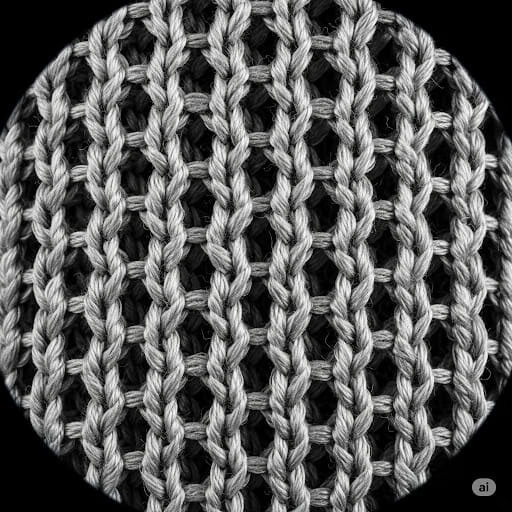
Tricot and raschel are the two major classes of warp knitting machine. Most tricot machines use two guide bars; raschel machines can carry up to 78. On a raschel the fabric is taken up at about 170° to the incoming yarn sheet, against 90° on a tricot, and the high take-up tension this allows is what makes open structures, elastomeric inlays (power net) and elastic pleated fabrics possible (KSRCT). Karl Mayer’s RE 4-1 raschel, for example, knits power net with three stitch-forming guide bars and one inlay bar. Power net is open-meshed and used in the wings of bras and in inserts in sports leggings, shirts and swimwear; the same machine also makes raschel locknit, sleek net and satin net, threaded with filament in the front two bars and elastane in the back ones (Karl Mayer). Raschel machines also make lace and nets, and their fabrics run from lace to carpets (KSRCT).
Milanese
Milanese is a warp knit, built on atlas laps. It looks much like tricot but can be told by a fine rib on the face and a diagonal pattern on the back, and it is smoother, more elastic, more regular and more resistant to friction than tricot (KSRCT).
Properties of knitted fabrics, and which structure sets each
- Stretch. A weft knit has a lower modulus and more elastic stretch along the course than along the wale; in a warp knit the reverse can be expected (NPTEL, module 1). Among the bases, rib stretches most across, purl most along. Floats cut stretch; elastane plated or laid in adds it (see the plating and elastane ratio calculator).
- Curl. Single jersey and locknit curl at a cut edge; rib, interlock and other balanced double knits lie flat.
- Unravelling and ladders. Single jersey unravels from either end and ladders when a yarn breaks; rib and interlock unravel only from the end knitted last; warp knits cannot be unravelled course by course.
- Thickness and weight. From the same yarn and loop length, interlock is thickest and heaviest, then rib and purl, then single jersey (NPTEL, module 2). Tucks add thickness; long warp underlaps add weight.
- Warmth and fit. Rib is elastic, form-fitting and warmer than plain (KSRCT). Knitted fabrics as a whole are compared with woven ones on the page on knitted fabrics for elasticity, thickness and warmth.
The withdrawn (2017) ASTM D3887 set tolerances for knitted fabrics, including mass per unit area; ASTM withdrew it without a replacement.
Worked example: the same yarn as single jersey and as 1×1 rib
Structure alone changes how much fabric a kilogram of yarn makes. IIT Delhi’s course designs a single jersey from 30s Ne cotton at a loop length of 3.1 mm, with 35.4 wales and 44.7 courses per inch, and arrives at 150 g/m² (NPTEL, module 4, question 13). The site’s knitted fabric GSM calculator multiplies loops per square metre by loop length and by the yarn’s linear density; with those figures entered it gives 149.66 g/m², from 2,452,694 loops and 7,603 m of yarn in each square metre.
Now knit the same yarn at the same loop length as 1×1 rib. On the course notes’ theoretical figure, relaxed rib is half the width of the equivalent plain fabric (KSRCT), so the same number of loops sits in half the width: counting the wales on both faces, 70.8 wales per inch. Keeping the courses at 44.7 per inch, the calculator gives 299.32 g/m², with 15,207 m of yarn in each square metre.
| 30s Ne cotton, 3.1 mm loop length | Single jersey | 1×1 rib (theoretical) |
|---|---|---|
| Wales per inch (both faces counted) | 35.4 | 70.8 |
| Courses per inch | 44.7 | 44.7 (assumed unchanged) |
| Loops per square metre | 2,452,694 | 4,905,388 |
| Yarn per square metre | 7,603 m | 15,207 m |
| Fabric weight | 149.66 g/m² | 299.32 g/m² |
The rib column is an upper estimate of the width effect, not a forecast: it uses the theoretical half width and assumes the course count is unchanged, while real 1×1 rib relaxes by about 30% from its knitting width and is knitted from a finer yarn than plain at the same gauge (KSRCT). What it shows is the order of the effect. From the same yarn, a rib trim can weigh considerably more per square metre than the jersey body it is sewn to. For a real fabric, count the courses and wales on a relaxed sample (across both faces for rib and interlock) and enter those; the stitch length calculator and the page on calculating GSM for knit fabrics cover the measurement.
How to identify a knit structure from a swatch
- Compare the two sides. Vs on one side and loop heads on the other is single jersey or a single-jersey derivative. Vs on both sides is rib, interlock or another double knit. Loop heads on both sides is purl.
- Stretch it across. If back wales open up between the Vs, it is rib; if the face stays closed, it is interlock (KSRCT).
- Try to unravel it. Loops that pull out from both ends mean single jersey. In rib, some wales withdraw towards one side and some towards the other; in plain they all withdraw the same way (KSRCT). A fabric that will not unravel course by course at all is a warp knit.
- Look for held loops on the back. A yarn lying free across the back of one or more wales is a float. A tuck is the loop whose head springs out as a hump as soon as the loop above it is pulled out (KSRCT). Regular cells on a jersey face mean pique.
- Check a warp knit’s face and back. Underlaps lying across the back mark a tricot-type structure; a fine rib face with a diagonal back is Milanese; an open mesh is raschel net.
Knit structures and sustainability: what the structure decides
The structure does not decide the fibre, the dyeing or the finishing; what it does decide is the yarn in each square metre and the waste in cutting. The worked example shows the first: on the theoretical half width, and if the course count is unchanged, the same yarn as 1×1 rib takes about twice the yarn of single jersey for each square metre; real rib narrows less than that, so it takes less than twice, but still more than jersey, so choosing the lightest structure that gives the stretch, stability and opacity a product needs is a yarn saving before any fibre choice is made. The second comes from shaping on the machine. A fabric knitted as a tube or a flat length is cut into panels, and the offcuts are waste; garments shaped as they are knitted avoid much of that cutting, and Shima Seiki’s WHOLEGARMENT machines knit a garment “in three dimensions without seams” (Shima Seiki). Elastane, which many power nets, locknits and plated jerseys carry for their stretch, mixes a second polymer into the fabric; the spandex fabric page covers the fibre.
The earlier version of this page gave percentage savings in water, energy and pesticides for each structure, and two unnamed company case studies. None of those figures could be traced to a source, and they are withdrawn.
Questions
What is a knit structure?
It is the pattern in which the loops of a knitted fabric are formed and joined: which needles knit, tuck or miss at each feed in weft knitting, or how each guide bar laps in warp knitting. The structure, more than the fibre, sets how the fabric stretches, curls and unravels.
What are the types of knit structures?
Weft knit structures have four bases, single jersey, rib, interlock and purl, and their derivatives, such as pique, ponte di Roma, French terry, fleece and jacquard. Warp knit structures include pillar, tricot, locknit, sharkskin, queenscord, satin, velour and atlas on tricot machines; Milanese, built on atlas laps; and power net, lace and nets on raschel machines.
What is a weft knitted fabric structure?
One in which each course is formed by a yarn fed across the needles, as in hand knitting. All weft knits derive from single jersey, rib, interlock and purl, changed by tuck and float stitches. They stretch most across the width and, as single knits, can unravel from either end.
What is the structure of single jersey?
Every needle in one bed knits a plain loop at every course, all drawn to the same side. The face shows columns of Vs and the back rows of loop heads. It is the lightest and cheapest base, curls at cut edges and can ladder.
What is the difference between single knit and double knit structures?
A single knit is made on one set of needles and looks different on its two sides; a double knit, such as rib, interlock or ponte di Roma, is made on two sets and looks alike on both. Double knits are heavier, more stable, do not curl and unravel only from the end knitted last, but knit more slowly.
What are the properties of knitted fabrics?
Stretch and recovery, mostly across the width in weft knits; softness and drape; and, depending on the structure, a tendency to curl, ladder or unravel. Each structure shifts these: rib adds width-way stretch, interlock adds stability and weight, and warp knits resist ladders.
Sources
- K.S. Rangasamy College of Technology, Knitting course notes (PDF): weft knit structures, stitches, warp lapping and warp knit structures. The wording follows Spencer’s Knitting Technology closely. Read 17 October 2026.
- IIT Delhi, Knitting Technology course on NPTEL, FAQs for module 1, module 2, module 4 and module 7. Read 17 October 2026.
- Cotton Incorporated, Single and double knits (CottonWorks learning hub) and the glossary entry for pique. Read 17 October 2026.
- Karl Mayer, New power net production machine (RE 4-1). Shima Seiki, WHOLEGARMENT. Both read 17 October 2026.
- Terms: ISO 4921, Knitting, basic concepts, vocabulary.
More on the subject on this site: knitting and knitted fabrics, an introduction that sets knitting beside weaving; knitted fabrics and their types, the list of named fabrics; and weft vs warp knitting, on loop formation, needles and machines.
How this page is kept
Last verified: 17 October 2026. The structure descriptions come from the university course material and the Cotton Incorporated guide listed above, each named in the sentence it supports; machine details are Karl Mayer’s and Shima Seiki’s own. Where those sources are silent, the table at the top leaves the cell blank. The worked example uses the site’s knitted fabric GSM calculator as it stood on this date, and each prefilled link was opened to check that it shows the figures quoted. The pictures of fabric are illustrations, not photographs of tested samples.
Change log. 17 October 2026: rewritten in full around the structures themselves, with the three stitches, the warp laps, pique, ponte di Roma, fleece, locknit, sharkskin and queenscord added. Corrected from the earlier version: Milanese is a warp knit, not a weft knit, and its picture, which showed a plain weft knit, is removed, as is an interlock picture that showed a rib; rib’s high stretch is across the width, not in both directions; its stretch percentages and weight ranges for each structure had no source and are withdrawn; its sustainability percentages, bottle counts and two unnamed company case studies could not be traced and are withdrawn; and its citation of a page on this site about knit structures pointed to a page on fibre identification.
Found an error? Please tell us through the contact page, naming the section and the source that disagrees.