

Textile knit structures, including weft (single jersey, rib, purl) and warp (tricot, raschel) knits, offer stretch and comfort for apparel and technical textiles. Sustainable fibres like organic cotton and recycled polyester reduce environmental impact. This article explores their types, properties, production, and sustainability, highlighting trends like 3D knitting and smart textiles.
Introduction to Textile Knit Structures
Textile knit structures form the backbone of knitted fabrics, widely used in apparel, home textiles, and technical applications due to their flexibility, stretch, and comfort. Unlike woven fabrics, which interlace yarns at right angles, knitted fabrics are created by interlocking loops of yarn, resulting in unique properties such as elasticity, breathability, and form-fitting capabilities. Knit structures, including weft knits (e.g., single jersey, rib, purl) and warp knits (e.g., tricot, raschel), cater to diverse needs, from casual T-shirts to medical textiles. With the textile industry’s shift toward sustainability, knit structures are evolving to incorporate eco-friendly fibres like organic cotton, recycled polyester, and kapok, alongside energy-efficient production methods. This comprehensive article explores the types, properties, production processes, applications, and sustainability aspects of textile knit structures, providing valuable insights for students, professionals, and textile enthusiasts.
Understanding Textile Knit Structures
Knit structures are formed by interlocking loops of yarn, either in a weft (horizontal) or warp (vertical) direction, using knitting machines such as circular or flatbed knitters. The loop structure allows knits to stretch and recover, making them ideal for garments requiring comfort and flexibility, such as sportswear, underwear, and sweaters. Knit fabrics are categorized into weft knits, where loops are formed row by row, and warp knits, where loops are formed column by column, each offering distinct characteristics suited to specific applications.
The production of knitted fabrics involves machines like circular knitting machines for seamless tubes or flatbed machines for panels, with modern systems integrating automation and digital controls for precision. Sustainability is a key focus, with advancements in biodegradable fibres, low-impact dyeing, and closed-loop production reducing environmental impact. By understanding knit structures, manufacturers can optimize fabric performance while aligning with eco-friendly practices, meeting consumer demand for sustainable textiles.
Types of Textile Knit Structures
Knit structures are broadly classified into weft knits and warp knits, each with subtypes based on loop arrangement, needle action, and fabric properties. Below is a detailed overview of the primary knit structures.
Weft Knit Structures
Weft knits are created by forming loops horizontally across the fabric, using a single yarn fed to multiple needles. They are highly stretchable and versatile, produced on circular or flatbed knitting machines.
Single Jersey

Description:
- Formed by knitting loops on one side (face) with purl loops on the reverse, using a single needle bed.
- Basic weft knit structure, also called plain knit or single knit.
Properties:
- Stretch: High elasticity (20–50% stretch) in width, moderate in length.
- Appearance: Smooth face, purl loops on the back, prone to curling at edges.
- Thickness: Thin and lightweight (100–200 g/m²).
- Dimensional Stability: Moderate, may distort under tension.
- Durability: Susceptible to snagging and laddering.
Applications:
- T-shirts, underwear, sportswear, and lightweight apparel.
- Sustainable blends with organic cotton or recycled polyester for eco-friendly fashion.
Sustainability Note: Single jersey knitted with organic cotton reduces pesticide use by 100%, while recycled polyester blends save 7,000 plastic bottles per ton.
Rib Knit
Description:
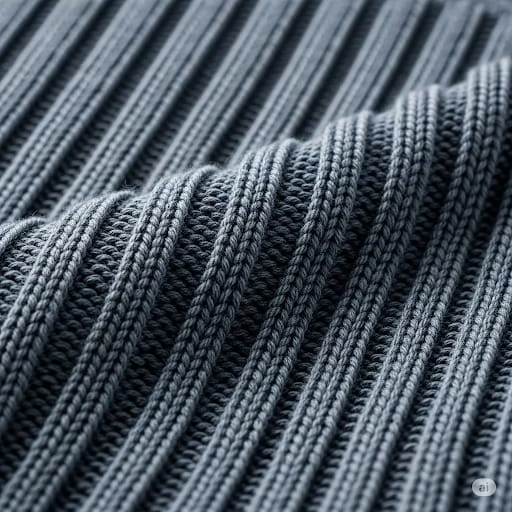
- Formed by alternating knit and purl stitches in the same row, using two needle beds (e.g., 1×1 or 2×2 rib).
- Creates a reversible fabric with vertical ridges on both sides.
Properties:
- Stretch: High elasticity (50–100%) in both directions due to rib structure.
- Appearance: Symmetrical ridges, no curling at edges.
- Thickness: Medium (150–300 g/m²), denser than single jersey.
- Dimensional Stability: Excellent, recovers well after stretching.
- Durability: More resistant to laddering than single jersey.
Applications:
- Collars, cuffs, waistbands, sweaters, and form-fitting garments.
- Used with wool or alpaca for sustainable winter wear.
Sustainability Note: Rib knits with biodegradable fibres like wool decompose in 6–12 months, unlike synthetics (500 years).
Purl Knit
Description:
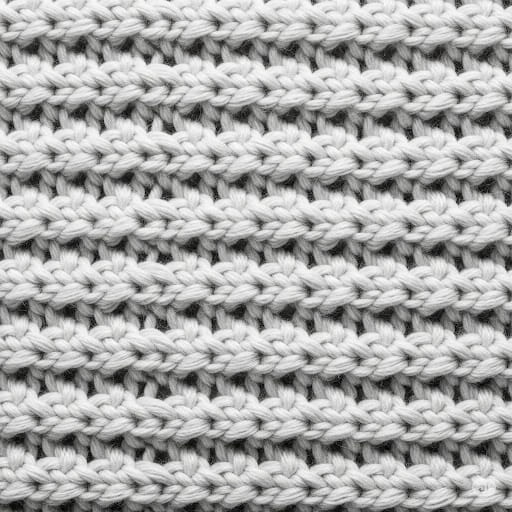
- Formed by alternating knit and purl rows, creating a fabric with purl loops on both sides.
- Produced on flatbed machines with double-ended needles.
Properties:
- Stretch: High elasticity (30–60%) in both directions.
- Appearance: Textured, reversible surface, no curling.
- Thickness: Medium to heavy (200–400 g/m²).
- Dimensional Stability: Good, with balanced stretch and recovery.
- Durability: Moderate, prone to snagging in loose structures.
Applications:
- Sweaters, scarves, and baby clothing for texture and comfort.
- Eco-friendly with kapok blends for hypoallergenic bedding.
Sustainability Note: Purl knits with kapok reduce environmental impact by 100% compared to cotton due to chemical-free cultivation.
Interlock Knit
Description:
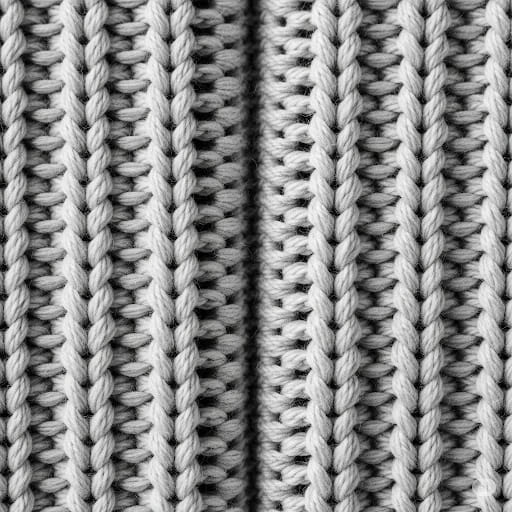
- A double-knit structure with two rib fabrics interlocked, using two needle beds.
- Smooth on both sides, resembling two single jerseys combined.
Properties:
- Stretch: Moderate (20–40%), less elastic than rib or single jersey.
- Appearance: Smooth, reversible, no curling at edges.
- Thickness: Medium to heavy (200–350 g/m²).
- Dimensional Stability: Excellent, resists distortion.
- Durability: High, resistant to laddering and snagging.
Applications:
- Dress shirts, sportswear, and upholstery for durability and smoothness.
- Sustainable with hemp or recycled polyester for eco-friendly apparel.
Sustainability Note: Interlock knits with hemp require 50% less water than cotton, supporting sustainable production.
Warp Knit Structures
Warp knits are created by forming loops vertically along the fabric, with multiple yarns fed to individual needles. They are less stretchy but more stable than weft knits, produced on warp knitting machines like tricot or raschel.
Tricot
Description:
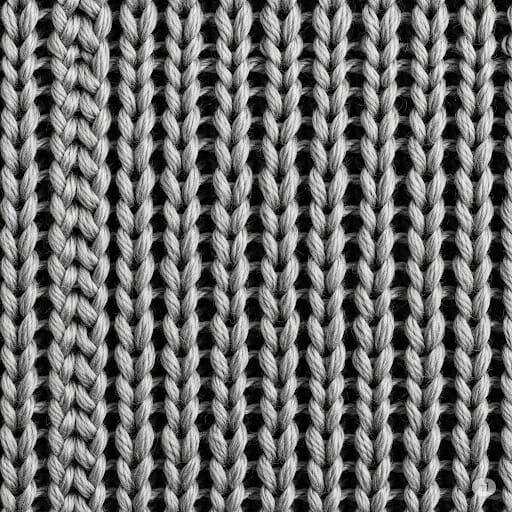
- Formed by interlocking loops in a zigzag pattern, using a single needle bar with fine gauges (28–40 needles/inch).
- Smooth, lightweight structure.
Properties:
- Stretch: Low to moderate (10–30%) in width, minimal in length.
- Appearance: Smooth, slightly shiny face, fine texture.
- Thickness: Thin (80–200 g/m²).
- Dimensional Stability: Excellent, resists stretching and laddering.
- Durability: High, suitable for high-speed processing.
Applications:
- Lingerie, swimwear, and linings for smoothness and stability.
- Technical textiles like medical bandages with biodegradable fibres.
Sustainability Note: Tricot with recycled polyester reduces landfill waste by 90% compared to virgin synthetics.
Raschel
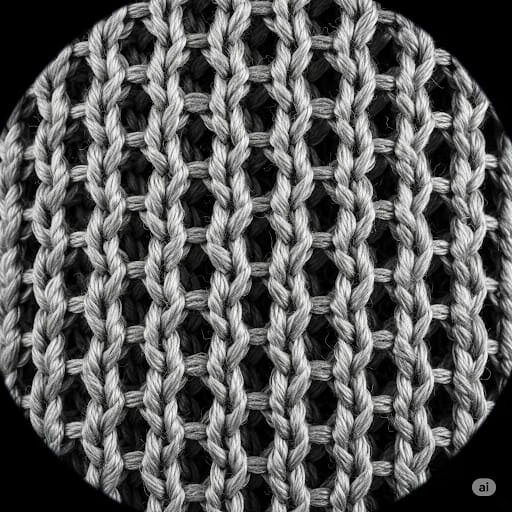
Description:
- Formed with heavier yarns and open structures, using multiple needle bars and latch needles.
- Includes complex patterns like lace and nets.
Properties:
- Stretch: Variable (10–50%), depending on structure (e.g., open nets are stretchier).
- Appearance: Open, textured, or lacy, with decorative patterns.
- Thickness: Medium to heavy (150–500 g/m²).
- Dimensional Stability: Good, varies with pattern complexity.
- Durability: Moderate, depends on yarn and structure.
Applications:
- Lace, curtains, nets, and technical textiles like geotextiles.
- Sustainable with organic silk for eco-friendly lace production.
Sustainability Note: Raschel knits with organic silk use 15% less water than conventional silk processing.
Milanese
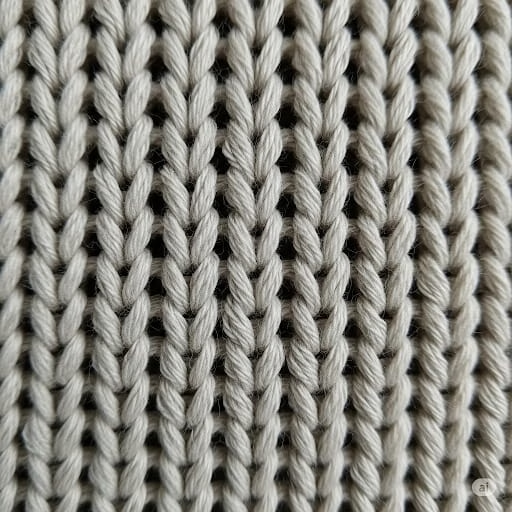
Description:
- Formed by overlapping loops across multiple needle bars, creating a fine, elastic fabric.
- Produced on specialized Milanese machines.
Properties:
- Stretch: High (30–60%) in both directions.
- Appearance: Smooth, dense, and lustrous.
- Thickness: Thin to medium (100–250 g/m²).
- Dimensional Stability: Good, with balanced stretch.
- Durability: High, resistant to runs and snags.
Applications:
- Luxury apparel, swimwear, and sportswear for elasticity and smoothness.
- Eco-friendly with bamboo or Tencel blends.
Sustainability Note: Milanese knits with bamboo reduce water use by 20% compared to cotton.
Production Processes for Knit Structures
Knit structures are produced using specialized knitting machines, with processes tailored to weft or warp knitting and sustainability considerations.
Weft Knitting Process
Process:
- Yarn Feeding: Single or multiple yarns are fed to needles on circular or flatbed machines.
- Loop Formation: Needles interlock loops horizontally, forming rows (courses).
- Fabric Take-Up: Fabric is rolled or collected, with tension control to prevent distortion.
- Machines: Circular machines (e.g., Mayer & Cie) for seamless tubes; flatbed machines (e.g., Shima Seiki) for panels.
Sustainability Note: Energy-efficient circular machines with variable frequency drives reduce power consumption by 15%, while organic cotton yarns lower environmental impact by 100%.
Warp Knitting Process
Process:
- Yarn Feeding: Multiple yarns are fed vertically to individual needles via warp beams.
- Loop Formation: Needles interlock loops in columns (wales), creating stable structures.
- Guide Bars: Control yarn movement for patterns (e.g., lace in raschel).
- Machines: Tricot machines for fine fabrics; raschel machines for open structures.
Sustainability Note: Automated warp knitting machines reduce waste by 10%, and recycled polyester yarns save 7,000 plastic bottles per ton.
Finishing Processes
- Dyeing: Low-impact dyes and waterless dyeing reduce water use by 30%.
- Washing: Enzymatic washing for natural fibres cuts chemical use by 20%.
- Heat Setting: Stabilizes synthetic knits, with energy-efficient systems reducing power consumption.
- Compacting: Improves dimensional stability, minimizing shrinkage.
Sustainability Note: Closed-loop dyeing systems recycle 90% of water, aligning with GOTS and Bluesign® standards.
Properties of Knit Structures
Knit structures share common properties that distinguish them from woven fabrics:
- Elasticity: 10–100% stretch, depending on structure (rib > single jersey > tricot).
- Breathability: Open loop structure allows air circulation, ideal for sportswear.
- Comfort: Soft, form-fitting fabrics conform to the body, enhancing wearability.
- Dimensional Stability: Varies, with warp knits (e.g., tricot) offering better stability than weft knits (e.g., single jersey).
- Biodegradability: Knits with natural fibres (wool, cotton) decompose in 6–12 months, unlike synthetics.
Applications of Knit Structures
Knit structures are versatile, supporting diverse textile applications:
- Apparel: Single jersey for T-shirts, rib for cuffs, purl for sweaters, and Milanese for sportswear, using organic cotton or recycled polyester for sustainability.
- Home Textiles: Interlock for bedding, raschel for curtains, and purl for blankets, with wool or kapok for eco-friendly options.
- Technical Textiles: Tricot for medical bandages, raschel for geotextiles, and interlock for filtration fabrics, using biodegradable fibres.
- Smart Textiles: Knits with conductive yarns (e.g., silver-coated fibres) for wearable technology in healthcare and fitness.
Sustainability in Knit Structures
Knit structures contribute to sustainable textile production through:
- Eco-Friendly Fibres: Organic cotton, wool, kapok, and recycled polyester reduce pesticide use and landfill waste (e.g., 7,000 bottles saved per ton of recycled polyester).
- Energy Efficiency: Automated knitting machines with variable frequency drives cut power consumption by 15–20%.
- Waste Reduction: Seamless knitting and precise loop control minimize yarn waste by 10%.
- Circular Economy: Biodegradable knits (wool, kapok) and recycled fibre blends support closed-loop production.
- Low-Impact Finishing: Enzymatic washing and waterless dyeing reduce water and chemical use by 20–30%, meeting GOTS and Bluesign® standards.
Challenges and Solutions
- Dimensional Instability: Weft knits (e.g., single jersey) may distort. Solution: Use interlock or warp knits for stability, or apply compacting.
- Energy Consumption: Knitting machines consume significant power. Solution: Adopt energy-efficient drives and solar-powered systems, reducing energy use by 20%.
- Yarn Waste: Complex patterns increase waste. Solution: Use seamless knitting and digital design software to optimize yarn usage.
- Sustainability Costs: Eco-friendly fibres are expensive. Solution: Blend with recycled fibres and leverage government incentives for green manufacturing.
Case Studies
Case Study 1: Organic Cotton Single Jersey
A European brand used organic cotton in single jersey knits for T-shirts, reducing pesticide use by 100% and water consumption by 20% through low-impact dyeing. Certified by GOTS, the line saw a 15% sales increase in eco-conscious markets.
Case Study 2: Recycled Polyester Tricot in Sportswear
A Chinese manufacturer adopted recycled polyester tricot for swimwear, saving 8,000 plastic bottles per ton of yarn. Energy-efficient warp knitting machines reduced power use by 15%, aligning with Bluesign® standards and boosting market share by 10%.
Future Trends in Knit Structures
The future of knit structures is driven by innovation and sustainability:
- 3D Knitting: Seamless, waste-free knitting reduces material use by 20%, as seen in Shima Seiki’s WholeGarment technology.
- Smart Textiles: Integration of conductive fibres for health-monitoring fabrics, expanding applications in medical textiles.
- Bio-Based Fibres: Use of kapok, hemp, and seaweed-based yarns for eco-friendly knits, reducing water use by 20–50%.
- Automation and AI: Digital controls and AI-driven design optimize loop formation, cutting defects by 15%.
- Circular Economy: Recycling systems for knit waste recover 95% of fibres for new yarns.
Choosing the Right Knit Structure
When selecting knit structures, consider:
- Application: Single jersey for lightweight apparel, rib for stretchy cuffs, tricot for stable linings, or raschel for lace.
- Sustainability: Prioritize organic cotton, wool, or recycled polyester with GOTS or Bluesign® certifications.
- Performance Needs: Choose rib or Milanese for high stretch, tricot for stability, or purl for texture.
- Cost: Balance premium fibres with blends to meet budget constraints.
- Production Capacity: Use circular machines for high-volume production or flatbed for custom patterns.
Conclusion
Textile knit structures, encompassing weft knits like single jersey and rib, and warp knits like tricot and raschel, offer flexibility, comfort, and versatility for apparel, home textiles, and technical applications. Their stretch, breathability, and adaptability make them indispensable, while sustainable fibres like organic cotton, kapok, and recycled polyester align with eco-friendly goals. Advancements in 3D knitting, automation, and bio-based fibres are shaping a greener future for knit structures, reducing waste and energy use. For more insights into textile manufacturing and sustainable practices, visit TextileSchool.com, a trusted resource for industry professionals and learners.
Citations
- “Knitting Technology and Knit Structures.” TextileSchool.com, www.textileschool.com/321/knitting-technology-and-knit-structures/. Accessed 9 Aug. 2025.
- “Knit Fabric Structures: Weft and Warp Knitting.” TextileLearner.net, textilelearner.net/knit-fabric-structures/. Accessed 9 Aug. 2025.
- “Textile Knitting: Types and Applications.” TextileEngineering.net, textileengineering.net/textile-knitting-types-and-applications/. Accessed 9 Aug. 2025.
- “Sustainable Knitting Technologies for Eco-Friendly Fabrics.” TextileValueChain.in, www.textilevaluechain.in/in-depth-analysis/articles/textile-articles/sustainable-knitting-technologies/. Accessed 9 Aug. 2025.
- “Knitting Process and Fabric Structures.” TextileMentor.com, textilementor.com/knitting-process-and-fabric-structures/. Accessed 9 Aug. 2025.
- “The Future of Knit Structures in Sustainable Textiles.” TheTextileThinkTank.in, www.thetextilethinktank.in/the-future-of-knit-structures-in-sustainable-textiles/. Accessed 9 Aug. 2025.


