Post-consumer fibre recycling turns worn clothes and household textiles back into fibre, and re-spinning turns that fibre into new yarn. Most of it is mechanical: the garments are sorted by fibre and colour, stripped of trims, cut, and torn apart on rollers covered with teeth or pins until they are loose fibre again, which is then blended, carded and spun. Tearing breaks fibres, so recycled cotton comes out about 6 to 18 mm long from post-consumer denim, against 29 to 40 mm for the high-quality cotton in the pre-consumer yarn Textile Exchange cites, and that sets everything that follows: it is spun into coarse and medium counts on rotor (open-end), carded ring or air-jet machines, blended with longer virgin cotton or polyester, and cannot be combed. Wool and cashmere survive the process better; post-consumer wool has been recycled this way since the early 1800s. The volume is still small: Textile Exchange puts textile-to-textile recycled fibre at about 1% of all fibre produced in 2025, roughly 1 to 1.5 million tonnes.
Last verified: 17 October 2026. Fibre lengths and spinnable counts come from Textile Exchange’s certification guidance; volumes from its Materials Market Report 2026; the process from peer-reviewed studies. Sources are linked where each fact is used and listed at the end.
Post-consumer fibre recycling at a glance
| Waste | Usual route | What comes out | What it is spun or made into |
|---|---|---|---|
| Cotton clothing, denim | Mechanical: cut, tear (garnett), blend | Short cotton fibre, 6 to 18 mm from post-consumer denim | Rotor yarns up to about Ne 24 at any recycled share, Ne 24 to 34 at no more than 50%; carded ring and air-jet yarns up to Ne 16 at any share, Ne 16 to 34 at no more than 60% |
| Wool and cashmere knitwear, woollen cloth | Mechanical: sorted by colour, pulled on toothed rollers | Recycled wool or hair, length depending on the fabric and the machine gauge | Woollen-spun yarns for knitwear and cloth, rotor yarns for lower grades, nonwovens |
| Polyester clothing | Mostly not recycled into fibre yet; chemical routes are in development | Textile-to-textile polyester is about 3% of all recycled polyester | Most recycled polyester, including fleece, is made from bottles instead |
| Nylon nets and carpets | Chemical or melt recycling | New polyamide fibre | Polyamide yarns; about 90% of recycled polyamide is textile-to-textile |
| Cellulosic textile waste | Chemical recycling to pulp | Man-made cellulosic fibre | About 1.5% of man-made cellulosic fibre in 2025 was made from recycled feedstock |
| Mixed or heavily worn textiles | Mechanical, without sorting by colour | Mixed short fibre | Lower-value uses: insulation, wiping cloths, mattress stuffing and other nonwovens |
Fibre lengths and counts in the first row are from Textile Exchange’s guidance on mechanical recycling of cotton (2021); polyester and polyamide shares from the Materials Market Report 2026; the wool route from Glasper and colleagues (2024).
Post-consumer, pre-consumer and fibre-to-fibre: what the terms mean
- Post-consumer fibre comes from products that reached a user and were thrown away or donated: worn clothing, sheets, towels, curtains. It arrives mixed, dyed, worn and full of seams, buttons and labels.
- Pre-consumer (post-industrial) fibre comes from waste inside the supply chain: spinning hard waste, selvedges, fabric and garment cutting waste. It is cleaner, sorted by nature, and gives longer fibre. Textile Exchange’s guidance shows pre-consumer yarn hard waste reaching 26 mm where post-consumer denim stops at 18 mm.
- Fibre-to-fibre, or textile-to-textile, recycling means the feedstock was a textile and the output is fibre for new textiles. A bottle turned into polyester fibre is recycled fibre, but not textile-to-textile.
- Recycled fibre is the umbrella term. The recycled-content standards use the ISO definition of recycled material and accept both pre-consumer and post-consumer sources (Textile Exchange, RCS and GRS), so a label saying “recycled” does not by itself tell you that worn clothes went in.
The gap these routes are trying to close is large. The Ellen MacArthur Foundation’s A New Textiles Economy (2017) estimated, for clothing in 2015, that less than 1% of the material used to make clothing was recycled into new clothing, 12% went to lower-value uses such as wiping cloths, insulation and mattress stuffing, and 73% was landfilled or incinerated.
How post-consumer textiles are recycled and re-spun, step by step
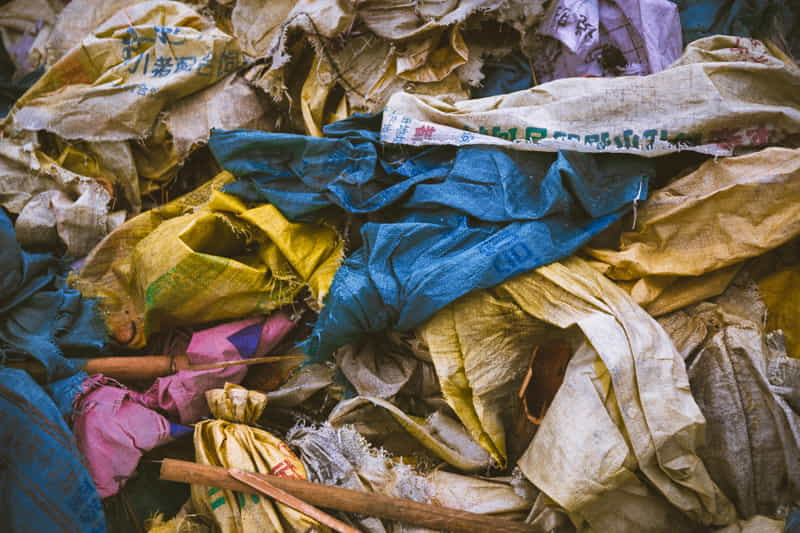
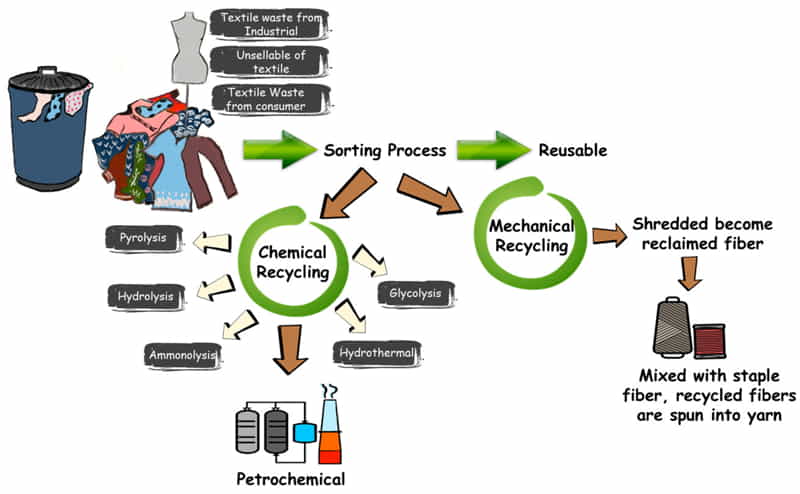
- Collection. Used textiles are gathered through charity and municipal banks, retailer take-back and sorting contractors. In the EU, separate collection of textiles has been required since 1 January 2025 (Article 11(1) of the Waste Framework Directive, as amended by Directive (EU) 2018/851).
- Sorting for reuse first. Wearable garments are sold for reuse; only what cannot be worn again goes on to recycling.
- Sorting for recycling. The rest is sorted by fibre content, colour and construction. Colour matters because mechanically recycled fibre keeps its dye: wool recyclers sort by colour, fibre content, knitted or woven construction and yarn type, and colour-sorted waste can be made into new cloth without stock or piece dyeing (Glasper et al., 2024).
- Removing hard parts. Zips, buttons, rivets, labels and thick seams are cut away, because metal and plastic damage the tearing rollers and seams tear into lumps.
- Cutting. The fabric is cut into small pieces. Ütebay and colleagues tested the size of the pieces fed to the shredder as a variable in recycled fibre quality (Ütebay, Çelik and Çay, 2019).
- Tearing, also called garnetting or pulling. The pieces pass between feed rollers and a fast opening roller clothed with pins or teeth, often several in a row, which pull the yarns apart into loose fibre. The fibres are under tension and bending while they are held, and some break. The gap between the feed rollers and the opening roller is one of the settings that decides how much length survives (Glasper et al., 2024). This tearing line is the “fibre recycling equipment” mills buy; the same machines open pre-consumer and post-industrial waste.
- Blending. The recycled fibre is mixed with longer virgin cotton, polyester or another carrier fibre so the yarn holds together. The share of recycled fibre the yarn can carry depends on the count and the spinning system (table below). The site’s guide to fibre blending in spinning covers how blends are made and checked.
- Carding and spinning. The blend is carded into sliver and spun. Rotor (open-end) spinning takes 100% recycled cotton up to Ne 24, against Ne 16 for carded ring and air-jet; both reach Ne 34, rotor at up to 50% recycled and carded ring or air-jet at up to 60% (Textile Exchange guidance, table A2). Combing is ruled out. Recycled wool is traditionally woollen-spun.
Why recycled fibre is shorter, and what that does to the yarn
Staple length is what lets fibres grip each other in a twisted yarn, and tearing a fabric apart breaks fibres. A peer-reviewed study that tore post-consumer cotton T-shirts and jeans found the drop in fibre length was most severe for the finer single jersey and for the least-worn garments, so heavy wear does not by itself rule a garment out (Aronsson and Persson, 2020). Another found that loosely knitted, undyed pre-consumer cotton waste gave less waste in recycling and stronger yarn than tight or dyed knits (Ütebay, Çelik and Çay, 2019). Feedstock choice is therefore the first quality control.
Textile Exchange turned the length problem into a certification rule in May 2021, after finding combed yarns certified as mechanically recycled cotton that could not have been made that way. Its guidance lists the fibre length each feedstock gives and the yarns that can be spun from it:
| Feedstock | Fibre length after mechanical recycling |
|---|---|
| Post-consumer denim and jeans | 6 to 18 mm |
| Pre-consumer garment cutting waste | 6 to 21 mm |
| Pre-consumer yarn hard waste and woven selvedge waste | 6 to 21 mm |
| Pre-consumer yarn hard waste of high-quality fibre (29 to 40 mm in the yarn) | up to 26 mm |
| Spinning system | Yarn count | Mechanically recycled cotton in the yarn |
|---|---|---|
| Rotor (open-end) | Ne 1 to 24 | 5% to 100% |
| Rotor (open-end) | Ne 24 to 34 | 5% to 50% |
| Ring or air-jet, carded, carded compact or carded core-spun | Ne 1 to 16 | 5% to 100% |
| Ring or air-jet, carded, carded compact or carded core-spun | Ne 16 to 34 | 5% to 60% |
| Ring or air-jet, combed, compact combed or combed core-spun | any | not possible |
| Any yarn above Ne 40, or recycled fibre above 25 mm | – | not certifiable as mechanically recycled cotton |
Source: Textile Exchange, Guidance: Mechanical Recycling of Cotton, RCS-202 and GRS-202, version 0.1, 14 June 2021, sections A1, A2, B1, B2 and the calibration of 17 May 2021. Yarns made only from the long pre-consumer hard waste in the last row of the first table can go finer, up to Ne 34 to 40 at 5% to 25% recycled cotton, with test evidence. The blend partner may be virgin cotton or another fibre, virgin or recycled.
In practice this means recycled cotton yarn is coarse to medium and leans on its blend partner for strength. When reviewing certified sites, certification bodies collect fibre and yarn test reports comparing recycled with virgin cotton (count CV, CSP or RKM, hairiness) and a fabric pilling report. A polyester or cotton core is one way to carry a high share of short fibre on the surface; the site’s page on core-spun yarn explains how that construction works.

Which fibres can be recycled into new yarn, and what the yarn is like
Recycled cotton and denim
Cotton is the main fibre re-spun mechanically. Textile Exchange estimates 0.4 million tonnes of recycled cotton in 2025, about 1% of the 25.7 million tonnes of cotton produced, all of it textile-to-textile (Materials Market Report 2026). Textile Exchange’s guidance lists post-consumer denim as a feedstock of its own, giving 6 to 18 mm fibre. As with any mechanically recycled fibre, the colour of the sorted waste becomes the colour of the yarn. The yarn is a coarse to medium rotor or carded ring yarn, blended with virgin cotton or another fibre, which suits denim and other mid- to heavyweight fabrics rather than fine shirting, where combed yarns are needed. For the virgin fibre, see the site’s cotton fibre guide.
Polyester fleece from bottles
Most recycled polyester never was a textile. In 2025 about 9.7 million tonnes of recycled polyester were produced, and 97% of it came from plastic bottles and other non-textile feedstock; textile-to-textile polyester was about 3% of recycled polyester, or 0.3% of all polyester (Materials Market Report 2026). Bottle flake is washed, melted and extruded into new filament or staple fibre, so the yarn behaves like virgin polyester of the same specification. That is how recycled-polyester fleece is made: the recycled staple or filament yarn is knitted, then brushed and sheared into a pile in the same way as virgin fleece. It is a recycled product, but it does not recover a worn garment. The site’s recycled polyester page covers the bottle route.
Recycled wool and cashmere
Wool has the second-highest recycled share of the major fibres after polyester (Materials Market Report 2026), and unlike polyester it comes back from textiles. Post-consumer wool clothing has been recycled in a closed loop since the early 1800s, traditionally by woollen spinning (Glasper, Picerno, Tausif and Russell, 2024), and recycled wool made up around 8% of the wool market in 2025 (Materials Market Report 2026). The 2024 study of an industrial wool-recycling line found that pulling had a negligible effect on fibre tensile properties, that the length lost depends on the starting length and the machine gauge, and that merino and cashmere knitwear, whose fibres start shorter than cross-bred wools, keep a greater share of their length. Woollen spinning needs a retained mean length of about 20 mm, and the study concluded that post-consumer knitwear can be recycled more than once. The yarns are woollen-spun for clothing and interior fabrics, and often blended with virgin wool or man-made fibre to meet a fabric specification; lower grades go to rotor yarns and nonwovens. The site’s wool fibre guide explains why wool fibres hold together so well.
Recycled hemp
There is very little of it. Hemp was about 0.3% of world fibre in 2025, around 0.4 million tonnes (Materials Market Report 2026), and the report gives recycled shares for cotton, wool, man-made cellulosics, polyester, polyamide and other synthetics, but none for hemp. We found no published study or certified supply of yarn re-spun from post-consumer hemp. A fabric sold as “recycled hemp” is more likely to be virgin hemp blended with a recycled fibre such as recycled cotton or polyester; check which fibre the recycled claim and its certificate cover. How hemp yarn itself is spun, and why cottonised hemp runs on cotton machinery, is on the site’s hemp yarn page.
Nylon and man-made cellulosics
Recycled nylon is re-melted or depolymerised rather than torn and re-spun, and recycled man-made cellulosic fibre is made by chemical recycling. Recycled polyamide was about 3% of polyamide in 2025, mostly from pre-consumer waste, fishing nets and carpets; and the share of man-made cellulosic fibre made from recycled feedstock rose from about 1.1% in 2024 to 1.5% in 2025, made from recycled cellulosic fibre (Materials Market Report 2026).
Worked example: does a 50/50 blend still carry 50% recycled fibre?
Cleaning and carding remove short fibre as waste, so recycled fibre, being shorter and more variable, usually loses a larger share in the mill than the virgin fibre it is blended with. A spinner making a coarse rotor yarn for denim (Ne 12, inside the 5% to 100% band in the table above) lays down 500 kg of post-consumer recycled cotton with 500 kg of virgin cotton, aiming for a yarn that is half recycled, the minimum recycled content the Global Recycled Standard sets. The waste rates below are assumptions for the example; use your own mill’s waste record, kept separately for each stream.
| Step | Working | Result |
|---|---|---|
| Recycled cotton out, at 12% waste | 500 × (1 − 0.12) | 440 kg |
| Virgin cotton out, at 5% waste | 500 × (1 − 0.05) | 475 kg |
| Yarn out | 440 + 475 | 915 kg (8.5% overall loss) |
| Recycled share of the yarn | 440 ÷ 915 | 48.09%, not 50% |
| Recycled input needed for 50% in the yarn | 0.50 × 475 ÷ (0.88 × 0.50) | 539.77 kg, 39.77 kg more |
Run it in the recycled content calculator, prefilled with this blend: it shows 48.09% recycled content on output, a 1.91-point shortfall against the 50% put in, and 539.77 kg of recycled fibre needed to reach 50%. The shortfall is small, and in the same direction whenever recycled fibre loses more than virgin, so a blend batched exactly at a threshold can land below it. How a certification body counts recycled content is governed by the standard’s own reconciliation rules, so use the arithmetic to set the lay-down, not to argue an audit. For the production side of the same yarn, the rotor spinning production calculator gives output per rotor.
Recycled-content claims: GRS, RCS and what the label means
- Recycled Claim Standard (RCS) and Global Recycled Standard (GRS), both owned by Textile Exchange, certify recycled content and its chain of custody, with a third-party audit at each stage. Both accept pre-consumer and post-consumer material. The GRS sets a higher minimum recycled content of 50% and adds social, environmental and chemical requirements for processing (Textile Exchange). Register entries: RCS and GRS.
- Length and count checks. Under the 2021 guidance above, certificates are not issued for mechanically recycled cotton in yarns finer than Ne 40 or with fibre longer than 25 mm, because such yarn cannot be made from it.
- A change of standard. Textile Exchange is merging its standards into the Materials Matter Standard: criteria released on 12 December 2025, effective from 31 December 2026 and mandatory from 31 December 2027, according to Textile Exchange’s RCS and GRS page. Check how a supplier’s certificate will move across before relying on it beyond 2027.
What a recycled label does not tell you: whether the input was post-consumer or pre-consumer (unless it says so), and whether the recycled fibre came from textiles or bottles. Ask the supplier for its scope and transaction certificates, which the certification body issues for certified products.
Rules that push collection and recycling
The EU has made textile collection a legal duty and is making producers pay for what follows. Since 1 January 2025 Member States must collect textiles separately under Article 11(1) of the Waste Framework Directive (Directive (EU) 2018/851). Directive (EU) 2025/1892, adopted on 10 September 2025 and published on 26 September 2025, requires extended producer responsibility schemes for textile, textile-related and footwear products by 17 April 2028, with national law due by 17 June 2027; producers will finance collection, sorting, preparing for reuse and recycling, and the directive names fibre-to-fibre recycling as one of the things the schemes are meant to build. Its recitals estimate the textile waste generated in the EU, including production and pre-consumer waste, at 12.6 million tonnes.
Benefits of fibre-to-fibre recycling, and its limits
The benefits. Fibre that is re-spun replaces fibre that would otherwise be grown or made new, and keeps the material out of landfill and incineration, where most of it goes now. Mechanical recycling needs no solvent and, when the waste is sorted by colour, no dyeing either, because the fibre keeps its colour (Glasper et al., 2024). Wool and cashmere can go round more than once. Recycled yarn also gives clothing makers a way to meet the recycled-content and collection rules above with material from their own sector.
The limits. Mechanical recycling shortens cotton fibre enough to rule out combed and fine yarns, so recycled cotton needs a longer partner fibre and ends up in coarse to medium counts. Blends are the hard part: a cotton-polyester or cotton-elastane garment cannot be separated by tearing, and Textile Exchange describes recycling fibres from blended textiles as a significant challenge that some start-ups are working on. Much collected textile still goes to nonwovens and insulation rather than yarn; the wool study notes substantial quantities of recycled post-consumer wool going to nonwovens for industrial products. And volume is small: textile-to-textile fibre was about 1% of the fibre market in 2025, with Textile Exchange expecting about 3 to 5 million tonnes by 2030.

Questions
What is post-consumer fibre?
Fibre recovered from products that have been used and discarded, such as worn clothing and household textiles. Pre-consumer fibre comes instead from waste made during spinning, weaving, knitting and cutting. Both count as recycled under the RCS and GRS, but post-consumer waste is dirtier, more mixed and gives shorter fibre.
What are the benefits of fibre-to-fibre recycling?
It keeps textile material in use as textile, instead of downcycling it into wiping cloths or insulation or burning it, and it replaces virgin fibre. Mechanical recycling of colour-sorted waste avoids redyeing, and wool can be recycled more than once. The trade-off is shorter fibre and coarser yarn.
How big is the post-consumer recycled textiles market?
Measured by fibre, small. Textile Exchange’s Materials Market Report 2026, published on 22 September 2026, puts pre- and post-consumer textile-to-textile recycled fibre at about 1% of the 139 million tonnes of fibre produced in 2025, roughly 1 to 1.5 million tonnes, and that includes pre-consumer waste.
How does recycled fibre compare with fresh (virgin) fibre?
Mechanically recycled cotton is much shorter (6 to 18 mm from post-consumer denim) and more variable, so its yarns are coarser and are blended with virgin fibre; it cannot be combed or spun finer than Ne 40 under the certification guidance. Recycled nylon and recycled man-made cellulosic fibre are made by melt or chemical routes instead, so they are not limited by the length of the waste fibre.
What machines recycle textile waste into fibre?
A tearing (garnetting) line: a cutter that reduces fabric to pieces, then a series of opening rollers clothed with pins or teeth that pull the pieces apart into fibre, with feed rollers whose distance from the opening roller controls how much fibre length survives. The fibre then goes to normal blowroom and carding machines and, for cotton, often to rotor spinning machines such as the Saurer Autocoro 9.
Can recycled cotton be ring spun?
Yes, as a carded ring yarn: up to 100% recycled cotton for counts up to Ne 16, and up to 60% from Ne 16 to 34, under Textile Exchange’s guidance. Combed and compact-combed ring yarns cannot be made from mechanically recycled cotton.
Sources
- Textile Exchange, Materials Market Report 2026, published 22 September 2026 (data for 2025): fibre volumes, recycled shares, textile-to-textile estimate.
- Textile Exchange, Guidance: Mechanical Recycling of Cotton, RCS-202 / GRS-202 V0.1, 14 June 2021: fibre lengths, spinnable counts and blend shares.
- Textile Exchange, Recycled Claim Standard and Global Recycled Standard: scope, 50% GRS minimum, transition to the Materials Matter Standard.
- M. J. Glasper, G. Picerno, M. Tausif and S. J. Russell, Closed loop mechanical recyclability of post-consumer waste wool fabrics based on fibre length retention, Cleaner Engineering and Technology 22 (2024) 100796.
- J. Aronsson and A. Persson, Tearing of post-consumer cotton T-shirts and jeans of varying degree of wear, Journal of Engineered Fibers and Fabrics 15 (2020).
- B. Ütebay, P. Çelik and A. Çay, Effects of cotton textile waste properties on recycled fibre quality, Journal of Cleaner Production 222 (2019).
- Ellen MacArthur Foundation, A New Textiles Economy: Redesigning fashion’s future, 28 November 2017, material flows for clothing in 2015.
- Directive (EU) 2018/851 amending the Waste Framework Directive, Article 11(1); Directive (EU) 2025/1892, Articles 22a and 2 and recitals.
How this page is kept
Last verified: 17 October 2026. Volumes and shares come from Textile Exchange’s Materials Market Report 2026 and change with each yearly edition; fibre lengths, counts and blend shares from Textile Exchange’s 2021 certification guidance; process behaviour from the peer-reviewed studies listed; dates and obligations from the directives’ text on EUR-Lex. The worked example uses assumed waste rates and was run in the site’s recycled content calculator as it stood on this date; the prefilled link was opened to check that it shows the figures quoted. Spotted an error? Tell us through the contact page, naming the section and the source that disagrees, and it will be corrected.
Change log. 17 October 2026: rewritten from end to end. The earlier version gave no figures or sources, said manufacturers test recycled fabrics to perform on par with virgin ones and that recycled yarns serve high-performance apparel, without the limits that fibre length puts on count and spinning system, and cited “circular economy” as if it were an organisation.