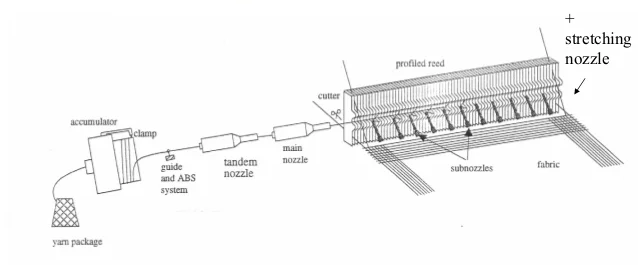
An air-jet loom is a shuttleless weaving machine that blows each pick of weft across the warp with compressed air. A measuring drum beside the loom winds off one pick’s length from the cone; a main nozzle shoots it into the shed; relay nozzles (sub-nozzles) along the sley fire one group after another to keep it moving through a tunnel in a profiled reed; a stretch nozzle holds it straight at the far side while the reed beats it up; and a cutter frees it at the near side. Because nothing heavier than the yarn has to be thrown across, the air-jet is the fastest loom for spun-yarn cloth: Tsudakoma states a maximum working speed of 1,350 rpm for its ZAX001neo Plus, and Picanol up to 1,350 wefts a minute in weaving mills for its OmniPlus-i Connect. The price is energy. Compressed air makes the air-jet the most energy-hungry weaving system, and most of what makers now advertise is a way of using less of it.
Last verified: 11 October 2026. Speeds are in picks per minute, which on a single-width loom equals its rpm. Machine figures are the makers’ own, each tied to the model it describes. Sources are linked in the text and listed at the end.
The air-jet loom at a glance
| Question | Answer | Source |
|---|---|---|
| What carries the weft? | A jet of compressed air: a main nozzle starts the pick, relay nozzles keep it moving | ITU notes |
| How fast are the air and the yarn? | Air leaves the nozzle at 200 to 300 m/s; the weft travels at 20 to 30 m/s | ITU notes |
| What guides the air through the shed? | Today a profiled (tunnel) reed with relay nozzles about every 50 mm; earlier, confusor guides | ITU notes |
| Fastest stated speed | 1,350 rpm (Tsudakoma, 190 cm machine); up to 1,350 wefts a minute in mills (Picanol) | Makers’ figures below |
| Widths sold | 140 to 390 cm (Toyota), 150 to 390 cm (Tsudakoma), 190 to 400 cm (Picanol) | Makers’ figures below |
| Yarns | Spun Ne 100 to Ne 2.4 and filament 20 to 1,000 denier (Picanol); up to 8 weft colours | Picanol brochure |
| Selvedge | Leno as standard; tuck-in as an option | Selvedges below |
| Energy | The highest of any weaving system: 3.2 kWh per kg of cloth in one course comparison, most of it at the compressor | NPTEL |
How does an air-jet loom work?
Air does not push the weft; it drags it. The pull comes from friction between the moving air and the yarn’s surface and grows with the square of the difference in their speeds, so the air must travel far faster than the yarn. Air is much less viscous than water, so the relative speed has to be high, and a hairy, rough yarn is easier to carry than a smooth one. That is why air-jet picking was designed for spun weft and adapted to filament only later, with better main nozzles (ITU jet weaving notes). One pick passes these parts in turn:
- Weft accumulator: stores exactly one pick’s length off a stationary cone.
- Main nozzle, often with a tandem nozzle before it: accelerates the leading end into the shed.
- Profiled reed and relay nozzles: a free jet mixes with the room air and slows within a short distance, so the reed forms a tunnel and the relay nozzles blow in sequence.
- Stretch nozzle: holds the pick straight at the far side until beat-up.
- Beat-up and cutter: the reed beats the pick into the cloth; a cutter on the supply side frees it.
- Selvedge device: leno threads or a tuck-in lock the cut ends.
The weft accumulator, or measuring drum
The air’s pull is weak, so the yarn cannot be dragged straight off the cone; it is measured out first. Two ways of storing it have been used: as a loop hanging in a storage pipe, or as turns wound on a drum (ITU notes); today’s looms use a drum. The drum is already in Max Pääbo’s patent of 1945: a rotating drum whose catch holds the wound yarn and then withdraws so the loop can be blown through the shed, giving “a constant length of thread” each time (US patent 2,519,786). Today’s versions are electronic: Toyota’s electric drum pooling, Tsudakoma’s FDP-A IV free drum pooling and Picanol’s Blue22 and Blue11 prewinders, which set the weft length electronically with the EasySet function (Toyota JAT910 catalogue; Tsudakoma catalogue; Picanol brochure).
The main nozzle and the tandem nozzle
The main nozzle gives the pick its start, sometimes with a tandem nozzle sharing the work (ITU notes). Toyota’s JAT910 has a conical tandem nozzle and a high-propulsion main nozzle as standard, and Itema says its double tandem nozzles let a mill weave at lower pressure with less stress on the weft (Toyota; Itema).
Relay nozzles, the profiled reed and confusor guides
Three ways of keeping the jet together across the shed have been sold (ITU notes):
- A single nozzle with confusor guides and suction at the exit side. The confusor is a row of flat metal plates on the raceboard in front of the reed, which rise between the warp ends during the pick and hold the air together. With no help along the way the jet runs out of speed, so the weaving width is limited.
- Several nozzles with guides: auxiliary nozzles at intervals blow in groups, one after another.
- Several nozzles with a profiled reed, now the standard. The reed wires are shaped to form a tunnel that guides the air and keeps the weft away from the warp. Relay nozzles stand about every 50 mm, about 25 mm apart for the last four at the exit side, and every extra nozzle adds to the air bill.
The relay nozzles take up to 80% of the air needed for weft insertion, according to research at RWTH Aachen’s Institut für Textiltechnik (Grassi et al., 2016), so that is where the makers work. Toyota fits tapered sub-nozzles and offers an air-saving reed; Tsudakoma has shortened the sub-nozzle pitch and, as an option, places the nozzles very close to the reed, with specially shaped dents; Itema states that its reed tunnel shape and single-hole relay nozzles cut air consumption by up to 23% (Toyota; Tsudakoma; Itema).
The stretch nozzle, the catch cord and the cutter
A stretch nozzle at the arrival side holds the pick by air so that no slack pick is beaten in (ITU notes); it is standard on the Tsudakoma ZAX001neo Plus. The end that overshoots is gripped in a waste selvedge, usually held by a catch cord and trimmed off: Toyota’s standard is a waste selvedge on the right with a catch cord, and Tsudakoma and Picanol both offer catch-cord-less options. At the supply side a cutter frees the pick after beat-up; Picanol’s electronic cutter has a separate cutting time for each colour (Toyota; Tsudakoma; Picanol).
Timing: the nozzle firing sequence
Everything happens within one turn of the main shaft, counted in degrees from beat-up at 0°. The weft can fly only while the shed is open, and the reed must beat it in at the end of the turn, so the nozzles fire to a timetable. The ITU notes show one machine’s settings: the main nozzle blows from 76° to 208°; the relay nozzles are grouped on 23 valves, each open for about 104° and each opening 8 or 9° after the one before (the last only 5°), so the blowing zone travels across the reed just ahead of the weft tip; and the stretch nozzle blows from 254° until 1°, just past beat-up (ITU notes).
| Nozzle (one machine in the ITU notes) | Opens | Closes |
|---|---|---|
| Relay group 1 (entry side) | 64° | 168° |
| Main nozzle | 76° | 208° |
| Relay group 2 | 72° | 177° |
| Relay group 12 (mid-width) | 161° | 265° |
| Relay group 22 | 249° | 357° |
| Relay group 23 (exit side) | 254° | 357° |
| Stretch nozzle | 254° | 1° (after beat-up at 0°) |
Firing the relay nozzles in sequence, rather than all at once, is what made the system affordable to run. A patent filed in the Netherlands in October 1969 by G. J. Vermeulen, whose German version names the machine builder Te Strake, sets out the idea: each jet is switched on as the weft reaches it, overlapping the next by a few degrees, and the last stays on into beat-up to keep the pick taut, using far less air than when every jet blows for the whole insertion (US patent 3,705,608; DE 2051446). Modern looms tune the timing themselves: Toyota’s i-SENSOR detects when the weft passes inside the warp and recommends pressures and valve timings, and Itema’s iRTC switches the relay valves according to the position of the weft tip (Toyota; Itema).
Selvedges: leno and tuck-in
Every pick on an air-jet is cut, so the edges must be locked. Two methods dominate:
- Leno, the standard. Two extra threads twist round each other and lock the cut ends, leaving a short fringe outside. Toyota’s JAT910 ships with a “Left/right rotary full-leno selvage device”, Tsudakoma’s ZAX001neo Plus with a mechanical planetary leno motion, and Picanol offers rotary o-Leno and e-Leno and its electronic ELSY system (Toyota; Tsudakoma; Picanol).
- Tuck-in, an option on all three, in mechanical and air versions. After beat-up the end of the pick is cut, caught by a stream of air in a capturing hole, then released and blown by small nozzles into the next shed, so it is woven back into the edge, as a Tsudakoma patent describes step by step (US patent 6,240,976). Toyota offers air and mechanical tuck-in, Picanol MTI (mechanical) and ATI (air), and Tsudakoma its needle-less ZTN devices.
A tucked edge has no fringe and looks closer to a shuttle selvedge; a leno edge is simpler. The site’s page on selvedges in woven fabrics covers the other kinds, and the shuttle loom vs shuttleless loom comparison explains why a cut edge is the price of every shuttleless loom.
What an air-jet loom weaves, and what it cannot
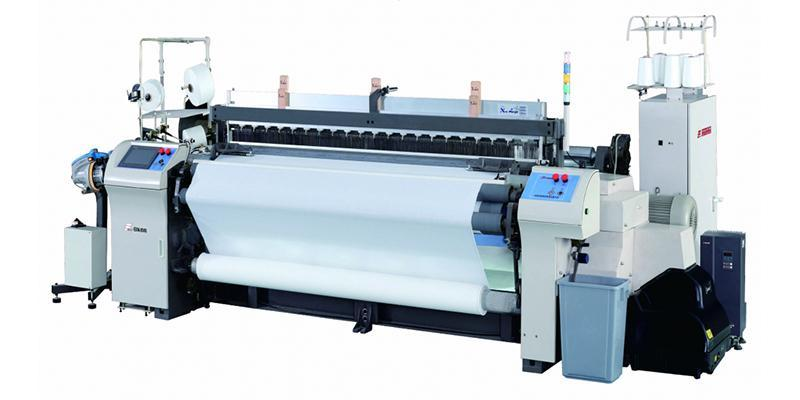
Air-jets were built for high-volume standard fabrics and have moved into heavier cloths such as denim and terry, and technical ones such as glass fabrics and tyre cord (ITU notes). Picanol states spun yarns from Ne 100 to Ne 2.4 and filament from 20 to 1,000 denier; Tsudakoma from Ne 100 to Ne 2.5 and from 17 to 1,350 dtex. Toyota and Picanol insert up to 8 weft colours, Tsudakoma 6 as standard and 8 as an option. Tsudakoma built a ZAX9100 for tyre cord in 2009, and Toyota and Tsudakoma both sell terry versions for towels (Picanol; Tsudakoma catalogue; Tsudakoma history; Toyota). The site’s denim weaving page follows one of them through the mill.
The limits come from the air. Textured yarns suit it well; monofilament does not (ITU notes). A finer or more highly twisted yarn offers the jet less surface and needs more air. A jet drags the whole length of the weft, so a cloth mixing very different weft yarns is usually given to a rapier, which grips only the tip; and the difficulty of keeping enough drag over a long distance limits the air-jet’s width, where the projectile loom goes much wider (NPTEL).
Air-jet loom speed and width: what each maker’s figure measures
| Machine | Speed, and what the figure measures | Widths (reed space) | Source |
|---|---|---|---|
| Toyota JAT910 | No speed published in its catalogue or launch release | 140 to 390 cm | Catalogue; release, 28 Nov 2022 |
| Tsudakoma ZAX001neo Plus | Maximum working speed 1,350 rpm, on a 190 cm, two-colour, positive-cam machine | 150 to 390 cm | Tsudakoma; catalogue |
| Picanol OmniPlus-i Connect | Up to 1,350 wefts a minute in weaving mills; no width given with it | 190 to 400 cm | Picanol, 2 Oct 2023 (speed); brochure (width) |
| Itema A9500EVO | No speed on its product page | Not on its product page (the brochure is sent on request) | Itema |
To compare looms of different widths, multiply picks per minute by the width the weft crosses to get the weft insertion rate: 1,350 picks a minute across 1.9 m is 2,565 metres of weft a minute. Picanol itself warns that the gap between a machine’s theoretical maximum and its effective speed in real conditions “is huge” (Picanol brochure). Show-floor records go higher still: Tsudakoma lists air-jet speed records of 554 rpm in 1979, 1,900 rpm in 2005 and 2,105 rpm at ITMA 2015, without the width or cloth (Tsudakoma history).
Worked example: air-jet loom production per day
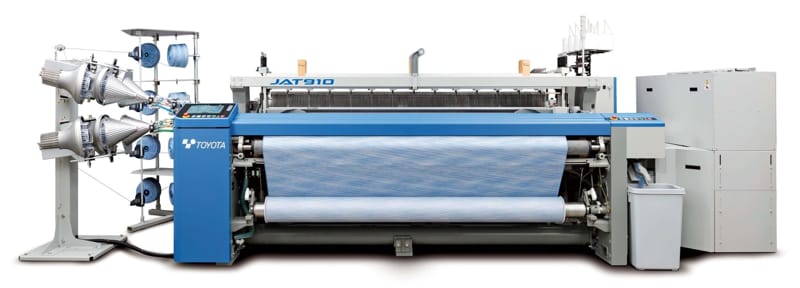
Take Tsudakoma’s 190 cm ZAX001neo Plus at its stated maximum working speed of 1,350 rpm, weaving the example cloth of the site’s weaving calculations page: a 63-inch cotton fabric with 80 picks per inch, on a 1.664 m reed width that fits a 190 cm machine. Run it for 24 hours at 90% efficiency, the share of the time the loom actually weaves (an assumption: use your own figure). The site’s loom production calculator works it as picks per hour = rpm × 60 × efficiency, and metres = picks ÷ picks per inch × 0.0254.
| Step | Working | Result |
|---|---|---|
| Picks inserted per hour | 1,350 × 60 × 0.90 | 72,900 |
| Effective speed | 1,350 × 0.90 | 1,215 picks a minute |
| Cloth per hour | 72,900 ÷ 80 × 0.0254 | 23.15 m |
| Cloth per day (24 h) | 23.146 × 24 | 555.50 m |
| Area per hour | 23.146 × 63 × 0.0254 | 37.04 m² |
| Weft insertion rate at full speed | 1,350 × 1.664 m | 2,246 m of weft a minute |
| Calculator, set to these figures | Open the loom production calculator with these inputs | |
One loom makes about 555 metres of this cloth a day, so an order for 50,000 metres needs about 90 loom-days (50,000 ÷ 555.50 = 90.0), for example ten looms for nine days. Treat it as a ceiling built on the maker’s top speed: the mill’s own speed and efficiency decide the real figure, and halving the picks per inch doubles the metres. Toyota publishes no speed for the JAT910, so for a Toyota loom enter the mill’s own running speed. The shuttle loom vs shuttleless loom page runs the same cloth on a shuttle loom and a rapier for comparison.
Energy efficiency: compressed air is the main cost
Air-jet weaving is “the most productive but also most energy consuming weaving method” (Grassi et al., 2016). In the IIT Delhi course comparison it uses 3.2 kWh per kilogram of cloth, against 2.5 for the rapier, 1.3 for the projectile and 0.9 for the water-jet, and the air compressor “consumes most of the 3.2 units” (NPTEL). A 2024 study states it plainly: the energy consumption of air-jet looms “mainly comes from air compressors” (Yu et al., Energies, 2024). The air comes from a central compressor house or from compressors built into the machines, filtered, cooled and dried, through an air tank (ITU notes), at about 5 to 6 bar (NPTEL).
The makers’ savings claims, and what they are measured against
| Maker and model | Claim | Compared with, and conditions stated |
|---|---|---|
| Toyota JAT910 | Air pressure 10% lower, air consumption 20% lower, power 10% lower | The JAT810 it replaced. Power: “under Toyota Industries Corporation’s test conditions with a machine of equivalent specifications”; air: “depends on specifications and/or weaving conditions” (release; catalogue) |
| Tsudakoma ZAX001neo Plus | Air 10% lower, power 15% lower, pressure 15% lower | The ZAX001neo it replaced; values include options and “may vary depending on specifications and fabric”. Its chart puts the electricity of loom plus compressor at 62% of the first ZAX’s (catalogue) |
| Picanol OmniPlus-i Connect | AirStream: up to 12 Nm³/h saved by sending air to the main nozzles only when needed. EcoBoost drive: up to 1.5 kW saved | No baseline or test condition stated for either the 12 Nm³/h or the 1.5 kW (news, 17 Oct 2025; brochure) |
| Itema A9500EVO | Air consumption up to 23% lower with its reed tunnel and single-hole relay nozzles | Not stated (Itema) |
Toyota and Tsudakoma measure against their own previous models, each under conditions of its own choosing; Picanol and Itema name no baseline at all. The figures therefore cannot be compared with each other or added up. A research nozzle shows how much is still on the table: a high-volume, low-pressure relay nozzle designed at RWTH Aachen made energy savings of up to 30% possible (Grassi et al., 2016). For your own looms, the site’s air-jet air consumption calculator turns measured nozzle air per pick into cubic metres an hour and compressor energy.
Supply pressure
Higher supply pressure gives a faster jet (ITU notes, figure 8.17), which is why it is tempting to turn it up to cure stops. It is also the most direct lever on the energy bill: Picanol states that reducing compressor pressure by 1 bar saves about 7% of energy (Picanol, 2025). The aim is the lowest pressure at which every pick still arrives on time, and makers now automate it: Toyota’s FACT-plus measures air pressure on the machines and sends optimal settings to the compressor, and Tsudakoma’s Smart Air Grid adjusts compressor pressure from its loom monitoring system (Toyota; Tsudakoma).
Leaks
Air that leaks is paid for and weaves nothing. The US Department of Energy says leaks often waste 20 to 30% of a compressor’s output, that 5 to 10% of total flow is a reasonable target, and that leakage rises with system pressure (DOE Tip Sheet 3). Worked through with the DOE’s own figures: a 1/16-inch hole at 90 psig (6.2 bar) leaks 5.72 cfm in the DOE’s table, which the DOE multiplies by 0.97 for a well-rounded hole (5.55 cfm) or by 0.61 for a sharp-edged one (3.49 cfm, the case its own example uses). At the DOE’s 18 kW per 100 cfm, that one hole takes 0.63 kW, and over the DOE’s 7,000 running hours about 4,400 kWh a year (compressed air leak calculator, set to these figures; enter your own tariff for the cost). Two such holes waste nearly as much power as the 1.5 kW Picanol claims for its new drive. The DOE recommends finding leaks with an ultrasonic detector or soapy water, as a standing programme. On the looms, Picanol’s AirMaster measures air consumption and detects leakage and blockage, and Tsudakoma’s ACI-II raises an alarm at abnormal pressure or flow, so that “defective valves can be easily identified” (Picanol; Tsudakoma).
Maintenance
Few moving parts, few spare parts and little maintenance are among the advantages the ITU notes list for the air-jet; most of the care goes into the air (ITU notes):
- Air quality. The air is filtered, compressed, cooled and dried before it reaches the loom, and its temperature, humidity and impurity content matter (ITU notes). ISO 8573-1 sets purity classes for compressed air for particles, water and oil.
- Nozzles and valves. Watch the loom’s own air readings, which is what AirMaster and ACI-II are built for: flow that changes at the same pressure points to a leak, a blockage or a failing valve.
- Lubrication. Toyota’s JAT910 runs its main parts in an oil bath with a fully automated central lubricator, and an optional oil filter in the gear box removes contaminants to extend bearing life; Tsudakoma uses an oil bath for the main drive and central greasing, manual as standard and automatic as an option (Toyota; Tsudakoma).
- Monitoring. Every Picanol machine carries a temperature and humidity sensor, and Toyota’s FACT-plus collects machine sensor data to plan maintenance (Picanol; Toyota).
History of the air-jet loom
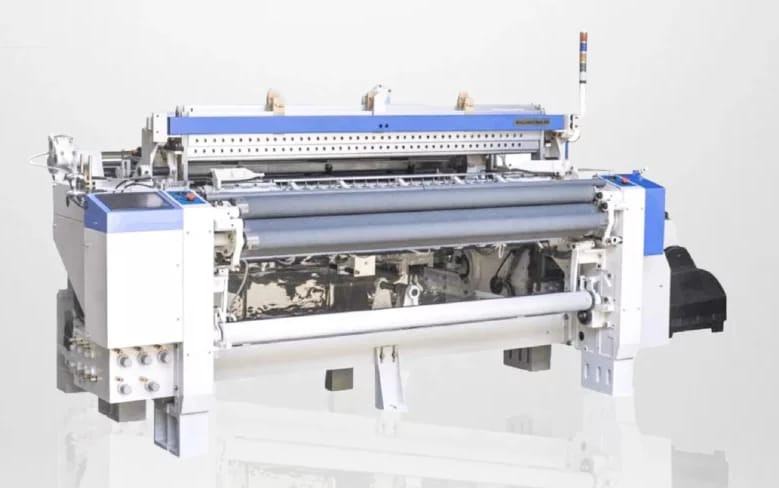
In August 1945 Max Pääbo of Norrköping, Sweden, filed a patent for a loom with a stationary nozzle that blows the weft through the shed with compressed air, a measuring drum with a catch that releases one pick at a time, scissors to cut the pick at the entry side and a suction funnel at the exit (US patent 2,519,786, granted 22 August 1950; Swiss patent 253,930). The patent says looms “of this type” were already known, with the nozzle on the swinging lay; fixing it to the frame was his improvement. A Maxbo air-jet loom built by A. B. Maxbo of Norrköping about 1950 survives in the Science Museum Group collection, given by the textile department of the University of Manchester Institute of Science and Technology (object Y1984.870).
Czechoslovakia worked on jet looms at the same time. The National Technical Museum in Prague, whose collections include industrial designs for textile machines from the 1950s on, describes “world-unique jet looms” developed systematically in that period (NTM). The ITU notes illustrate the jet loom with an Elitex machine, and a Czechoslovak engineer was still patenting a main nozzle that blows the weft into a confusor in 1979 (ITU notes; CS patent 204943).
Today’s machine rests on relay nozzles fired in sequence (Vermeulen’s 1969 patent, above) and the profiled reed. Tsudakoma developed its prototype ZA air-jet in 1975, began production in 1978 and set a speed record of 554 rpm in 1979 (Tsudakoma history). The ITU notes give air-jets of the 1980s as 1.4 to 3.6 m wide at 400 to 700 rpm (ITU productivity notes); today’s are rated at up to 1,350, and Toyota calls the air-jet “the most popular type of loom” (Toyota Industries). The wider story is on the site’s history of looms page.
Questions people ask about air-jet looms
What is an air-jet loom?
A weaving machine that inserts the weft with a jet of compressed air instead of a shuttle, rapier or projectile. A main nozzle starts each pick and relay nozzles along a profiled reed carry it across; the pick is cut at each side, so the edges are held with leno threads or tucked in. It is the fastest loom for spun-yarn cloth, and Toyota calls it the most popular type.
What is the working principle of an air-jet loom?
Drag. Air moving much faster than the yarn, 200 to 300 m/s against 20 to 30 m/s, pulls it along by friction on its surface. A free jet slows quickly, so relay nozzles fire in a timed sequence from one side to the other and the profiled reed keeps the air together.
What is air-jet fabric?
Not a fabric type. It usually means cloth woven on an air-jet loom, which covers a great deal of standard cotton and blended cloth, denim and terry. Its edge is cut and held by leno threads or tucked in, as on any shuttleless loom, so the edge alone does not show that an air-jet wove it. Air-jet spinning and air-jet texturing are different things: ways of making yarn.
How much does an air-jet loom produce per day?
Metres per day = rpm × 60 × efficiency ÷ picks per inch × 0.0254 × 24. At 1,350 rpm and 90% efficiency on a cloth with 80 picks per inch, that is 555.50 m a day. Fewer picks per inch or a higher speed give more; see the worked example.
What is the speed of an air-jet loom?
The fastest stated figures are 1,350: Tsudakoma’s maximum working speed in rpm for a 190 cm ZAX001neo Plus, and Picanol’s up to 1,350 wefts a minute in mills for the OmniPlus-i Connect. Mill speeds are lower: Picanol calls the gap between theoretical and real-life speed “huge” (Picanol brochure). They also fall as looms get wider: a 1992 table in the ITU notes has a 3.3 m Toyoda JAT600 at 662 rpm against 1,342 rpm for a 1.9 m Tsudakoma ZAX (ITU productivity notes). So compare looms by weft insertion rate, picks per minute × width.
What is the difference between an air-jet and a water-jet loom?
Both blow the weft across, but water grips the yarn far better than air, and a water-jet loom works with a single nozzle and no relay nozzles. Water-jets take only water-repellent yarns, in practice synthetic filament, while air-jets take spun and filament yarns. Water-jets weave narrower cloth and use less energy per kilogram (0.9 kWh against 3.2 in the IIT Delhi comparison), but the wet cloth must be squeezed and dried (NPTEL; Toyota Industries; ITU notes). The shuttle vs shuttleless loom page compares all the insertion systems, and the site’s guides to the rapier loom, the water-jet loom and the projectile loom take each in detail.
Sources
- Makers: Toyota Industries (JAT910 release, 28 November 2022; JAT910 catalogue; types of looms); Tsudakoma (ZAX001neo Plus; catalogue; history); Picanol (2 October 2023; 17 October 2025; OmniPlus-i Connect brochure); Itema (A9500EVO).
- Course material: Istanbul Technical University, TEK332E Weaving Technology II (jet weaving; productivity); NPTEL, Shuttleless Weaving, IIT Delhi (module 3 questions).
- Research: C. Grassi, A. Schröter, Y.-S. Gloy and T. Gries, “Reducing environmental impact in air jet weaving technology”, International Journal of Clothing Science and Technology 28(3), 2016; Yu et al., “A Study on Short-Term Air Consumption Prediction Model for Air-Jet Looms”, Energies 17(16), 2024.
- Compressed air: US Department of Energy, Compressed Air Tip Sheet 3, Minimize Compressed Air Leaks (2004); ISO, ISO 8573-1:2010, and the site’s ISO 8573-1 record.
- History: patents US 2,519,786 and CH 253,930 (M. Pääbo, priority 1945), US 3,705,608 and DE 2051446 (G. J. Vermeulen, priority 1969), CS 204943 (priority 1979) and US 6,240,976 (Tsudakoma, priority 1999); Science Museum Group, Maxbo air-jet loom; National Technical Museum, Prague, mechanical engineering collections.
How this page is kept
Last verified: 11 October 2026. Machine speeds, widths, yarn ranges and savings claims are the makers’ own figures, read on their sites, catalogues and brochures on that date, attributed to the model they describe and given with the conditions the maker states; when a maker replaces a model, its figures are replaced, not averaged. Mechanism and timing come from university course material and patents. The worked examples use the site’s loom production and compressed air leak calculators as they stood on this date, and each prefilled link was opened to check that it shows the figures quoted.
Change log. 11 October 2026: rewritten in full. The earlier version gave no speed, width, date or source, and is corrected on these points: it said air-jet looms use less energy than shuttle looms, by up to 30%, when the air-jet is the most energy-hungry weaving system; it said the compressed air is stored in high-pressure cylinders, when it comes from compressors through a treated supply; it measured the jet by the kinetic energy of the air, when the weft is carried by drag; it described “regenerative braking” energy recovery that no maker documents; it had the weft leave a “weft carrier”, when it comes off a measuring drum; and its three unnamed mill “case studies”, with gains of 60%, 35% and 30%, could not be traced and are withdrawn.
Found an error? Please tell us through the contact page, naming the section and the source that disagrees.