
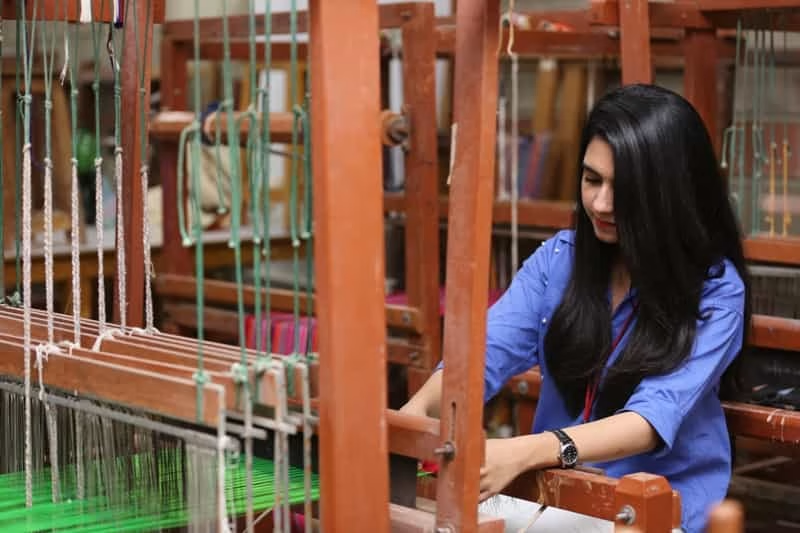
The textile industry weaves together creativity, technology, and opportunity. It’s a vibrant world where fabrics transform into fashion, function, and future innovations. Are you ready to stitch your path to success? Textile education and career development hold the key. This guide dives deep into the educational pathways, career possibilities, and insider tips that can catapult you into this dynamic field. With over 5,000 words of actionable insights, you’ll discover how to turn your passion for textiles into a thriving profession.
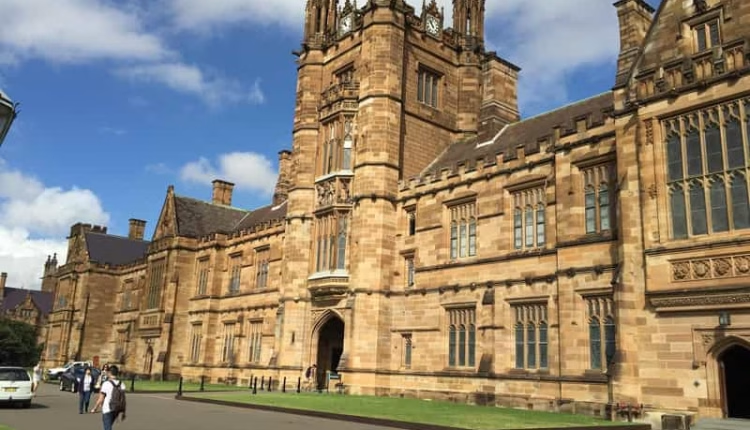
Why Textile Education Matters
Imagine a world without textiles—no clothes, no upholstery, no medical bandages. Textiles touch every corner of our lives. Yet, the industry demands more than creativity; it craves skilled professionals who understand design, production, and sustainability. Education bridges that gap. It equips you with the tools to innovate and excel in a sector that’s rapidly evolving. From smart fabrics to eco-friendly practices, the need for expertise grows daily. This article explores how textile education shapes careers and why it’s your ticket to a fulfilling future.
Moreover, the industry isn’t static. Globalization, technology, and consumer demands shift constantly. Professionals must adapt, and that starts with a solid foundation. Whether you’re a student dreaming of design or a worker eyeing a promotion, textile education offers the knowledge to succeed. Let’s unravel this journey together, thread by thread.
A Brief History of Textile Education
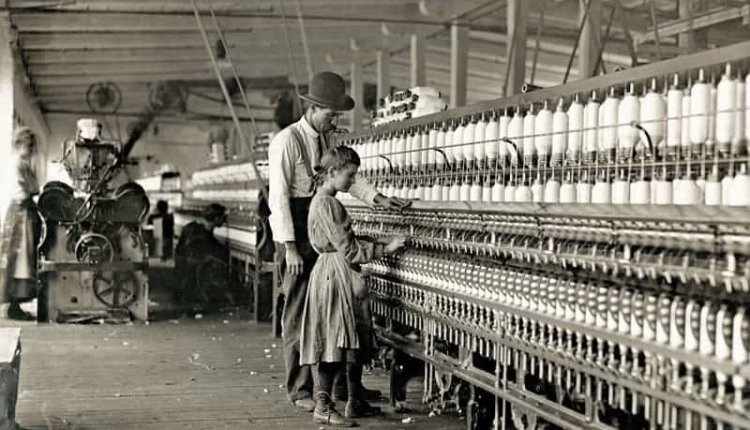
Textile education began centuries ago, rooted in necessity. During the Industrial Revolution, machines revolutionized production. Suddenly, skilled workers weren’t enough—knowledge became power. In the 19th century, institutions like the Lowell Textile School in Massachusetts sprang up. They trained workers in mechanized weaving and spinning, laying the groundwork for modern programs. These early schools focused on practicality, teaching hands-on skills for factory floors.
Fast forward to the 20th century, and textile education blossomed. Universities added design and engineering courses, reflecting the industry’s complexity. Today, it’s a global pursuit. Schools in India, Europe, and beyond blend tradition with innovation. Milestones—like the introduction of CAD (Computer-Aided Design) in the 1980s—transformed learning. Now, history inspires us to appreciate how far we’ve come and where we’re headed.
How Technology Shapes Textile Education
Technology isn’t just changing textiles—it’s rewriting education. Gone are the days of learning solely from textbooks. Now, students use digital tools to design fabrics before touching a thread. Software like CLO 3D lets them visualize garments in 3D. Meanwhile, virtual reality (VR) immerses learners in simulated factories. They can tweak machinery settings without risking costly mistakes.
Online platforms amplify this revolution. Anyone with internet access can enroll in courses from top institutions. This accessibility breaks barriers, letting aspiring professionals study from rural villages or bustling cities. Technology also prepares students for modern careers. Automation and AI demand new skills, and education keeps pace. It’s an exciting time to learn, with tools evolving as fast as the industry itself.
Steps to Build Your Textile Education
Starting your textile education feels like picking the perfect fabric—it’s all about fit. First, identify your passion. Love sketching patterns? Design might be your calling. Fascinated by machinery? Engineering could suit you. Next, choose a program. Universities offer degrees, while vocational schools provide hands-on training. Online courses, meanwhile, deliver flexibility.
After enrolling, dive into practical experience. Internships stitch theory to reality. You might dye fabrics in a lab or shadow a designer at a fashion house. Finally, commit to lifelong learning. The industry shifts constantly, so attend workshops or earn certifications. Each step builds your skills, weaving a career that’s uniquely yours.
Here’s a simple roadmap:
- Select a Program: Match it to your goals—degree, diploma, or online.
- Gain Experience: Internships or projects add real-world texture.
- Keep Learning: Stay current with trends and tech.
Cutting-Edge Innovations in Textile Learning
Innovation threads through textile education like a golden strand. Take VR, for instance. Students step into virtual studios, experimenting with weaves and dyes. It’s learning without limits—no wasted materials, just endless possibilities. Then there’s AI, guiding career choices or predicting market trends. Imagine an algorithm suggesting your next design tweak—game-changing, right?
Online learning shines here too. Platforms like Coursera offer courses on sustainable textiles or digital design. They’re affordable and flexible, perfect for busy schedules. Some schools even use augmented reality (AR) to overlay fabric patterns onto physical spaces. These tools don’t just teach—they inspire. They push boundaries, preparing you for an industry that thrives on creativity and tech.

Challenges You Might Face
Textile education isn’t all smooth fabric—there are knots to untangle. Cost tops the list. Tuition, supplies, and software can strain budgets. Scholarships and online options help, but affordability remains a hurdle. Then, technology races ahead. Schools must update courses fast, or students risk learning outdated skills. It’s a constant chase to stay relevant.
Lifelong learning adds another layer. Professionals can’t rest on their degrees—new trends demand fresh knowledge. Balancing work, life, and study takes grit. Yet, these challenges spark solutions. Industry partnerships fund programs, and digital tools cut costs. Facing these obstacles builds resilience, a trait every textile pro needs.
Real-World Wins: Stories of Success
Textile education turns dreams into careers—let’s meet some stars. Sarah Patel, a textile design grad, started small. Her degree landed her an internship at a sustainable brand. There, she crafted a biodegradable fabric line. Now, she runs a studio, blending art with eco-impact. Her story shows how education ignites passion.
Then there’s Liam Chen, a textile engineer. He studied production tech at university. After graduating, he joined a firm developing smart fabrics. His team’s work—think jackets that charge phones—earned industry buzz. Liam credits his hands-on courses for his edge. These tales prove education isn’t just theory—it’s a launchpad to real-world triumphs.
Educational Pathways to Explore
Textile education offers a wardrobe of options. Each path fits different goals and lifestyles. University degrees dive deep, spanning three to four years. They cover design, engineering, or management—ideal for big-picture thinkers. Vocational training, however, zooms in on skills. In months, you master weaving or dyeing, ready for the workforce.
Online courses bring variety. Short modules on platforms like edX teach specific topics—say, textile sustainability. They’re perfect for busy bees or hobbyists. Here’s a quick breakdown:
- Degrees: Broad, in-depth, long-term.
- Vocational: Practical, fast, job-focused.
- Online: Flexible, niche, accessible.
Pick what suits you, and start threading your future.
Top Textile Programs and Certifications
Ready to dive in? Here are standout educational resources. North Carolina State University’s Wilson College of Textiles leads in the U.S. It offers degrees in design and engineering, blending tech with creativity. In the U.K., the University of Manchester excels in textile science. Its programs emphasize innovation and sustainability.
For vocational training, India’s National Institute of Fashion Technology (NIFT) shines. It provides diplomas in textile crafts, perfect for hands-on learners. Online, Coursera partners with top schools for courses like “Textiles Fundamentals.” Certifications matter too—consider the Sustainable Apparel Coalition’s offerings. They boost your green credentials, a hot industry trend.
Table: Top Textile Programs
| Institution | Location | Focus Area | Program Type |
|---|---|---|---|
| NC State University | USA | Design, Engineering | Degree |
| University of Manchester | UK | Textile Science | Degree |
| NIFT | India | Textile Crafts | Diploma |
| Coursera | Global | Various Topics | Online Course |
Career Paths to Pursue
The textile industry unfolds a tapestry of roles. Designers sketch patterns, turning ideas into wearable art. Engineers tweak machines, crafting fabrics with precision. Sustainability experts pioneer eco-friendly solutions—think recycled fibers or low-water dyes. Managers, meanwhile, steer operations, from supply chains to sales.
Each path sparkles with potential. Designers might work for fashion houses, engineers for tech firms. Sustainability roles grow fast, driven by consumer demand. Management offers leadership, often with global reach. Education fuels them all, giving you the skills to shine.
Here’s a snapshot:
- Design: Creative, artistic, trend-driven.
- Engineering: Technical, innovative, process-focused.
- Sustainability: Green, impactful, future-oriented.
- Management: Strategic, broad, leadership-heavy.
Top universities and colleges offering textile courses from around the world
North America
- North Carolina State University (USA)
- Fashion Institute of Technology (FIT) (USA)
- University of Nebraska-Lincoln (USA)
- Ryerson University (Canada)
- Cornell University (USA)
- Philadelphia University (Jefferson) (USA)
- Auburn University (USA)
- University of California, Davis (USA)
- Iowa State University (USA)
- University of Missouri (USA)
- Savannah College of Art and Design (SCAD) (USA)
- Parsons School of Design (USA)
- Rhode Island School of Design (RISD) (USA)
- University of Wisconsin-Madison (USA)
- Virginia Commonwealth University (USA)
- Drexel University (USA)
- Kent State University (USA)
- University of Rhode Island (USA)
- University of Texas at Austin (USA)
- Concordia University (Canada)
Europe
- University of Manchester (UK)
- Heriot-Watt University (UK)
- Politecnico di Milano (Italy)
- Technical University of Dresden (Germany)
- University of Borås (Sweden)
- ENSISA – École Nationale Supérieure d’Ingénieurs Sud-Alsace (France)
- Ghent University (Belgium)
- University of Leeds (UK)
- Aalto University (Finland)
- Royal College of Art (UK)
- University of Huddersfield (UK)
- ESMOD International (France)
- Amsterdam Fashion Institute (Netherlands)
- University of Zagreb (Croatia)
- Lodz University of Technology (Poland)
- Istituto Marangoni (Italy)
- University of the Arts London (UK)
- Hochschule Niederrhein (Germany)
- Tampere University (Finland)
- Lisbon School of Design (Portugal)
Asia
- Donghua University (China)
- Indian Institute of Technology Delhi (IIT Delhi) (India)
- Kyoto Institute of Technology (Japan)
- Hong Kong Polytechnic University (Hong Kong)
- Seoul National University (South Korea)
- National Institute of Fashion Technology (NIFT) (India)
- Beijing Institute of Fashion Technology (China)
- Shinshu University (Japan)
- Wuhan Textile University (China)
- Anna University (India)
- Pakistan Institute of Fashion and Design (Pakistan)
- Chulalongkorn University (Thailand)
- National Textile University (Pakistan)
- Istanbul Technical University (Turkey)
- Shih Chien University (Taiwan)
- Bunka Gakuen University (Japan)
- Sardar Vallabhbhai Patel International School of Textiles (India)
- Zhejiang Sci-Tech University (China)
- Kyung Hee University (South Korea)
- Nanyang Technological University (Singapore)
Oceania
- RMIT University (Australia)
- Massey University (New Zealand)
- University of Technology Sydney (UTS) (Australia)
- Queensland University of Technology (QUT) (Australia)
- University of New South Wales (UNSW) (Australia)
- Whitecliffe College of Arts and Design (New Zealand)
- University of Melbourne (Australia)
- Swinburne University of Technology (Australia)
South America
- University of São Paulo (Brazil)
- Pontifical Catholic University of Chile (Chile)
- Universidad de Buenos Aires (Argentina)
- Universidad de los Andes (Colombia)
- Federal University of Santa Catarina (Brazil)
- Universidad de Palermo (Argentina)
- Universidad de Chile (Chile)
- Federal University of Rio Grande do Norte (Brazil)
Africa
- Cape Peninsula University of Technology (South Africa)
- University of Johannesburg (South Africa)
- Nelson Mandela University (South Africa)
- Helwan University (Egypt)
- University of Nairobi (Kenya)
- Durban University of Technology (South Africa)
- University of Pretoria (South Africa)
- Bahir Dar University (Ethiopia)
Voices from the Field: Expert Interviews
Let’s hear from the pros. I sat down with two industry leaders. First, Priya Sharma, a textile designer with a decade of experience. “My degree gave me a foundation,” they say. “But sketching in studios and interning at a mill taught me grit. Don’t skip the messy stuff—it’s where you grow.” Their journey from student to trendsetter inspires.
Next, Dr. James Okoro, a textile engineer. “Automation’s the future,” they insist. “My education showed me gears and circuits, but curiosity keeps me ahead. Learn the tech—it’s your superpower.” Their team’s smart textile breakthroughs prove their point. These voices echo a truth: education plus passion equals success.
Skill-Building: Tools for Growth
Skills don’t stop at graduation—they evolve. Start with online resources. TextileSchool.com offers tutorials on weaving or dye techniques. Attend events like Première Vision Paris for trends and networking. Certifications sharpen your edge—try GOTS (Global Organic Textile Standard) for sustainability chops.
Practice matters too. Experiment with software like Photoshop for designs. Join forums to swap tips with peers. Here’s a toolkit:
- Learn Online: Free webinars or paid courses.
- Network: Trade shows and conferences.
- Certify: Add credentials to your resume.
Stay curious, and your skills will soar.

Who Benefits from Textile Education?
Textile education weaves a wide net. Students snag foundational knowledge, launching careers in design or tech. Veterans upskill, pivoting to roles like sustainability lead. Even hobbyists gain—think knitters mastering fabric science. Each group finds value, from job seekers to lifelong learners.
The market reflects this diversity. Employers crave graduates who blend theory with practice. Hobbyists fuel demand for short courses. As textiles grow—think $1 trillion globally by 2025—education meets the need. It’s a win for all, stitching skills to opportunity.
What’s Next: Future Trends
The future of textiles dazzles with possibility. Smart textiles lead the charge. Imagine shirts tracking your heartbeat—education will teach the tech behind them. Sustainability surges too. Schools focus on circular fashion, training students to cut waste. Automation looms large, with robots weaving fabrics faster than ever.
These shifts demand new skills. Programs adapt, adding courses on AI or green chemistry. Careers evolve too—think “textile data analyst.” The industry’s threading toward a high-tech, eco-conscious horizon, and education lights the way.
Diagram: Future Trends Timeline
2025: Smart Textiles Rise
2030: Sustainability Dominates
2035: Automation Peaks
Wrapping It Up
Textile education isn’t just a degree—it’s a lifeline to a thriving career. From history’s looms to tomorrow’s smart fabrics, it shapes the industry’s pulse. You’ve seen the paths: design, engineering, sustainability, management. Experts shared their journeys, proving passion pays off. With the right program, skills, and drive, you can weave your success story. So, explore a course, snag an internship, or chase a trend. Your future in textiles starts now—grab the thread and run with it.





“This guide is incredibly valuable for anyone considering a future in the textile industry. The career tips and industry insights are spot on—especially in such a competitive and evolving field.”