

Knitted fabric is cloth made by knitting: loops of yarn pulled through other loops, row after row, instead of two sets of yarn crossing at right angles as in a woven fabric. The vertical columns of loops are called wales and the horizontal rows are called courses. There are two families of knitted fabric. In weft knitting one yarn runs across the fabric and forms a whole course; jersey, rib, interlock, purl, piqué, fleece and French terry are weft knits. In warp knitting every wale has its own yarn fed from a beam and the loops run along the length; tricot, raschel, lace, powernet and most mesh are warp knits. The loops are what give knitted fabric its stretch, softness and wrinkle recovery, and also its tendency to curl, ladder and lose its shape if it is handled carelessly.
Last verified: 18 November 2026. The terms on this page follow the international knitting vocabularies, ISO 4921 (basic concepts) and ISO 8388 (types of knitted fabric). Machine figures are each maker’s own published specifications, read on the date above. Sources are listed at the end.
Types of knitted fabric at a glance
Every named knit fabric is one of four weft-knit base structures (jersey, rib, interlock, purl), a pattern or pile built on one of them, or a warp knit. The table gives the construction, how the fabric behaves and where it is used. Each name links to its description and picture below.
| Fabric | Family and machine | Face and back | Stretch | Curl and ladder | Typical uses |
|---|---|---|---|---|---|
| Single jersey | Weft, one needle bed (circular or flat) | V-shaped loops on the face, semicircular loop heads on the back | More across than along | Curls at cut edges; ladders and unravels | T-shirts, underwear, dresses, linings for other knits |
| Rib (1×1, 2×2) | Weft, two needle beds | Same on both sides: face wales alternate with back wales | Very high across the width | Lies flat; unravels only from the end knitted last | Cuffs, collars, waistbands, fitted tops |
| Interlock | Weft, two needle beds, interlock needle set-out | Smooth, the same on both sides | Moderate both ways; firmer than rib | Lies flat; hard to ladder | Polo and T-shirts, babywear, sports tops |
| Purl | Weft, double-headed needles that pass loops between beds | The same on both sides, showing loop heads | Very high along the length | Lies flat; unravels from either end | Sweaters, children’s wear |
| Double knit (Milano, Ponte di Roma, cardigan) | Weft, two needle beds, rib or interlock based | Usually the same both sides, firm | Low to moderate; stable | Lies flat; does not ladder easily | Dresses, trousers, jackets, sweaters |
| Piqué | Weft, single jersey with tuck stitches | Small honeycomb or diamond cells on the face | Less than jersey | Curls less than jersey | Polo shirts, sports tops |
| Jacquard knit | Weft, needles selected one by one | Coloured or textured motif; floats or a birdseye backing on the back | Lower where floats lie | Varies with the base | Sweaters, dresses, upholstery |
| Intarsia | Weft, flat machine or hand, one yarn per colour area | Blocks of colour, no floats on the back | Like the base fabric | Like the base fabric | Sweaters, logo knitwear |
| Cable knit | Weft, loops crossed by transfer | Rope-like raised cables on a plain ground | Lower across the cables | Lies flat in a rib or purl ground | Sweaters, cardigans, throws |
| Pointelle | Weft, loops transferred to leave eyelets | Pattern of small holes | Like the base fabric | Like the base fabric | Tops, nightwear, babywear |
| Bird’s eye | Weft; a jacquard backing, or a fine eyelet mesh | Speckled back, or tiny regular holes | Moderate | Varies | Jacquard knitwear; sports mesh |
| Knitted terry | Weft, single jersey with an extra loop yarn | Smooth face, uncut pile loops on the back | Moderate | Lies flatter than jersey | Towelling robes, babywear, socks |
| French terry | Weft, single jersey with a looped back yarn | Smooth face, small flat loops on the back, not brushed | Moderate | Lies flat | Sweatshirts, joggers, hoodies |
| Fleece | Weft, the same looped back, then raised (brushed) | Smooth face, soft brushed back; polar fleece brushed both sides | Moderate to low | Lies flat; does not fray | Sweatshirts, jackets, blankets |
| Velour | Weft, knitted terry with the loops cut and sheared | Short, dense cut pile | Moderate | Lies flat | Leisurewear, dresses, upholstery |
| Sliver knit (high pile) | Weft, loose fibre fed in with the ground yarn | Long pile like fur | Low | Lies flat | Imitation fur, coat linings, toys |
| Tricot | Warp, usually two guide bars, filament yarn | Fine vertical wales on the face, crosswise laps on the back | Moderate; elastane versions high | Does not ladder or unravel | Lingerie, swimwear, sportswear, linings |
| Raschel | Warp, more guide bars, latch or compound needles | Open, lace, net or textured surfaces | Low to high (powernet) | Does not ladder | Lace, powernet, curtains, nets, spacer fabrics |
What is knitted fabric?
Knitted fabric is a textile formed by intermeshing loops of yarn with needles. Each needle holds a loop, catches new yarn, and draws it through the old loop, which is then cast off over the needle head. One column of loops formed by one needle is a wale; one row of loops across the fabric is a course. Counting them gives the fabric’s density: wales per inch (or per cm) across, courses per inch along. The length of yarn in one loop is the stitch length, or loop length, and it controls the fabric’s weight, tightness and shrinkage more than any other setting.
Only three stitches are used in weft knitting. A knit stitch is a normal loop. A tuck is made when a needle takes new yarn but keeps its old loop, so the yarn sits in the fabric as an open loop; tucks make piqué, cardigan and some mesh. A miss (float) is made when a needle takes no yarn, so the yarn floats past it on the back; misses make single jersey jacquards and Milano rib. Every named weft knit is a combination of these three stitches on one or two beds of needles.
A machine’s gauge is the number of needles per inch of needle bed, written E28 for 28 needles per inch. Fine gauges with fine yarn make lightweight jersey; coarse gauges with thick yarn make chunky knits. One current single jersey machine is built in gauges from E18 to E32 (Mayer & Cie, Relanit 3.2 HS II), while chunky knitwear is made on flat machines with only a few needles per inch, or by hand.
What is knitting?
Knitting is the method of making fabric from yarn by forming it into loops and drawing each new loop through one made before, so that the loops hold one another. With weaving, it is one of the two main ways of turning yarn into cloth, and it can be done by hand or by machine. Hand knitting, on two needles or a circular needle, is always weft knitting. The hand knitter’s stocking stitch, with every loop showing the same way on the right side, is single jersey; garter stitch, with alternate rows of loops facing opposite ways, is purl. Warp knitting is done only by machine, because every needle needs its own yarn lapped round it at the same moment as all the others.
Machine knitting began with William Lee, who invented the first knitting frame in 1589 at Calverton, near Nottingham (Science Museum Group). On a modern machine the needles form the loops. Circular machines knit the fabric as a tube, the usual body fabric of T-shirts, polo shirts and sweatshirts; flat machines knit open-width or shaped pieces, such as the collars and cuffs of polo shirts and the panels of sweaters. The gauge fixes how many wales the machine knits across the fabric; the stitch length, set at the machine’s stitch cams, decides how close the courses lie and how heavy the fabric is.
Weft knitting and warp knitting
The two families differ in which way the yarn runs. In weft knitting the yarn is fed across the needles, so each course is formed by one yarn, and a single yarn could in principle make the whole fabric. A circular machine has many feeders round the cylinder, each laying its own course on every turn, so it knits as many courses per revolution as it has feeders; the courses climb in a spiral, which is one reason circular knits can twist after washing (spirality, measured under ISO 16322). Weft knits are made on circular machines (most jersey, rib, interlock and fleece, knitted as a tube), on flat V-bed machines (sweaters, collars and shaped garment pieces) and by hand.
In warp knitting a sheet of parallel yarns comes off a beam, like a weaving warp, and guide bars swing the yarns round the needles so that each yarn forms loops in one wale and then laps across to the next wale. Every course is made at once across the full width. Because each loop is held by yarns from both sides, warp knits do not unravel or ladder. The two main machine types are tricot and raschel. The weft and warp knitting comparison sets out the loop formation, needles and machines side by side, and warp knitting covers the warp side in more depth.
| Current machine (maker’s page) | Type | Published figures | Fabrics the maker lists |
|---|---|---|---|
| Mayer & Cie Relanit 3.2 HS II | Circular, single jersey | 26–48 inch diameters, E18–E32, 96 feeders at 30 inches, up to 50 rpm at 30 inches | Plain and structured single jersey, piqué and double piqué, two-thread fleece |
| Mayer & Cie IG 3.2 QC | Circular, double jersey | 30–38 inch diameters, E18–E44, 96 feeders at 30 inches, 35 rpm at 30 inches | Fine rib and interlock |
| Karl Mayer HKS 2-SE | Warp knitting, tricot | Two ground guide bars, E32–E40, 130 and 312 inch working widths | Elastic fabrics for lingerie, swimwear, sportswear and outerwear |
| Karl Mayer RSE 4 | Warp knitting, raschel | Four ground guide bars | Tulle and embroidery grounds, intimate apparel, outerwear, activewear, mosquito nets |
The two circular machines show the usual trade-off: at the same 30-inch diameter and 96 feeders, the double jersey machine’s published top speed is 35 rpm against 50 rpm for the single jersey machine. The figures are the makers’ maximums; mills run below them to suit the yarn and fabric.
Classification of knitting machines
An older textbook classification, drawn below, sorts knitting machines by how their needles move rather than by the fabric they make.
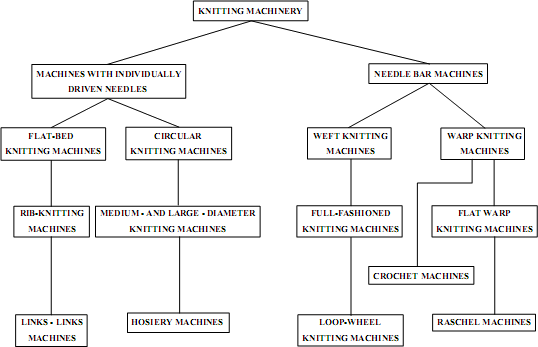
- Machines with individually driven needles. Each needle has a butt that cams raise and lower one at a time as the needle bed or the cam carriage moves. These are the weft knitting machines that make most knitted fabric: circular machines (a cylinder of needles for single jersey; a cylinder and a dial for rib and interlock; small diameters for socks and hosiery) and flat-bed machines (two beds in a V for rib, and links-links machines, whose double-headed needles knit purl). Most use latch needles.
- Needle bar machines. All the needles are fixed in one bar and move together. For weft knitting these are the full-fashioned (straight-bar) machines, which shape stocking and sweater panels as they knit, and the circular loop-wheel machines, both with bearded needles. All warp knitting machines are needle bar machines: tricot, raschel and crochet machines.
The grouping used in industry today is by product: circular, flat, full-fashioned and complete-garment machines for weft knitting, tricot and raschel for warp knitting. The weft and warp knitting page sets out each group with current makers’ figures and the latch, bearded and compound needles each uses; the needle bed page explains how gauge is measured, and ISO 7839 is the vocabulary for knitting machine types. The machines on sale are listed in the knitting machinery register.
The four base weft knits: jersey, rib, interlock and purl
Single jersey (plain or flat knit)
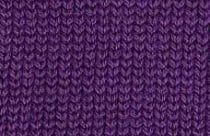
Single jersey is knitted on one set of needles, with every loop drawn to the same side. The technical face shows columns of V-shaped loops; the back shows rows of semicircular loop heads. It is the lightest and quickest weft knit to make and the basis of most T-shirts, underwear and lightweight dresses. It stretches more across than along, curls at a cut edge, and if a loop breaks it ladders down the wale. Jersey is varied by fibre and yarn (cotton, viscose, polyester, with elastane for stretch), by stitch length and by adding tucks, misses or extra yarns, which give piqué, jacquard, terry and fleece.
“Flat knit” is used in two ways. Some writers mean plain single jersey, because it is flat on the face; in the trade it more often means fabric or garment pieces made on a flat (V-bed) machine rather than a circular one, such as sweater panels, collars and cuffs.
Rib knit
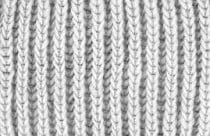
Rib needs two sets of needles, on a cylinder and dial or on the two beds of a flat machine, so that some wales are knitted to the face and others to the back. In 1×1 rib they alternate one by one; in 2×2 rib, two by two. The back wales sink between the face wales, so rib looks the same on both sides, and in its relaxed state the wales close up; pulled across the width it opens far more than jersey and springs back. It does not curl and it unravels only from the end knitted last. That elasticity is why rib is used for cuffs, collars, neckbands and waistbands, and, in finer gauges with elastane, for fitted tops.
Interlock knit
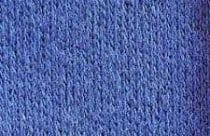
Interlock is two 1×1 rib fabrics knitted into each other. The needles of each bed are divided into two alternating sets, and two feeders together knit one complete interlock course: the first set on one feeder, the second on the next. The face wales of one rib cover the back wales of the other, so both sides look like the face of single jersey. Interlock is smooth, thicker and firmer than jersey of the same yarn, less extensible than rib, lies flat and resists laddering. It is used for polo shirts, T-shirts, babywear and sports tops, and it is the base of many double knits.
Purl knit
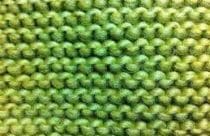
In purl, whole courses alternate between face loops and back loops, so the loop heads show on both sides as horizontal ridges; hand knitters know the simplest purl structure as garter stitch. On a machine it needs double-headed latch needles that pass each loop from one bed to the other, which makes purl machines slower than circular rib or jersey machines. The courses close up like a concertina, so purl is thick, very extensible along its length, lies flat and is the same on both sides. It unravels from either end. It is used mainly for sweaters and children’s wear.
Double knits: Milano rib, Ponte di Roma and cardigan
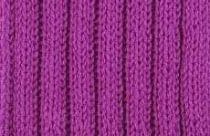
Double knit is a general name for weft knits made on two needle beds, usually rib or interlock based, whose two faces are held together so that the fabric is firm, stable and does not curl or ladder. They take more yarn per square metre than jersey and drape less, which suits dresses, trousers, skirts and jackets.
- Half Milano rib: one course of 1×1 rib on both beds, then one course on one bed only. Unbalanced, so it is used mainly in coarse-gauge sweaters.
- Full Milano rib: one course of 1×1 rib, then one course on the front bed only and one on the back bed only. Balanced, less extensible across than plain rib, and dimensionally more stable than half Milano; used for firmer outerwear.
- Ponte di Roma: an interlock-based double knit with single-bed courses added, made over a repeat of four feeders. Heavy, smooth and stable, it is the “ponte” sold for trousers, skirts and fitted dresses.
- Half cardigan: one course of rib on both beds, then a course knitted on one bed and tucked on the other. Thicker and wider than plain rib, and different on its two sides.
- Full cardigan: courses alternate between knitting on the front bed while tucking on the back, and the reverse. The tucks open the rib out, so full cardigan is bulky, thick and the same on both sides; it is a classic coarse-gauge sweater stitch, usually in wool or acrylic.
Patterned knits: piqué, jacquard, intarsia, cable, pointelle and bird’s eye
Piqué knit
Knitted piqué is single jersey with tuck stitches arranged so that the face forms small raised cells, honeycomb or diamond shaped. Single piqué and double piqué differ in how many courses carry tucks in each repeat. The tucks make it less extensible and less prone to curl than plain jersey, and the open texture breathes, which is why it is the standard polo-shirt fabric. Single jersey machines make it; the maker’s page for the single jersey machine in the table above lists piqué and double piqué among its fabrics.
Jacquard knit
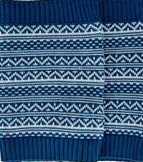
A jacquard knit has a motif formed by selecting needles individually, now electronically, so that each needle knits, tucks or misses each colour or yarn as the design requires. In single jersey jacquard, a colour that is not showing floats across the back, so the back is a mesh of floats and the fabric stretches less there. In double jacquard the back bed knits the unused colours into a backing, either in stripes or in the speckled “birdseye” pattern, so there are no long floats. Jacquard knits are used for patterned sweaters, dresses and upholstery. The banded sweater fabric in the picture is a two-colour jacquard.
Intarsia knit
Intarsia makes large blocks of colour by giving each area its own yarn, which knits only in that area and is turned back at its edge. Because no colour runs behind another, there are no floats and the fabric is a single layer, the same thickness everywhere, with the design visible on the back as well. It is made on flat machines with intarsia yarn carriers, or by hand, and is slower than jacquard. It is used for sweaters with argyle diamonds, large motifs or logos.
Cable knit
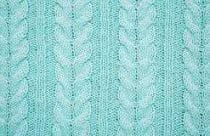
Cables are made by transferring groups of loops so that they cross over neighbouring wales, which twists the columns into raised ropes and plaits. On a machine the crossing is done by loop transfer on a flat V-bed machine; by hand, with a cable needle. Cables pull the fabric in across its width and add thickness. They are the signature of fisherman and Aran-style sweaters, cardigans and throws.
Pointelle knit
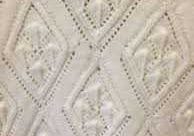
Pointelle has a pattern of small holes made by transferring a loop onto the neighbouring needle, which leaves the emptied needle to start a fresh loop and opens an eyelet. Arranged in lines and diamonds, the eyelets give a light, lace-like fabric. Pointelle is made on rib and interlock machines with transfer needles and on flat machines, and is used for women’s tops, nightwear, babywear and lightweight sweaters.
Bird’s eye knit
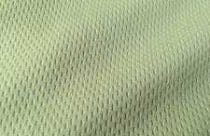
“Bird’s eye” names two different knits. In knitwear it is the backing of a double jacquard: the back bed knits every colour in alternation, which gives the reverse a fine, speckled look, like a bird’s eye. In sportswear it is a fine knit mesh with rows of tiny regular holes, usually polyester, sold as bird’s eye mesh for team shirts and linings, which is the fabric in the picture. A woven bird’s eye is a third thing: a small dobby pattern with a dot in the centre of each diamond.
Pile and fleece knits: terry, French terry, fleece, velour and sliver knit
All of these start as single jersey with an extra yarn or fibre that sits on the back. What happens to that extra yarn, left as loops, brushed or cut, decides the fabric.
Knitted terry
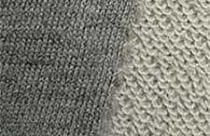
Knitted terry is knitted with two yarns in each course: a ground yarn that forms the jersey, and a pile yarn plated with it and drawn over taller sinkers so that it forms long loops on the back. The loops are left uncut. Knitted terry is softer and stretchier than woven terry towelling but less firm and hard-wearing, and it is used for bathrobes, beachwear, babywear and the cushioned soles of sports socks.
French terry
French terry, also called loopback, is a single jersey face with a second, usually thicker yarn tucked into it at intervals, which leaves small flat loops on the back. The back is not brushed, so the loops stay visible. It is lighter and cooler than fleece and stretches moderately. French terry is the usual fabric for spring sweatshirts, joggers and hoodies. Its loops are shorter and flatter than the pile of knitted terry, and it is not a pile fabric.
Fleece
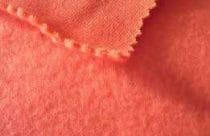
Sweatshirt fleece is the same construction as French terry, with the back yarn then raised by wire-covered rollers, which pull fibres out of the loops into a soft, warm nap. In two-thread fleece the fleece yarn is tucked directly into the ground jersey; in three-thread fleece a third, binding yarn holds it, which allows a much thicker fleece yarn. Both are knitted on single jersey machines; the single jersey machine in the table above lists two-thread fleece among its fabrics. Polar fleece is a different product: a polyester knit raised and sheared on both sides. Fleece is used for sweatshirts, track tops, jackets and blankets.
Knitted velour
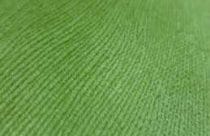
Velour is knitted terry whose pile loops are cut and sheared to an even height, then brushed, which gives a short, dense, velvety pile. It is usually piece-dyed in solid colours and used for leisurewear, dresses, baby sleepsuits and upholstery. Velvet, by contrast, is a woven pile fabric; see velvet fabric for the difference.
Sliver knit (high-pile fabric)
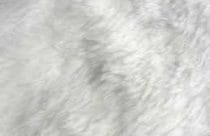
In sliver knitting, a loose rope of carded fibre (a sliver) is fed to the needles with the ground yarn, and each needle catches a tuft of fibre in its loop. The tufts stand up from the back as a long, dense pile. This is how most imitation fur is made, usually from acrylic and modacrylic, and the same fabric is used for coat linings, paint rollers and soft toys. It is lighter than real fur and needs no cold storage.
Warp knitted fabrics: tricot and raschel
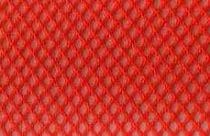
Warp knits are identified by their back: the yarns lap diagonally from wale to wale, so a counting glass shows slanting underlaps across the back, while the face shows slightly inclined loops in vertical columns. They cannot be unravelled course by course, and a cut edge does not ladder, which is why warp knits are used where a fabric is cut close and sewn, or must not run if snagged. Mesh, net and lace are their most visible forms.
Tricot
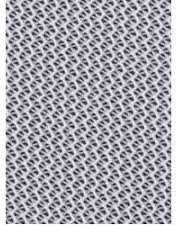
Tricot machines are fast, fine-gauge warp knitting machines with usually two to four guide bars, knitting mostly continuous filament yarns of nylon or polyester, which must be very even to run at speed. The commonest two-bar tricot, locknit, is smooth, light and opaque, with fine vertical wales on the face and crosswise laps on the back. With elastane in one bar it becomes the stretch fabric of swimwear, lingerie and sportswear. The tricot machine in the table above is built in gauges E32 to E40, with two ground guide bars, and its maker lists elastic fabrics for lingerie, swimwear, sportswear and outerwear.
Raschel
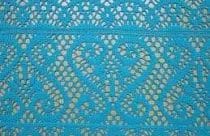
Raschel machines take a wider range of yarns, spun or filament, fine or coarse, and can carry many more guide bars, so they make open and three-dimensional structures that tricot cannot: lace and tulle, powernet for shapewear, curtain net, mosquito net, industrial and agricultural nets, and, on double-needle-bar machines, spacer fabrics with two faces joined by pile yarns. Much machine lace is now warp-knitted on raschel machines. The four-bar raschel machine in the table above is listed by its maker for tulle, embroidery grounds, intimate apparel, outerwear, activewear and mosquito nets.
Knitted and woven fabric compared
| Property | Knitted | Woven |
|---|---|---|
| Structure | Interlocking loops, in wales and courses | Two sets of yarn crossing at right angles, warp and weft |
| Stretch without elastane | Yes, mostly across the width | Little, except on the bias |
| Wrinkles | Recovers from creasing, but does not hold a pressed crease well | Creases more, depending on fibre; holds a pressed crease |
| Warmth and feel | Loops trap still air: soft, warm and bulky for their weight | Depends on the weave and density; usually thinner and firmer |
| Cut edge | Weft knits curl or ladder; warp knits do not | Frays |
| Shape retention | Lower; can grow, shrink or twist | Higher; holds a tailored shape |
| Typical garments | T-shirts, polos, sweaters, leggings, sportswear, underwear | Shirts, trousers, jeans, suits, sheets |
The types of woven fabric page covers the woven side, and the types of fabric list sets knitted, woven and nonwoven names side by side, with a four-step test for telling them apart.
Knitwear: three ways a knitted garment is made
- Cut and sew: fabric is knitted as a tube or open width on a circular machine, finished, then cut and sewn like woven cloth. Almost all T-shirts, polos, sweatshirts, leggings and underwear are made this way.
- Fully fashioned: each garment piece is knitted to shape on a flat machine, widening and narrowing by loop transfer, then linked together. There is little cutting waste, and the shaping marks show at the armholes of classic sweaters.
- Complete garment: a flat machine with two needle beds knits the whole garment, body and sleeves, in one piece with few or no seams. Makers sell these lines under their own names; the site’s machinery register lists one maker’s knit-and-wear range.
Fibre is chosen separately from structure. Cotton and cotton-polyester dominate jersey, rib, interlock and fleece; viscose and modal give drape; polyester and nylon filament run on warp knitting machines; wool, acrylic and their blends make flat knitwear; and a few per cent of elastane, plated with the main yarn, is added to almost any of them for stretch and recovery (spandex fabric).
What a knitted fabric weighs: a worked example
A knitted fabric’s weight follows from its loops: loops per square metre × stitch length gives the metres of yarn in a square metre, and that × the yarn’s linear density gives grams. Take a cotton single jersey counted on a fully relaxed sample at 42 courses and 32 wales per inch, with a stitch length of 2.9 mm, in 30s Ne yarn (19.68 tex).
| Step | Working | Result |
|---|---|---|
| Courses and wales per metre | 42 ÷ 0.0254; 32 ÷ 0.0254 | 1,653.5 and 1,259.8 |
| Loops per square metre | 1,653.54 × 1,259.84 | 2,083,204 |
| Yarn per square metre | 2,083,204 × 2.9 mm ÷ 1000 | 6,041.3 m |
| Yarn linear density | 590.5 ÷ 30 Ne | 19.68 tex (g per 1000 m) |
| Fabric weight | 6,041.3 × 19.68 ÷ 1000 | 118.9 g/m² |
Count on a relaxed sample: fabric straight off the machine is stretched lengthwise, so it shows too few courses and calculates light. Finished fabric is weighed, not calculated, under ASTM D3776. Calculators: knitted fabric GSM, set to this example, stitch length and course length, loop length for a target finished weight, circular knitting production and, for warp knits, runner lengths to fabric weight.
Questions about knitted fabric types
How many types of knit fabric are there?
Two families, weft knits and warp knits. Weft knits rest on four base structures, single jersey, rib, interlock and purl, built from three stitches (knit, tuck and miss); warp knits divide into tricot and raschel. The dozens of trade names, from piqué and Ponte di Roma to fleece and powernet, are patterns, pile or finishes on those bases.
Is knitted fabric stretchy?
Yes, because loops change shape when pulled, even with no elastane in the yarn. How much, and which way, depends on the structure: single jersey stretches more across than along, rib stretches most across the width, purl most along the length, and double knits such as Ponte di Roma very little, which is why they are called stable knits. Warp knits like locknit stretch moderately. Loops alone recover slowly, so knits that must spring back, such as leggings, swimwear and fitted tops, have a few per cent of elastane plated in.
What are wales and courses in knit fabric?
They are not yarns but lines of loops. A wale is a vertical column of loops, one per needle; a course is a horizontal row of loops across the fabric. Their counts per inch or per centimetre, measured under ASTM D8007 for weft knits, describe the fabric’s density and go into its weight.
What is another word for knit fabric?
“Jersey” is the everyday word, though strictly it means single jersey, the plain weft knit. The trade also says “knits” or “knitted goods”, “hosiery” in South Asia for knitted garments and underwear, and “tricot” (French for knitting) for one kind of warp knit. Knitwear means knitted garments, especially sweaters.
Which knit fabrics do not curl?
Rib, interlock, purl and the double knits lie flat, because their loops are balanced between the two sides. Single jersey curls at a cut edge; piqué, terry and fleece curl less than plain jersey. Warp knits such as tricot do not ladder, though a lightweight tricot can still roll at the edge.
What is the difference between French terry and fleece?
They are knitted the same way, a jersey face with a looped back yarn. French terry leaves the back loops as they are; fleece has them brushed into a soft nap, which makes it warmer and fluffier but less breathable.
How can you tell weft knit from warp knit?
Pull a yarn from a cut edge across the courses. A weft knit unravels as one crinkled yarn, course by course; a warp knit will not. Under a counting glass a warp knit’s back shows diagonal laps from wale to wale, while a single jersey back shows rows of loop heads.
Which knit fabrics are used for tops?
T-shirts are single jersey, or interlock for a heavier, smoother shirt; polo shirts are piqué; fitted tops and vests are rib with elastane; sweatshirts and hoodies are French terry or fleece; sweaters and cardigans are flat knits in rib, cable, jacquard or cardigan stitch.
Sources and how this page is kept
- Vocabulary: ISO 4921, Knitting, basic concepts, vocabulary; ISO 8388:1998, Knitted fabrics, types, vocabulary (listed as current by DIN Media); ISO 7839, knitting machines. None of the texts is reproduced here.
- Structures, stitches and their properties: D. J. Spencer, Knitting Technology, 3rd edition (Woodhead Publishing, 2001); and the textbooks cited on the site’s weft and warp knitting page.
- History: Science Museum Group collection, William Lee.
- Machines, read on 18 November 2026 from each maker’s page: Relanit 3.2 HS II and IG 3.2 QC (Mayer & Cie); HKS 2-SE and RSE 4 (Karl Mayer).
- Testing: ASTM D3776 (mass per unit area), ASTM D8007 (wale and course count of weft knits) and ISO 16322 (spirality after laundering).
Change log. 18 November 2026: rewritten in full, with a structure table, the three stitches, what knitting is and how knitting machines are classified, current machine figures from the makers and a worked weight example. The site’s shorter pages on knitting and knitted fabrics (“Knitting: Knitted Fabrics” and “Knitted Fabrics for Elasticity, Thickness and Warmth”) are folded into this one. Corrected from the earlier versions: wales and courses are columns and rows of loops, not “the vertical yarn” and “the horizontal yarn”; one yarn, not two, forms a weft-knitted course; the vertical columns are wales, not “ribs or wales”; double knits are made on two needle beds, not “two pairs of needles set at an angle”; jersey, rib, interlock and purl are the four base structures, and the stitches are knit, tuck and miss; French terry is a looped-back jersey, not a weft-insertion fabric; pointelle eyelets come from loop transfer, not miss stitches; the bird’s eye backing of a double jacquard is not a tuck-stitch eyelet; the picture once shown as intarsia is a banded jacquard and is now captioned as one; and an unmarked link to a commercial site has been removed.
Found an error? Please tell us through the contact page, naming the section and the source that disagrees.



Great article! The breakdown of different knitted fabrics and their constructions is really helpful. I especially appreciate how clearly the differences between weft and warp knits are explained—it makes the subject much easier to grasp. This will be a great reference for students and anyone working with textiles.
good and usefull informations, thank you
regards
Adam from https://refinansujemy.com/
Hello,
I have a lot of material for bobbin lace or other textile works for sale.If you are interested ,I wil lsend you somepictures.My mom is famous artist in Slovakia,and she does not use it anymore..linen thread,hemp yarn, bobbin lace sticks…
Very Nice content.
Its informative too.
Very informative. Thanks a lot for giving your precious time to knowledge sharing.
I Want to learn textile study, tks a lot for the details
Thanks for sharing knowledge.
Pretty! This has been an extremely wonderful article. Thanks for providing these details.
Having read this I believed it was very informative. I appreciate you spending some time and effort to put this short article together. I once again find myself spending a significant amount of time both reading and leaving comments. But so what, it was still worthwhile!
That is a good tip particularly to those fresh to the blogosphere. Simple but very precise info… Thank you for sharing this one. A must read article!
How can we order
Good discription on topics
Many many thanks, good job
I want learn textile study